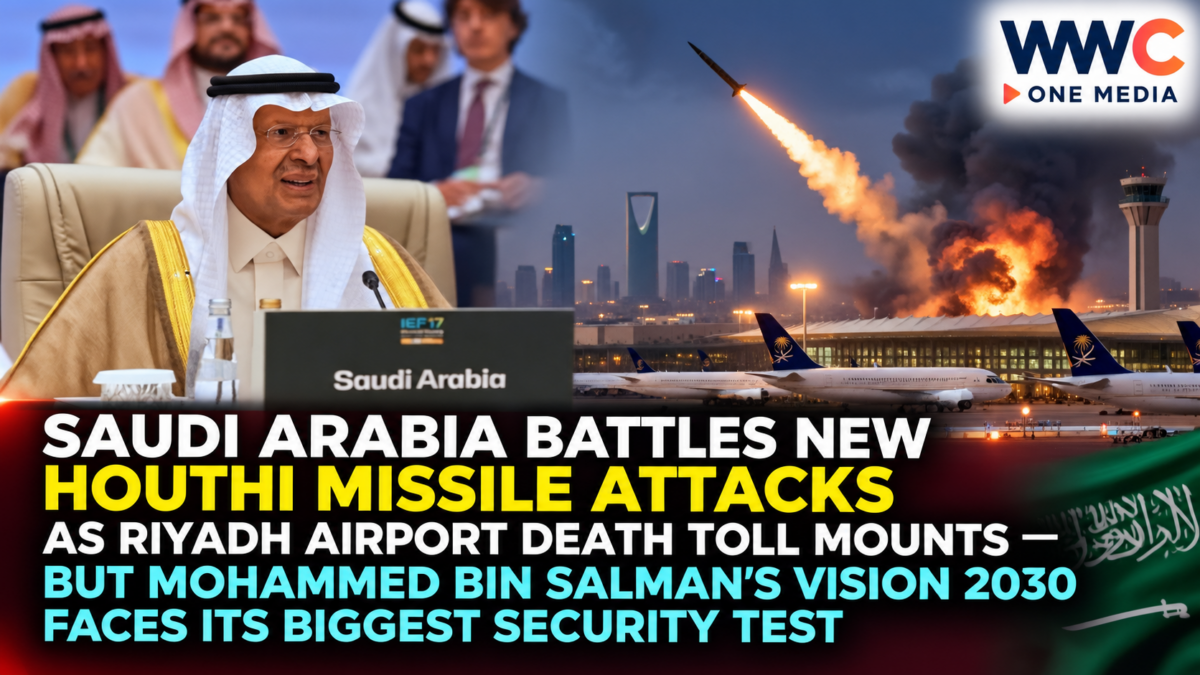
RIYADH, Saudi Arabia — October 14, 2026 — Saudi Arabia is confronting one of its gravest security challenges in years as repeated missile and drone attacks by Yemen’s Iran-backed Houthi movement strike airports, threaten energy infrastructure and disrupt international business events at a crucial moment for Crown Prince Mohammed bin Salman’s economic transformation agenda.
The Saudi-led military coalition reported intercepting additional missiles and drones on October 12 and 13 after a deadly series of attacks on King Khalid International Airport in Riyadh.
The weekend strikes killed at least 14 people and wounded more than 300, according to Bloomberg’s October 12 reporting. Subsequent reports placed the cumulative death toll higher as the attacks continued.
The latest escalation has forced severe restrictions on airport operations, disrupted thousands of passenger journeys and prompted international companies to reconsider attendance at major events in the kingdom.
The situation worsened on October 13, when an attack struck an administrative building at Saudi Aramco’s headquarters complex in Dhahran, sparking a limited fire.
Saudi authorities reported no deaths or injuries at the Aramco building, but the incident demonstrated how the conflict could threaten facilities associated with the world’s largest oil exporter.
For Mohammed bin Salman, widely known as MBS, the timing could hardly be more damaging.
The crown prince has spent years seeking to transform Saudi Arabia into a global destination for tourism, finance, technology and investment under his Vision 2030 economic program.
But as missiles and drones threaten the airports, oil facilities and international business events central to that vision, a bigger question is emerging: Can Saudi Arabia protect its economy without being drawn into an even more dangerous regional war?
Saudi Arabia Intercepts More Missiles and Drones After Deadly Airport Attacks
Saudi authorities reported new aerial threats on October 12 as the country continued recovering from deadly attacks on Riyadh’s main international airport.
According to Bloomberg, the Saudi-led coalition said it detected and responded to incoming drones and cruise missiles.
The threats included areas near important oil and gas infrastructure.
On October 13, the coalition reported further interceptions, including three drones north of Riyadh and two ballistic missiles directed toward Khamis Mushait, near the Yemeni border.
The repeated attacks suggest that Houthi forces retain the ability to launch long-range weapons despite Saudi airstrikes and defensive operations.
Saudi Arabia operates advanced air defense systems, but experts warn that simultaneous drone and missile attacks can overwhelm even sophisticated protection networks.
The challenge becomes greater when strikes occur repeatedly across several locations.
Defenders must protect airports, residential districts, energy facilities and military installations while managing finite stocks of interceptors.
Successful interceptions can also create risks when falling debris lands in populated areas.
Riyadh Airport Attacks Kill Civilians and Injure Hundreds
The most devastating recent strikes targeted King Khalid International Airport in the Saudi capital.
According to Associated Press reporting, a major attack on October 10 killed 12 people and injured more than 300.
A subsequent attack on October 11 killed another person and wounded additional victims.
Bloomberg’s October 12 coverage reported at least 14 fatalities across the weekend incidents.
Later accounts recorded a higher cumulative death toll as further attacks were reported.
The differences reflect changing casualty counts and the time at which individual reports were published.
Saudi authorities launched an investigation into how the weapons penetrated the country’s defenses.
Associated Press reporting, citing regional officials, indicated that the attacks may have involved drones followed by cruise and ballistic missiles.
Such combinations can complicate defensive operations by forcing air defense systems to identify and respond to multiple threats with different flight characteristics.
However, the full findings of Saudi Arabia’s investigation have not been publicly established.
Saudi Aramco Headquarters Complex Comes Under Attack
The escalation spread to Saudi Arabia’s Eastern Province on October 13.
Reuters reported that an administrative building belonging to Saudi Aramco in Dhahran was attacked, causing a limited fire.
The Saudi Ministry of Energy said authorities responded to the incident and reported no casualties.
A person familiar with the incident told Reuters that a ballistic missile struck an office tower at the complex, damaging its upper floors.
The headquarters site is significant because it supports the administration and oversight of Saudi Aramco’s extensive energy operations.
These include oil fields, pipelines, refineries and export facilities.
The attack therefore heightened concern about threats to the kingdom’s oil infrastructure.
However, the incident should not be characterized as the destruction of Aramco’s headquarters or the shutdown of Saudi oil production.
The official statement confirmed a limited fire at an administrative building, not a nationwide energy supply collapse.
Why Mohammed bin Salman’s Vision 2030 Is Under Pressure
Saudi Arabia’s Vision 2030 strategy aims to reduce the economy’s dependence on oil and create new sources of investment, employment and economic growth.
Major priorities include tourism, entertainment, transportation, financial services, technology and large infrastructure projects.
Riyadh is central to this transformation.
The capital has been promoted as a regional headquarters destination for multinational companies and a location for major global events.
The government wants the city to compete more effectively with established international business centers.
That strategy depends partly on confidence in the country’s security, accessibility and long-term stability.
Repeated strikes against airports and civilian infrastructure threaten those conditions.
International companies may remain interested in Saudi Arabia’s large domestic market and government investment programs.
But business travel disruptions, safety concerns and rising insurance costs can make commercial activity more difficult.
The central question is whether Saudi Arabia can preserve investor confidence while facing continued attacks.
World Petroleum Congress Disrupted as Oil Executives Cancel Trips
The attacks have affected one of Riyadh’s most important international gatherings.
The World Petroleum Congress was scheduled to bring major oil industry executives, government representatives and energy specialists to the Saudi capital.
However, several prominent executives withdrew from the event after the airport strikes.
According to Financial Times reporting, executives associated with major energy companies including ExxonMobil, TotalEnergies, Shell and BP canceled or changed their participation.
Airport closures and travel advisories created additional logistical difficulties.
Despite the disruption, Saudi officials sought to demonstrate that the event would continue.
Saudi Energy Minister Prince Abdulaziz bin Salman emphasized the importance of maintaining the kingdom’s long-term economic commitments.
His message was that the country should respond seriously to security threats while continuing investment.
The challenge, however, is that international conferences depend on the ability of delegates to travel safely and reliably.
Even temporary aviation disruptions can undermine attendance and commercial planning.
Future Investment Initiative Faces a Major Confidence Test
Another closely watched event is the Future Investment Initiative, Riyadh’s flagship global investor gathering.
The conference has historically attracted senior figures from major banks, investment funds, technology companies and multinational corporations.
The event is important to the kingdom’s efforts to promote investment opportunities and strengthen international business relationships.
Organizers have said preparations are continuing.
However, the airport attacks raise concerns about whether foreign executives will attend in person if security conditions remain unstable.
For Saudi Arabia, hosting international business events is about more than tourism revenue.
Such gatherings help establish relationships, promote government projects and encourage long-term financial commitments.
The loss of business confidence could therefore have consequences extending beyond individual canceled hotel bookings or flights.
Nevertheless, there is no verified evidence that the Future Investment Initiative has been permanently canceled.
Saudi Economy Faces Additional Pressure From Defense Spending
The security deterioration arrives as Saudi Arabia faces difficult fiscal conditions.
According to Bloomberg’s October 12 report, the government recently increased its budget-deficit projection partly because of additional defense spending.
The report also cited an official expectation that the economy could contract by approximately 3.6%.
If realized, such a contraction would represent a significant setback for a government seeking to expand non-oil economic activity.
Higher military spending can limit fiscal flexibility by increasing pressure on public resources.
Money used for defense operations and emergency security measures may compete with other government priorities.
However, budget deficits and economic forecasts do not establish that Vision 2030 has failed.
Saudi Arabia continues to possess substantial financial resources and remains a major global energy producer.
The challenge is managing immediate security requirements without undermining long-term economic development.
Yemen Conflict Reignites After Years of Uneasy De-escalation
The latest fighting is connected to the long-running war in Yemen.
Houthi forces seized control of the Yemeni capital, Sanaa, in 2014.
Saudi Arabia intervened militarily in 2015 in support of the internationally recognized Yemeni government.
The conflict caused severe humanitarian suffering and displaced large numbers of civilians.
A United Nations-brokered truce in 2022 helped reduce fighting and created opportunities for diplomacy.
However, renewed military operations have reversed some of that progress.
According to Reuters, the Saudi-backed coalition resumed offensive operations after Houthi forces made territorial gains along Yemen’s Red Sea coast.
The Houthis responded with missile and drone attacks targeting Saudi infrastructure.
The renewed confrontation is also connected to the broader regional conflict involving Iran, Israel and the United States.
The result is a complicated military and diplomatic environment in which local Yemeni disputes overlap with regional strategic rivalries.
Bab el-Mandeb Strait Becomes Another Major Strategic Flashpoint
The renewed fighting has intensified around territory near the Bab el-Mandeb Strait.
This narrow waterway connects the Red Sea with the Gulf of Aden and provides access to the Indian Ocean.
It is an important route for international shipping.
Commercial vessels traveling between Asia and Europe frequently use the Red Sea and the Suez Canal.
Security threats near Bab el-Mandeb can force ships to consider longer alternative routes.
The strait has become particularly important as disruptions around the Strait of Hormuz have already complicated oil transportation.
Reuters reported that the Houthis advanced toward key areas near Bab el-Mandeb before Saudi-backed forces regained some territory.
The Houthis nevertheless remain active nearby.
Continued instability could threaten shipping costs, delivery schedules and energy supply chains.
However, the latest military developments do not establish that all shipping through Bab el-Mandeb has stopped.
Why Saudi Arabia’s Air Defenses Face Difficult Challenges
Saudi Arabia has invested heavily in modern air defense systems.
Its defenses include equipment intended to detect and intercept ballistic missiles, cruise missiles and hostile aircraft.
However, defending a large country against repeated attacks is technically difficult.
Ballistic missiles can travel at high speeds, while cruise missiles may approach at lower altitudes.
Drones can be relatively inexpensive and may be launched in large numbers.
Attackers can combine different weapons to complicate radar detection and interception.
Security experts interviewed by The National warned that no air defense system can guarantee protection against every simultaneous attack.
Saudi Arabia has also been seeking additional military equipment and support from allied countries.
But purchasing more interceptors is not a complete solution.
Defensive planning also depends on intelligence, surveillance, warning systems and the ability to disrupt attacks before weapons are launched.
Saudi-Led Airstrikes Intensify in Yemen
Saudi Arabia has responded with military operations targeting Houthi-controlled areas.
On October 13, Reuters reported that the Saudi-led coalition carried out strikes against facilities near Sanaa.
The coalition said the operations were intended to reduce the Houthis’ ability to launch attacks against Saudi Arabia and international shipping.
Houthi-controlled media reported that an oil facility was among the targets.
The operations carry risks for Yemen’s civilian population.
Airstrikes near populated areas and fuel infrastructure can cause casualties, displacement and shortages of essential goods.
International humanitarian concerns therefore remain significant.
The Houthis have threatened further retaliation against Saudi targets.
The exchange of strikes creates a risk of continued escalation without a clear path toward ending the conflict.
United States Faces Difficult Decision Over Military Support
Washington remains a major security partner of Saudi Arabia.
The US has supplied military equipment and supported regional defense cooperation for decades.
But the latest escalation presents a difficult decision for President Donald Trump’s administration.
Direct involvement against the Houthis could strengthen Saudi defenses and increase pressure on the armed group.
However, it could also deepen US involvement in an already expanding regional conflict.
Reuters reported that Washington had not committed to directly joining Saudi Arabia’s renewed military campaign in Yemen.
The US has provided other forms of support, including intelligence and planning assistance.
Trump has publicly discussed the possibility of additional action.
Nevertheless, no verified decision to launch a new direct American military intervention had been announced in the reporting reviewed.
Turkey, Pakistan and Egypt Condemn Houthi Strikes
The attacks have prompted diplomatic responses from Saudi Arabia’s regional partners.
Reuters reported that Turkey, Pakistan, Egypt and Saudi Arabia issued a joint condemnation of the assaults on Riyadh’s international airport.
The countries described the attacks as a dangerous escalation.
They called for an end to hostilities and affirmed support for Saudi Arabia’s right to defend itself.
The response reflects the kingdom’s efforts to strengthen cooperation with regional partners.
However, diplomatic condemnation does not automatically mean every participating country has committed combat troops.
Specific military contributions depend on bilateral arrangements, domestic legal requirements and government decisions.
For Saudi Arabia, broader diplomatic support may help discourage further attacks, but it cannot by itself guarantee security.
Iran Offers Mediation as Regional Tensions Rise
Iran occupies a complicated position in the conflict.
The Houthis have long received political and military support from Tehran, according to Western and regional governments.
Iran, meanwhile, has offered to help mediate between Saudi Arabia and the Houthi movement.
Reuters reported that Iranian Foreign Minister Abbas Araqchi reiterated the mediation proposal as fighting intensified.
The offer comes amid the broader conflict involving Iran and US-Israeli military operations.
A successful diplomatic initiative could potentially reduce the risk of further attacks.
However, the willingness of the parties to negotiate remains uncertain.
Saudi Arabia must decide whether continued military pressure, negotiations or a combination of both offers the best path toward long-term security.
The existence of a mediation offer should not be confused with a negotiated ceasefire or peace agreement.
Oil Prices Remain Above $100 as Energy Risks Mount
The attacks are also raising concerns among global energy traders.
Saudi Arabia is one of the world’s most important oil producers and exporters.
Threats to its energy infrastructure can influence perceptions of future supply reliability.
Reuters reported that Brent crude settled at approximately $105.69 per barrel on October 13.
West Texas Intermediate crude finished at around $94.14.
The difference reflects the characteristics of the two oil benchmarks and their respective market conditions.
The Saudi Aramco incident and renewed maritime risks contributed to market uncertainty.
However, oil prices are influenced by numerous factors, including demand, inventories, production levels, sanctions and global economic conditions.
It would be inaccurate to attribute every change in oil prices solely to the latest Houthi attacks.
The larger risk is that a sustained deterioration in security could increase the cost of moving and protecting energy supplies.
Saudi Arabia’s Reputation as a Tourism Hub Faces New Risks
Vision 2030 has encouraged Saudi Arabia to expand tourism and international entertainment.
The government has invested in airports, hotels, resorts, cultural destinations and major events.
These projects depend on reliable international transportation.
Repeated attacks on airports can undermine confidence among visitors, airlines and event organizers.
International travel advisories may also influence decisions by tourists and businesses.
Following the Riyadh attacks, several governments urged caution or advised travelers to avoid affected areas.
Some airlines suspended services or changed routes.
However, the latest reporting does not establish that all tourism activities throughout Saudi Arabia have stopped.
The severity of the longer-term economic impact will depend on how quickly authorities restore safe aviation operations and prevent further attacks.
What the Escalation Means for Filipino Workers in Saudi Arabia
The developments are particularly important for the Philippines because Saudi Arabia is a major destination for overseas Filipino workers.
Filipinos are employed in healthcare, hospitality, engineering, domestic services and other industries across the kingdom.
Airport closures and flight disruptions could complicate travel arrangements for affected workers and their families.
Security incidents may also increase concerns among Filipinos living near targeted areas.
However, the reporting reviewed does not establish that Filipino nationals were among the victims of the latest airport attacks.
It would therefore be inappropriate to identify any Philippine casualties without confirmation from Philippine authorities.
Filipinos in Saudi Arabia should follow official security advisories, verify flight schedules directly with airlines and monitor announcements from Philippine diplomatic missions.
The consequences for employment and remittances will depend on whether the conflict develops into a prolonged disruption of business activity.
Could a Wider Saudi–Houthi War Affect Asia’s Economy?
A sustained escalation could have consequences across Asian economies.
Many Asian countries depend on imported oil and international shipping routes connected to the Middle East.
Higher energy prices can increase transportation and manufacturing costs.
Disrupted aviation routes can affect travel, tourism and cargo operations.
Shipping insecurity around the Red Sea and Gulf of Aden may also force vessels to take longer routes.
These effects can place pressure on consumer prices and international trade.
However, the impact will differ from country to country.
Governments with diverse energy supplies, strategic fuel inventories and strong financial buffers may be better positioned to manage disruptions.
For Asian policymakers, the priority is monitoring whether the Saudi security crisis translates into sustained supply shortages or transportation disruptions.
The Bigger Question: Can MBS Protect Vision 2030 Without a Wider War?
The missile and drone attacks have exposed an uncomfortable reality for Saudi Arabia.
Economic transformation cannot be separated from national security.
Mohammed bin Salman has sought to build a more diversified economy, attract international investors and make Riyadh a leading global business destination.
Yet the repeated attacks on airports and critical facilities are threatening the infrastructure required to support those ambitions.
Saudi authorities have demonstrated an ability to intercept additional weapons, but earlier attacks caused substantial civilian casualties.
The government is responding militarily while also seeking support from regional and international partners.
The United States is weighing its involvement, and Iran has offered mediation.
Meanwhile, international businesses are reconsidering travel and participation in major events.
The crown prince faces a strategic dilemma.
A stronger military response could reduce some immediate threats but might also prolong the conflict.
Diplomacy could provide a route toward de-escalation, though its success remains uncertain.
For investors, the ultimate measure will be whether Saudi Arabia can restore confidence that essential infrastructure and international business activity can operate safely.
Saudi Arabia has intercepted another wave of missiles and drones, but the bigger battle is far from over. Mohammed bin Salman must now defend the kingdom against a widening conflict while protecting the tourism, investment and economic transformation plans on which its future depends.