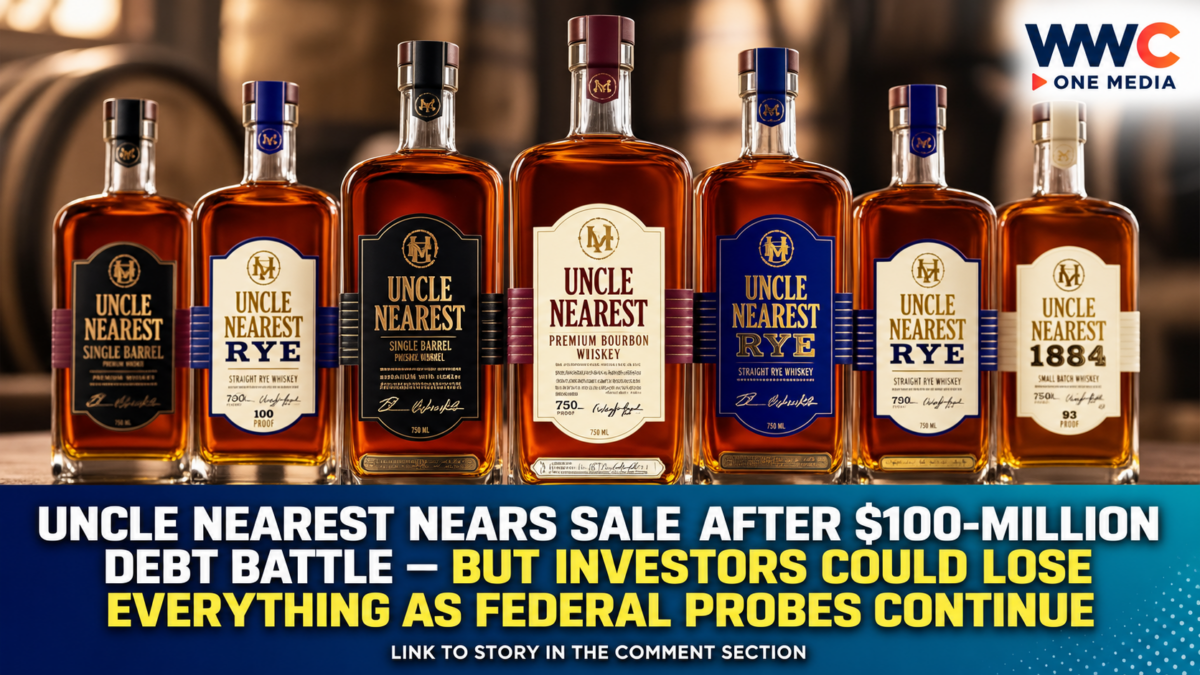
TENNESSEE, United States — October 14, 2026 — Uncle Nearest, the award-winning American whiskey company built around the legacy of a formerly enslaved distiller who helped shape Tennessee whiskey, is approaching a potential sale after a year of financial turmoil, courtroom battles and mounting questions about its future.
The company is negotiating with three prospective buyers, according to an October 9 federal court report filed by receiver Phillip G. Young Jr.
Young believes an agreement to sell substantially all of Uncle Nearest’s operating assets could be reached soon.
But the latest report also contains a stark warning: existing shareholders may receive nothing from the sale.
The potential transaction comes after Uncle Nearest was placed into court-ordered receivership in August 2025 following a dispute with agricultural lender Farm Credit Mid-America over alleged defaults on more than $100 million in financing.
Since then, the company’s finances, ownership structure and leadership have been the subject of extensive legal proceedings.
The receiver has also disclosed continuing requests for documents from the US Securities and Exchange Commission and federal prosecutors in New York.
No buyer has been publicly identified, no binding purchase agreement has been signed and no sale price has been disclosed.
Uncle Nearest’s next owner could inherit an internationally recognized whiskey brand and a powerful American historical legacy. But the bigger question is whether a sale can save the business — or whether its debt, legal problems and deteriorating finances have already destroyed the value of its shareholders’ investment.
Uncle Nearest Moves Closer to Sale After a Year in Receivership
Uncle Nearest’s financial restructuring has reached a critical stage.
In his fifth quarterly report, filed October 9 in the US District Court for the Eastern District of Tennessee, receiver Phillip G. Young Jr. outlined ongoing negotiations with three prospective purchasers.
The interested parties are considering acquiring substantially all the assets associated with the whiskey operations.
Young said negotiations were continuing and that he believed a purchase agreement could be close.
However, the report makes clear that no transaction has been finalized.
The names of the prospective buyers and the amounts they are willing to pay have not been disclosed.
That distinction matters.
The company is pursuing a potential sale, not announcing a completed acquisition.
A successful transaction will depend on financing, negotiations, legal procedures and eventual court approval.
Earlier Proposed Acquisition Falls Apart
The latest negotiations follow a failed attempt to sell the business earlier this year.
On May 29, the receiver signed a nonbinding letter of intent with a prospective buyer.
That agreement provided a period of exclusive negotiations.
The buyer was described at the time as an investment firm with African-American ownership and leadership.
It expressed an intention to retain employees and respect the cultural significance of the Uncle Nearest brand.
The proposed transaction generated optimism that the company might emerge from its financial crisis under new ownership.
But the buyer did not complete a purchase before the exclusivity period expired.
The receiver subsequently began negotiations with three other interested parties.
The October 9 report does not identify those parties.
It would therefore be inaccurate to assume that the earlier prospective buyer remains involved in the current negotiations.
A Chapter 11 Bankruptcy May Follow the Sale Agreement
The proposed sale is expected to involve a court-supervised bankruptcy process.
Young’s report says that once an asset purchase agreement is signed, he intends to file Chapter 11 bankruptcy petitions for most of the companies under receivership.
The objective would be to complete an asset sale under Section 363 of the US Bankruptcy Code.
A Section 363 sale allows a bankruptcy estate to sell assets under court supervision, subject to applicable protections and approval requirements.
Such transactions can help transfer operating businesses to new owners while addressing claims against the seller.
The proposed structure could allow Uncle Nearest’s business and brand to continue under new ownership.
However, it would not guarantee the survival of every existing company, contract or shareholder interest.
The court would need to approve the appropriate legal steps.
As of October 14, the proposed new Chapter 11 filings described in the receiver’s report had not been confirmed as completed.
The $100-Million Loan Dispute That Triggered the Crisis
The legal conflict began in August 2025.
Farm Credit Mid-America brought a lawsuit alleging defaults on financing totaling more than $100 million.
The lender sought court intervention to protect its interests in the company and related assets.
A federal judge granted the receivership request and appointed Phillip Young on August 22, 2025.
The appointment placed control of the relevant businesses and assets with the receiver.
That meant founders Fawn and Keith Weaver could no longer exercise ordinary management authority over the companies covered by the receivership.
The allegations underlying the lender’s lawsuit remain subject to the relevant court proceedings.
The amount involved represents disputed financing obligations, not a final judicial finding that the founders personally stole money.
It is essential to distinguish alleged loan defaults from criminal misconduct.
Founder Fawn Weaver’s Bankruptcy Attempt Was Dismissed
In March 2026, Fawn Weaver attempted to place Uncle Nearest and related entities into Chapter 11 bankruptcy protection.
That effort was challenged by the receiver and the lender.
A bankruptcy court dismissed the petitions because Weaver lacked the authority to file them after control had been vested in the receiver.
Weaver appealed.
In August, a federal district court affirmed the dismissal.
The dispute centered on who had legal authority to initiate bankruptcy proceedings for the companies.
The earlier dismissed bankruptcy petitions are separate from the Chapter 11 filings the receiver now proposes to pursue as part of a potential asset sale.
That difference is important.
It would be misleading to describe the receiver’s current plan as a completed bankruptcy restructuring.
Receiver Warns Shareholders May Get Nothing
One of the most serious findings in the latest court report concerns the company’s investors.
Young said the available evidence indicated that no funds were likely to remain for shareholders after the liquidation of company assets.
The receiver is still reconciling ownership records and the company’s capitalization table.
Therefore, a final shareholder recovery has not yet been determined.
Nevertheless, the warning is significant.
In a distressed asset sale, proceeds may first be required to satisfy secured debts, priority claims and other obligations.
Shareholders are generally last in the payment hierarchy.
If liabilities exceed realizable asset values, there may be no money remaining for equity investors.
The financial consequences could be substantial for people who invested in the company’s growth story.
However, the receiver’s projection should not be presented as an already completed distribution or a final court ruling.
New Financial Report Reveals Cash Flow Under Pressure
The receiver’s October filing provides detailed financial information covering June 29 through September 27, 2026.
During that reporting period, the business received approximately $4.77 million in total cash collections.
Expenditures reached approximately $4.99 million.
That produced a net cash outflow of $218,091.
Uncle Nearest’s latest quarterly financial figures
| Item | Amount |
|---|---|
| Operating collections | $4,323,685 |
| Additional Farm Credit funding | $450,000 |
| Total collections | $4,773,685 |
| Operating disbursements | $3,159,040 |
| Professional fees | $1,832,736 |
| Total disbursements | $4,991,776 |
| Net cash flow | -$218,091 |
Operating collections exceeded operating disbursements during the period.
However, legal, advisory and other professional expenses more than absorbed that operating surplus.
The figures also included certain nonrecurring proceeds, meaning they should not be treated as a normal quarterly revenue statement.
Young continues to monitor cash flow closely.
The company also depends on support from Farm Credit and strict expenditure controls to maintain operations.
Professional Fees Surpass $6.1 Million
The cost of the prolonged receivership is becoming a major concern.
Since the receiver took control in August 2025, professional fees have reached approximately $6.15 million.
Those expenses include legal representation, financial advisers, restructuring specialists and other professional services.
During the latest quarter alone, professional fees totaled approximately $1.83 million.
The prolonged process creates a difficult financial situation.
The company needs professional assistance to manage creditors, investigate records and negotiate a sale.
But those services also consume cash.
The receiver has reported that continuing delays could damage the business’s value and increase the difficulty of preserving operations.
Professional fees are not proof of wrongdoing.
They are an important cost of managing a complex restructuring.
The central concern is whether the business can complete a transaction before additional expenses erode its remaining financial flexibility.
Uncle Nearest Has Reportedly Not Filed Federal Income Tax Returns Since 2018
Another serious finding involves the company’s tax records.
According to the October 9 report, Uncle Nearest has not filed federal income tax returns since 2018.
The receiver is working with tax authorities and outside advisers to reconstruct records and determine potential liabilities.
The review also identified possible obligations involving Tennessee and Delaware tax filings.
The amount of any resulting tax liability has not been definitively established in the report.
Missing returns can complicate a sale because prospective buyers need to understand outstanding obligations.
They may also need clarity about historical financial statements and potential tax exposures.
However, the report does not establish that a court has found criminal tax evasion.
That would require separate evidence and legal findings.
Federal Prosecutors and SEC Continue Seeking Records
The receiver has also disclosed document requests from federal authorities.
According to the court report, the US Attorney’s Office for the Southern District of New York and the Securities and Exchange Commission issued subpoenas for records.
Both agencies subsequently updated their requests.
The receiver says his team is cooperating.
The inquiries are significant because they add uncertainty to an already complicated financial situation.
Potential buyers may want to understand whether future enforcement actions could affect the business or particular assets.
However, subpoenas and document requests do not establish guilt.
The receiver’s filing does not report a criminal conviction or a final SEC enforcement finding arising from those inquiries.
It also does not identify which individuals, if any, might face future charges.
Responsible reporting must separate the existence of government investigations from conclusions about criminal liability.
Accounting Records Complicate the Restructuring
Young’s report describes problems reconstructing Uncle Nearest’s financial records.
The receiver says certain accounts were not adequately reconciled and some transactions lacked sufficient documentation.
The review has also examined relationships between the operating company and other businesses associated with the founders.
According to the filing, concerns include the recording of revenue, related-party transfers and the classification of assets and liabilities.
The receiver is working with accounting professionals to rebuild reliable statements.
These problems can affect buyer confidence.
Potential purchasers want accurate information about inventory, debt, receivables, contracts and cash flow.
If historical accounting records are incomplete, the buyer must assume greater uncertainty.
That can influence both valuation and transaction structure.
However, an accounting irregularity identified during a receivership is not automatically proof of fraud.
The factual and legal significance of individual transactions remains subject to review.
Nearest Green Distillery Is Central to the Proposed Sale
The company’s physical assets are an important part of the potential transaction.
The Nearest Green Distillery in Shelbyville, Tennessee, is associated with the Uncle Nearest brand and its visitor experience.
It includes distilling facilities and other infrastructure connected to whiskey production.
The proposed sale is expected to include the core operating business and brand assets.
That combination could attract buyers interested in preserving an existing premium spirits business rather than building a new brand from scratch.
A purchaser might benefit from established distribution relationships, inventory, facilities and brand recognition.
But those assets also come with commercial challenges.
Demand for some premium spirits has weakened, and the company’s reputation has been affected by litigation.
A buyer would need sufficient financial resources to stabilize operations and invest in future growth.
French Vineyards and Chateau Face Separate Sales
The receiver is also pursuing sales involving assets in Cognac, France.
These assets are being handled separately from the proposed American whiskey-business sale.
Young reported accepting an offer for the company’s French vineyards, subject to government and court approvals.
The transaction must pass through the French agricultural oversight process involving SAFER.
That process includes appraisal and public-notice requirements.
The company also owns a French chateau.
Finding a buyer for the property has proved more difficult.
Young has begun considering a possible auction.
However, an auction has not been confirmed or completed.
The receiver intends to handle these French assets within the existing receivership rather than the proposed US bankruptcy sale.
This means the potential disposition of the French properties should not be confused with the sale of Uncle Nearest’s core whiskey business.
Why the Global Whiskey Slowdown Matters
The company is facing financial challenges at a difficult time for the spirits industry.
The receiver cited declining worldwide demand for spirits among the factors affecting Uncle Nearest.
After years of strong growth in premium alcoholic beverages, several international markets have experienced slower demand.
Consumers have become more selective amid higher living costs.
Distributors and retailers have also adjusted inventories.
Meanwhile, trade restrictions and tariffs have created additional uncertainty for some producers.
Industry conditions influence buyer valuations.
An acquirer may be less willing to pay a high price for a spirits business if near-term sales growth is uncertain.
But the downturn does not mean every whiskey producer is performing poorly.
Performance varies by brand, pricing, geographic market and distribution strategy.
Fawn Weaver Built Uncle Nearest Around an Overlooked American History
Uncle Nearest carries cultural significance beyond its commercial operations.
The brand was launched in 2017 by Fawn Weaver and named after Nathan “Nearest” Green.
Green was a formerly enslaved man whose distilling knowledge played an important role in the development of Tennessee whiskey.
He is widely recognized for his role in teaching Jack Daniel the craft of distillation.
For generations, his contribution received relatively limited public recognition.
Weaver’s project helped bring his story to a wider audience.
Uncle Nearest built its identity around honoring Green’s legacy and the contributions of Black distillers to American whiskey history.
The brand attracted media attention, consumer support and business investment.
That history remains valuable regardless of the outcome of the current financial proceedings.
But the cultural importance of the brand does not remove the need to resolve debts and legal obligations.
Jay-Z’s Investment Adds to the Company’s Prominence
Uncle Nearest has attracted investors associated with major entertainment and business figures.
Among them is Jay-Z, whose investment interests have been linked to the brand through an associated venture firm.
The involvement of prominent investors helped increase awareness of the company.
However, the latest receiver report does not establish the exact amount that each individual investor could recover.
Nor does it prove that any specific investor will receive a particular payment under the proposed transaction.
The receiver’s broader warning is that shareholders collectively may receive no proceeds after the company’s obligations are addressed.
Any assessment of individual investor losses would require verified ownership and investment records.
What Happens to Uncle Nearest Employees?
Employee retention is another concern.
The receiver reported that uncertainty about the business’s future has affected morale.
At least one important operational employee left during the latest reporting period.
Management redistributed responsibilities among remaining workers and outside consultants.
Further departures could make it harder to preserve operations.
A successful sale could potentially provide stability and new financial resources.
However, the current negotiations have not produced a binding agreement guaranteeing employment for every worker.
Statements made by the earlier prospective buyer about retaining employees should not automatically be attributed to the three bidders now in discussions.
The future workforce structure will depend on the eventual buyer and the final transaction terms.
What Could a New Owner Do With the Brand?
The potential buyer would inherit both opportunities and problems.
The brand has a recognizable identity and an established historical narrative.
Its whiskey products have received substantial industry attention.
The physical distillery and related facilities could also support tourism and direct consumer engagement.
However, the company faces debt disputes, legal expenses, accounting problems and uncertain demand.
A buyer could pursue a turnaround through tighter financial controls, revised distribution strategies and more disciplined spending.
New ownership might also improve reporting systems and address compliance issues.
But the success of any strategy will depend on the purchase price, liabilities assumed and the buyer’s ability to rebuild confidence.
There is no confirmed plan from the unidentified prospective buyers.
What Happens Next in the Uncle Nearest Sale?
The receiver has identified several steps toward a possible resolution.
Negotiating a binding agreement: Discussions continue with three prospective buyers.
Potential Chapter 11 filings: The receiver intends to pursue bankruptcy proceedings once an agreement is signed.
Court-supervised asset sale: Most core assets are expected to be sold through a Section 363 process, subject to approval.
Shareholder reconciliation: Ownership records are still being reviewed, with little recovery currently expected.
Government inquiries: The receiver continues complying with federal document requests.
French asset sales: The vineyards and chateau are being marketed through separate processes.
Operating continuity: Cash management and employee retention remain important while negotiations continue.
These developments will determine whether the business can move into new ownership before its remaining value deteriorates further.
The Bigger Question: Can Uncle Nearest Survive Beyond Its Founders?
Uncle Nearest’s financial crisis presents a difficult contrast.
The brand was created to recognize a man whose contributions helped shape American whiskey history.
It became a prominent example of entrepreneurship and cultural storytelling in the spirits industry.
But rapid growth and strong brand recognition have not insulated the company from financial difficulties.
Today, it operates under court-appointed management while facing a major creditor dispute, continuing investigations and uncertainty over its ownership.
Three prospective buyers remain in discussions.
The receiver believes a sale could be near.
Yet he has also warned that shareholders may recover nothing.
The future of Uncle Nearest may therefore depend on whether a new owner can preserve the brand’s historical identity while rebuilding the business on a more sustainable financial foundation.
Uncle Nearest is approaching a potential sale after a year of court battles and financial distress. But the biggest test may come after a buyer is found: Can new ownership save the whiskey brand that restored Nathan “Nearest” Green’s place in American history — or will its debt and legal problems overshadow the legacy it was created to honor?