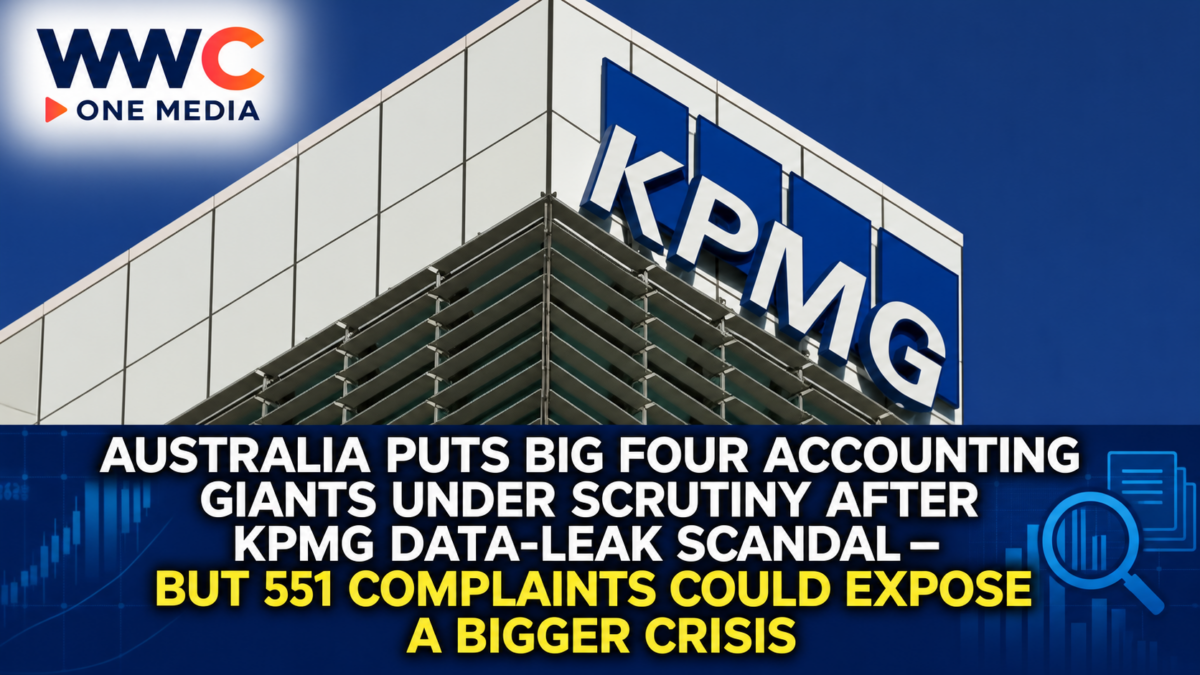
MELBOURNE, Australia — October 14, 2026 — Australia’s powerful accounting industry is facing an unprecedented test of public trust as the country’s corporate watchdog prepares to reveal findings from a sweeping examination of the Big Four firms following explosive allegations involving confidential client information and whistleblower misconduct.
The Australian Securities and Investments Commission (ASIC) plans to publish preliminary findings from its surveillance of KPMG, Deloitte, Ernst & Young (EY) and PricewaterhouseCoopers (PwC) before the end of 2026.
The announcement follows a scandal at KPMG Australia involving allegations that confidential information belonging to corporate clients was improperly shared or used during efforts to win lucrative audit contracts.
According to Bloomberg’s October 12 report, ASIC is examining internal misconduct complaints and whistleblower allegations across the four firms to determine whether further enforcement action may be warranted.
The investigation has already placed the industry’s internal governance, audit independence and treatment of whistleblowers under intense scrutiny.
The scale of the regulatory exercise is substantial.
ASIC disclosed in September that it was reviewing 551 internal complaints provided by the Big Four, dating from July 1, 2023.
The regulator has stressed that the figure represents complaints requiring examination, not 551 proven cases of serious misconduct.
Meanwhile, KPMG has already suffered major leadership departures and the loss of prominent corporate audit clients.
The controversy has revived memories of Australia’s 2023 PwC tax-information scandal, which severely damaged confidence in the consulting industry.
Australia’s Big Four firms now face a critical reckoning over confidentiality, professional ethics and corporate accountability. But the bigger question is whether ASIC’s findings will reveal isolated failures — or expose weaknesses that demand a fundamental overhaul of how the country’s biggest auditors are regulated.
ASIC Promises to Release Findings Before Year-End
ASIC Chair Sarah Court outlined the regulator’s plans in remarks prepared for October 13.
The surveillance focuses on complaints raised within the firms, including concerns brought forward by whistleblowers.
The watchdog expects to publish high-level findings before the end of 2026.
The review covers the four dominant international accounting networks operating in Australia.
It is designed to examine how the firms receive, assess and respond to concerns about audit-related misconduct.
The regulator will also consider whether particular matters justify further investigations or enforcement proceedings.
However, the review is ongoing.
ASIC has not yet published a final set of sector-wide conclusions.
The announcement should therefore not be interpreted as evidence that Deloitte, EY, PwC and KPMG have all been found guilty of wrongdoing.
The KPMG Scandal That Triggered the Review
The regulatory crackdown followed allegations that confidential corporate information was improperly handled within KPMG Australia.
The controversy gained public attention earlier in 2026 after whistleblower allegations were raised in Parliament.
The allegations involved sensitive documents associated with major corporate clients, including property group Lendlease.
Questions emerged about whether confidential material was used or shared internally in connection with attempts to secure audit work involving other major companies.
Such information is commercially sensitive.
Audit firms routinely receive access to confidential financial records, board papers, management forecasts and internal strategic plans.
Companies provide that information because they expect auditors to maintain strict confidentiality and independence.
If sensitive information is used to seek commercial advantage, the resulting damage can extend beyond an individual client.
It can undermine confidence in the entire audit system.
KPMG Admits Failures in Handling Whistleblower Complaints
KPMG has acknowledged serious shortcomings in its response to the whistleblower allegations.
In a May 29 statement, the company conceded that the original investigations had lacked sufficient rigor.
The firm also acknowledged weaknesses in its management of the whistleblower, its investigative processes and leadership responses.
KPMG said a further external investigation was being conducted by law firm Allens, with oversight from a board subcommittee.
The company also disclosed that its investigation had identified a separate incident in which documents containing client information were improperly shared internally.
KPMG apologized to the whistleblower and affected clients.
These admissions are significant.
They establish failures in the firm’s handling of sensitive complaints and information.
However, they do not establish that every allegation made by the whistleblower has been substantiated.
The scope of proven misconduct must be distinguished from allegations still under examination.
Senior KPMG Executives Leave Amid Controversy
The scandal triggered major leadership changes.
In May, KPMG Australia announced that chief executive Andrew Yates had resigned with immediate effect.
Julian McPherson, the firm’s national managing partner for audit and assurance, also stepped down from his leadership position and was to leave the firm following an orderly transition.
KPMG appointed Stan Stavros as interim chief executive.
The firm also confirmed disciplinary action in connection with the issues identified.
Subsequent changes in senior leadership followed as the controversy continued.
For one of Australia’s most prominent professional-services businesses, the departures represented a serious governance crisis.
But resignations and disciplinary measures do not replace the need to determine whether laws or professional obligations were breached.
That assessment remains a matter for the relevant authorities.
ASIC Reviews 551 Complaints Across the Big Four
One of the most important revelations emerged during a parliamentary hearing on September 4.
ASIC’s executive director of enforcement and compliance, Chris Savundra, said the regulator had received information concerning 551 internal complaints across the Big Four.
The complaints cover a period beginning July 1, 2023.
They involve possible issues relating to audit conduct, including the misuse or sharing of confidential information.
ASIC has been using compulsory information-gathering powers to obtain relevant material.
Court emphasized that the number does not mean regulators have uncovered 551 serious whistleblower cases.
Some complaints may concern matters outside ASIC’s enforcement priorities.
Others may lack evidence of a regulatory breach.
The watchdog must assess each case before determining whether further action is justified.
This distinction is essential because the number of complaints can be easily mistaken for a count of proven offenses.
Big Four Firms Face a Wider Trust Problem
The case has renewed concerns about the concentration of the accounting industry.
KPMG, Deloitte, EY and PwC audit many of Australia’s largest publicly listed corporations.
They also provide consulting, tax, advisory and other services.
Their size gives them substantial commercial influence.
But the combination of different business activities can create potential conflicts.
An audit firm is expected to independently scrutinize a company’s financial reporting.
At the same time, professional-services organizations face pressure to grow revenue and attract clients.
Strong safeguards are needed to ensure that commercial incentives do not compromise professional judgment.
The current controversy has intensified debate over whether those safeguards are adequate.
ANZ Ends Its 57-Year Relationship With KPMG
The reputational damage has translated into significant commercial consequences.
In October, ANZ Group moved to end its long-standing relationship with KPMG as external auditor.
The decision brought an approximately 57-year association to an end.
Other companies have also reconsidered their arrangements with the firm.
Macquarie reversed an earlier decision to appoint KPMG as auditor.
Insurance Australia Group and Lendlease have also moved away from the company.
These developments demonstrate how confidence affects the audit industry.
Large corporations depend on auditors that can handle sensitive information and provide credible independent assurance.
Once that trust is damaged, client relationships may become difficult to maintain.
However, a company changing auditors does not itself establish that a specific legal offense occurred.
Government Contracts With Big Four Firms Decline
The industry has also faced a significant reduction in Australian federal government work.
Reuters reported in June that government contracts awarded to Big Four firms fell to approximately A$348 million in 2025, compared with A$637 million in 2024.
That represents a substantial decline.
The figures reflect broader government contracting trends following a series of controversies involving major professional-services firms.
They should not be attributed entirely to the KPMG scandal, which became public later.
Nevertheless, the decline illustrates the pressure on the sector.
Governments increasingly want stronger safeguards around procurement, conflicts of interest and the protection of confidential information.
Firms seeking public contracts may face greater scrutiny of their internal controls.
The PwC Tax-Leaks Scandal Still Casts a Shadow
KPMG’s difficulties follow a separate controversy involving PwC Australia.
In 2023, revelations emerged that confidential Australian government tax-policy information had been improperly shared within PwC and used in connection with commercial work.
The scandal generated public outrage and parliamentary investigations.
PwC subsequently sold its Australian government advisory business for a nominal A$1.
The incident led to demands for tighter regulation of accounting and consulting firms.
It also raised questions about whether existing rules sufficiently separated public responsibilities from private commercial interests.
The latest KPMG controversy has strengthened arguments that reform remains unfinished.
However, the two scandals involve different facts and should not be treated as a single coordinated case.
Regulators Say Existing Laws Are Inadequate
One of the most important concerns raised by ASIC involves the structure of Australia’s regulatory framework.
Court has argued that existing rules focus too heavily on individual registered auditors and particular engagements.
That creates difficulties when regulators need to examine conduct across large multidisciplinary firms.
A modern Big Four organization may operate through complex legal structures involving partnerships and corporate entities.
Different activities can fall under different regulatory regimes.
This may limit the regulator’s ability to address organization-wide governance failures.
ASIC has welcomed consideration of reforms that could strengthen enforcement powers and disciplinary arrangements.
Australia’s Treasury is examining possible changes.
The outcome could shape how major accounting firms are supervised in the years ahead.
Whistleblower Protection Becomes a Central Issue
The KPMG controversy also highlights the risks faced by employees who report suspected wrongdoing.
Whistleblowers can help expose issues that would otherwise remain hidden.
But internal reporting systems are only effective when complaints receive independent and thorough examination.
Employees may be reluctant to speak up if they fear retaliation, reputational damage or career consequences.
KPMG’s admission that its initial handling of the whistleblower fell short has therefore become a major part of the controversy.
During parliamentary hearings, lawmakers questioned whether existing safeguards were sufficient.
ASIC has also acknowledged the need for clarity about the protection available to people who report possible misconduct.
Effective reform may require better protection for complainants, clearer reporting channels and greater accountability for those overseeing investigations.
What Could ASIC’s Findings Reveal?
The regulator’s forthcoming update could provide insight into how the Big Four handle internal complaints.
It may identify recurring weaknesses in governance, audit independence or confidentiality controls.
It could also highlight examples of effective complaint management.
However, the high-level disclosure may not identify individual complainants or provide detailed findings for every firm.
Whistleblower confidentiality and ongoing investigations may restrict what ASIC can make public.
The regulator could decide to pursue additional enforcement action where evidence supports it.
But the announcement does not guarantee prosecutions, fines or disciplinary orders against all four firms.
Those outcomes would require appropriate legal and regulatory processes.
Why the Scandal Matters for Investors and Corporations
Auditors play a fundamental role in financial markets.
Investors rely on audited financial statements when assessing corporate performance.
Banks use financial information to make lending decisions.
Regulators depend on accurate reporting to supervise markets.
If confidence in auditors deteriorates, those relationships can be affected.
Companies may face higher governance costs or greater scrutiny.
Investors may demand more transparency about internal controls.
Corporate boards may reconsider how they appoint auditors and manage conflicts of interest.
The consequences can be substantial even when no immediate financial penalty has been imposed.
For the accounting profession, public trust is one of its most valuable assets.
What This Means for Asia and the Philippines
The Big Four operate internationally, including throughout Southeast Asia and the Philippines.
Their member firms provide audit, tax and advisory services to corporations, financial institutions and public-sector organizations.
The Australian controversy may therefore encourage boards and regulators elsewhere to examine their own governance practices.
Relevant questions include how confidential client data is protected, how potential conflicts are managed and whether whistleblower complaints receive independent review.
However, ASIC’s Australian surveillance is not an investigation of every Big Four office worldwide.
It does not establish misconduct by their Philippine member firms.
Any country-specific regulatory conclusions would require separate evidence.
For Philippine companies, the key lesson is the importance of evaluating auditor independence and confidentiality safeguards rather than relying solely on a firm’s international brand.
What Happens Next?
Several developments could determine the direction of the controversy.
ASIC’s preliminary findings: A high-level report is expected before the end of 2026.
KPMG investigations: Outstanding allegations and possible regulatory breaches remain subject to further examination.
Potential enforcement: ASIC may decide whether evidence supports particular investigations or proceedings.
Treasury reforms: The government is considering changes to the supervision of large accounting firms.
Client decisions: Major corporations may continue reviewing auditor appointments and governance standards.
Whistleblower protections: Lawmakers and regulators may pursue improvements to reporting and complaint-handling systems.
The findings could influence both immediate regulatory action and the future structure of Australia’s audit industry.
The Bigger Question: Can the Big Four Restore Public Trust?
Australia’s accounting sector is approaching a decisive moment.
The KPMG controversy has exposed weaknesses in how sensitive client information and whistleblower complaints were handled.
The firm’s admissions and leadership changes demonstrate that the scandal has already produced serious consequences.
ASIC’s wider surveillance now extends beyond one company.
With 551 complaints under review, regulators must determine whether the problems are isolated or indicate more widespread weaknesses.
The outcome could affect corporate governance standards, audit supervision and the relationships between major companies and professional advisers.
But the public findings have not yet been released, and the allegations must still be assessed fairly.
Australia’s biggest accounting firms face a new test as ASIC prepares to reveal the results of its sector-wide scrutiny. But the real question is whether those findings will help restore confidence — or expose a deeper governance crisis that forces regulators to rewrite the rules for the entire industry.