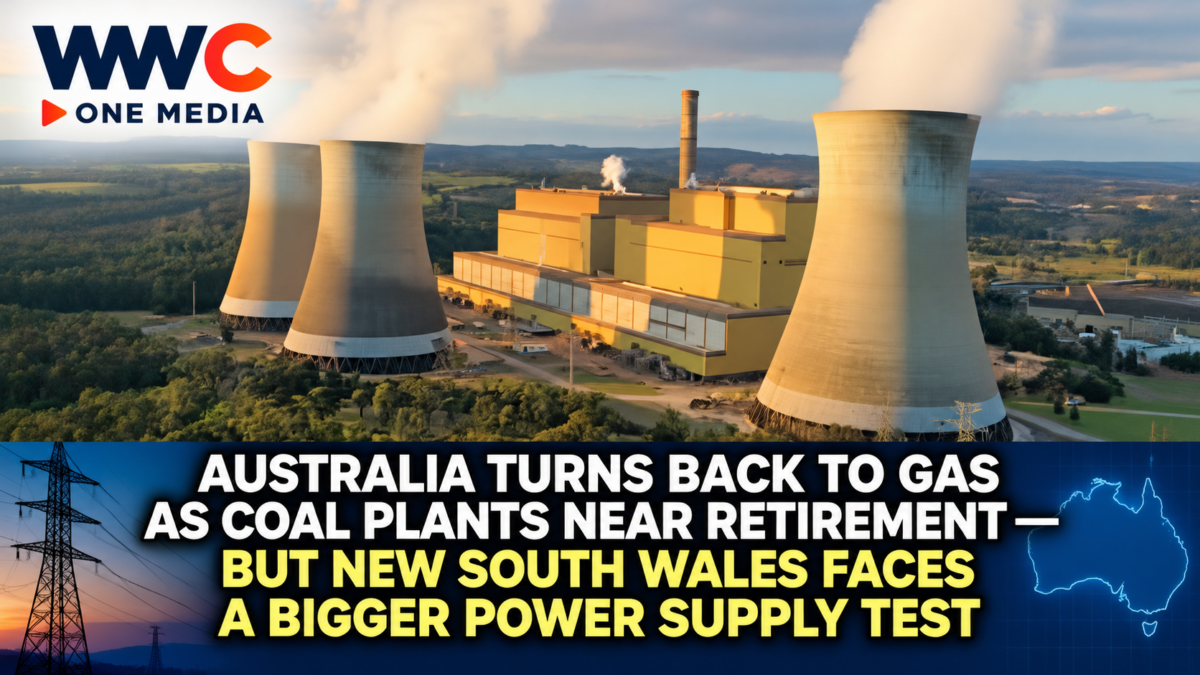
SYDNEY, Australia — October 14, 2026 — Australia’s most populous state is preparing to increase its reliance on natural gas as a backup source of electricity, unveiling plans to secure 1,500 megawatts of new power capacity ahead of the closure of aging coal-fired stations.
The New South Wales government announced the move on October 13, signaling that gas-fired generators will play a critical role in preventing electricity shortages as the state accelerates its transition toward renewable energy.
The proposed competitive tender is expected to favor gas-fired peaking plants—facilities designed to operate when electricity demand is high or when wind, solar and battery storage cannot provide enough supply.
Energy Minister Penny Sharpe outlined the initiative at the Australian Financial Review’s Energy and Climate Summit in Sydney.
The state is preparing for a projected electricity reliability shortfall in 2033–34, when two major coal-fired power stations are expected to retire.
The government says its grid will increasingly depend on renewable energy supported by batteries, pumped hydro and other storage technologies.
But it acknowledges that prolonged periods of low renewable generation could require another source of dispatchable power.
The proposed procurement marks an important development in Australia’s energy transition.
While governments continue investing in cleaner electricity, they are also confronting difficult questions about reliability, energy security and the cost of replacing aging coal infrastructure.
New South Wales is betting that natural gas can help keep the lights on while renewable energy expands. But the bigger question is whether the state can secure enough affordable fuel and complete its replacement power projects before coal plants shut down.
NSW Seeks 1,500 MW of Backup Electricity
The New South Wales government is preparing a competitive tender for 1,500 MW of new electricity capacity.
The procurement will be managed by ASL, the state’s independent Consumer Trustee.
The government has begun consultation on the proposed tender design, with the formal process expected to launch in 2027.
Gas-fired peaking power stations are considered the most likely solution.
These plants can generate electricity when required without operating continuously throughout the year.
Their principal role is to provide reliability during periods when other sources cannot fully meet demand.
The tender has not yet been awarded.
No final list of successful developers, locations or project costs has been announced.
The 1,500-MW figure represents the capacity NSW wants to procure, not electricity already being generated.
Why Gas Is Returning to the Center of the Energy Debate
Gas-fired electricity generation has attracted controversy because it produces greenhouse gas emissions.
Australia is seeking to increase renewable energy and reduce dependence on fossil fuels.
However, wind and solar power are weather-dependent.
Their output varies according to sunlight, wind conditions and the time of day.
Batteries can store electricity and release it when needed.
But storage capacity is finite, and some prolonged weather conditions may last longer than available energy reserves.
NSW officials argue that gas-fired peaking plants can provide additional protection against those extended periods.
Gas turbines can start when required and operate as dispatchable generators.
That makes them potentially useful for supporting a grid increasingly supplied by variable renewable energy.
However, their economic attractiveness depends on construction costs, fuel availability, operating hours and market revenues.
Eight-Hour Requirement Could Favor Gas Plants
The proposed tender includes an important technical requirement.
Participating projects must be able to supply electricity for at least eight hours and operate as net energy contributors.
This favors generation sources able to produce electricity rather than merely shift previously generated electricity between different periods.
Many existing battery storage systems are designed for shorter discharge durations.
Some longer-duration storage technologies can operate for eight hours or more, but their eligibility would depend on the final procurement rules.
Bloomberg reported that the tender conditions effectively exclude most conventional battery projects.
However, the NSW government says other technologies may qualify.
The distinction matters.
The state is not introducing a blanket ban on energy storage.
Instead, it is designing a particular procurement to secure a specific type of reliability service.
Batteries and pumped hydro will continue to play important roles elsewhere in the NSW energy system.
Coal Plant Closures Create a 2033–34 Deadline
NSW has traditionally relied heavily on coal-fired power stations.
But many of those facilities are approaching the end of their operating lives.
The state expects a reliability shortfall in 2033–34 as additional coal capacity retires.
Two particularly important plants are Bayswater and Vales Point.
<text></text>
| Coal-fired power station | Approximate capacity | Energy transition issue |
|---|---|---|
| Bayswater | 2,710 MW | Expected retirement around 2033 |
| Vales Point | 1,360 MW | Expected retirement around 2033 |
| Eraring | 2,880 MW | Closure delayed to April 2029 |
| Mount Piper | 1,400 MW | Another major source of coal generation |
The retirement dates and operating assumptions may change according to plant decisions and regulatory developments.
The new 1,500-MW procurement is designed to address a projected reliability requirement, not replace the entire nameplate capacity of all coal stations on a one-for-one basis.
Replacement energy also comes from renewables, storage, transmission upgrades and other sources.
Eraring Closure Already Delayed
Australia’s largest coal-fired power station, Eraring, offers a warning about the difficulty of managing the transition.
Operator Origin Energy had planned to retire the facility earlier.
But concerns about electricity reliability prompted further arrangements to extend operations.
Earlier in 2026, Origin announced that Eraring would continue operating until April 2029.
The extension gave NSW more time to bring new electricity infrastructure online.
It also demonstrated that replacing coal generation requires careful coordination.
The state must ensure that new capacity, network connections and storage systems become operational before existing plants shut down.
Simply announcing renewable energy projects does not guarantee their completion.
Construction schedules, financing costs, planning approvals and transmission access all affect delivery.
NSW Says Coal’s Share Has Already Fallen Dramatically
The NSW government says coal once generated more than 90% of the state’s electricity.
That share has since fallen to approximately 54%.
Meanwhile, the government reports that operating large-scale solar and wind capacity has increased by more than 80% since the current Labor administration took office.
Installed storage capacity has also expanded rapidly, increasing 39-fold over the same period, according to state figures.
These changes demonstrate that renewable energy is already becoming more important.
The government’s gas plan is therefore intended to support a wider transition, rather than reverse it.
However, renewable capacity growth and electricity generation are not identical measures.
The amount of electricity produced depends on weather conditions, equipment availability and network constraints.
The challenge is maintaining adequate supply at every hour, not simply building enough generation to meet annual demand.
Penny Sharpe Defends Gas as a Reliability Measure
Energy Minister Penny Sharpe has emphasized that the state needs different technologies for different electricity needs.
Solar and wind are expected to provide a substantial share of future generation.
Batteries and pumped hydro can shift electricity across time.
Gas-fired plants would help cover occasional prolonged shortfalls.
Speaking at the October 13 energy summit, Sharpe stressed the importance of maintaining reliability while new infrastructure is being built.
The government argues that planning early gives developers enough time to secure investment and complete projects before 2033–34.
That seven-year preparation period could reduce the risk of emergency procurement or costly delays.
Nevertheless, the final success of the strategy will depend on delivery.
A tender announcement is only the beginning of the process.
Gas Plants May Receive Revenue Guarantees
The planned projects are expected to be supported through the state’s Long-Term Energy Service Agreement framework.
This mechanism is designed to encourage investment in electricity infrastructure by reducing uncertainty about future revenue.
Gas peaking plants may operate only during relatively rare periods of tight supply.
That can make it difficult for developers to recover construction costs through ordinary electricity sales alone.
A revenue-support mechanism can help make such projects financeable.
However, public financial support creates important questions.
How much will consumers ultimately pay?
Will the plants be needed as frequently as forecast?
Could another technology deliver reliability at a lower total cost?
These issues will become clearer as the proposed tender design and commercial arrangements are finalized.
No definitive price for the 1,500-MW procurement has been announced.
Australia’s Gas Supply Challenge Could Complicate the Plan
The availability of natural gas is another major issue.
NSW relies heavily on gas supplies from other Australian states.
The Australian Energy Market Operator has warned about possible gas supply shortfalls along Australia’s east coast in coming years.
A reliable gas-fired power station still requires reliable fuel deliveries.
That means new generating capacity must be supported by appropriate gas supply contracts, pipeline access and infrastructure.
If fuel becomes scarce or expensive, gas-fired electricity can be costly.
This creates a challenge for policymakers seeking both affordable electricity and secure backup generation.
The state’s October 7 Gas Statement acknowledged that gas will continue playing a defined role in manufacturing, economic activity and the electricity transition.
But the government must ensure that projected supplies are actually available when required.
Canberra’s Domestic Gas Reservation Debate Adds Uncertainty
At the federal level, Australia is considering stronger measures to protect domestic gas availability.
The Albanese government has proposed a reservation framework requiring some exportable gas to be directed toward domestic customers.
The policy is intended to improve energy security and address concerns about local shortages.
However, gas producers have warned that poorly designed reservation rules could discourage investment.
Companies including Woodside and Shell have criticized aspects of the proposal.
They argue that producers need adequate commercial incentives to develop new supplies.
Energy consumers, meanwhile, want affordable gas and greater security.
The debate is particularly relevant to NSW because gas peaking plants may depend on available fuel during periods of electricity stress.
Even if a plant operates infrequently, it must have access to gas when needed.
Is the Plan a Setback for Renewable Energy?
Environmental advocates are likely to scrutinize any additional fossil-fuel infrastructure.
Gas produces carbon dioxide when burned.
Methane leakage across the gas supply chain can also increase its climate impact.
Long-lived gas infrastructure may create financial and environmental risks if clean alternatives become cheaper more quickly than expected.
Supporters of the government’s approach argue that occasional gas generation is different from using gas as a continuous source of electricity.
A plant that operates for limited periods may produce much less electricity—and potentially fewer annual emissions—than a coal station operating frequently.
But the actual outcome depends on operating hours, efficiency, fuel supply and the technologies displaced.
The state projects that gas-fired power will account for approximately 3.9% of its electricity generation by 2050.
That is a forecast rather than a binding guarantee of future output.
The central policy challenge is ensuring that backup capacity does not unnecessarily delay investment in lower-emission alternatives.
Storage and Transmission Remain Essential
The government’s decision does not reduce the importance of electricity storage.
Large batteries can respond rapidly to changes in electricity demand and generation.
Pumped hydro can store energy over longer periods.
Transmission infrastructure allows electricity from renewable energy zones to reach major cities and industrial centers.
NSW is pursuing a range of these projects.
In July, the state approved the Hunter Transmission Project, designed to improve the movement of renewable electricity from inland generation areas toward areas of demand.
The government’s October energy announcement argues that gas-fired peaking plants should complement this infrastructure.
However, transmission and storage projects must also be delivered on schedule.
Delays in any major component can affect the reliability of the wider system.
Sydney’s Data Center Boom Adds Pressure
Electricity demand could grow as the state attracts data centers and advanced industries.
Data centers require reliable power to support cloud computing, digital services and artificial intelligence.
Recent reporting indicates that developers in Western Sydney are seeking substantial new grid connections.
Some projects may face delays because of network constraints.
Not every proposed data center will necessarily be built.
But a significant increase in electricity demand would add pressure to the state’s infrastructure planning.
This makes reliable generation, transmission upgrades and demand management particularly important.
Policymakers must prepare for both the retirement of old supply and the possibility of higher future demand.
What the Plan Means for Electricity Bills
For households and businesses, the most important question is whether the new system will deliver reliable electricity at an affordable price.
Gas-fired peaking plants can help prevent shortages and extreme wholesale price spikes.
But building and maintaining backup capacity also costs money.
If the plants are used infrequently, some costs may still need to be recovered through contractual support arrangements.
Gas fuel prices introduce another source of uncertainty.
The final effect on electricity bills will depend on tender prices, gas markets, network costs and the performance of other technologies.
There is no verified basis for claiming that the 1,500-MW tender will automatically reduce household bills by a specific amount.
Nor is there enough information to conclude that it will inevitably make electricity more expensive.
The commercial details remain to be determined.
Australia Offers a Warning for Southeast Asia
The NSW decision comes as Southeast Asian economies face their own energy-transition challenges.
Countries including the Philippines and Vietnam have considered expanding gas-fired generation to support economic growth and diversify electricity supply.
However, Reuters reported on October 12 that high LNG prices and infrastructure costs are challenging some proposed gas projects in emerging Asia.
Some projects have been delayed as renewable energy becomes more competitive.
The International Energy Agency expects wind and solar to take a larger share of Southeast Asia’s electricity mix by 2030.
For energy planners, the question is not simply whether to choose gas or renewables.
It is how to construct a power system that can meet demand reliably at a sustainable cost.
NSW’s experience demonstrates the importance of considering backup generation, fuel security, storage and electricity networks together.
What the Philippines Can Learn
The Philippines has experienced power-supply constraints and periodic electricity alerts in some regions.
It is also expanding renewable energy while developing gas-related infrastructure.
The NSW initiative offers several practical lessons.
First, generation projects must be aligned with the timing of plant retirements.
Second, renewable energy growth must be supported by sufficient system flexibility.
Third, gas-fired plants need dependable fuel supplies—not merely installed turbines.
Fourth, storage and transmission infrastructure are essential.
Finally, policymakers must consider the full costs of ensuring reliability.
However, the NSW announcement does not establish that the Philippines needs the same 1,500-MW gas procurement or an identical regulatory structure.
Each electricity market has different resources, demand patterns and network conditions.
The relevant lesson is integrated planning rather than copying a single technology decision.
What Happens Next?
The government has begun consultation on the proposed tender arrangements.
The competitive process is expected to launch in 2027.
Developers will need to demonstrate that their projects can provide the required reliability service.
The state will evaluate proposed technologies, commercial terms and delivery schedules.
Gas supply and infrastructure planning will also influence whether projects proceed.
Major coal-retirement milestones remain important.
Eraring is currently scheduled to retire in 2029, while further coal closures are expected around 2033.
The state’s objective is to ensure replacement infrastructure is available before the projected 2033–34 reliability shortfall emerges.
The actual energy transition will depend on how successfully those plans are implemented.
The Bigger Question: Can Australia Replace Coal Without Sacrificing Reliability?
New South Wales is confronting one of the most difficult questions in modern energy policy.
Coal-fired electricity has provided dependable generation for decades, but the state’s aging power stations cannot operate indefinitely.
Renewable energy is expanding rapidly.
Battery storage and new transmission lines are becoming more important.
Yet the government believes that occasional periods of low wind and solar output will still require additional dispatchable power.
Its answer is to seek 1,500 MW of new capacity, with natural gas expected to play the leading role.
The plan could improve energy security during a difficult transition.
But it also creates questions about fuel prices, emissions, infrastructure costs and public support for private projects.
The success of the strategy will depend on whether NSW can deliver a reliable, affordable and increasingly low-emission electricity system.
Australia’s most populous state is preparing to rely on gas-fired backup power as coal stations approach retirement. But the decisive test is still ahead: Can New South Wales build enough reliable electricity capacity before the old plants close—or could gas shortages, costly infrastructure and delayed renewable projects leave households and businesses exposed to another power crisis?