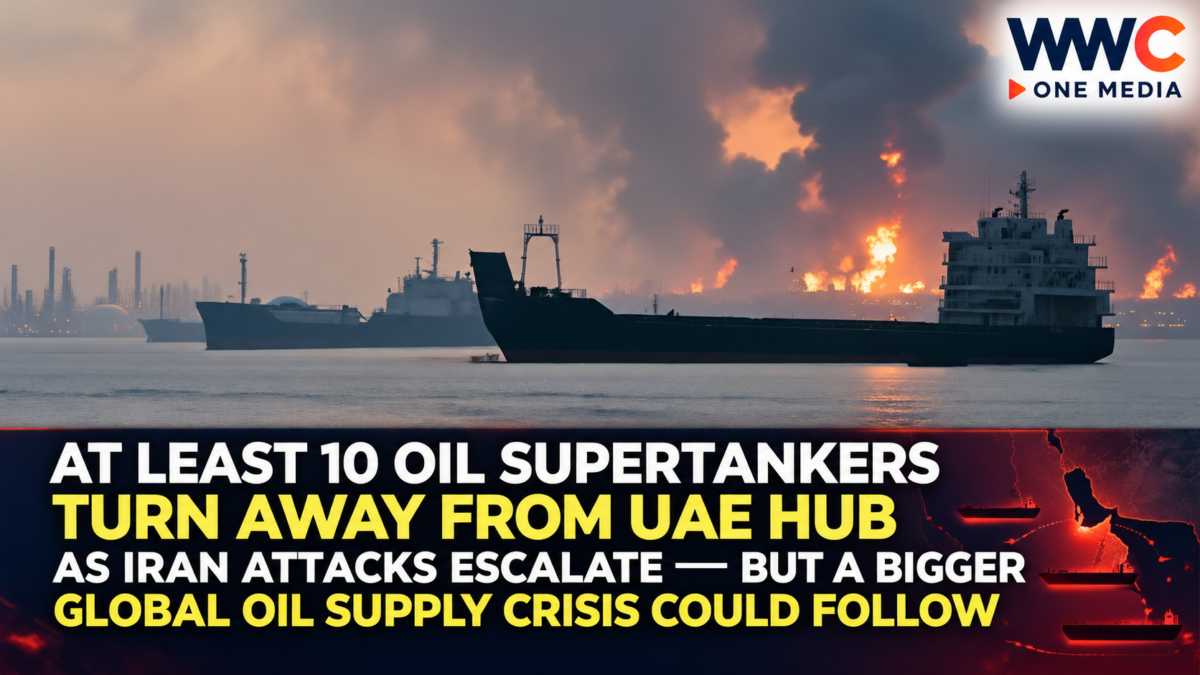
DUBAI, United Arab Emirates — October 14, 2026 — The global oil industry is facing another dangerous disruption as at least 10 empty supertankers have halted or reversed course while approaching a crucial oil transfer hub near the Strait of Hormuz, raising fears that escalating attacks on commercial ships could undermine the fragile recovery in Middle Eastern crude exports.
The vessels were approaching Fujairah, a major oil shipping and logistics center on the eastern coast of the United Arab Emirates, when their movements changed amid a renewed wave of attacks on maritime traffic.
According to tanker-tracking data compiled by Bloomberg and reported on October 12, at least 10 very large crude carriers, or VLCCs, and several Suezmax tankers stopped or turned away in recent days.
The development is significant because Fujairah and nearby Omani waters have become essential to a wartime shipping arrangement that allows Gulf oil producers to move crude through the Strait of Hormuz despite severe security risks.
Under the system, smaller tankers transport oil through the dangerous waterway and transfer their cargoes onto larger vessels waiting in comparatively accessible waters outside the strait.
But as attacks spread closer to the transfer areas, even the receiving supertankers are becoming reluctant to approach.
The pullback comes as crude oil prices remain above $100 a barrel and shipowners demand extraordinary compensation for operating in one of the world’s most dangerous maritime regions.
But the bigger threat is no longer limited to whether tankers can pass through the Strait of Hormuz. It is whether the emergency shipping network keeping Gulf oil flowing can survive if the supertankers needed to collect that oil stop arriving.
At Least 10 Supertankers Halt or Reverse Course Near Fujairah
The latest vessel-tracking data indicate a growing reluctance among tanker operators to send empty ships toward the UAE’s eastern coastline.
Bloomberg identified at least 10 VLCCs and several Suezmax vessels that had stopped or changed course while approaching Fujairah.
A VLCC is generally capable of carrying approximately 2 million barrels of crude oil.
Suezmax tankers are smaller, typically carrying roughly 1 million barrels, depending on their specifications.
These vessels are important to long-distance crude transportation because they can move substantial volumes between producing regions and overseas refineries.
However, the reported ships were empty.
Their change of course therefore does not establish that they abandoned shipments of oil already loaded aboard.
Instead, the concern is that they may no longer be available to collect cargoes being brought out of the Persian Gulf.
Other vessels were still proceeding toward the area, indicating that maritime traffic had not completely stopped.
Nevertheless, the movement of multiple empty tankers away from a major transfer hub suggests that security risks are influencing commercial decisions.
Why Fujairah Has Become Critical to Global Oil Supplies
Fujairah is one of the most strategically important energy logistics centers in the Middle East.
Unlike major export facilities located inside the Persian Gulf, Fujairah sits on the Gulf of Oman side of the Strait of Hormuz.
Its position allows some oil-related operations to take place without every large receiving tanker entering the narrow waterway.
During the Iran war, this geographic advantage has become especially valuable.
The region’s oil producers and shipping companies have relied on alternative export routes, shuttle tankers and ship-to-ship transfers to maintain energy flows.
Fujairah serves as a major staging point for vessels participating in these operations.
Some ships identify Fujairah as an interim destination before proceeding to nearby offshore transfer areas.
Others eventually continue into the Persian Gulf.
Consequently, a decline in vessels approaching Fujairah may signal weakening confidence in operating near the Strait of Hormuz more broadly.
The latest retreat is therefore significant even though the vessels were not necessarily scheduled to load oil inside the port itself.
How the Wartime Oil Transfer System Works
The Gulf’s emergency crude transportation network has helped oil producers maintain exports despite attacks and restrictions around the strait.
<escape>STAGE 1 — CRUDE LOADING</escape>
Oil is loaded onto shuttle tankers at terminals located inside the Persian Gulf.
<escape>STAGE 2 — TRANSIT THROUGH HORMUZ</escape>
The shuttle vessels navigate the high-risk Strait of Hormuz, where attacks and maritime security threats have become increasingly frequent.
<escape>STAGE 3 — SHIP-TO-SHIP TRANSFER</escape>
After reaching designated waters off Fujairah or Oman, the shuttle tankers transfer oil to larger receiving vessels.
<escape>STAGE 4 — LONG-DISTANCE DELIVERY</escape>
The larger tankers carry the crude to importing countries and international refining markets.
The arrangement reduces the need for every VLCC to enter the most dangerous part of the shipping corridor.
However, it introduces additional costs and operational complexity.
Cargo transfers require suitable weather, equipment, coordination and available vessels.
If receiving tankers stop arriving, shuttle vessels may have to wait longer before unloading.
That reduces the number of trips each shuttle tanker can complete.
Over time, the slowdown could constrain export capacity even if some ships continue to navigate Hormuz successfully.
Iran-Linked Maritime Attacks Reach Dangerous New Intensity
The tanker retreat coincides with one of the most intense periods of maritime attacks since the Iran war began.
According to the Financial Times, 24 ships were attacked during the two weeks leading up to October 11.
Six vessels were targeted on October 11 alone.
The incidents affected different types of commercial ships, including crude oil tankers, refined-product carriers and cargo vessels.
Some attacks caused injuries, while two Indian seafarers were reported missing.
The pattern has raised fears that vessels involved in ordinary commercial shipping are becoming increasingly exposed.
Associated Press reporting on October 13 described concerns that ship-to-ship oil transfer operations near the Strait of Hormuz could be attracting greater attention from Iranian forces.
Iran has also made accusations about oil smuggling operations in the area.
However, individual incidents must be assessed separately.
Not every attack had been formally claimed by Iran, and some incidents remained under investigation.
The attribution and circumstances of specific strikes should therefore not be treated as identical.
Strait of Hormuz Oil Flows Fall Sharply After September Recovery
The security deterioration threatens an export recovery that had appeared increasingly encouraging just weeks earlier.
According to Financial Times reporting, Middle Eastern oil exports reached approximately 15.5 million barrels per day in September.
That represented more than 80% of prewar levels.
The recovery reflected adaptation by Gulf producers, including alternate pipeline routes and maritime transfers.
However, attacks in October have undermined confidence in that progress.
The Financial Times reported that oil shipments through the Strait of Hormuz fell to approximately 2.9 million barrels on October 11, compared with a September peak of around 15.5 million barrels per day.
The comparison illustrates the severity of disruption on the reported day.
It should not be interpreted as proof that all Gulf production or exports remained at that lower level throughout October.
Daily shipping volumes can fluctuate sharply as vessels bunch, delay departures or change routes.
Nevertheless, the decline demonstrates how quickly security incidents can disrupt a major energy corridor.
Oil Export Recovery Could Be at Risk Without Receiving Tankers
The most immediate concern is the shortage of large vessels available to collect crude outside Hormuz.
The wartime shuttle system depends on two interconnected groups of ships.
One group carries oil through the strait.
Another receives those cargoes and delivers them to international markets.
Both are necessary for the system to operate efficiently.
If receiving tankers withdraw from Fujairah and nearby Omani waters, shuttle tankers may spend more time waiting for transfers.
That could create congestion and reduce the total amount of crude moved through the network.
Oil producers could then face difficulties maintaining export schedules.
The risk is particularly serious when global tanker availability is already constrained.
Shipping companies cannot instantly create new VLCCs to replace vessels avoiding the region.
Even ships willing to accept the risks may require higher charter rates and additional security arrangements.
The result could be a sustained increase in transportation costs and greater uncertainty for oil buyers.
Supertanker Freight Rates Reach Extraordinary Levels
The war has transformed the economics of oil shipping.
The Financial Times reported that supertanker earnings reached approximately $805,000 per day on October 9.
That extraordinary figure reflects tight vessel availability, significant demand for transportation and the risks involved in operating near conflict zones.
Such rates are far above ordinary shipping costs.
For oil importers, higher freight expenses can increase the delivered price of crude even if the market price of the oil itself remains unchanged.
Shipping costs can also vary significantly depending on the route, vessel, insurance arrangements and contract terms.
Not every tanker operator earns the same amount.
Likewise, the $805,000 figure does not mean that every ship receives that payment each day or that it represents pure profit after expenses.
The figure nevertheless illustrates how severely the conflict has disrupted the tanker market.
Reuters Reveals How Oil Transfers Kept Gulf Exports Moving
The latest Bloomberg report builds on earlier investigations into the emergency transportation network.
In June 2026, Reuters described a maritime arrangement involving ship-to-ship oil transfers near Fujairah and Sohar in Oman.
Reuters reported that US-supported efforts helped facilitate the movement of Gulf crude through transfer operations designed to limit the exposure of large receiving vessels.
The investigation identified at least 116 vessels involved at the two main transfer sites during the period examined.
According to Reuters, the system moved approximately 90 million barrels of oil over about one month.
The operations demonstrated the scale of the effort required to maintain energy shipments during the conflict.
However, the arrangements were complex and expensive, and the volumes remained below what normal, unrestricted commercial shipping could support.
The latest pullback of receiving tankers illustrates why the network remains vulnerable.
A system built around avoiding one dangerous passage can still be threatened if attacks spread toward the places where ships transfer their cargoes.
Saudi Arabia and UAE Have Used Pipelines to Bypass Hormuz
Shipping transfers are not the only measures supporting Gulf oil exports.
Saudi Arabia has made use of its East-West pipeline, which carries crude toward the Red Sea.
The United Arab Emirates also operates pipeline infrastructure connecting its oil-producing areas to export facilities outside the Strait of Hormuz.
These routes provide alternatives to shipping every barrel of crude through the strait.
They have helped reduce some of the economic damage caused by the conflict.
However, pipeline capacity is limited.
Alternative routes cannot necessarily accommodate every barrel normally exported from the Gulf.
They also face their own logistical and security risks.
Associated Press reporting has highlighted how attacks on regional infrastructure have complicated efforts to keep oil moving.
For international energy markets, the central question is whether a combination of pipelines, maritime transfers and conventional tanker traffic can continue meeting demand.
Saudi and Gulf Exports Had Recovered Before Latest Attacks
The broader oil market has shown considerable resilience despite months of war.
According to Reuters, energy intelligence firm Vortexa estimated that oil exports from Gulf producers other than Iran had recovered to more than 81% of prewar levels during September.
Saudi Arabia contributed substantially to the rebound.
The recovery demonstrated the ability of producers and shipping companies to adapt.
However, renewed attacks have raised questions about whether that progress can be sustained.
The recent improvements depended on functioning export facilities, available vessels and viable shipping routes.
If any of those components become severely constrained, the recovery could reverse.
The retreat from Fujairah is important because it threatens the availability of ships required by one of the region’s central export workarounds.
Iranian Crude Exports Face Separate Pressure From US Blockade
The shipping crisis is unfolding alongside a separate disruption affecting Iranian crude exports.
On October 13, Reuters reported that Vortexa estimated Iranian crude exports had fallen to zero during October as a result of the US blockade.
That estimate refers to tracked Iranian crude exports under the conditions and methodology used by the analytics provider.
It does not establish that Iran has permanently ceased producing oil.
Meanwhile, exports from other Gulf countries had recovered substantially before the latest escalation.
The distinction is important because the oil market is facing several overlapping disruptions.
Iranian exports, commercial shipping near Hormuz and shipments from other Gulf producers are affected by different operational and geopolitical factors.
The combined impact can create additional uncertainty for oil buyers.
Brent Crude Remains Above $100 as Supply Risks Persist
The tanker disruptions are contributing to continued volatility in global oil markets.
According to Reuters, Brent crude settled at approximately $105.69 per barrel on October 13.
US West Texas Intermediate crude finished at around $94.14.
Oil prices have remained elevated as traders weigh the possibility of further supply interruptions.
The market is responding not only to actual shortages but also to the risk that future shipments could be delayed.
Security threats can push up transportation costs, insurance premiums and the financial risks associated with long-distance crude purchases.
However, oil prices are also influenced by global demand, refinery activity, inventories, production decisions and broader financial conditions.
The latest tanker retreat is therefore an important source of concern, but it is not the sole explanation for crude price movements.
Why Even a Partial Shipping Disruption Can Affect Global Consumers
Oil markets are international.
A disruption near the Strait of Hormuz can affect buyers thousands of kilometers away.
If exporters struggle to move crude, importers may need to purchase oil from alternative suppliers.
Those suppliers may be located farther away or charge higher prices.
Longer shipping routes can increase freight costs and delivery times.
Refineries may also need to adjust operations if replacement crude differs from the grades they normally process.
Higher oil and shipping costs can eventually influence gasoline, diesel, aviation fuel and other petroleum-product prices.
The effects may extend to transportation, food distribution, manufacturing and electricity generation.
However, the impact on consumer prices differs across countries.
Domestic taxes, subsidies, refining capacity, exchange rates and existing fuel inventories can either amplify or cushion changes in international oil prices.
What the Gulf Tanker Crisis Means for the Philippines
The Philippines is particularly exposed to developments in global energy markets because it imports substantial amounts of petroleum products and relies on international fuel supply chains.
A prolonged disruption in Gulf shipping could affect the country through several channels.
Fuel prices
Higher international crude and refined-product prices may eventually contribute to domestic gasoline and diesel price increases.
Transportation costs
More expensive diesel and aviation fuel can raise costs for land transportation, aviation and logistics businesses.
Electricity expenses
Fuel-price changes can influence the cost of power generation where affected fuels are used.
Inflation
Higher transportation and energy costs may contribute to price pressures across goods and services.
Exchange-rate exposure
International oil purchases are generally priced in US dollars, making the peso’s exchange rate an additional factor.
However, the Bloomberg report does not establish that Philippine fuel prices have already increased by a specific amount because of the tanker retreat.
Any domestic effect would depend on global prices, inventory conditions, pricing schedules and government measures.
Could Asian Economies Face a New Energy Shock?
The wider Asian region is highly sensitive to the movement of Middle Eastern oil.
Major economies including China, India, Japan and South Korea depend on international crude supplies.
If tanker shortages and attacks reduce the reliability of Gulf exports, buyers may seek alternative cargoes.
That could intensify competition for available oil and shipping capacity.
Countries with large strategic inventories or diversified supply contracts may be better positioned to manage temporary disruptions.
Others may face greater exposure to rising costs.
For central banks, expensive energy adds another challenge by increasing inflation pressure.
Governments may also face pressure to provide assistance to consumers or energy-intensive businesses.
Nevertheless, the severity of any regional energy shock will depend on how long the shipping disruption continues and whether alternative supply routes remain available.
Can Naval Protection Keep the Oil Moving?
Maritime security operations have helped some tankers continue navigating high-risk waters.
Naval escorts, surveillance and other protective measures can reduce certain threats.
However, the latest attacks illustrate the difficulty of protecting commercial shipping across a broad maritime area.
Tankers are large and relatively slow-moving vessels.
Operations involving ship-to-ship transfers may require vessels to remain in the same area for extended periods, potentially increasing exposure to security threats.
Even when military protection is available, shipowners must consider the safety of crews, vessels and cargoes.
Insurance providers also assess whether routes are commercially acceptable.
Consequently, naval protection does not necessarily guarantee that all shipping companies will continue operating near a conflict zone.
Commercial confidence remains essential to maintaining oil flows.
Five Developments Energy Markets Should Watch
1. Tanker arrivals at Fujairah
A sustained decline in empty VLCC arrivals would indicate growing pressure on the receiving-tanker network.
2. Attacks near Oman and the UAE
Further incidents around offshore transfer sites could increase the risks faced by vessels that remain outside Hormuz.
3. Daily crude export volumes
Shipping data will show whether the disruption translates into sustained reductions in Gulf oil deliveries.
4. Freight and insurance costs
Rising costs could make long-distance shipments more expensive even if sufficient crude remains available.
5. Diplomatic and military developments
Changes in regional security arrangements, ceasefire efforts or naval protection could influence the willingness of shipowners to return.
These indicators will be important in determining whether the current disruption remains temporary or becomes a more serious supply-chain problem.
The Bigger Question: Can the Global Oil Industry Keep Its Wartime Lifeline Open?
The retreat of at least 10 supertankers from the Fujairah area highlights a potentially dangerous turning point in the Iran war’s impact on global energy supplies.
For months, Gulf producers have relied on alternative pipelines, shuttle vessels and offshore transfers to keep crude moving.
Those arrangements helped exports recover even as the Strait of Hormuz remained vulnerable.
But the system depends on the willingness of shipowners to operate near an active conflict zone.
Escalating attacks have now begun to threaten not only vessels passing through the strait but also the wider transfer network that was supposed to reduce their exposure.
If enough receiving tankers withdraw, oil may be able to leave Gulf terminals but struggle to reach final buyers efficiently.
That could increase delays, freight costs and pressure on international energy markets.
For governments and energy companies, restoring confidence in commercial shipping may become as important as protecting production facilities.
At least 10 supertankers have already turned away from a critical Gulf oil hub. But the bigger danger is what happens next: If the vessels that collect crude stop coming, the wartime system keeping Middle Eastern oil flowing could begin to break down — threatening higher energy costs for economies far beyond the Strait of Hormuz.