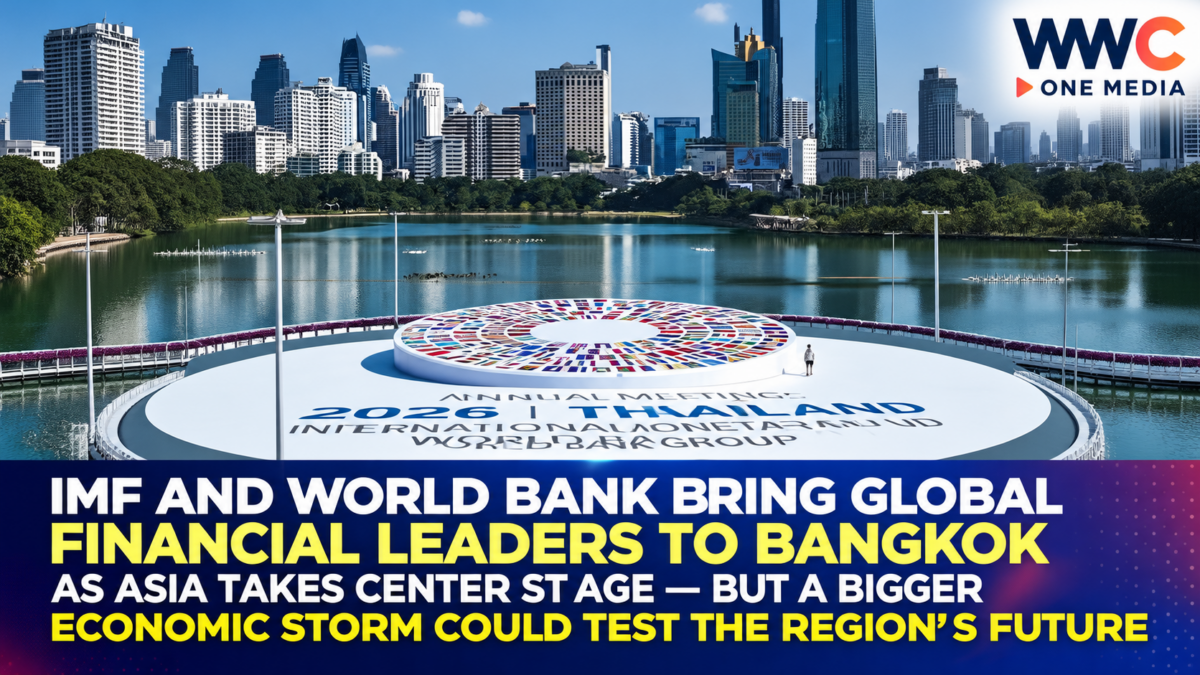
BANGKOK, Thailand — October 13, 2026 — Asia has moved to the center of the global economic debate as the International Monetary Fund (IMF) and World Bank Group gather in Bangkok for their 2026 Annual Meetings, bringing together finance ministers, central bankers, business executives and development leaders amid mounting concerns over global debt, high energy prices and the growing influence of artificial intelligence.
The weeklong meetings, scheduled from October 12 to 18, mark the first time Thailand has hosted the prestigious gathering in 35 years, underscoring Asia’s expanding influence in international finance and economic policymaking.
Approximately 18,000 participants are expected to attend the meetings, according to Reuters, making Bangkok a major center for discussions about the future of the world economy.
The event comes as Asian economies benefit from investment in artificial intelligence, semiconductor manufacturing and digital technology, even as energy supply disruptions, geopolitical conflicts and rising government borrowing costs threaten the global recovery.
In its latest economic assessment released October 13, the IMF projected global economic growth of 3.1% in 2026, slightly above its previous forecast of 3.0%.
However, the international lender warned that resilience could weaken if inflation, financial market volatility and geopolitical tensions intensify.
But while Asia is gaining greater influence over the global economy, a bigger question is emerging: Can the region sustain its growth advantage when the world faces mounting debt, expensive energy and the possibility of a sharp correction in the AI investment boom?
Bangkok Hosts IMF–World Bank Annual Meetings for First Time Since 1991
Thailand is hosting the IMF and World Bank Annual Meetings for the first time since 1991.
The gathering is being held primarily at the Queen Sirikit National Convention Center in Bangkok, with major sessions and related events taking place throughout the week.
According to the IMF, the meetings bring together governors of central banks, finance and development ministers, business executives, representatives of civil society organizations and academics.
Their discussions focus on global economic stability, international financial cooperation, development financing, poverty reduction and sustainable growth.
Hosting the meetings represents a diplomatic and economic milestone for Thailand.
The event also symbolizes how significantly Asia’s position in the global economy has changed over the past three and a half decades.
Since 1991, the region has become a major center for manufacturing, international trade, digital technology, finance and investment.
China and India have emerged as major economic powers, while Southeast Asian economies have deepened their participation in international supply chains.
The Bangkok meetings provide an opportunity for Asian governments to influence discussions about the policies that will shape global financial markets.
IMF Raises 2026 Global Growth Forecast to 3.1%
The IMF’s latest World Economic Outlook provides a mixed assessment of the global economy.
According to Associated Press reporting on October 13, the IMF raised its 2026 global economic growth forecast to 3.1%, compared with an earlier projection of 3.0%.
The world economy expanded by an estimated 3.5% in 2025.
For 2027, the IMF forecasts growth of approximately 3.4%.
GLOBAL ECONOMIC GROWTH OUTLOOK
| Period | IMF Growth Estimate |
|---|---|
| 2025 | 3.5% |
| 2026 | 3.1% |
| 2027 | 3.4% |
These figures suggest that the world economy is continuing to expand despite geopolitical uncertainty and financial pressures.
However, growth is not equally distributed among countries.
Economies with strong technology industries and exposure to AI-related demand are benefiting more than countries heavily dependent on imported energy or facing severe financing constraints.
The IMF has warned that high government debt, inflation and volatility in financial markets could weaken the outlook.
The upward revision is therefore not a signal that global economic risks have disappeared.
Asia Becomes a Major Beneficiary of the Artificial Intelligence Boom
Artificial intelligence has emerged as one of the defining themes of the Bangkok meetings.
The IMF has identified AI investment as an important factor supporting global economic activity.
Demand for advanced processors, memory chips, data-center infrastructure and other technology products has strengthened manufacturing and trade in several Asian economies.
According to Reuters, IMF Chief Economist Silvana Tenreyro said global trade expanded 8.3% between 2023 and 2025, supported significantly by AI-related trade.
Trade connected to AI increased approximately 29% during that period.
Without AI-related trade, the IMF estimates that overall trade growth would have been around 4.6%.
The figures show the growing importance of artificial intelligence in international commerce.
Asian economies such as Taiwan and South Korea occupy important positions in semiconductor manufacturing, while China and India are benefiting from parts of the wider technology investment cycle.
However, the concentration of AI-related supply chains also creates vulnerabilities.
Disruptions affecting semiconductor production, global technology spending or financial markets could have consequences extending far beyond the technology industry.
IMF Warns AI Could Transform Millions of Jobs
The rapid expansion of artificial intelligence is creating both economic opportunities and labor market risks.
IMF Managing Director Kristalina Georgieva has warned that AI could significantly change employment patterns worldwide.
According to IMF research cited in Reuters and AP reporting, approximately 40% of jobs globally could be affected by artificial intelligence.
In advanced economies, the proportion could reach around 60%.
These estimates refer to jobs exposed to AI-driven changes, not a prediction that 40% to 60% of workers will become unemployed.
Some occupations could experience productivity improvements, while others may face task automation, reduced demand for certain skills or major changes in job responsibilities.
Entry-level positions may be particularly vulnerable if companies use AI to automate routine administrative and analytical tasks.
Georgieva has emphasized the importance of adapting education, workforce training and economic policies to the changing employment landscape.
For Asian countries with large working-age populations, the challenge will be to turn technological investment into broader productivity gains without leaving workers behind.
Singapore Warns AI Could Widen the Gap Between Rich and Developing Economies
Singapore President Tharman Shanmugaratnam has raised concerns that artificial intelligence could increase inequality between advanced and developing economies.
Countries with strong digital infrastructure, skilled workers, research institutions and access to investment capital may be better positioned to benefit.
Other economies could struggle to adopt the technology quickly enough to compete.
The concern is especially relevant for Southeast Asia, where countries differ considerably in infrastructure, workforce skills and technological capabilities.
Singapore has invested heavily in digital infrastructure and innovation.
Other ASEAN economies are developing their own strategies to expand digital services, improve productivity and attract technology investment.
However, the economic benefits of AI may remain concentrated unless countries invest in skills, connectivity and institutional capacity.
For policymakers, the challenge is ensuring that AI becomes a tool for broader economic development rather than another source of inequality.
World Bank Sees Opportunities for AI in Agriculture, Health and Jobs
World Bank Group President Ajay Banga has emphasized the potential for practical AI applications to improve productivity in developing economies.
Unlike large-scale AI infrastructure projects requiring enormous capital investment, smaller applications can potentially help businesses and public institutions solve specific problems.
Examples include using AI to support agricultural decisions, improve access to health information and assist business operations.
The World Bank’s program in Bangkok includes discussions on AI and job creation, as well as ways to mobilize private investment for development.
The institution is particularly focused on ensuring that technology supports economic opportunities and does not become limited to wealthy countries.
For developing economies, successful adoption will depend on affordable digital infrastructure, reliable electricity, workforce readiness and appropriate regulation.
Middle East Conflict and High Oil Prices Threaten Asian Economies
The Bangkok meetings are taking place during a period of heightened geopolitical instability.
Conflict in the Middle East has disrupted parts of the global energy market and contributed to elevated oil prices.
For countries dependent on imported fuel, high energy costs can increase transportation expenses, electricity generation costs and inflationary pressure.
These effects are particularly important for Asian economies that import substantial amounts of crude oil and petroleum products.
Higher fuel prices can also weaken household purchasing power and increase operating expenses for businesses.
The IMF has identified energy shocks as a major risk to the global economic outlook.
The situation creates difficult choices for central banks.
Lower interest rates could support borrowing and economic growth, but easing monetary policy too quickly could worsen inflation if energy prices remain elevated.
Governments also face pressure to protect vulnerable households while managing increasingly constrained public finances.
Global Debt Becomes Another Major Concern
Rising public debt is another central issue at the IMF and World Bank meetings.
Governments in both advanced and developing economies face pressure from higher borrowing costs, fiscal deficits and demands for public spending.
The IMF has warned that governments must rebuild fiscal buffers and strengthen debt management to protect their economies against future shocks.
Reuters and Financial Times reporting highlight concerns that major economies are carrying exceptionally large borrowing requirements.
The United States and China face significant fiscal challenges, while several European governments are struggling to balance spending commitments with debt sustainability.
Developing countries face an even more difficult position when borrowing costs rise.
Money spent servicing debt cannot simultaneously be used for infrastructure, education, healthcare or other development priorities.
The challenge is to stabilize public finances without undermining long-term economic growth.
Developing Nations Face a Triple Economic Shock
A separate United Nations Development Programme warning has highlighted the pressures confronting developing countries.
According to reporting from The Guardian, vulnerable economies face simultaneous risks from expensive energy, severe climate conditions and rising borrowing costs.
These overlapping shocks can weaken government budgets and increase poverty risks.
Some developing nations are already struggling to maintain public services while managing debt repayments.
Climate-related disruption can also affect agriculture, food prices and essential infrastructure.
For countries with limited fiscal resources, responding to several crises at once may require international financial assistance or debt restructuring.
The discussions in Bangkok are therefore particularly important for governments seeking affordable development financing and stronger international cooperation.
However, the meetings themselves do not guarantee immediate debt relief or new financial commitments.
US Treasury Secretary Skips Bangkok Meetings
The gathering has also attracted attention because of the absence of a senior United States official.
According to Financial Times reporting, US Treasury Secretary Scott Bessent is not attending the Bangkok meetings because of pressing domestic responsibilities.
Deputy Treasury Secretary Francis Brooke and Under Secretary Erin Browne are representing the United States Treasury.
Federal Reserve Chairman Kevin Warsh is also participating in the week’s program.
The absence comes amid concerns about US fiscal conditions, energy prices and financial market volatility.
The United States remains an influential shareholder in international financial institutions, making its participation important to discussions on debt, development finance and economic policy.
However, Bessent’s absence does not mean that the United States has withdrawn from the IMF or World Bank meetings.
American officials continue to participate in the discussions.
IMF and World Bank Meetings Spotlight Asia’s Growing Economic Influence
The decision to hold the meetings in Bangkok reflects the increasing importance of Asia in global economic activity.
The region contains major manufacturing centers, rapidly growing consumer markets and critical technology supply chains.
India remains one of the world’s fastest-growing major economies, while China continues to play a central role in manufacturing and international trade.
South Korea and Taiwan are essential suppliers of advanced semiconductors, and Southeast Asia has become increasingly important for global supply-chain diversification.
These strengths give Asian economies greater influence over global trade, investment and technology development.
However, the region also faces structural challenges.
Aging populations in some countries, uneven infrastructure development, financial vulnerabilities and geopolitical tensions could limit future growth.
The IMF and World Bank discussions offer an opportunity to examine how the region can strengthen its resilience while maintaining economic competitiveness.
What the Bangkok Meetings Mean for the Philippines
Although the Philippines is not hosting the gathering, the policy discussions have important implications for its economy.
The country is sensitive to several of the issues dominating the meetings, including global energy prices, international borrowing costs, trade conditions and technological change.
Energy prices and inflation
Higher oil prices can affect transportation expenses, electricity costs and household budgets.
Government borrowing
Changes in global bond yields influence the financing conditions faced by countries seeking funding for infrastructure and public services.
Overseas Filipino workers
Changes in international economic conditions, particularly in major overseas employment markets, can affect job opportunities and remittance flows.
Artificial intelligence and business services
The Philippines’ business process outsourcing and information technology industries face both opportunities and challenges from automation and AI-enabled services.
Foreign investment
Policies affecting international trade and development finance can influence investment flows into emerging economies.
The Bangkok meetings could therefore shape the wider economic environment facing Philippine policymakers, companies and workers.
However, the gathering has not announced a specific new Philippine loan, bailout or investment package in the verified reporting reviewed for this article.
Important IMF–World Bank Events Scheduled in Bangkok
According to the official IMF and World Bank schedules, the major events include:
October 12, 2026
Opening public programs and discussions focusing on artificial intelligence, jobs and economic development.
October 13, 2026
Release and discussion of the IMF’s World Economic Outlook and Global Financial Stability Report.
October 14, 2026
IMF Fiscal Monitor discussions and World Bank sessions on mobilizing private capital for jobs.
October 15, 2026
Development Committee meetings and regional economic briefings.
October 16, 2026
Annual Meetings Plenary Session, including major discussions involving international economic and financial leaders.
October 17, 2026
International Monetary and Financial Committee proceedings.
October 18, 2026
Final day of the scheduled Annual Meetings period.
The official program may be updated during the week.
The Bigger Question: Can Asia Lead Through a More Dangerous Global Economy?
The 2026 IMF–World Bank Annual Meetings place Asia at the center of discussions about the future of international finance.
Bangkok’s return as host after 35 years reflects the region’s growing economic significance.
Artificial intelligence, expanding technology supply chains and consumer market growth are creating opportunities for several Asian economies.
But those opportunities exist alongside serious risks.
The Middle East conflict has increased energy uncertainty.
Government debt and borrowing costs are constraining economic policy.
And the AI investment boom, while supporting growth, could expose financial markets to sharp corrections if expectations prove unrealistic.
For developing economies, the challenge is even greater: they must invest in productivity, infrastructure and human capital while remaining vulnerable to external shocks.
The success of the Bangkok meetings will therefore depend less on the prominence of participating leaders and more on whether governments and international institutions can translate policy discussions into practical measures.
Asia may be gaining greater influence over the world economy, but the IMF and World Bank’s Bangkok summit has revealed a harder reality: the region’s next phase of growth will depend on whether it can survive energy shocks, manage rising debt and turn the AI revolution into sustainable prosperity.