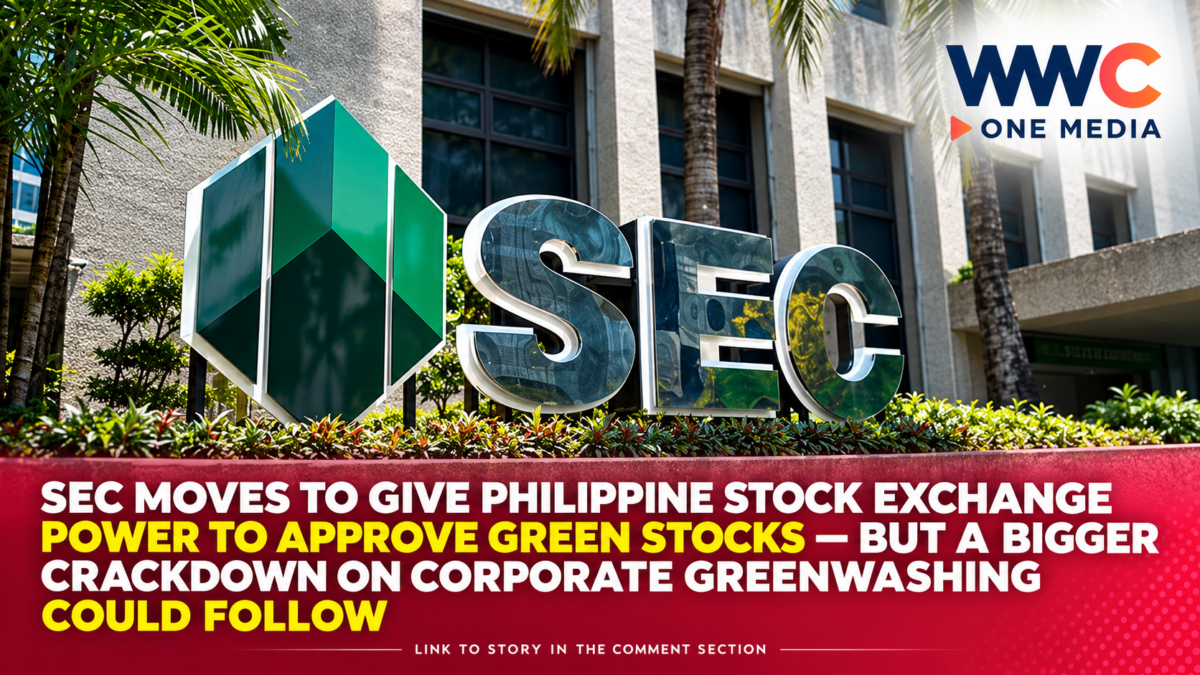
MANILA, Philippines — October 13, 2026 — The Securities and Exchange Commission (SEC) is proposing a major change in how environmentally sustainable companies are recognized in the Philippine stock market, seeking to give the Philippine Stock Exchange (PSE) greater authority to decide which listed firms deserve the country’s official Green Equity Label.
Under proposed amendments released for public consultation on October 8, the PSE would take responsibility for reviewing applications, approving qualified companies and overseeing independent assessors that verify environmental credentials.
The proposal could reshape how investors identify companies with credible sustainable business activities while strengthening safeguards against corporate greenwashing — the practice of presenting businesses as more environmentally responsible than their actual operations justify.
The move comes as regulators seek to expand sustainable investment opportunities, improve transparency and build confidence in the Philippine capital market.
But the bigger question is whether stricter green investment standards will reveal which companies are genuinely sustainable — and which are merely using environmental promises to attract investors.
SEC Wants PSE to Decide Which Companies Qualify as Green Investments
The proposed regulatory changes would shift key Green Equity Label approval functions from the SEC to the Philippine Stock Exchange.
Currently, the framework established by SEC Memorandum Circular No. 13, Series of 2025, provides standards for identifying listed companies whose business activities meet environmental sustainability requirements.
Under the proposed amendments, the PSE would assume responsibility for assessing applications and granting the official designation.
The exchange would also establish an accreditation system for independent external reviewers tasked with evaluating whether applicants meet the necessary sustainability standards.
Such reviewers are essential because companies seeking the label must demonstrate that their environmental claims are supported by verifiable business activities, financial information and sustainability disclosures.
The proposed shift is intended to streamline the approval process, reduce overlapping regulatory responsibilities and strengthen the exchange’s role in sustainable finance.
However, the changes remain subject to public consultation and regulatory approval.
The PSE has not yet been granted these expanded powers under the October proposal.
What Is the Philippine Green Equity Label?
The Philippine Green Equity Label is a regulatory designation intended to help investors identify publicly listed companies with substantial environmentally sustainable operations and investments.
Unlike broad environmental, social and governance (ESG) marketing claims, the Green Equity Label is tied to measurable eligibility requirements.
The framework seeks to direct attention toward businesses whose operations and investments support environmental objectives.
These may include qualifying activities in renewable energy, energy efficiency, climate change mitigation and other sectors recognized under applicable sustainable finance taxonomies.
The designation is intended to provide investors with a clearer basis for distinguishing companies with verifiable green activities from firms relying primarily on environmental branding.
However, receiving the label does not guarantee that a company’s shares will increase in value or that it is free of all environmental risks.
The Green Stock Test: Companies Must Meet Financial and Environmental Standards
Under the Philippine Green Equity Guidelines adopted in September 2025, companies seeking the designation must meet several qualifying conditions.
These include:
- Green revenue requirement: More than 50% of company revenue must come from qualifying environmentally sustainable activities.
- Green investment requirement: More than 50% of qualifying investments, measured under the applicable framework, must support green activities.
- Fossil fuel limitation: Revenue derived from fossil fuel activities must remain below 5%.
- Sustainable finance alignment: Business activities must satisfy the relevant Philippine Sustainable Finance Taxonomy Guidelines or ASEAN Taxonomy for Sustainable Finance requirements.
- Independent assessment: An external reviewer must evaluate whether the company’s activities and disclosures satisfy the required standards.
- Continuing compliance: Companies must maintain relevant disclosures and meet continuing requirements to retain their designation.
These standards create a more specific framework for assessing environmental sustainability in the stock market.
A company making substantial environmental claims would therefore need to provide evidence of qualifying activities rather than relying solely on promotional statements.
PSE Could Gain Greater Control Over Independent Green Reviewers
One of the most important parts of the SEC proposal concerns the accreditation and oversight of independent reviewers.
These professionals and organizations assess whether companies applying for the Green Equity Label meet the prescribed eligibility criteria.
Under the proposed changes, the PSE would establish a formal accreditation mechanism and oversee reviewers involved in the certification process.
This could help standardize sustainability assessments and improve accountability.
However, independent oversight will remain essential.
If reviewers apply inconsistent methods or fail to identify weaknesses in corporate disclosures, investors could receive misleading impressions about a company’s environmental performance.
For the framework to gain credibility, reviewers must demonstrate competence, independence and transparent evaluation procedures.
SEC Proposes Extending Compliance Deadline to December 2026
The SEC is also proposing additional time for companies to align their operations and disclosures with recognized sustainable finance standards.
According to the October 13 InsiderPH report, the regulator wants to extend the transitional compliance period until December 31, 2026, replacing the previous September 23 deadline.
Under the proposal, qualifying companies would be exempt from administrative penalties during the transition period while working toward full alignment.
However, they would still need to explain how their activities contribute to recognized environmental objectives.
Full compliance with the applicable taxonomy requirements would become mandatory beginning fiscal year 2027 for companies seeking to obtain or maintain the designation.
The proposed extension would give businesses additional time to complete sustainability assessments, update disclosures and establish compliance procedures.
It is not a permanent exemption from the Green Equity Label’s environmental standards.
Greenwashing Becomes a Bigger Concern for Philippine Investors
The SEC’s proposal comes amid growing scrutiny of corporate environmental claims.
Greenwashing can occur when a business exaggerates its environmental achievements, selectively highlights favorable information or presents ordinary commercial activities as sustainable without adequate evidence.
In financial markets, such practices can mislead investors who want to allocate capital toward environmentally responsible companies.
A credible green equity designation can help reduce this risk by establishing clear assessment criteria and requiring independent verification.
However, an official label cannot eliminate greenwashing risk on its own.
The effectiveness of the system will depend on rigorous review, accurate disclosures and continuing monitoring of certified companies.
Companies that materially change their operations after obtaining a label must also remain subject to appropriate compliance checks.
For investors, the central question is not simply whether a company describes itself as environmentally friendly, but whether its financial and operational data support that description.
PSE Has Already Taken Steps Toward Sustainable Finance
The proposed changes build on earlier sustainability initiatives undertaken by the Philippine Stock Exchange.
In June 2026, the PSE announced that it had joined CDP as a capital markets signatory, strengthening its commitment to environmental disclosure and transparency.
CDP operates a global environmental disclosure system that helps investors and other stakeholders assess corporate environmental information.
The PSE has also identified climate-related investment products and sustainability disclosures as important areas of market development.
Its 2025 sustainability progress report discussed the Philippine Green Equity Label as a mechanism for improving the visibility of environmentally responsible listed companies.
Giving the exchange a larger role in reviewing and granting labels would represent another step in that strategy.
Alternergy Shows How Green Equity Certification Can Work
The Philippine Green Equity Label is not merely a concept awaiting its first applicant.
Renewable energy developer Alternergy Holdings Corporation previously disclosed that it had received SEC confirmation of its qualification to carry the designation.
In its stock exchange disclosure, Alternergy said all of its revenue came from renewable energy sources and that more than 90% of relevant operating expenses and capital expenditures were directed toward green activities.
The company also highlighted its alignment with applicable sustainable finance requirements.
The certification demonstrated how the framework can recognize companies whose business operations are predominantly focused on qualifying green activities.
However, certification should not be interpreted as a recommendation to buy a company’s shares.
Investors must still evaluate profitability, debt, financial performance, market valuation and other investment risks.
Could Green Equity Labels Attract More Foreign Investment?
The broader ambition of the Green Equity Label framework is to improve the visibility and credibility of sustainable investment opportunities in the Philippines.
International investment funds increasingly evaluate environmental risks and sustainability disclosures when assessing potential investments.
Clearer classifications could help investors identify Philippine companies that meet particular environmental investment mandates.
They could also support companies seeking to communicate their sustainability performance to domestic and international financial markets.
However, the introduction of stronger standards does not automatically guarantee increased foreign investment.
Capital inflows will still depend on market conditions, company fundamentals, investor preferences, financing costs and broader economic risks.
The label’s potential value lies in creating a clearer and more credible information framework for investment decisions.
Philippine Green Equity Rules Move Closer to International Market Practices
The SEC’s proposed reforms also reflect international efforts to strengthen the credibility of sustainable investment classifications.
Major stock exchanges and financial regulators have developed various systems for environmental disclosure, sustainable investment products and independent assessment.
The SEC’s proposal draws on international exchange practices, including those associated with Nasdaq and the London Stock Exchange.
The objective is to make the Philippine system more consistent, transparent and operationally efficient while adapting it to local regulatory requirements.
A more credible framework could help the Philippines participate more effectively in the expanding global sustainable finance market.
But international alignment must also be accompanied by effective domestic enforcement.
SEC Opens Public Consultation Until October 19
The SEC is accepting public comments on the proposed amendments until October 19, 2026.
The consultation gives listed companies, investors, independent reviewers and other stakeholders an opportunity to examine the changes before the regulator finalizes the framework.
Issues likely to attract attention include the accreditation of external reviewers, application procedures, the PSE’s oversight responsibilities and the proposed transition period.
The final rules may differ from the consultation draft.
Until the revised regulations are approved, the existing SEC Green Equity Guidelines remain the relevant regulatory foundation.
The Bigger Test: Who Really Deserves to Be Called a Green Company?
The SEC’s proposal signals a potentially significant change in the way Philippine capital markets recognize environmentally sustainable businesses.
By transferring key approval responsibilities to the PSE, regulators hope to create a more streamlined certification process while strengthening the credibility of the Green Equity Label.
For companies, the proposed framework reinforces the importance of measurable environmental performance and reliable disclosures.
For investors, it could provide an additional tool for identifying businesses with qualifying sustainable activities.
However, the ultimate test will be the credibility of the designation.
A green label that is awarded without rigorous scrutiny could weaken investor confidence. A designation backed by strong standards, independent verification and ongoing compliance could become a more meaningful benchmark for sustainable investing.
As the SEC prepares to give the Philippine Stock Exchange a bigger role in determining who deserves the green label, one question could reshape the market: Will stricter standards reward genuinely sustainable companies — or expose the gap between corporate environmental promises and reality?