MANILA, Philippines — Security Bank Corporation is stepping up its fight against money laundering and financial crime, deploying artificial intelligence (AI) technology that has expanded its sanctions-screening coverage tenfold as Philippine banks prepare for another major international regulatory assessment.
The bank has partnered with Singapore-based financial technology company Tookitaki to strengthen its anti-money laundering (AML) and financial crime compliance systems, allowing it to identify suspicious identities, hidden connections and potential sanctions matches that traditional screening methods might overlook.
The technology upgrade comes as the Philippines works to protect its hard-earned removal from the Financial Action Task Force (FATF) grey list in February 2025, with another international evaluation scheduled for 2027.
But while Security Bank’s AI system promises stronger financial protection, the bigger question is whether Philippine banks can keep pace with increasingly sophisticated financial crime.
Security Bank Expands Financial Crime Screening Coverage 10-Fold
Security Bank’s latest compliance transformation centers on Tookitaki’s FinCense Screening platform, an AI-powered solution designed to improve how financial institutions identify individuals and organizations potentially connected to money laundering, sanctions violations and other financial crime risks.
According to reports from InsiderPH, Context.ph and Gadgets Magazine, the implementation has delivered several improvements.
These include:
- A tenfold expansion in sanctions-screening coverage.
- Screening extended to 100% of related contacts within the relevant screening scope.
- Improved detection of names with different spellings, formats and arrangements.
- Increased identification of genuine sanctions matches.
- More transparent and auditable compliance decisions.
- The ability to rescreen existing relationships when sanctions and watchlists change.
The technology allows Security Bank to examine potential risk connections more thoroughly while supporting financial crime investigators with better-quality screening results.
However, the bank has not publicly disclosed the actual number of confirmed matches identified each month or the number of financial crimes prevented by the system.
The reported tenfold improvement refers to screening coverage, not a tenfold increase in detected money laundering cases.
How Artificial Intelligence Detects Suspicious Names That Older Banking Systems May Miss
One of the biggest challenges in financial crime prevention is identifying people whose names appear differently across bank records, identification documents and international watchlists.
Traditional systems that depend heavily on exact spelling can struggle when names contain minor variations.
For example, a name may appear with a different sequence of first names, middle names or surnames. Variations may also result from transliteration, abbreviations or different naming conventions.
Such differences can create difficulties for banks trying to identify potential sanctions matches.
Tookitaki’s FinCense Screening platform uses AI-assisted matching techniques to analyze these variations rather than relying exclusively on identical spelling.
The technology helps identify potentially relevant matches that can be reviewed by compliance investigators.
This is particularly significant in the Philippines, where naming conventions often include multiple given names, maternal surnames and other variations.
The upgraded screening process also extends beyond account holders themselves to related contacts, allowing the bank to assess a broader range of potential financial crime risks.
Nevertheless, a screening alert is not proof of criminal activity. Potential matches require further verification and appropriate investigation.
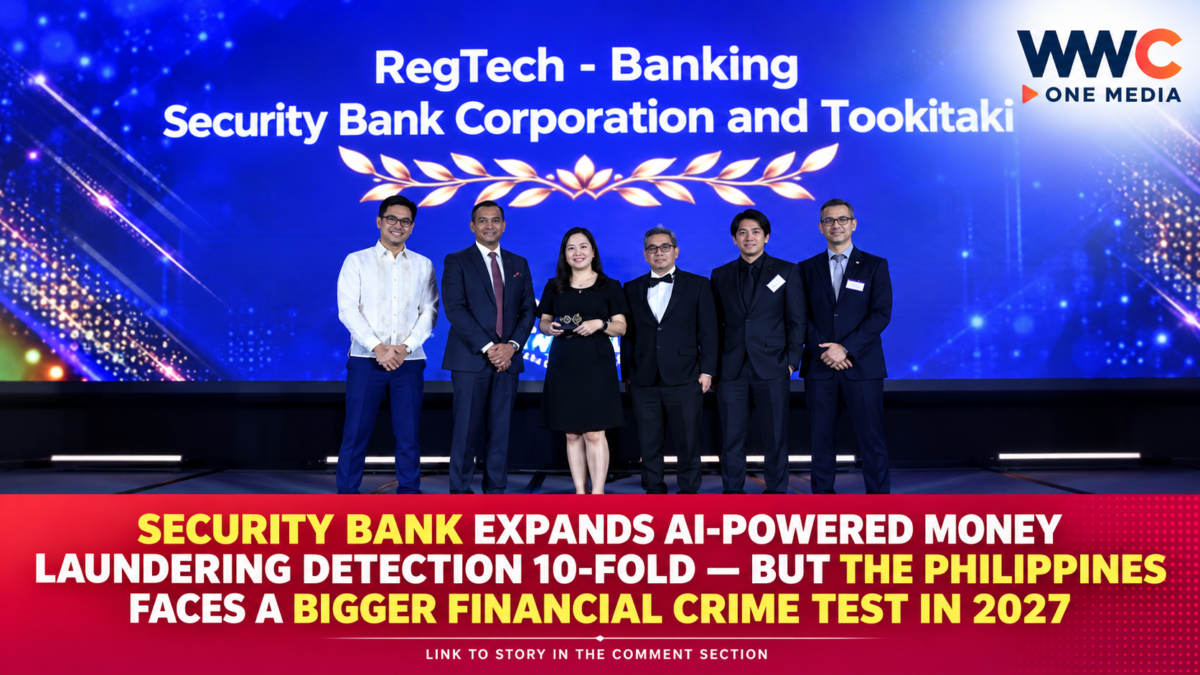
Security Bank and Tookitaki Win Major Technology Recognition
Security Bank’s financial crime compliance upgrade has also received recognition at the Asian Technology Excellence Awards 2026.
The project was honored during the September 17 awards ceremony for its use of regulatory technology to improve financial crime prevention.
The bank’s official awards listing identifies its recognition as the Philippines Excellence Award for RegTech – Banking.
The recognition highlights growing interest in technology that helps banks strengthen compliance, improve operational efficiency and manage increasingly complex regulatory obligations.
Security Bank Head of Financial Crime Compliance Daniel Ang said the collaboration delivered a scalable platform that improves screening coverage and the identification of genuine matches while supporting transparent and auditable decision-making.
The project demonstrates how artificial intelligence is moving beyond customer service applications and becoming an increasingly important tool in banking risk management.
Philippines Faces Another Major Anti-Money Laundering Evaluation in 2027
Security Bank’s investment comes at a critical period for the Philippine financial system.
On February 21, 2025, the FATF officially removed the Philippines from its grey list of jurisdictions subject to increased monitoring.
The decision followed years of government and private-sector efforts to address deficiencies in the country’s anti-money laundering and counter-terrorist financing framework.
The Philippines had been under increased monitoring since June 2021.
Its removal was considered an important milestone for the country’s international financial credibility.
However, exiting the grey list did not mean that the country’s financial crime vulnerabilities had disappeared.
The Philippines is scheduled to undergo another mutual evaluation under the Asia/Pacific Group on Money Laundering in 2027.
That assessment will examine the country’s compliance with international standards and the effectiveness of measures intended to prevent and combat financial crime.
For local financial institutions, the approaching evaluation adds pressure to demonstrate that compliance systems are not merely documented but are operating effectively.
Security Bank’s deployment of more advanced screening technology is one example of how lenders are preparing for that environment.
Why Staying Off the FATF Grey List Matters to Filipino Consumers and Businesses
The Philippines’ removal from the FATF grey list was an important development for banks, companies, overseas Filipino workers and international investors.
Countries under increased monitoring can face heightened scrutiny from international financial institutions because of concerns about financial crime controls.
Such scrutiny may complicate certain banking relationships and increase compliance costs.
After the Philippines exited the list, the Department of Finance said stronger financial governance could support investor confidence, international trade and cross-border financial transactions.
Bangko Sentral ng Pilipinas Governor Eli Remolona Jr. also emphasized the need for the country to sustain improvements and avoid returning to increased monitoring.
For Filipinos, maintaining confidence in the financial system is particularly important because of the country’s extensive remittance activity and international commercial relationships.
Strong anti-money laundering safeguards can help legitimate money flows move through a trusted banking system while making it harder for criminals to misuse financial services.
AI Is Becoming a New Weapon in the Global Fight Against Financial Crime
Security Bank’s initiative reflects a broader international shift toward AI-assisted banking compliance.
Financial institutions around the world are exploring artificial intelligence to improve sanctions screening, identify suspicious transaction patterns and support regulatory reporting.
In South Korea, Shinhan Bank reportedly pursued an AI transformation project in July 2026 to assist with suspicious transaction reporting and improve anti-money laundering workflows.
In the United States, Reuters reported in June 2026 that banking regulators were increasing scrutiny of financial institutions’ AI applications, including their risk-management practices and reliance on outside technology providers.
These developments show how artificial intelligence is reshaping both financial crime detection and the expectations placed on banks using advanced technology.
AI systems can process complex datasets and identify relationships that might otherwise require substantial manual investigation.
However, their effectiveness depends on accurate data, appropriate controls, regular testing and human oversight.
Could AI-Powered Banking Security Create New Risks?
Although AI-assisted screening offers substantial potential benefits, it also creates challenges that financial institutions must manage.
One concern involves false positives, where legitimate customers are incorrectly flagged as possible sanctions matches.
Such errors can generate unnecessary investigations and may delay legitimate financial activity if not properly handled.
Another challenge is the transparency of automated screening decisions.
Banks must be able to explain why a potential match was flagged and demonstrate that their compliance processes follow applicable laws and regulatory requirements.
Customer privacy, data security and vendor oversight are also important considerations.
Financial institutions therefore need to balance stronger detection capabilities with safeguards that protect legitimate customers.
Security Bank’s reported emphasis on auditable decisions is particularly relevant because compliance teams must be able to review and justify their findings.
Ultimately, artificial intelligence should support investigators and compliance professionals rather than replace human judgment in consequential financial crime decisions.
Bigger Challenge: Can Philippine Banks Stay Ahead of Financial Criminals?
Security Bank’s tenfold expansion in screening coverage represents a significant technological development in its financial crime compliance infrastructure.
The partnership with Tookitaki strengthens the bank’s ability to examine customer identities and related contacts against relevant sanctions and watchlists.
It also demonstrates how Philippine financial institutions are investing in technology ahead of more demanding international regulatory assessments.
But technology alone cannot eliminate financial crime.
Effective prevention still depends on strong governance, reliable customer information, timely investigations, cooperation with authorities and the ability to adapt to emerging threats.
As the Philippines approaches its 2027 mutual evaluation, regulators and financial institutions will face increasing pressure to prove that the country’s anti-money laundering improvements are sustainable.
The broader challenge is not simply identifying more potential matches. It is ensuring that suspicious activity is properly investigated while legitimate financial transactions remain protected.
Security Bank may have expanded its AI-powered screening coverage tenfold, but the real test is still ahead: Can Philippine banks use advanced technology to stay ahead of financial criminals and protect the country’s international financial credibility?