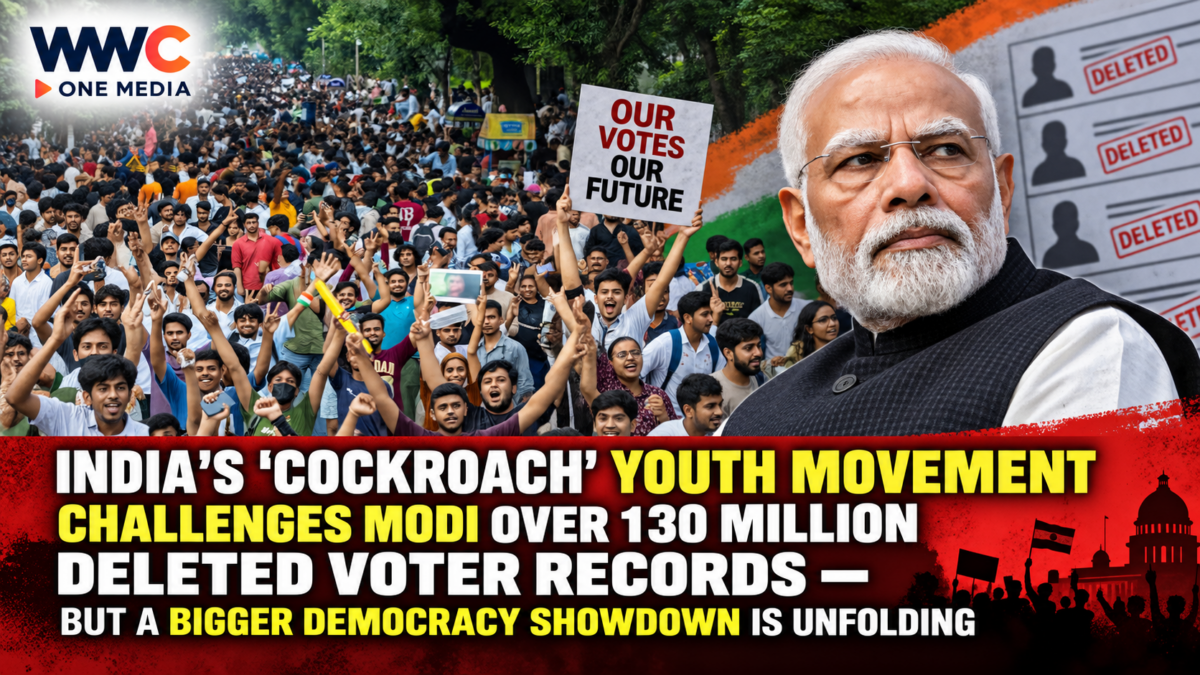
NEW DELHI, India — October 13, 2026 — A growing wave of youth-led demonstrations is confronting Indian Prime Minister Narendra Modi’s government after a controversial voter registration overhaul removed more than 130 million names from electoral rolls, triggering allegations of electoral manipulation, mass detentions and a mounting battle over democratic rights in the world’s most populous country.
The protests, led in part by the rapidly expanding Cockroach Janta Party (CJP) movement, have spread across major Indian cities, drawing students, opposition leaders and civil society groups demanding the resignation of Chief Election Commissioner Gyanesh Kumar.
Thousands have marched through New Delhi, while police have detained protesters and restricted access to traditional demonstration sites.
On October 13, several leaders of the movement were again detained after entering the grounds of Jantar Mantar, a historic observatory and longtime protest location.
The unrest comes as Modi continues to defend India’s democratic institutions, describing the country as the “mother of democracy” during a Bloomberg New Economy event.
But as the government insists the voter-list overhaul is legitimate, a more consequential question is emerging: Could a youth movement that began online turn into one of the biggest political challenges to Modi’s 12 years in power?
Why India’s 130 Million Deleted Voter Records Sparked Nationwide Protests
At the center of the controversy is the Election Commission of India’s Special Intensive Revision (SIR), an exercise intended to update electoral rolls and remove records that no longer meet voter-registration requirements.
The revisions, which began in 2025, have resulted in more than 130 million names being removed from voter lists, according to figures reported by Reuters and Indian media.
The reported deletions include approximately:
- 28 million records involving deceased people.
- 63 million involving people recorded as having relocated.
- 30 million involving individuals officials said could not be traced.
The broader figures also include other categories of records, such as duplicates, depending on the government’s accounting.
The scale of the exercise is extraordinary: the number of removed entries exceeds the population of Japan.
However, removing 130 million names from electoral rolls does not establish that 130 million legitimate voters were deliberately disenfranchised.
Some records may involve people who died, moved or were entered more than once.
The controversy centers on whether eligible voters were improperly removed, whether safeguards were sufficient and whether the process disproportionately affected particular communities.
Opposition groups allege that the revisions favor Modi’s ruling Bharatiya Janata Party (BJP).
The Election Commission and BJP reject those accusations.
Who Are the ‘Cockroach’ Protesters Challenging Modi?
The Cockroach Janta Party is a youth-led protest movement that emerged through online activism before developing into a force capable of organizing large demonstrations.
Although its name resembles that of a political party, it functions primarily as a protest movement rather than an established national electoral party.
Founded by activist Abhijeet Dipke, the group has mobilized young Indians around concerns involving education, employment, government accountability and electoral integrity.
Its unusual name has helped attract attention on social media while symbolizing the movement’s determination to remain politically active despite pressure from authorities.
Earlier in 2026, the organization participated in protests over examination paper leaks and education-related grievances.
Those demonstrations helped establish its ability to mobilize students and other younger citizens.
The latest voter-list controversy has given the movement a much larger national platform.
With opposition parties joining demonstrations, the campaign now extends beyond student grievances into questions about the fairness and credibility of Indian elections.
Police Detain Protest Leaders as Delhi Demonstrations Intensify
Tensions escalated during the first half of October as protesters attempted to hold major demonstrations in central New Delhi.
On October 10, authorities deployed substantial security forces, installed barricades and detained protesters amid efforts to prevent unauthorized gatherings.
The crackdown affected student activists, political demonstrators and other participants.
Authorities also restricted access to parts of the capital, while protesters responded by organizing smaller gatherings in different locations.
Delhi Police subsequently announced that Jantar Mantar would no longer be designated as an official demonstration site and identified three alternative protest venues.
The decision became another flashpoint because Jantar Mantar has historically served as a prominent location for public demonstrations.
On October 13, CJP members entered the restricted observatory grounds after crossing barricades.
According to Reuters, movement leaders Ashutosh Ranka, Saurav Das and Ajinkya Shinde were among approximately 20 volunteers detained.
The activists said they wanted to reclaim the location as a symbol of public protest.
The police action intensified the dispute over the balance between maintaining public order and protecting the right to peaceful assembly.
Modi Defends India as ‘Mother of Democracy’
Despite the escalating unrest, Prime Minister Narendra Modi has defended India’s democratic system.
Speaking at a Bloomberg New Economy event on October 13, Modi referred to India as the “mother of democracy” and emphasized its tradition of open public debate.
His remarks came as opposition leaders and youth activists accused authorities of suppressing demonstrations concerning electoral integrity.
The contrast has become a central theme in the political confrontation.
Supporters of the government argue that India remains a functioning democracy with established electoral institutions, judicial oversight and constitutional processes.
Critics counter that repeated detentions, restrictions on protests and disputed voter-registration procedures raise questions about whether democratic rights are being adequately protected.
The controversy is therefore not simply about a technical revision of voter lists.
It has become a broader debate about institutional independence, public accountability and citizens’ ability to challenge government decisions.
Opposition Leader Rahul Gandhi Joins Major Protest March
The political pressure increased on October 12 when opposition leaders joined thousands of demonstrators marching toward India’s Supreme Court.
The procession traveled approximately seven kilometers through central New Delhi.
Rahul Gandhi, the leader of the opposition in the Lok Sabha, joined other political figures calling for greater scrutiny of the voter-list changes.
The demonstrators submitted a petition seeking judicial intervention.
Their demands included an independent audit of deleted voter records, protections against removals without proper notice and hearings, and an interim suspension of the contested revisions.
The petition also seeks accountability from election authorities.
According to Reuters, Monday’s march proceeded peacefully despite heavy security restrictions.
Police closed six metro stations for approximately 11 hours and imposed traffic restrictions along several routes.
The demonstration highlighted the increasing cooperation between established opposition parties and the emerging youth movement.
Election Commission Rejects Allegations of Political Bias
India’s Election Commission maintains that the voter-list revisions are intended to improve electoral accuracy rather than favor any political party.
The commission says outdated registrations must be removed to prevent errors involving deceased voters, relocated individuals and duplicate entries.
It has also stated that eligible voters whose names were incorrectly removed can seek re-enrollment.
On September 26, authorities launched a special enrollment drive targeting voters who had been left out of the revised lists.
The BJP has defended the commission and accused opposition parties of attempting to undermine confidence in India’s democratic institutions.
Government representatives argue that maintaining accurate electoral rolls is necessary for credible elections.
Opposition groups, however, say the burden of correcting wrongful removals can be especially difficult for citizens who face documentation barriers or limited access to registration offices.
The central unresolved issue is whether the safeguards are strong enough to prevent eligible voters from losing their voting rights.
Minorities Raise Concerns Over Possible Disenfranchisement
One of the most sensitive allegations involves the potential impact of voter-list revisions on religious minorities.
Opposition parties and civil society groups allege that Muslim voters and other communities less likely to support the BJP may have been disproportionately affected.
They argue that differences in documentation, residential mobility and administrative procedures could create barriers to restoring valid registrations.
The Election Commission and BJP deny that the revisions target any religious or political group.
The available reporting does not independently establish the number of eligible voters wrongfully removed or prove a coordinated political effort to exclude minorities.
Nevertheless, the allegations have intensified demands for independent examination of the registration process.
For election administrators, the challenge is ensuring that records are accurate without preventing legitimate voters from participating.
Supreme Court Faces Pressure to Examine Electoral Roll Changes
India’s Supreme Court has become an increasingly important venue in the dispute.
The controversy has prompted legal challenges and demands for explanations from the government and election authorities.
Opposition leaders are seeking stronger procedural safeguards and an audit of deletions.
The court’s review could influence how election authorities conduct future voter-list revisions and how individuals challenge their removal from electoral rolls.
The legal dispute also raises wider questions about administrative fairness, the independence of election institutions and constitutional voting protections.
However, the filing of petitions does not mean the Supreme Court has ruled that the revisions were fraudulent.
Any determination of illegality or constitutional violations would require judicial findings based on the evidence presented.
United Nations Raises Concerns Over Protest Crackdown
The protests have also attracted international attention.
According to CNBC, the United Nations Human Rights Office raised concerns on October 10 about mass detentions and urged Indian authorities to respect the right to peaceful assembly.
The intervention increased international scrutiny of India’s response to the demonstrations.
India’s Ministry of External Affairs rejected the UN comments on October 11, describing them as unwarranted interference in the country’s internal affairs.
The exchange highlighted a broader disagreement over the role of international human rights institutions in examining domestic protest restrictions.
Human rights advocates argue that governments must protect peaceful assembly even when demonstrations criticize elected officials.
Indian authorities maintain that public demonstrations must comply with applicable laws and security requirements.
The controversy underscores the importance of distinguishing legitimate public-order measures from restrictions that may disproportionately interfere with peaceful political expression.
Experts Warn Police Crackdown Could Fuel Bigger Protests
Political analysts interviewed by CNBC warned that aggressive police tactics could make the protests more difficult to contain.
Michael Kugelman, a South Asia expert at the Atlantic Council, said the demonstrations did not currently pose a serious threat to India’s overall political stability.
However, he warned that heavy-handed security responses could encourage larger gatherings and greater volatility.
Arpit Chaturvedi, a South Asia adviser at Teneo, similarly described the scale of the crackdown as unusually substantial compared with certain earlier protest movements.
He suggested that strong police responses could increase the likelihood of further demonstrations.
The warnings reflect a common challenge for governments confronting sustained protest movements.
Restrictive measures may disrupt individual demonstrations while also generating additional public anger.
Whether the current movement expands or loses momentum will depend on political developments, legal proceedings, government decisions and the organizers’ ability to sustain participation.
Could India’s Political Unrest Affect Investors and Financial Markets?
Although the protests have generated major political attention, analysts are not yet describing them as an immediate threat to India’s financial stability.
According to CNBC, Kugelman said the movement had not reached a scale sufficient to significantly disrupt capital flows or investor behavior.
However, the situation could become more consequential if confrontations intensify or lead to prolonged instability.
Investors generally monitor political risk because uncertainty can influence corporate confidence, economic policy and capital allocation.
India remains one of Asia’s major economies and an important destination for international investment.
For businesses, the immediate impact of demonstrations may include traffic restrictions, temporary transport disruptions and security concerns in affected areas.
Broader financial consequences would depend on whether the unrest expands into sustained political or economic disruption.
There is no verified basis for claiming that the current protests have already caused a nationwide financial crisis or large-scale capital flight.
Delhi Protest Restrictions Raise Economic Concerns
The demonstrations have also affected normal activity in parts of the Indian capital.
The closure of metro stations, traffic restrictions and police barricades have complicated travel through central Delhi.
The Indian Express reported that traders and legal representatives approached the Delhi High Court seeking clearer rules governing demonstrations and associated restrictions.
The petitioners claimed that disruption related to the protest controls had caused substantial business losses, estimated by them at approximately ₹2,000 crore.
The amount is a claim made by the petitioners, not an independently verified nationwide economic loss.
The legal challenge seeks a clearer framework that balances protest rights, public safety and access to commercial districts.
The development illustrates how prolonged political confrontations can create practical economic problems even without directly threatening the stability of financial markets.
Can India’s Youth Movement Become a Lasting Political Force?
The Cockroach movement’s growing influence reflects broader dissatisfaction among segments of India’s younger population.
Its earlier campaigns focused on issues such as examinations, education infrastructure and employment.
The voter-list dispute has allowed it to connect those concerns with the broader question of democratic accountability.
Young activists are increasingly using social media to organize demonstrations, coordinate messages and draw attention to political grievances.
However, the movement faces several challenges.
Maintaining participation over time requires organization, resources and coordination.
It must also decide whether to remain primarily an activist campaign or develop a more formal political structure.
Its cooperation with opposition parties may expand its reach but could also create disagreements over political strategy.
For Modi’s government, the movement represents a test of how it responds to a new generation of political activists.
For the opposition, it creates an opportunity to mobilize public concern beyond traditional party networks.
The Bigger Question: Can India Resolve Its Electoral Crisis?
The controversy over India’s voter lists has grown from a technical election-administration dispute into a major national political confrontation.
More than 130 million voter records have been removed during the revision process, but serious disagreements remain over whether the exercise was conducted fairly and whether eligible citizens were adequately protected.
The Election Commission insists that the revisions are legitimate and that people removed incorrectly can seek reinstatement.
Opposition groups are demanding stronger safeguards, judicial scrutiny and accountability.
Meanwhile, the youth-led Cockroach movement continues to challenge protest restrictions and demand the resignation of the country’s election chief.
The coming weeks could be important for determining whether the confrontation eases through judicial review and administrative reforms or develops into broader political unrest.
The central issue is larger than one protest organization or one election official.
It concerns public confidence in the fairness of India’s democratic institutions.
Prime Minister Narendra Modi has defended India as the “mother of democracy,” but as young protesters confront police over 130 million deleted voter records, the bigger test is whether the world’s most populous country can restore trust in its elections without further deepening its political divisions.