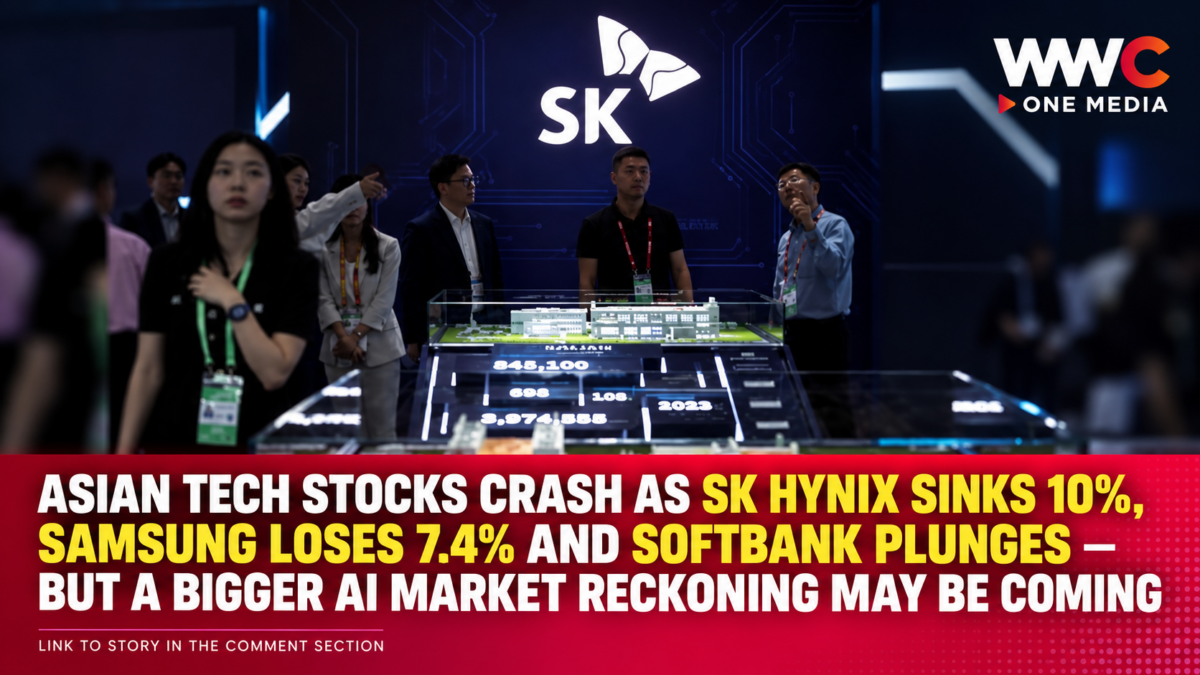
SINGAPORE — October 13, 2026 — Asia’s biggest artificial intelligence and semiconductor stocks suffered a dramatic selloff on Tuesday as fears over China’s growing chipmaking capabilities, expensive AI infrastructure investments and rising financing costs sent investors rushing out of technology shares.
South Korean chip giants SK Hynix and Samsung Electronics led the losses, falling approximately 10.1% and 7.4%, respectively, while Japan’s SoftBank Group tumbled 8.5%, according to Associated Press market reporting.
The selling pressure spread across major Asian technology companies, pulling South Korea’s benchmark Kospi index down 5.5% to 6,035.35 after it briefly plunged more than 7% during the session.
Japan’s Nikkei 225 fell 1.8%, while Taiwan’s Taiex declined 2%, extending concerns that the once-booming artificial intelligence investment trade may be entering a more volatile period.
The downturn followed losses on Wall Street, where semiconductor companies retreated amid warnings that AI investment could face increasingly difficult financial conditions.
But beyond the billions of dollars in market value lost during the selloff, a bigger question is emerging: Is the global AI boom simply undergoing a healthy market correction, or are investors beginning to question whether trillions in technology spending can generate enough profits?
SK Hynix and Samsung Lead Asia’s Semiconductor Selloff
South Korea emerged as the center of the regional technology market downturn.
SK Hynix, one of the world’s leading producers of high-bandwidth memory chips used in AI computing systems, dropped approximately 10.1%.
Samsung Electronics, another global semiconductor powerhouse, declined 7.4%.
Both companies are central to the supply chain supporting artificial intelligence infrastructure, including data centers, advanced processors and high-performance memory.
Their shares came under pressure as investors reassessed how long elevated demand for AI-related memory products could sustain high valuations and profit expectations.
The selloff also raised concerns that competition from Chinese semiconductor manufacturers could eventually weaken the pricing power of established memory chip producers.
South Korea’s Kospi index fell to 6,035.35 after dropping below 6,000 during intraday trading.
The heavy declines demonstrated how exposed the South Korean equity market has become to investor expectations surrounding artificial intelligence.
Asian Technology Stock Market Losses — October 13, 2026
According to Associated Press reporting, the following major shares and indexes declined during Tuesday’s trading session:
| Company or Index | Reported Decline |
|---|---|
| SK Hynix | 10.1% |
| Samsung Electronics | 7.4% |
| SoftBank Group | 8.5% |
| Tokyo Electron | 7.2% |
| Taiwan Semiconductor Manufacturing Co. | Approximately 2% |
| South Korea Kospi | 5.5% |
| Japan Nikkei 225 | 1.8% |
| Taiwan Taiex | 2.0% |
The figures reflect the October 13 market reporting and may differ from percentages quoted earlier in the session.
CNBC’s initial report recorded losses of more than 8% for SK Hynix, approximately 6.7% for Samsung and 8.8% for SoftBank.
Those figures were recorded at an earlier stage of trading, while subsequent market reports reflected updated prices.
The difference highlights the unusually sharp intraday volatility affecting technology stocks.
China’s CXMT Emerges as a Major Threat to Global Memory Chip Leaders
A central factor behind the selloff was growing concern about technological progress by Chinese memory chip manufacturer ChangXin Memory Technologies, commonly known as CXMT.
According to Reuters, the company announced progress in developing a new memory chip architecture designed to increase the amount of data that can be stored on memory devices.
The announcement triggered concerns that Chinese manufacturers could become more competitive in segments traditionally dominated by South Korean and American companies.
Samsung Electronics, SK Hynix and Micron Technology are among the world’s most important producers of dynamic random-access memory, or DRAM.
DRAM is used in personal computers, smartphones, servers and other electronic systems.
Advanced forms of memory, especially high-bandwidth memory, are also critical components of artificial intelligence accelerators.
The market’s concern is that improved Chinese chipmaking capabilities could increase competition, place pressure on prices and eventually affect the profitability of established manufacturers.
However, technological progress does not automatically mean CXMT can immediately replace Samsung or SK Hynix in advanced AI memory applications.
High-bandwidth memory requires complex manufacturing processes, reliable production yields, rigorous customer qualification and integration with advanced computing systems.
The immediate competitive threat to established HBM suppliers remains uncertain.
SoftBank Plunges as Investors Question the Cost of the AI Boom
Japan’s SoftBank Group was another major casualty of the technology selloff.
The investment conglomerate, which has substantial exposure to artificial intelligence companies and infrastructure, fell approximately 8.5%.
SoftBank has positioned itself as one of the leading financial backers of the AI industry, including through its investment relationship with OpenAI.
The company’s ambitions have also required access to substantial financing.
Reuters reported that SoftBank completed a $4.5-billion high-yield debt transaction in September 2026, offering a yield as high as 9.75% on debt with a seven-and-a-half-year maturity.
The borrowing terms illustrate how expensive financing can become for major investors seeking capital to support large technology investments.
When borrowing costs rise, companies must generate stronger future returns to justify capital-intensive projects.
This challenge is especially significant for artificial intelligence infrastructure, where data centers, semiconductor equipment and computing systems require enormous upfront investments.
SoftBank’s sharp share-price decline suggests investors are becoming more sensitive to the financial risks associated with the AI buildout.
However, the stock’s decline does not establish that SoftBank’s underlying AI investments have failed.
Broadcom CEO’s AI Warning Intensifies Investor Concerns
The selloff also followed comments from Broadcom CEO Hock Tan that raised questions about the sustainability of artificial intelligence investment.
During a technology and investment event in Singapore, Tan suggested that parts of the AI investment landscape resemble speculative gambling.
His remarks highlighted concerns that some investors are funding expensive AI projects without fully understanding their future financial returns.
Broadcom is a major supplier of semiconductor and connectivity technology used in data centers and AI systems.
Its leadership therefore has direct exposure to the opportunities and challenges associated with infrastructure spending.
Tan also identified capital availability as a potential constraint on future AI expansion.
The warning reinforced concerns that the biggest challenge for AI companies may no longer be simply acquiring chips or electricity.
It may increasingly involve securing affordable financing for massive infrastructure investments.
For investors, that raises questions about which companies can transform growing AI demand into sustainable profits.
Wall Street Chip Selloff Spreads to Asia
The Asian market downturn followed a difficult session for US semiconductor stocks.
On October 12, Wall Street’s Philadelphia Semiconductor Index fell approximately 2.7%.
Major technology companies also declined.
According to Associated Press reporting:
- Nvidia fell approximately 1.3%.
- Advanced Micro Devices declined 2.3%.
- Micron Technology lost 3.9%.
- Broadcom fell 1.9%.
- The Nasdaq Composite slipped approximately 0.4%.
The weakness in American semiconductor shares helped shape investor sentiment before Asian markets opened.
Because semiconductor supply chains are globally interconnected, developments affecting major US chipmakers can influence investor expectations for suppliers in South Korea, Taiwan and Japan.
However, stock-price movements across the industry do not necessarily indicate that all companies face identical business risks.
Memory manufacturers, chip designers, equipment suppliers and AI infrastructure investors operate under different commercial conditions.
Samsung’s Profit Boom Fails to Stop Share Price Slide
One of the most striking aspects of the selloff is that it occurred despite strong recent semiconductor earnings.
Samsung Electronics had previously reported a major increase in third-quarter profitability, supported by demand for memory chips and other semiconductor products.
According to Financial Times reporting, Samsung’s third-quarter profit increased approximately ninefold.
Such results would ordinarily be viewed as evidence of strong business momentum.
However, investors appeared more concerned about whether those earnings could be sustained.
Semiconductors are historically cyclical, with periods of strong demand and elevated prices sometimes followed by supply expansion and weaker profitability.
The concern is that growing Chinese competition, expensive AI infrastructure and slowing investment could eventually weaken the industry’s earnings outlook.
The selloff therefore reflects uncertainty about future performance rather than a sudden disappearance of existing semiconductor demand.
Rising Interest Rates Could Threaten AI Infrastructure Spending
The cost of financing has become an increasingly important risk for AI-related investments.
Developing artificial intelligence infrastructure requires extraordinary capital expenditure.
Companies must acquire processors, memory chips, cooling systems, networking equipment and other hardware.
They also need access to electricity, land, data-center facilities and financing.
Higher borrowing costs can reduce the financial attractiveness of projects whose expected returns may take years to materialize.
Reuters reported that bond market volatility is beginning to influence investor valuations across AI-related companies.
The situation becomes especially challenging for businesses financing projects through large debt offerings.
If investors demand higher yields, companies may face increased interest expenses and greater pressure to demonstrate profitability.
The result could be more selective spending, delayed projects or reduced demand for certain infrastructure products.
However, higher financing costs do not necessarily mean that AI infrastructure spending will collapse.
Large technology companies with strong cash flows may be better positioned to continue investing than smaller, heavily indebted competitors.
Nvidia-Backed Data Center IPO Collapse Signals Changing Sentiment
Another warning sign emerged in Australia.
According to Reuters, data-center operator Firmus, backed by Nvidia, shelved a planned $5-billion initial public offering after investor appetite weakened.
The decision reflected a more cautious environment for companies seeking capital to fund AI-related infrastructure.
Earlier in the AI boom, businesses associated with computing infrastructure often attracted strong investor interest.
The abandoned offering suggests investors are increasingly evaluating financial risks rather than simply rewarding companies for their exposure to artificial intelligence.
The development also demonstrates how market volatility can affect companies seeking new financing.
A weaker IPO market may make it more difficult for infrastructure developers to raise capital at attractive valuations.
IMF Warns AI Market Correction Could Have Global Consequences
The International Monetary Fund also highlighted risks associated with heavy investment in artificial intelligence.
In its latest financial stability analysis, released October 13, the IMF warned that a significant AI-related market correction could have international financial consequences.
The concern centers on the increasing influence of AI-related investment on equity markets and economic expectations.
If investors revise assumptions about future AI profits, major technology companies could experience significant changes in market valuation.
Those effects could spread through stock indexes, investment funds and financial institutions with substantial technology exposure.
However, the IMF warning is a risk assessment, not a prediction that a global financial crisis is inevitable.
The report also recognizes the potential economic benefits associated with artificial intelligence.
The challenge is ensuring that market valuations remain supported by realistic expectations about productivity, earnings and investment returns.
BlackRock Turns More Cautious on US Stocks
Investor caution is also becoming more visible among major asset managers.
Reuters reported that BlackRock’s research division moved its outlook for US equities to neutral, citing uncertainty surrounding AI infrastructure investment.
The firm simultaneously adopted a more favorable view of short-term US Treasury securities.
The adjustment suggests some institutional investors are seeking a more balanced approach to market risks.
Rather than assuming AI-related technology companies will continue delivering exceptional returns, investors are placing greater emphasis on valuations, financing costs and economic conditions.
However, BlackRock’s positioning is not equivalent to a recommendation for all investors to sell technology shares.
Investment decisions depend on individual risk tolerance, financial objectives and market expectations.
Japan and Taiwan Feel the Semiconductor Shock
The selloff spread beyond South Korea.
In Japan, semiconductor equipment supplier Tokyo Electron fell approximately 7.2%, contributing to the Nikkei 225’s 1.8% decline.
Taiwan’s stock market also weakened.
The Taiex fell approximately 2%, while Taiwan Semiconductor Manufacturing Company declined by a similar amount.
TSMC is a major manufacturer of advanced chips used by global technology companies, making it an important part of the AI supply chain.
The declines demonstrate how concerns about AI infrastructure spending can affect semiconductor businesses across different countries.
However, not all Asian markets declined.
Hong Kong’s Hang Seng index edged higher, while mainland China’s Shanghai Composite registered a small gain.
The differences show that the selloff was concentrated in particular technology-sensitive markets rather than representing a uniform collapse across all Asian equities.
What the Selloff Means for the Philippines
Although the Philippines is not a major producer of advanced high-bandwidth memory chips, developments in the global semiconductor industry can still influence its technology and manufacturing sectors.
The country participates in international semiconductor supply chains through assembly, testing, electronics manufacturing and related services.
Changes in global electronics demand can eventually affect orders, investment decisions and export activity.
A sustained slowdown in semiconductor investment could therefore create challenges for some Philippine electronics manufacturers.
However, the October 13 stock market selloff does not establish that Philippine factories have already experienced reduced orders or production cuts.
The longer-term consequences would depend on actual customer demand, supply-chain adjustments and investment decisions by international technology companies.
For Filipino investors holding global technology stocks or funds with substantial semiconductor exposure, the declines also highlight the risks associated with concentrated investment in a rapidly changing industry.
Is the Artificial Intelligence Bubble Finally Bursting?
The sharp declines have revived concerns about whether AI-related stocks were priced for unrealistic growth.
During the AI boom, investors rewarded companies expected to benefit from rising demand for computing power, memory chips, data centers and related infrastructure.
That enthusiasm helped drive substantial gains in semiconductor and technology shares.
But market expectations can change quickly.
When valuations assume years of strong future earnings, even small signs of weaker demand or increased competition can trigger significant selling pressure.
The latest downturn reflects several overlapping concerns: higher capital costs, competition from China, stretched valuations and uncertainty about the financial returns from AI deployment.
Nevertheless, a steep stock market correction does not automatically mean that artificial intelligence demand has disappeared.
Reuters cited investment professionals who believe the market may be entering a phase in which investors focus more closely on monetization and returns on invested capital.
In that environment, companies with strong balance sheets, competitive technology and sustainable earnings may be better positioned than firms relying heavily on speculative expectations.
What Investors Should Watch Next
Several developments could influence whether the technology selloff continues or stabilizes.
Corporate earnings: Semiconductor companies’ upcoming results will provide evidence of demand, pricing trends and profit margins.
Chinese chip competition: Investors will watch whether CXMT can translate technological announcements into reliable commercial production.
AI capital expenditure: Spending plans from major technology companies will indicate whether demand for advanced computing equipment remains strong.
Interest rates and bond yields: Changes in financing costs could affect the economics of AI infrastructure investment.
Memory prices: DRAM and high-bandwidth memory pricing trends will remain important for Samsung, SK Hynix and Micron.
Market valuations: Investors will assess whether lower share prices provide better entry points or reflect deteriorating business expectations.
These factors may have greater significance over time than a single trading session.
Bigger Question: Is the Global AI Trade Entering a New Era?
The October 13 technology selloff represents an important shift in investor sentiment.
For much of the AI investment boom, enthusiasm centered on companies supplying the chips, infrastructure and financial resources needed to develop increasingly powerful AI systems.
Now, investors are asking more difficult questions.
How much capital will be required?
How quickly will companies generate returns?
Can established semiconductor manufacturers defend their market positions against Chinese competitors?
And will demand remain strong enough to justify extraordinary spending?
The answers will determine whether the latest market correction becomes a temporary setback or the beginning of a more significant industry adjustment.
For Samsung, SK Hynix, SoftBank and other technology leaders, the challenge will be demonstrating that AI-related growth can support sustainable business performance.
Asia’s technology giants have suffered a dramatic market reversal, but the biggest test is still ahead: Can the global AI industry deliver enough real profits to justify its enormous investment boom — or will investors discover that the market has been pricing in growth that cannot be sustained?