MANILA, Philippines — October 13, 2026 — A high-stakes battle over the future of the Philippines’ largest coal mine is intensifying after Semirara Mining and Power Corporation (SMPC) accused the Department of Energy (DOE) of imposing bidding conditions that effectively prevent the Consunji-led company from competing for the mining operations it has managed for decades.
At the center of the controversy is a government requirement that Semirara says would force it to surrender billions of pesos worth of mining equipment and operational assets before participating in the auction for a new coal operating contract.
The company argues that the requirement is unfair, contradicts its rights under Philippine mining law and could threaten production continuity when its existing contract expires in July 2027.
The DOE, however, has defended its decision to overhaul the bidding process, saying the government must ensure that the country’s coal resources generate appropriate financial returns and tangible benefits for Filipino consumers.
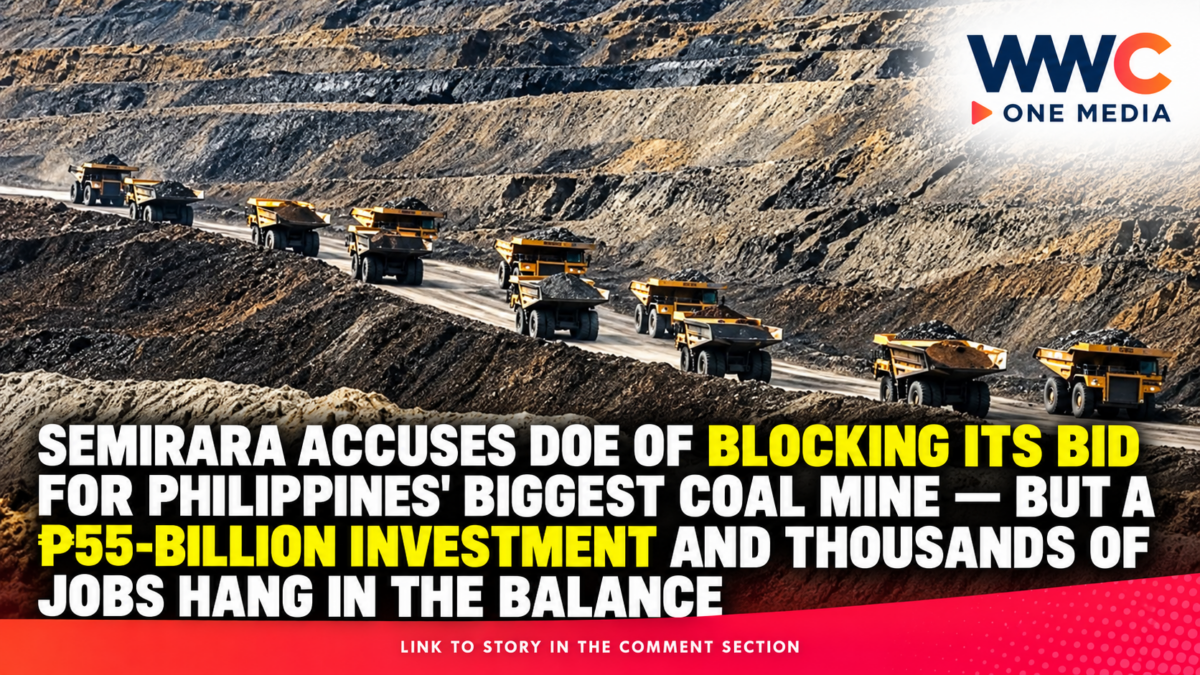
With more than ₱55 billion in mining investments, approximately 4,000 workers and a major source of domestic coal supply at stake, the controversy raises an urgent question: Could the fight over Semirara’s future eventually affect the Philippines’ energy security?
Semirara Claims DOE Bidding Rules Effectively Exclude It From the Auction
Semirara Mining and Power Corporation says the government’s revised bidding framework places it at a disadvantage compared with prospective competitors.
According to the company, the rules require the incumbent operator to provide a complete inventory of its mining equipment and operational assets and surrender those assets to the government as a condition of participating in the bidding.
SMPC maintains that the condition applies specifically to the existing operator, creating what it considers an unequal playing field.
The company believes that the requirement forces it to choose between protecting assets it owns and pursuing the opportunity to continue operating the mine.
Semirara Chairman Isidro Consunji has strongly criticized the government’s approach, arguing that the conditions effectively discourage the company from joining the bidding process.
The allegation represents Semirara’s position in an ongoing regulatory dispute. It does not establish that the DOE has formally banned the company from participating.
₱55 Billion in Mining Investments at the Center of the Dispute
One of Semirara’s biggest concerns involves the ownership and treatment of the equipment and infrastructure it has developed over decades of mining operations.
The company says it has invested more than ₱55 billion in mining assets and infrastructure supporting the extraction of coal from deposits roughly 350 meters below sea level.
The operation requires hundreds of specialized machines, experienced mining personnel and extensive technical knowledge.
SMPC argues that its investments are protected under Presidential Decree No. 972, also known as the Coal Development Act of 1976.
The company maintains that the law preserves its ownership rights over certain mining assets and provides a period of up to one year after contract expiration to remove applicable equipment.
Under Semirara’s interpretation, compelling the company to surrender those assets before competing for a new contract conflicts with the protections provided by law.
However, the legal disagreement has not been conclusively resolved in the reporting reviewed.
The question of which assets belong to the operator, which rights apply upon contract expiration and what conditions the government may impose remains a central issue in the dispute.
DOE Says Coal Resources Must Deliver Better Returns to Filipinos
The Department of Energy has presented a different rationale for revising the coal bidding process.
In an official statement issued on September 19, Energy Secretary Sharon Garin said the government had terminated the earlier coal bid round to reassess the criteria for awarding coal operating contracts.
According to the DOE, coal reserves are valuable state-owned natural resources, and the government has a responsibility to ensure that their development generates appropriate public benefits.
The agency wants future contract awards to give greater weight to measurable financial returns, domestic coal utilization and benefits for electricity consumers.
The DOE also cited legal questions involving the current operator’s assets, concerns raised by prospective bidders and continuing water seepage at Semirara Island.
Officials said these developments created uncertainties that justified a review of the bidding framework.
The department’s position is grounded in the constitutional principle that natural resources belong to the State.
The central disagreement is therefore not simply about who can offer the highest payment, but about how the government should balance public revenue, legal rights, technical competence and uninterrupted coal production.
Semirara Warns Highest Bidder May Not Be Best Mine Operator
Another major point of contention involves how the government evaluates potential bidders.
Semirara argues that technical qualifications and operational experience should play a decisive role in determining who receives the mining contract.
According to the company, the government’s revised approach places greater emphasis on financial offers without adequately demonstrating that bidders possess the technical capabilities needed to operate a complex coal mine.
SMPC warns that an inexperienced operator could encounter serious difficulties acquiring equipment, training workers and maintaining production.
Such concerns are particularly important because Semirara’s operations depend on specialized machinery and experienced personnel.
Mining below sea level also involves technical challenges, including groundwater management and safety considerations.
The company argues that a winning bidder’s financial commitment would have limited value if the new operator could not deliver actual coal production.
However, the DOE has stated that it intends to develop a comprehensive evaluation framework. The final requirements for bidders and the degree of technical scrutiny remain important issues to clarify.
Semirara Contract Expires July 14, 2027
The approaching expiration of Semirara’s coal operating contract adds urgency to the dispute.
The company currently operates under Coal Operating Contract No. 5, which is scheduled to expire on July 14, 2027.
In February 2026, Energy Secretary Sharon Garin said the government would not grant Semirara’s requested extension after receiving a legal opinion from the Department of Justice.
According to BusinessWorld, Garin said the government would instead conduct competitive bidding for the mining rights.
At that time, the DOE indicated that the incumbent operator would be allowed to participate in the auction.
The position marked a significant shift for Semirara, which had sought to continue operating the coal mine under an extended contract.
With less than a year remaining before expiration, the government and prospective operators face increasing pressure to resolve the rules and establish a workable transition process.
Any change in operator would require careful preparation to maintain mine safety, operational continuity and employment arrangements.
Government Cancels Coal Bid Round After Legal and Safety Concerns
The bidding controversy had already triggered government action before Semirara’s latest public criticism.
On September 15, the DOE terminated the 2026 coal bidding round involving three predetermined coal areas.
The affected areas included coal blocks on Semirara Island in Antique, as well as sites in Isabela and Cagayan.
The department cited several reasons for its decision, including stakeholder concerns, uncertainties surrounding mining assets and water seepage at Semirara.
The DOE said the cancellation would allow it to revise the framework and better protect the government’s financial and strategic interests.
The agency also said it was coordinating with the Department of Environment and Natural Resources on an improved policy framework for awarding contracts involving natural resources.
Semirara subsequently objected to the revised requirements, alleging that they remained unfair to the incumbent operator.
The developments have created continuing uncertainty over the terms and future outcome of the bidding process.
Around 4,000 Workers Could Face Uncertainty
Beyond the legal and commercial battle, thousands of workers have a stake in the outcome.
Semirara says its coal mining operations support a workforce of approximately 4,000 people.
The company has developed a specialized labor force trained to operate and maintain equipment used in large-scale coal extraction.
A change in mine operator would raise important questions about employment continuity, worker retention, retraining and future operating arrangements.
However, the existence of a bidding dispute does not mean that all 4,000 workers will lose their jobs.
Employment outcomes will depend on the eventual contract award, any transition arrangements and the operating plans of the successful bidder.
For Semirara Island and surrounding communities, the uncertainty is nevertheless significant because mining employment supports local households and economic activity.
San Miguel Had Shown Interest in Government Coal Auction
The bidding process could also attract competition from other major Philippine energy companies.
In March 2026, BusinessWorld reported that representatives of San Miguel Global Power and its subsidiary Sual Power attended a DOE pre-submission conference related to the coal areas being offered.
The development suggested that San Miguel’s energy businesses were examining potential opportunities in the government’s coal auction.
However, attendance at a pre-submission conference does not constitute a formal bid or prove that a company will ultimately acquire the mining rights.
San Miguel’s possible interest illustrates why the Semirara contract is commercially significant to the Philippine energy sector.
The mining blocks include established coal resources that could be valuable to companies involved in electricity generation and related energy activities.
Could the Dispute Affect Philippine Electricity Supply?
The Semirara controversy carries implications beyond one company’s future.
Semirara operates the Philippines’ largest coal mine and is a significant supplier of domestic coal.
According to earlier reporting from InsiderPH, its output accounts for roughly 10% of the country’s coal requirements.
The country’s electricity system continues to rely substantially on coal-fired power plants, making supply reliability an important energy policy concern.
Semirara warns that an unprepared new operator could face production difficulties, potentially reducing domestic coal availability and government revenue.
Such an outcome could create additional procurement challenges for coal-dependent power producers.
However, a mine transition would not automatically result in electricity shortages or higher household power bills.
Any impact would depend on the duration and severity of production disruptions, available coal inventories, alternative suppliers, imported coal prices and electricity market conditions.
The risk remains a scenario raised by the company, not an established consequence of the bidding process.
Water Seepage Creates Another Complication
Another issue affecting the government’s evaluation is continuing water seepage at Semirara Island.
The DOE has acknowledged that water entering certain mining areas could affect the volume of economically recoverable coal reserves.
This matters because potential bidders need reliable information about the quantity of coal that can be safely and commercially extracted.
Uncertainty over recoverable reserves can influence investment decisions, contract valuations, mine development plans and operating costs.
The water seepage issue also reinforces the importance of technical expertise and safe operating practices.
Any future operator would need to demonstrate an ability to manage the mine’s geological and operational challenges.
The DOE has cited these concerns as part of its rationale for reassessing the bidding framework.
Legal Fight Could Intensify Before Contract Expiration
Semirara’s objections raise the possibility of further legal action involving the government.
The company has challenged the fairness of the bidding requirements and questioned whether the proposed asset turnover conditions comply with existing law.
At issue is the relationship between the government’s authority over state-owned natural resources and the contractual and property rights asserted by the current operator.
The outcome could help define how Philippine authorities manage the transition of major mining operations when long-running coal contracts expire.
The government must protect public resources and ensure transparent competition.
At the same time, the bidding process must comply with applicable laws and address legitimate issues surrounding privately owned equipment and other operational assets.
The legal and regulatory uncertainty could persist unless the parties clarify these questions before the contract expires.
The Bigger Question: Who Should Control the Philippines’ Largest Coal Mine?
The struggle over Semirara has become more than a disagreement over bidding documents.
For the government, the issue is whether the Philippines can secure stronger economic returns from valuable coal reserves while maintaining fair and competitive access to mining contracts.
For Semirara, it is about protecting decades of investment, preserving operational continuity and securing the opportunity to compete for the mine it currently operates.
For workers and nearby communities, the dispute raises questions about employment and local economic stability.
And for electricity consumers, the central concern is whether the transition can occur without avoidable disruption to domestic energy supply.
Neither the incumbent operator’s historical investment nor the government’s preference for higher financial offers can, on its own, resolve every legal, operational and public-interest issue.
The final outcome will depend on how the bidding process balances technical qualifications, financial commitments, legal protections, mine safety and public benefits.
Semirara’s ₱55-billion investment and decades of mining experience may give it an operational advantage, but the government controls the future award of the coal operating contract. With July 2027 approaching, the bigger question is whether the two sides can resolve their dispute before it becomes a costly test for Philippine energy security.