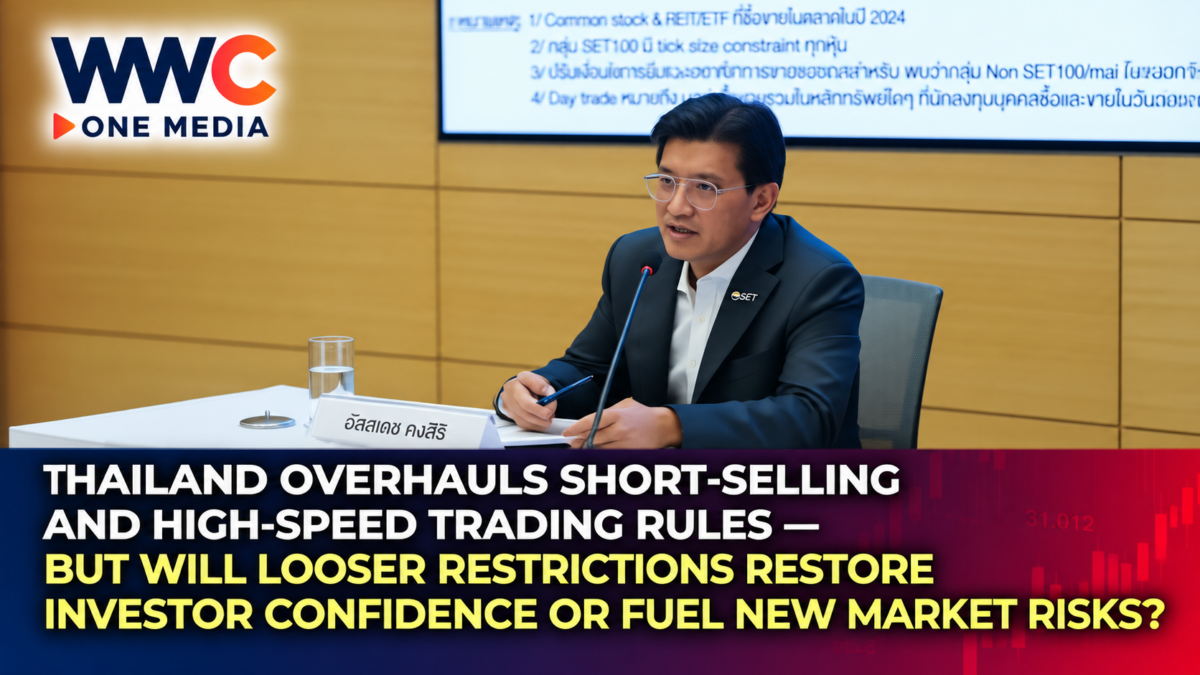
BANGKOK, Thailand — October 10, 2026 — Thailand’s stock exchange is preparing one of its most consequential changes to trading regulations in recent years, approving eight reforms covering short selling, high-frequency trading, stock-price movements and market supervision in an effort to restore confidence in the country’s capital markets.
The Stock Exchange of Thailand (SET) announced that the new measures will take effect on November 16, following consultations with market participants and approval from Thailand’s Securities and Exchange Commission.
The reforms aim to make trading more efficient, reduce unnecessary costs and strengthen oversight of potentially abusive trading behavior.
Among the biggest changes, Thailand will allow more flexible short-selling orders under normal market conditions, reduce minimum price increments for selected stocks and remove restrictions affecting high-frequency traders.
The exchange will also introduce additional charges for accounts that submit exceptionally large numbers of orders without executing many transactions.
However, the package contains a significant trade-off.
Some restrictions introduced to reduce market volatility will be eliminated, raising questions about how effectively the exchange can protect investors while giving professional traders greater freedom.
The bigger question is whether Thailand’s new approach can bring investors back to its stock market — or whether relaxing trading restrictions could expose the market to new volatility.
Thailand Announces Eight Major Trading Reforms
The Stock Exchange of Thailand confirmed the revised framework in an October 9 announcement.
SET President Asadej Kongsiri said the package is intended to enhance market quality, create more equal trading conditions and strengthen confidence in Thai capital markets.
The announcement follows public consultations conducted in May 2026.
Thailand’s securities regulator has approved the measures, allowing the stock exchange to proceed with implementation on November 16.
The package reflects a change in regulatory strategy.
Instead of relying heavily on broad restrictions affecting trading activity, the exchange is placing greater emphasis on identifying potentially problematic behavior.
The approach is designed to preserve market liquidity while discouraging practices that may create unnecessary volatility.
However, the new regulations have not yet taken effect, and their practical impact will only become clear once trading begins under the revised framework.
Short-Selling Rules Will Become More Flexible
One of the most significant changes involves short selling.
Short selling allows an investor to sell borrowed securities in anticipation of buying them back later, potentially at a lower price.
Under Thailand’s previous restrictions, short-selling orders generally had to be placed above the most recent traded price.
The new system will restore the zero-plus tick rule under normal conditions.
This means a short-selling order can be entered at a price equal to or higher than the latest executed price.
The change is intended to reduce friction and help investors execute legitimate transactions more efficiently.
However, the exchange will retain an additional safeguard during sharp price declines.
If a security closes at least 10% below its previous day’s closing price, the stricter uptick rule will apply during the following trading day.
Under that condition, short-selling orders must be priced above the latest traded price.
The objective is to slow additional selling pressure when a stock is experiencing an unusually steep decline.
This makes the new framework a combination of greater flexibility during normal conditions and tighter controls during severe price movements.
Short Selling Will Be Limited to More Liquid Securities
Although the exchange is easing some pricing restrictions, it is also narrowing the types of securities eligible for short selling.
Under the new framework, eligible instruments include specified highly liquid securities such as SET100 shares, relevant underlying securities for single-stock futures, depositary receipts and exchange-traded funds.
The objective is to reduce the risk of aggressive short selling in less liquid securities.
Smaller companies can be more vulnerable to sudden price movements when relatively few shares are available for trading.
By restricting short-selling eligibility to securities meeting the revised criteria, the SET aims to reduce the likelihood of disruptive trading in vulnerable market segments.
However, the detailed eligibility rules must be applied according to the exchange’s official lists and regulations.
Investors should not assume that every Thai-listed stock will remain available for short selling after November 16.
High-Frequency Traders Will Get More Freedom
The reforms also affect high-frequency trading, commonly known as HFT.
High-frequency traders use computer algorithms and fast electronic connections to submit and execute large numbers of trading orders.
These systems can help market participants respond quickly to price changes and may contribute to trading liquidity.
However, HFT has also attracted scrutiny because excessive order activity or certain trading practices may make markets harder to monitor.
Thailand previously imposed restrictions on securities that registered high-frequency traders could purchase.
The new package removes those specific limits.
This is intended to give market participants more equal access to eligible securities and align Thailand’s market practices more closely with international standards.
However, removing the security restrictions does not mean high-frequency trading will become unregulated.
The exchange is simultaneously revising its registration and surveillance framework.
The effectiveness of that oversight will be essential to maintaining fair trading conditions.
SET Will Monitor Trading Behavior More Closely
Thailand is shifting toward a supervision system that focuses more directly on how traders behave.
The revised registration criteria will take account of factors such as the use of dedicated trading interfaces, order-submission frequency, trading speed, end-of-day positions and daily transaction values.
This approach is designed to help regulators identify trading activities that require closer monitoring.
The exchange has also discussed using technology to detect unusual order patterns.
Rather than treating all high-frequency trading as inherently harmful, the framework attempts to distinguish ordinary automated activity from potentially disruptive behavior.
That distinction is important.
Fast trading is not necessarily market manipulation.
But order activity intended to create misleading signals or overwhelm market systems can raise serious regulatory concerns.
The challenge for Thailand will be maintaining effective surveillance as the volume and complexity of automated trading increase.
Extra Fees Target Excessive Orders With Few Completed Trades
One of the package’s more targeted measures involves the order-to-trade ratio.
This compares the number of orders submitted by a trading account with the number of actual trades completed.
A high ratio may indicate that an account is repeatedly submitting, modifying or canceling orders without completing many transactions.
Such activity can sometimes be legitimate.
However, exceptionally high order volumes can consume trading-system resources and may warrant closer scrutiny.
Under the new rules, additional charges will apply to accounts meeting specified thresholds.
Thai reporting on the announcement says the charge applies when an account has an order-to-trade ratio above 50 and averages more than 50 orders per minute.
For qualifying accounts, an additional fee of 0.15 baht per order will apply to orders exceeding 15,000 in a day.
The measure is designed to reflect the cost of heavy system usage and discourage excessive order activity without automatically penalizing all algorithmic traders.
It is not a blanket fee on every retail order or every high-frequency transaction.
Thailand Will Reduce Price Increments for Selected Stocks
The exchange will also introduce smaller minimum price increments, known as tick sizes, for shares priced between 5 baht and 50 baht.
A tick size is the smallest amount by which the quoted price of a security can change.
For example, if a stock must move in increments of 0.10 baht, investors cannot normally place orders at prices between those permitted increments.
Smaller tick sizes can allow buyers and sellers to quote prices more precisely.
That can narrow the difference between the highest buying price and the lowest selling price, known as the bid-ask spread.
Narrower spreads may reduce trading costs and improve the efficiency of order matching.
However, smaller price increments do not guarantee lower trading costs for every transaction.
Actual outcomes will depend on market liquidity, trading behavior and how investors respond to the revised price structure.
Dynamic Price Bands Will Be Removed
Another major change is the removal of the exchange’s dynamic price band mechanism for individual securities.
Dynamic price bands place limits on how far prices may move relative to a reference price during a trading session.
They are intended to help manage unusually sharp intraday fluctuations.
Thailand introduced such measures to address concerns about volatility.
But the exchange has concluded that some restrictions can create trading obstacles, especially for securities with lower liquidity.
Removing the dynamic bands could make it easier for buyers and sellers to complete transactions when prices are changing rapidly.
However, the decision also raises questions about how extreme price movements will be managed.
Importantly, eliminating this specific mechanism should not be confused with abolishing every market safeguard.
Other price limits, trading suspensions and surveillance arrangements may continue to apply under separate rules.
The change concerns a particular intraday price-control mechanism.
Minimum Resting-Time Rule Will Also Be Scrapped
The exchange will eliminate its minimum resting-time requirement for trading orders.
A resting-time rule requires certain orders to remain in the trading system for a minimum period before they can be canceled or modified.
Such requirements are intended to discourage excessive order cancellation and other potentially disruptive behavior.
However, they can also make it harder for traders to respond to changing market conditions.
The SET concluded that the measure was creating operational burdens while providing limited regulatory benefit.
Removing it should make order management more flexible.
The exchange will instead rely on alternative supervision measures, including monitoring trading patterns and imposing additional charges on accounts with exceptionally high order-to-trade ratios.
The decision illustrates Thailand’s broader move toward behavior-based regulation.
Some Foreign-Linked Products Will Start Trading Earlier
The reforms also include a change to trading hours for certain products linked to overseas securities.
From November 16, trading in selected depositary receipts, derivative warrants and exchange-traded funds referencing foreign assets will begin at 8 a.m.
That is two hours earlier than the previous opening time.
Closing times will remain unchanged.
The measure is intended to give Thai investors more opportunities to respond to developments in overseas markets.
This could be especially relevant when international market movements occur outside Thailand’s traditional trading hours.
However, earlier trading does not remove investment risks.
Foreign-linked products may be affected by exchange-rate fluctuations, overseas market volatility and differences in market liquidity.
Investors should understand the underlying assets and product structures before trading.
Why Thailand Is Reconsidering Its Earlier Restrictions
The latest measures mark another stage in a regulatory process that began several years ago.
In July 2024, Thailand implemented tighter short-selling and program-trading rules to address concerns about market fairness and investor confidence.
The changes included stricter short-sale pricing rules and registration requirements for high-frequency traders.
In 2025, the exchange further restricted HFT purchases to large, liquid securities.
Those measures were intended to protect investors and reduce abnormal price movements.
But the SET subsequently reviewed whether the restrictions were placing excessive burdens on trading activity.
Its consultation documents acknowledged that market liquidity remained weak and that earlier controls had not delivered every intended benefit.
The new framework reflects an attempt to correct that balance.
Thailand is not simply eliminating oversight.
It is redesigning some controls to preserve liquidity while targeting behavior considered potentially harmful.
What the Reforms Mean for Retail Investors
For individual investors, the changes could affect trading costs, execution quality and short-term price movements.
Smaller tick sizes may allow more precise bid and offer prices.
More flexible trading rules could make some securities easier to buy and sell.
Changes to high-frequency trading may also alter how quickly quoted prices respond to market conditions.
However, faster trading does not automatically produce a better outcome for retail investors.
Some sophisticated market participants have access to technology, data and trading infrastructure that ordinary investors do not.
Regulators must therefore monitor whether the new framework supports fair access and transparent pricing.
Retail investors should also distinguish between short selling and unlawful market manipulation.
Short selling can be a legitimate investment and hedging strategy when conducted within applicable rules.
The regulatory concern is whether trading behavior becomes abusive, misleading or destabilizing.
Could Foreign Investors Return to Thailand’s Market?
One objective of the reforms is to make Thailand’s stock market more competitive.
International investors consider a range of factors when allocating capital, including liquidity, transaction costs, market transparency and regulatory predictability.
Rules that support efficient trading can make a market more attractive.
However, foreign investment decisions also depend on economic growth, corporate profitability, currency conditions and political stability.
The new trading rules cannot guarantee higher share prices or renewed foreign capital inflows.
They may improve the trading environment, but their effectiveness will need to be measured after implementation.
Indicators worth monitoring include bid-ask spreads, trading turnover, market depth and the frequency of abnormal price movements.
Sustained improvements in those measures would provide more evidence of success than a short-lived rise in the stock index.
Why the Philippines and Other ASEAN Markets Should Pay Attention
Thailand’s reforms are relevant to stock exchanges across Southeast Asia.
Markets in the Philippines, Singapore, Indonesia, Malaysia and Vietnam are also balancing investor protection, trading liquidity and competition for international capital.
Advances in automated trading make this challenge increasingly important.
Restrictions that are too broad can make trading more expensive or discourage participation.
Rules that are too weak can create opportunities for abusive trading and undermine confidence.
Thailand’s approach may provide a regional case study in using targeted supervision while allowing market participants greater operational flexibility.
For Philippine investors, the changes could also influence how regional asset managers evaluate trading costs and liquidity across ASEAN markets.
However, Thailand’s rules will not automatically apply to the Philippine Stock Exchange.
Each country operates under its own securities laws, exchange rules and regulatory structure.
The Bigger Picture: Thailand Is Testing a New Balance Between Speed and Safety
The stock market depends on trust.
Investors need confidence that prices reflect genuine buying and selling interest and that transactions occur under fair and enforceable rules.
At the same time, markets require sufficient liquidity to function efficiently.
Thailand’s latest regulatory package recognizes that these objectives can sometimes conflict.
Tighter restrictions may help reduce specific risks but can also make trading harder.
More flexible trading arrangements may improve market efficiency while creating new surveillance challenges.
The exchange is attempting to balance those interests through targeted controls, revised eligibility rules and closer scrutiny of trading behavior.
The real test will come when the package is implemented.
If liquidity improves without a significant increase in disruptive activity, the reforms may strengthen confidence in Thailand’s market.
If volatility increases or investor complaints persist, regulators could face pressure to reconsider parts of the framework.
THE BOTTOM LINE
Thailand’s Stock Exchange will introduce eight revised trading measures on November 16, 2026, covering short selling, high-frequency trading, tick sizes, market supervision and price controls.
The new rules will allow more flexible short-selling orders under normal conditions while imposing stricter pricing when a stock falls at least 10% in a day.
Short-selling eligibility will focus on more liquid securities, while high-frequency traders will face revised registration and behavioral supervision.
The exchange will also introduce extra fees for specified excessive order activity and remove both dynamic price bands and minimum resting-time requirements.
The biggest question is whether Thailand can improve market liquidity and reduce trading costs without weakening the safeguards that protect investors from disruptive trading.
Bangkok is betting that smarter oversight — rather than blanket trading restrictions — can help rebuild confidence. But investors will judge the overhaul by what happens after November 16, not by the promises made before it.