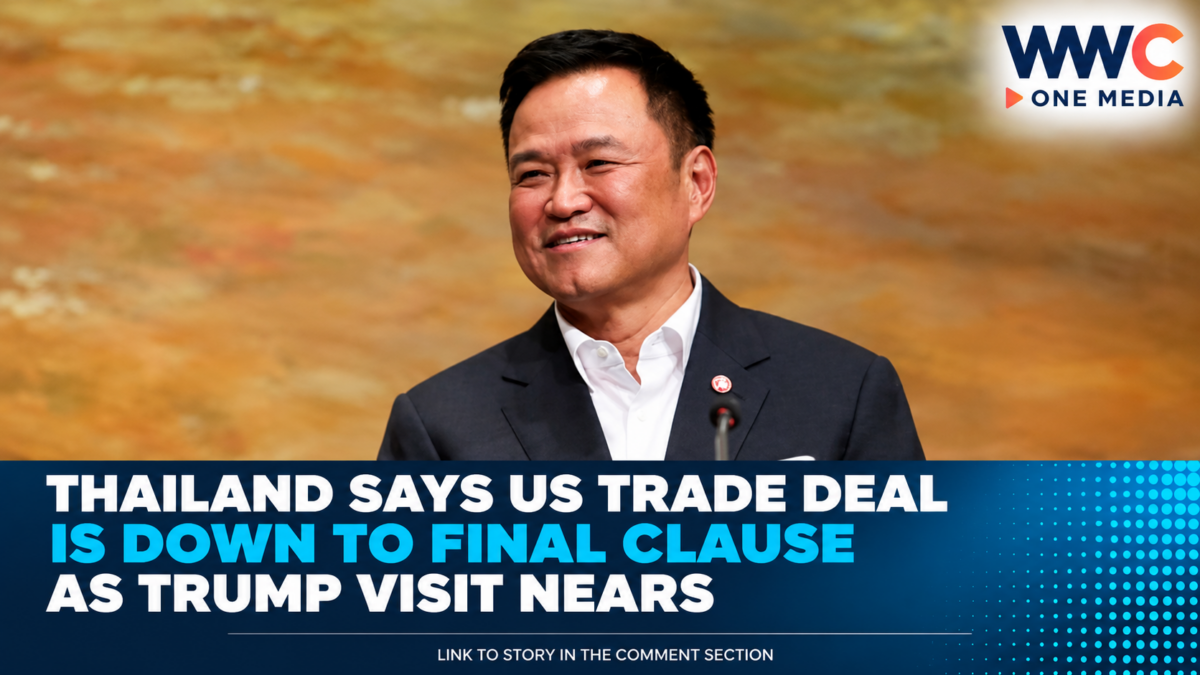
Thailand is in the final stretch of negotiations for a trade agreement with the United States, with Prime Minister Anutin Charnvirakul saying only the “last paragraph” remains to be completed.
Anutin made the remarks on Wednesday, Oct. 7, during a forum in Singapore, saying he expected Thailand and the United States to sign the Agreement on Reciprocal Trade (ART) during US President Donald Trump’s next visit to Asia, potentially in November.
The announcement comes as Thailand faces a 12.5% US tariff on its exports and seeks greater certainty for businesses and exporters. The United States is Thailand’s largest export market, accounting for about 24% of Thailand’s exports so far this year.
Trump Letter Signals Final Stage
Anutin said he received a letter from Trump last week confirming that negotiations had reached their final stage.
According to the Thai prime minister, Trump instructed him to ensure that Thai officials and the US Trade Representative complete the agreement’s final clause.
Anutin said the deal could then be signed during Trump’s next trip to Asia. Trump is expected to attend ASEAN meetings in the Philippines in November, as well as the Asia-Pacific Economic Cooperation (APEC) summit in Shenzhen, China.
The timing would give both governments an opportunity to present the agreement as a significant step in strengthening bilateral economic ties.
However, the deal has not yet been signed, and the final text and domestic approval procedures still have to be completed.
Thailand Faces 12.5% US Tariff
Thailand has been seeking an agreement with Washington partly to address tariff pressures affecting its exporters.
The United States currently applies a 12.5% tariff on imports from Thailand, according to Reuters and CNA. The rate followed the expiry of a temporary 10% tariff in July.
The tariff issue is particularly important because of the scale of Thailand’s trade relationship with the United States.
US data cited by CNA showed that Thailand recorded a US$71.7 billion goods trade surplus with the United States in 2025, up 59.1% from the previous year.
That imbalance has been an important backdrop to Washington’s push for what it calls reciprocal trade arrangements with major trading partners.
Framework Was Already Agreed
The latest negotiations build on a framework announced by the United States and Thailand in October 2025.
Under that framework, Thailand agreed to eliminate tariffs on approximately 99% of goods from the United States, covering industrial, agricultural and food products.
The United States, meanwhile, agreed to maintain a 19% reciprocal tariff rate on Thai-origin goods while identifying certain products that could qualify for a zero-percent reciprocal tariff.
The framework also went beyond tariffs.
Thailand committed to addressing a range of non-tariff barriers affecting US businesses, including market-access issues involving vehicles, pharmaceuticals, medical devices, agricultural products and ethanol.
The two countries also agreed to continue work on digital trade, services, investment, intellectual property and economic-security cooperation.
Agriculture, Energy and Aircraft Deals
The framework also included several proposed commercial agreements between US and Thai companies.
The United States said Thai purchases of agricultural products such as feed corn, soybean meal and dried distiller’s grains could be worth an estimated US$2.6 billion annually.
Thailand was also expected to increase purchases of US energy products, including liquefied natural gas, crude oil and ethane, with an estimated value of US$5.4 billion a year.
Another major component was Thailand’s planned procurement of 80 US aircraft, valued at about US$18.8 billion.
These commitments form part of Washington’s broader effort to reduce trade imbalances while expanding access for American exporters.
Thailand Wants to Attract More Investment
Anutin has also used his international appearances to promote Thailand as an investment destination rather than simply a low-cost manufacturing base.
Speaking in Singapore, he said Thailand wanted international businesses to view the country as a regional distribution and investment hub supported by logistics and communications infrastructure.
He also pointed to growing Chinese investment in Thailand, particularly in the automotive sector, as a potential factor in reducing Thailand’s substantial trade deficit with China.
Thailand’s goods trade deficit with China reached US$55.13 billion in the first seven months of 2026, according to figures cited by CNA.
Anutin has argued that Chinese investment and manufacturing activity could eventually help narrow that imbalance by increasing production and exports from Thailand.
China Remains a Major Economic Factor
Thailand’s efforts to deepen trade ties with Washington come as Bangkok maintains extensive economic relations with China.
The competing relationships have made Thailand’s trade policy increasingly important as major economies seek to strengthen supply chains and attract investment.
The 2025 US-Thailand framework included commitments to cooperate on supply-chain resilience, export controls, investment security and measures aimed at combating duty evasion.
Thailand also agreed to work with Washington on intellectual-property enforcement and labor and environmental protections.
For Bangkok, completing the US agreement would provide greater clarity for exporters while allowing the government to maintain its broader strategy of attracting investment from multiple major economies.
Final Agreement Still Has to Be Completed
Despite Anutin’s optimistic comments, the agreement remains unfinished.
The two sides still need to settle the final language and complete the necessary domestic procedures before the agreement can enter into force.
The White House’s framework stated that the countries would negotiate and finalize the agreement, prepare it for signature and then undertake domestic formalities before implementation.
Anutin’s description of negotiations being down to the “last paragraph” therefore signals that talks are close to completion, rather than that the trade pact is already legally in effect.
If the agreement is completed in time, a signing ceremony during Trump’s expected November Asia trip could mark the culmination of months of negotiations.
For Thailand, the outcome could be particularly significant for exporters seeking greater certainty in the US market. For Washington, the agreement would further advance the Trump administration’s push for reciprocal market access and reduced trade imbalances with Asian partners.