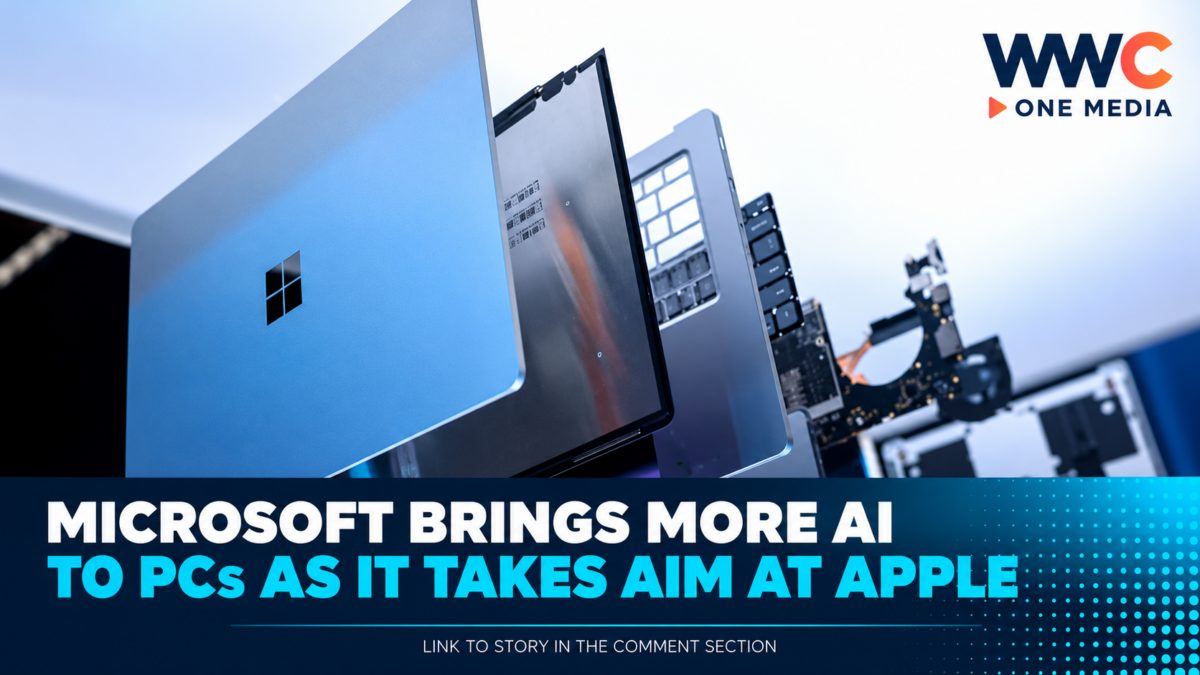
Microsoft is making a major push to bring more powerful artificial intelligence directly onto Windows computers, unveiling new hardware and software designed to let AI models and autonomous agents perform demanding tasks locally rather than relying entirely on the cloud.
At an event in San Francisco on Wednesday, Oct. 7, Microsoft introduced a new AI coding model that can run directly on personal computers, alongside security technology designed to prevent AI agents from accessing files and other data without permission.
The company also unveiled the Surface Laptop Ultra, a high-performance Windows laptop powered by Nvidia’s new RTX Spark platform, as Microsoft seeks to position Windows as a serious rival to Apple’s increasingly AI-focused Mac lineup.
Microsoft Wants AI to Run Directly on Your PC
Microsoft’s strategy is centered on what it calls “hybrid intelligence” — a combination of local and cloud-based AI.
Instead of sending every AI request to Microsoft’s Azure data centres, Windows can determine whether a task should be processed on the computer itself or handled in the cloud.
That could reduce cloud computing costs while also improving privacy and response times for certain tasks.
Microsoft says its upgraded Copilot will eventually be able to use information stored locally on a user’s computer, perform actions on the device with permission and access AI models running directly on the machine.
The company is particularly targeting developers, creators and businesses that need to run large AI models or sophisticated AI agents.
Microsoft’s Windows and Devices chief Pavan Davuluri said the goal is to make Windows a platform where agents can work locally when appropriate while still connecting to the cloud when more computing power is required.
Surface Laptop Ultra Leads the New Push
The centerpiece of Microsoft’s hardware announcement was the Surface Laptop Ultra, its most powerful Surface laptop to date.
The 15-inch machine is built around Nvidia’s RTX Spark platform and can be configured with up to 128GB of unified memory.
Microsoft says the hardware is capable of running AI models exceeding 120 billion parameters locally, putting capabilities that traditionally required cloud infrastructure into a laptop-sized device.
The Surface Laptop Ultra starts at US$2,599, while higher-end configurations can reach US$5,899.
The first devices are scheduled to become available on Oct. 16. Other RTX Spark-powered Windows machines are also being introduced by companies including Asus, Dell, HP, Lenovo and MSI.
Microsoft is also offering a Surface RTX Spark Dev Box for developers who want substantially more local AI computing power.
Nvidia Joins Microsoft on Stage
Nvidia CEO Jensen Huang appeared alongside Microsoft CEO Satya Nadella at the event, underscoring the importance of their partnership.
The RTX Spark platform combines Nvidia’s graphics technology with a central processor architecture designed to deliver high-performance AI computing in a personal computer.
Huang described the project as an effort to bring together capabilities traditionally found in gaming PCs, workstations, supercomputers and cloud data centres.
The collaboration also gives Nvidia a way to expand further into the PC market, where Intel and AMD have historically dominated the processor space.
Microsoft and Nvidia began working together on the RTX Spark platform several years ago, with the goal of creating Windows machines capable of handling increasingly sophisticated AI workloads locally.
Microsoft Is Also Trying to Make AI Agents Safer
The push toward local AI creates another problem: security.
AI agents can do much more than answer questions. They can potentially read files, write code, interact with applications and perform actions on behalf of users.
That creates risks if an AI system is manipulated or given excessive access to sensitive information.
Microsoft is therefore introducing Microsoft Execution Containers, or MXC, a security technology designed to restrict what AI agents can access and do on a Windows machine.
The system can allow organisations to establish rules governing AI agents and prevent those agents from carrying out unauthorised actions.
Microsoft said companies including OpenAI, Anthropic and Nvidia will use the technology.
The company is also integrating identity and management controls so organisations can determine which AI agent performed an action and establish policies governing agent activity across employee devices.
Copilot Is Moving Beyond the Cloud
Microsoft’s Copilot strategy is also changing.
Rather than treating Copilot simply as a cloud-based chatbot, Microsoft wants it to become a more capable agent that understands the user’s computer and can take actions directly on the device.
With permission, Copilot will be able to use local context such as files and recent activity.
It will also be able to perform tasks such as organising files, diagnosing problems, troubleshooting devices and assisting with coding.
Microsoft says Copilot will determine when a task is best handled locally and when it should be sent to the cloud.
The company expects these hybrid-intelligence Copilot capabilities to begin rolling out to Copilot+ PCs in the coming months.
Apple Is Chasing the Same AI Opportunity
Microsoft’s move comes as Apple is also positioning its Macs as powerful machines for running AI locally.
Apple recently refreshed its Mac mini and Mac Studio lines with newer M-series processors, promoting their ability to handle increasingly sophisticated AI models and autonomous agents without sending all of the processing to the cloud.
Apple has an advantage in this area because its tightly integrated chips and unified-memory architecture have made its computers well suited to certain AI workloads.
Reuters reported last month that Apple was increasingly pitching its high-end Macs to corporate customers as an alternative to paying continuously for cloud-based AI computing.
But Microsoft has a major advantage of its own: Windows dominates the corporate PC market.
That gives Microsoft access to a much larger installed base of business computers, even though it must support hardware from a wide range of manufacturers.
The Price Problem
One of the biggest obstacles to Microsoft’s vision is cost.
The Surface Laptop Ultra’s US$2,599 starting price puts it firmly in premium territory. The highest-end configuration approaches US$5,900.
That is particularly significant because Microsoft’s original pitch for local AI was partly based on the idea that running workloads on a user’s computer could be cheaper than repeatedly paying for cloud computing.
But the hardware needed to run increasingly large AI models is itself becoming expensive.
Rising memory prices have contributed to higher costs across the industry, making powerful AI-capable computers less accessible to ordinary consumers.
Analyst Anshel Sag told Reuters that the technology has reached an awkward point: the software is becoming capable enough for local AI, but the hardware required to run it can be prohibitively expensive.
Microsoft Faces a Different Kind of AI Race
The competition between Microsoft and Apple is no longer simply about processor speed, battery life or operating-system features.
Both companies are increasingly competing over where AI computing should happen.
Cloud-based AI remains essential for the largest models and most demanding workloads. But local processing can offer advantages in privacy, responsiveness and predictable costs.
Microsoft is betting that Windows can become the operating system where those two approaches work together seamlessly.
Its new hardware is aimed at users who need enough computing power to run sophisticated models locally, while Copilot and Microsoft’s broader Windows ecosystem are intended to make those capabilities useful to everyday users and businesses.
Apple is pursuing a similar direction through its own silicon and tightly integrated hardware-software ecosystem.
A New Era for the PC
Microsoft’s latest announcements suggest that the traditional personal computer is being redesigned around AI.
Instead of simply running applications selected by the user, future Windows PCs are expected to host AI agents that can understand context, write code, manipulate files and perform tasks on a user’s behalf.
That creates enormous opportunities but also raises difficult questions about privacy, security, cost and how much control users should give AI systems.
For Microsoft, the challenge is to make those capabilities useful without making Windows computers prohibitively expensive or giving autonomous agents too much freedom.
For Apple, the challenge is to turn its early strengths in efficient local computing into a broader advantage in business and professional markets.
The next phase of the PC battle may therefore be less about which company makes the fastest computer — and more about which company can make AI genuinely useful, secure and affordable on the device sitting on your desk.