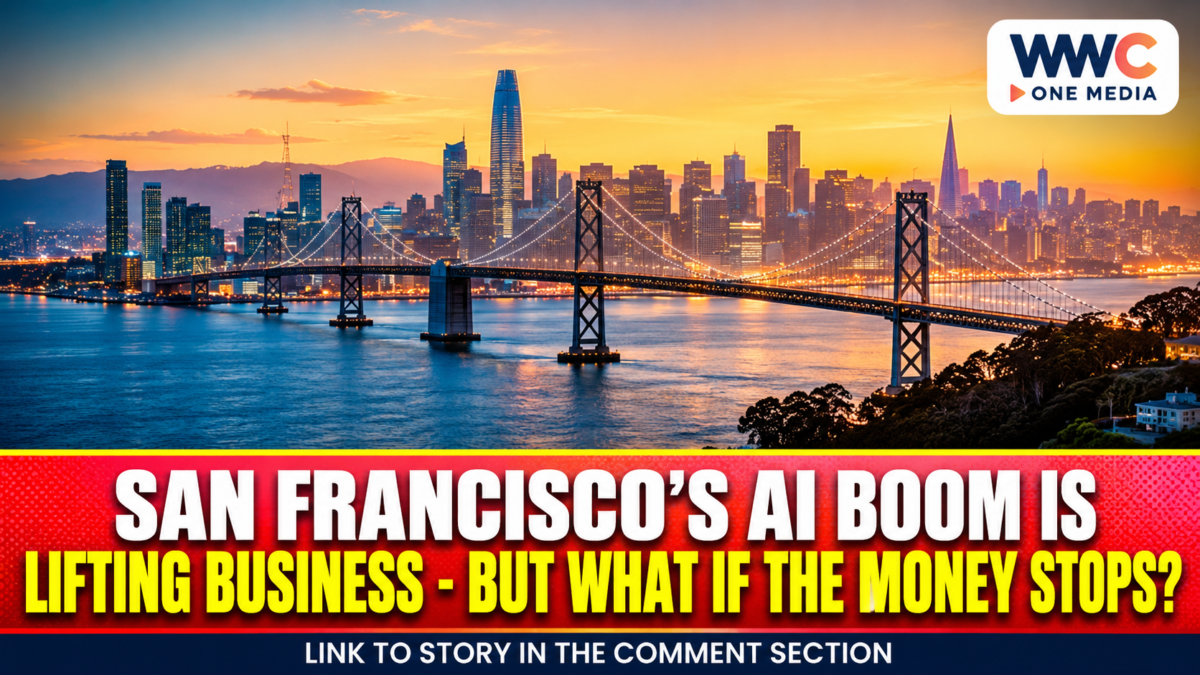
San Francisco’s artificial intelligence industry is generating new business for the city, but its economic recovery is increasingly exposed to a question investors and local officials cannot ignore: how much of the current momentum depends on continued AI spending?
The concern is not simply whether technology companies will lose value. A slowdown could affect office demand, housing costs and the restaurants, shops and service businesses that benefit when highly paid technology workers spend money locally.
Official records show that the city has experienced an AI-linked improvement in office leasing and economic activity. The International Monetary Fund has also identified a possible AI-related market correction as a financial-stability risk. Those developments frame a more useful question than whether an AI crash is inevitable: how resilient is San Francisco if investment cools?
San Francisco AI boom meets a more complicated jobs picture
San Francisco’s economic recovery has been uneven. The city’s Controller’s Office, in its third-quarter 2026 economic report published on Nov. 5, described improvement in several downtown indicators but a relatively weak employment picture.
Downtown foot traffic accelerated during the quarter, while Muni Metro and downtown BART ridership reached post-pandemic highs. Hotel occupancy had also returned to pre-pandemic levels, although inflation-adjusted room rates were still recovering. SF Media API+1
Yet employment has not expanded at the same pace as the visible signs of recovery.
The report found that total employment across the San Francisco metropolitan division was largely flat over the preceding year. Its industry breakdown showed that private education and health services added approximately 5,200 jobs between September 2025 and September 2026, while leisure and hospitality added approximately 3,800. The information sector lost approximately 2,400 jobs over the same period. SF Media API
The figures cover the San Francisco metropolitan division, which includes San Francisco and San Mateo counties. They should not be mistaken for a count of AI jobs inside the city itself.
That distinction matters. A technology investment boom can attract capital, raise demand for office space and support local businesses without immediately producing a broad increase in employment.
Office demand is improving, but vacancies remain high
The city’s office market provides one of the clearest indicators of the recovery.
The Controller’s third-quarter report put office vacancy at approximately 30.8% in the third quarter of 2026, down from approximately 35.3% in the same quarter of 2025. Asking rents were approximately $74.30 per square foot, compared with approximately $73 a year earlier. SF Media API
The direction is encouraging, but the remaining vacancy level is substantial.
For property owners, lower vacancy can mean stronger leasing activity and improved income prospects. For nearby businesses, more occupied offices can mean additional customers during working hours.
However, an improving market does not establish that every vacant building has found a tenant or that the recovery is permanent. If companies reduce expansion plans, some of the demand supporting office leasing could weaken.
San Francisco’s earlier technology cycles offer a reminder that commercial property demand can change when companies reassess costs, staffing and growth expectations.
The IMF’s warning is about financial exposure, not a prediction
The possibility of an AI-related correction has also become a subject of international financial analysis.
In its October 2026 Global Financial Stability Report, the IMF said weaker or less durable AI investment and profitability could trigger a correction in AI-related asset prices. It also identified rising leverage and concentrated exposures as factors that could amplify the impact. International Monetary Fund+1
This is a risk assessment, not a forecast that a crash will happen.
The distinction is important because the AI industry includes companies with different business models, funding arrangements and levels of profitability. A decline in the share price of one listed company would not automatically mean that every AI business would fail.
The IMF’s concern is broader: if investors have built large exposures around expectations of sustained AI growth, disappointing returns could cause financial pressure to spread beyond the companies developing the technology.
For readers following the wider regional implications, WWC has examined Asia’s AI investment boom and the profitability test facing the sector. The central issue is whether substantial spending eventually produces revenue and lasting economic value.
Anthropic’s IPO shows how much capital is moving into AI
The scale of investment is visible in Anthropic’s public listing.
The company announced on Nov. 20 that its initial public offering had closed. It sold 1,103,351,354 Class A shares, while certain existing shareholders sold another 23,648,646 shares, at $83 per share.
The company said the offering generated approximately $93.5 billion in gross proceeds before expenses, of which approximately $91.6 billion went to Anthropic. Its shares began trading on the Nasdaq Global Select Market on Nov. 19 under the symbol ANT. Anthropic
Anthropic also disclosed a concurrent private placement involving 313,253,007 Class N shares sold to seven companies, including NVIDIA, Microsoft, Google and Advanced Micro Devices. That transaction generated approximately $26 billion in gross proceeds. Anthropic
The figures demonstrate the capacity of major AI businesses to attract enormous amounts of capital. They do not, by themselves, prove that the industry is overvalued or that the investment will produce the returns investors expect.
For a broader look at how funding expectations are shaping the sector, WWC has also covered OpenAI’s financing and the questions surrounding AI valuations.
NVIDIA’s results illustrate the difference between risk and current performance
The financial performance of major suppliers is another part of the picture.
NVIDIA reported third-quarter fiscal 2027 revenue of $115.8 billion for the three months ended Oct. 25, 2026, up 103% from a year earlier. Data centre revenue reached $107.6 billion, an increase of 110% year on year. Net income was $65.3 billion, compared with $31.9 billion in the corresponding quarter a year earlier. NVIDIA Investor Relations+1
Those results show that demand for AI computing infrastructure remained strong during the reported period. They also demonstrate why a discussion of a possible market correction should not be confused with a claim that the entire industry is already in decline.
The more difficult question is how long exceptional growth can continue, how much future spending has already been anticipated in company valuations, and whether customers will generate enough returns from AI systems to justify continued investment.
That is also relevant to the infrastructure businesses supplying the sector. WWC has explored how AI computing demand is changing the data-centre and telecommunications landscape.
Could a downturn spread beyond technology companies?
A significant reduction in AI investment could affect San Francisco through several channels.
Companies that slow hiring or reduce office requirements could weaken demand for commercial property. Employees whose compensation or job security depends on the sector might reduce spending. Businesses that serve office workers and technology professionals could then feel the effects.
These are plausible economic transmission channels, not confirmed outcomes.
The city’s own data also shows why the impact may not be uniform. Healthcare, education and hospitality have contributed to employment growth, while hotel occupancy has recovered to pre-pandemic levels. These sectors provide economic activity that is not exclusively tied to AI investment. SF Media API+1
Housing presents another complication. The Controller’s report said San Francisco had some of the fastest-growing housing prices among the 100 largest cities tracked by Zillow, while asking rents for vacant apartments showed signs of slowing. SF Media API
If technology-sector demand weakens, housing and commercial property markets could respond differently depending on supply, interest rates, employment and household incomes.
For that reason, a market correction should not automatically be equated with a citywide economic collapse.
What happens next
San Francisco’s challenge is to benefit from technology investment without becoming too dependent on it.
The city’s economic indicators suggest that downtown activity and office leasing have improved, but employment growth remains modest and office vacancy is still high. The IMF’s warning adds a global financial dimension to those local conditions.
The next indicators worth watching include technology-sector hiring, office leasing, commercial property vacancy, hotel activity and employment in industries that serve local households and businesses.
A sustained AI expansion could support further recovery. A sharp slowdown could test the strength of that recovery, particularly for businesses whose customers and revenue depend heavily on technology workers.
For now, the evidence points to a city benefiting from the AI industry while retaining economic weaknesses that a downturn could expose. The question is not whether San Francisco should abandon the sector driving much of its renewed attention. It is whether the city can build enough economic diversity to withstand a change in the investment cycle.
Frequently asked questions
1. Why is San Francisco benefiting from the AI boom?
AI companies and related businesses have contributed to demand for office space and downtown activity. The city’s Controller reported falling office vacancy and stronger downtown foot traffic in its third-quarter 2026 assessment.
2. Has the IMF predicted an AI market crash?
No. The IMF identified a possible AI-related market correction as a financial-stability risk if investment or profitability proves weaker or less durable than expected.
3. How much did Anthropic raise in its IPO?
Anthropic reported approximately $93.5 billion in gross IPO proceeds before expenses, of which approximately $91.6 billion went to the company.
4. Is San Francisco’s employment market fully recovered?
No. The city’s third-quarter 2026 report described overall employment growth as largely flat over the preceding year, despite improvements in several downtown indicators.
5. Could an AI downturn affect businesses outside technology?
Yes, potentially. Reduced hiring or spending by technology companies could affect restaurants, retail, property and other services. The scale of any impact would depend on the severity and duration of a slowdown.