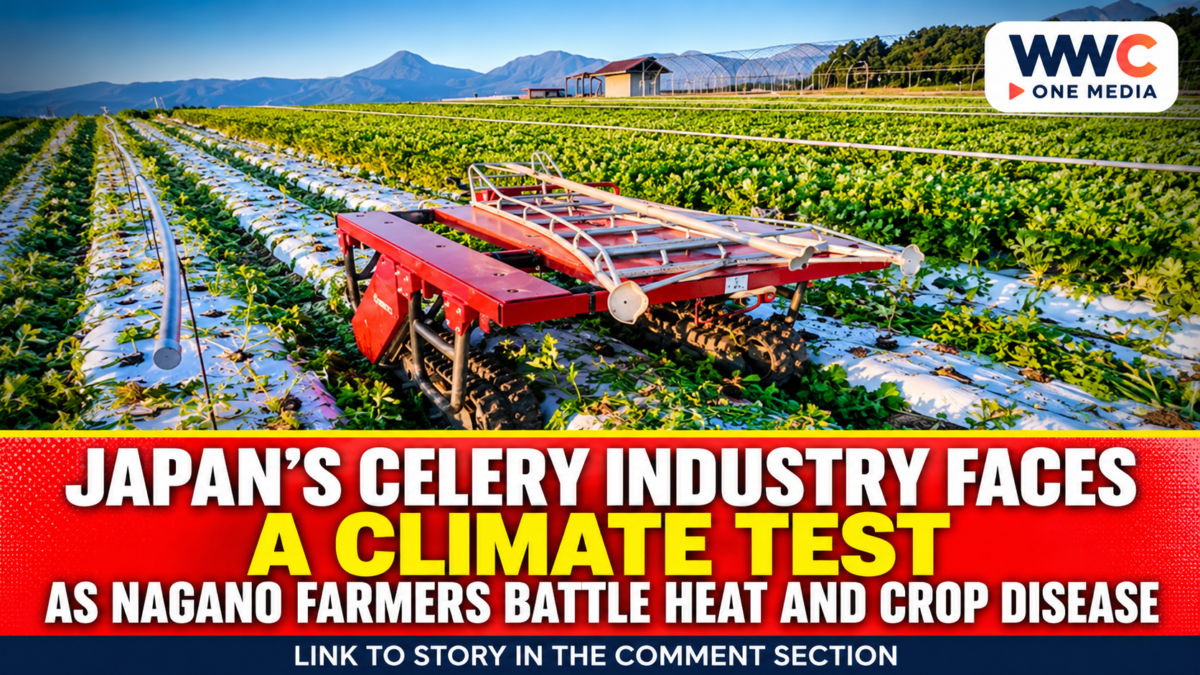
Nagano Prefecture, Japan’s leading celery-producing region, is confronting a growing challenge as hotter growing seasons and disease threaten the reliability of a crop that has long depended on the area’s cooler mountain conditions. A new agricultural manual published by the prefectural government in 2026 documents rising temperatures, declining shipments in the Suwa production area and the spread of celery blight.
The issue has implications beyond individual farms. Nagano produced 12,000 tonnes of celery in 2024, representing 41.5% of Japan’s national output, according to the prefecture’s agricultural statistics. The region’s ability to maintain production matters to domestic vegetable supply, farm incomes and the businesses involved in growing, transporting and selling fresh produce.
The official findings also show why climate adaptation is becoming a practical necessity for agriculture. Farmers must manage not only hotter conditions but also periods of excessive rainfall, waterlogged fields and crop diseases that can make production less predictable.
Nagano’s celery industry faces pressure from changing conditions
Nagano’s importance to Japan’s celery supply is substantial. The prefecture recorded 12,000 tonnes of production from 226 hectares in 2024, retaining its position as the country’s largest celery-producing prefecture.
The figures in Nagano’s 2026 agricultural overview also show how production has changed over time. In 1975, the prefecture harvested 14,700 tonnes from 333 hectares. By 2024, the cultivated area had declined to 226 hectares, while annual output stood at 12,000 tonnes.
Those figures do not establish that climate change caused the reduction in cultivated area. Changes in the number of growers, farm economics, production methods and other conditions can also influence agricultural output.
However, the prefectural government’s latest celery disease-control manual identifies climate and disease pressures as important concerns for the Suwa region, one of Nagano’s key production areas.
Its findings show that the challenge is no longer limited to maintaining the traditional growing schedule. Production planning increasingly needs to account for conditions that can change within a single growing season.
Temperatures during the growing season have increased
The Nagano prefectural manual compares temperatures in Hara, a municipality in the Suwa region, across two five-year periods.
Between late June and mid-September, the average daily maximum temperature was 27.7 degrees Celsius during 2021–2025. For the same seasonal period in 1991–1995, the average was 24.4 degrees Celsius.
That represents an increase of 3.3 degrees Celsius between the two periods.
The comparison is particularly relevant because the manual identifies 25 to 30 degrees Celsius as the favourable temperature range for the development of celery blight, a disease affecting the crop.
The findings do not mean that every hot day will produce an outbreak. Disease development also depends on moisture, field conditions and the presence of the pathogen.
But the temperature comparison highlights an important agricultural problem: conditions that were once less common during parts of the growing season are now occurring more frequently in the local production environment.
The wider national trend is consistent with the concern. Japan’s Agriculture, Forestry and Fisheries Ministry has reported that the summer of 2025 was the hottest in the country since national statistics began in 1898. The ministry has also documented heat-related effects on vegetable production and encouraged growers to consider measures suited to local conditions.
A disease outbreak adds another layer of risk
Heat is not the only problem confronting celery producers.
Nagano’s manual documents the discovery of celery blight in June 2021 in fields in the Suwa region, particularly in areas with poor drainage. The disease was attributed to a pathogen belonging to the Phytophthora group and was subsequently identified as celery blight.
The disease can cause yellowing leaves, reduced plant growth, discoloured vascular tissue and decay around the growing centre. Severe infections can lead to plant death.
The manual explains that the pathogen can survive in soil and infected plant material. It also identifies temperatures between 25 and 30 degrees Celsius and excessive moisture as conditions that favour disease development.
This creates a difficult combination for growers. Hot conditions can encourage disease development, while heavy rain and waterlogged soil can provide the moisture that allows the pathogen to spread.
The prefecture’s earlier plant-protection notice, issued in February 2022, also identified poorly drained fields as a concern and advised growers to improve drainage and remove infected plants.
The problem is therefore not simply a matter of keeping crops cool. Farmers must also manage water carefully enough to prevent prolonged saturation while ensuring that plants receive adequate irrigation.
Official research shows declining shipments in the Suwa region
The 2026 manual provides another important indication of the pressure on local production.
Based on information from the JA Shinshu Suwa agricultural cooperative, the document says the number of celery producers in the area had declined by approximately four growers each year since 2017. Shipments also showed a downward trend.
The manual identifies celery blight as an additional factor that contributed to the decline.
It also compares shipment volumes before and after the disease was identified. The prefectural support centre found that shipments during high-temperature periods, particularly from mid-July to early August and again in late August, had fallen substantially after the disease was confirmed.
The document attributes the reduction to the effects of high temperatures and celery blight.
These findings are important because they connect environmental conditions to an actual production challenge recorded by the regional agricultural support centre.
They also illustrate how crop losses can affect the wider agricultural economy. Lower shipments can reduce the amount of produce available to wholesalers and retailers, while growers may face higher costs when they need to replace damaged plants, manage disease or adjust cultivation practices.
WWC previously examined the importance of reliable water infrastructure for agricultural communities in its report on the ₱30.57-million Kalinga irrigation project. Although the Philippine project addresses different conditions, both cases demonstrate how water management can influence the reliability of agricultural production.
Nagano is turning research into practical farm measures
The prefectural government’s response includes a dedicated celery blight control manual prepared through work conducted between fiscal years 2023 and 2025. The document was published in March 2026.
Its recommendations cover field selection, soil preparation, drainage, nursery management and disease prevention.
Among the measures are improving field drainage, avoiding locations with a history of celery blight where possible, removing infected plants and using clean water for irrigation.
The manual also recommends preventing contaminated soil from being carried between fields on equipment and footwear. Such precautions matter because the pathogen can remain in soil and infected plant residues.
The prefecture also conducted tests involving pesticide treatment during transplanting. Its manual reports that the treatment tested in fiscal year 2025 prevented disease development for up to 30 days after application.
The document identifies registered fungicide options and provides instructions on their permitted use. Farmers are directed to follow the applicable product labels, including application rates, timing and limits on the number of treatments.
These measures do not eliminate the effects of changing weather. They do, however, provide growers with a more structured approach to managing a disease that can become more difficult to control under warm and wet conditions.
Climate adaptation is becoming an economic issue for agriculture
The challenges in Nagano reflect a wider concern for vegetable producers: climate adaptation increasingly requires investment, technical knowledge and adjustments to established farming practices.
Japan’s agriculture ministry identifies several approaches to managing high temperatures, including improved ventilation, irrigation management, shading materials, cooling equipment and heat-tolerant varieties.
A separate national assessment of agricultural adaptation measures also notes that equipment and materials can involve additional costs and labour. This creates a practical obstacle, particularly for smaller producers with limited financial resources.
The same challenge is relevant to the Philippines, where farmers face their own combination of heat, rainfall variability and water shortages.
WWC has previously reported on Central Visayas’ potential agricultural losses linked to El Niño, highlighting how water availability can influence crop production and regional food supply.
The importance of timely climate information is another shared concern. In its report on AI-powered weather forecasting for Philippine agriculture, WWC examined how better access to weather and climate data could support planting schedules, irrigation decisions and farm preparation.
Nagano’s experience offers a useful example of why adaptation must be specific to the crop and location. Measures that work for one vegetable or growing region may not be sufficient for another.
What happens next
Nagano’s immediate challenge is to protect production while helping growers manage the combined risks of heat, excessive moisture and disease.
The prefectural manual provides practical guidance, but its long-term effectiveness will depend on how consistently the measures are adopted and whether they can keep pace with changing field conditions.
Future production and shipment data will help show whether the measures are improving the situation. The number of active growers will also remain an important indicator of the industry’s ability to maintain its position.
For now, the official evidence points to a clear problem: Nagano remains central to Japan’s celery supply, but the conditions supporting that production are becoming more difficult to manage.
The experience is a reminder that climate change does not affect agriculture only through dramatic disasters. It can also reshape ordinary growing seasons, increase disease risks and make the production of familiar vegetables more demanding year after year.
Frequently asked questions
Why is Nagano important to Japan’s celery supply?
Nagano produced 12,000 tonnes of celery in 2024, accounting for 41.5% of Japan’s national output. It ranked first among Japanese prefectures for celery production.
How much have temperatures increased in Nagano’s celery-growing season?
The Nagano prefectural manual recorded an average daily maximum temperature of 27.7 degrees Celsius in Hara during the late-June-to-mid-September growing period in 2021–2025, compared with 24.4 degrees Celsius in 1991–1995.
What is celery blight?
Celery blight is a plant disease caused by a pathogen belonging to the Phytophthora group. It can cause yellowing leaves, poor growth, decay around the growing centre and, in severe cases, plant death.
Does hot weather cause celery blight?
The disease is favoured by temperatures of 25 to 30 degrees Celsius and excessive moisture. Heat alone does not guarantee an outbreak, but warm and waterlogged conditions can increase the risk.
What is Nagano doing to protect celery production?
The prefecture published a celery blight control manual in March 2026. It includes recommendations on field drainage, clean irrigation water, removal of infected plants, nursery hygiene and appropriate disease-control treatments.