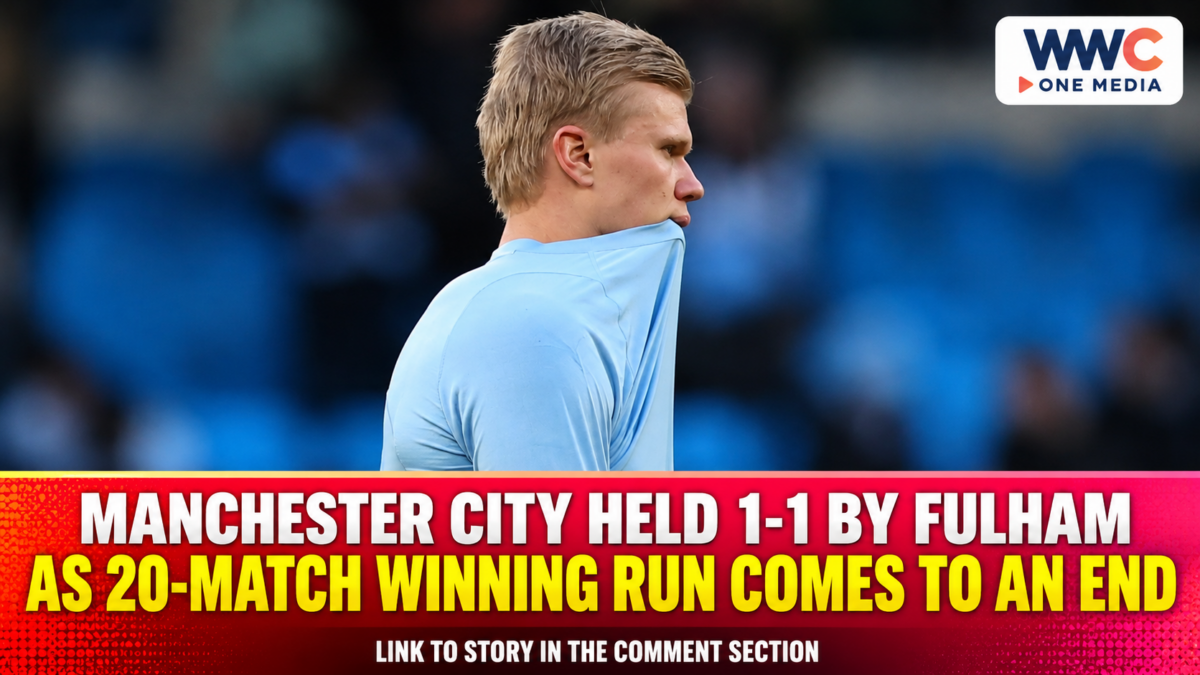
Manchester City were forced to settle for a 1-1 draw against Fulham at the Etihad Stadium on Nov. 21, 2026, after Rodrigo Muniz gave the visitors an early lead and Elliot Anderson equalised in the second half. The result ended City’s 20-match winning streak against Fulham across all competitions and left the Manchester club third in the Premier League table, five points behind leaders Arsenal.
The match also produced a major talking point involving Erling Haaland. His first-half effort was ruled out after referee Tom Bramall judged that the striker had fouled Fulham goalkeeper Bernd Leno, with VAR confirming the decision.
For City, the dropped points came at a difficult stage of the campaign. The club had been trying to recover from a run of defeats, and the draw offered only a partial response. Fulham, meanwhile, left Manchester with a result that ended a long period without taking points against one of the league’s strongest sides.
Fulham Strike First and Put City Under Pressure
Fulham took the lead in the 16th minute through Muniz, who finished after Oscar Bobb created the opportunity. The goal gave the visitors an early advantage and forced City to chase the match.
The home side struggled to establish its usual attacking rhythm during the opening period. Fulham defended compactly, limited City’s opportunities to play through the middle and looked for openings when possession changed hands.
Bobb nearly helped Fulham extend the lead before the interval. His effort tested Gianluigi Donnarumma, but the City goalkeeper prevented the visitors from going further ahead.
The early goal was significant beyond the scoreline. City had conceded first in several consecutive matches, making the need for a more controlled start an increasingly important issue.
The club’s wider season has included strong attacking performances, including Erling Haaland’s scoring contribution in its earlier Premier League victory over Ipswich Town. Against Fulham, however, the challenge was less about creating a headline score and more about finding a way through an organised defence.
Haaland’s Disallowed Goal Puts VAR in the Spotlight
One of the most discussed moments came around the 25th minute, when Haaland appeared to force the ball into the net after Leno had made a save.
Bramall ruled that the striker had committed a foul on the goalkeeper. VAR checked the decision and upheld it, meaning City’s apparent equaliser did not count.
The Premier League’s explanation focused on the goalkeeper’s control of the ball. The match officials determined that Leno had possession between his hands before Haaland played the ball away and into the goal. Premier League
That interpretation is connected to Law 12 of the Laws of the Game. The rule states that a goalkeeper is considered to be in control when the ball is between the goalkeeper’s hands or arms, among other specified situations. An opponent cannot challenge a goalkeeper while the goalkeeper has control in that manner.
The decision therefore concerned more than whether Haaland managed to put the ball over the line. The key question was whether Leno still had control when the striker intervened.
The incident will inevitably attract debate among supporters, particularly because it denied City a possible equaliser during a period when the team was struggling to break through. But the official explanation provides the basis for the decision: the goalkeeper was judged to have control, and VAR found no reason to overturn the referee’s call.
For readers following the increasing influence of video technology on major football matches, WWC has also examined a separate Manchester derby VAR controversy involving a Haaland goal. The incidents involved different circumstances, but both illustrate how decisions made during critical attacking moments can shape the discussion after a match.
Anderson’s Volley Rescues a Point
City found their equaliser in the 57th minute through Anderson, who struck a first-time volley after Fulham had cleared a corner only partially.
The midfielder’s finish from around 20 yards gave Leno little opportunity to prevent the ball from entering the net. It also changed the atmosphere at the Etihad, giving the home side renewed hope of completing a comeback.
City pushed forward after levelling the score. Anderson came close to scoring again when a clever touch from a Haaland cross sent the ball narrowly wide of the post.
Fulham also threatened. Muniz forced another save from Donnarumma, showing that the visitors were not content simply to defend their advantage.
Despite City’s pressure, Fulham maintained its defensive shape and prevented the home side from finding a second goal.
Anderson’s performance was one of the main positives for City. His equaliser restored the contest, while his later opportunity showed that he remained a threat around the penalty area.
The result also continued a broader conversation about City’s squad and attacking responsibilities. Haaland has been a major source of goals, but a demanding season requires contributions from other players when opponents limit the striker’s opportunities.
What the Draw Means for the Premier League Table
The result left Manchester City third with 22 points from 11 matches, recording seven wins, one draw and three defeats. Brighton were level on points but had a better goal difference and a game in hand.
Arsenal remained at the top with a five-point advantage over City and had also played one fewer match at the time of the published standings. Manchester City FC+1
That gap makes the dropped points important. City did not lose ground through a defeat, but they missed an opportunity to put pressure on the teams above them.
The draw also ended a remarkable sequence against Fulham. City had won 20 consecutive matches against the London club across all competitions before the November meeting. In the Premier League alone, the winning run had lasted 17 matches. Premier League+1
For Fulham, the result was a meaningful achievement. It showed that the club could compete against City and manage the closing stages of a match without allowing the home side to take control.
City’s earlier narrow win over Coventry, covered in WWC’s report on Manchester City’s difficult 1-0 victory, had already demonstrated that not every league match would be straightforward. The Fulham draw reinforced the point that City must find more consistent ways to turn possession and attacking pressure into victories.
City’s Defensive Record Becomes a Concern
The result also raised questions about City’s ability to prevent opponents from scoring first.
Manager Enzo Maresca acknowledged the problem after the match, saying: “After going behind you do things, you rush, and that’s not good for us. We need to find a way to keep a clean sheet.” Manchester City FC
His comments pointed to an issue that cannot be solved solely by adding more attacking pressure. When City concede early, opponents can become more comfortable defending their lead, while City are required to take greater risks to recover.
The Premier League’s matchweek review noted that City had gone nine matches in all competitions without keeping a clean sheet, conceding 18 goals during that period. Premier League
That record gives the coaching staff a clear area to address. A team competing for the title needs to create chances, but it must also manage the opening stages of matches and avoid repeatedly giving opponents an advantage.
The Fulham match offered evidence of both sides of City’s current situation: the team can respond after falling behind, but its recovery efforts do not always produce a winning result.
What Happens Next
Manchester City are scheduled to face Napoli in the UEFA Champions League on Nov. 24 before travelling to the Emirates Stadium for a Premier League meeting with Arsenal on Nov. 29. Manchester City FC
The Arsenal fixture could carry significant consequences for the title race. City will have an opportunity to reduce the gap against the league leaders, but they will need a more convincing performance than the one that produced a draw against Fulham.
The immediate priority is to improve defensive concentration, avoid conceding early and make better use of attacking opportunities.
Fulham, meanwhile, can take confidence from ending a long losing sequence against City. The point does not determine the club’s season, but it provides a valuable result against a major opponent.
Frequently Asked Questions
What was the score between Manchester City and Fulham?
The match ended in a 1-1 draw on Nov. 21, 2026, at the Etihad Stadium.
Who scored the goals?
Rodrigo Muniz scored for Fulham in the 16th minute. Elliot Anderson equalised for Manchester City in the 57th minute.
Why was Erling Haaland’s goal disallowed?
Referee Tom Bramall ruled that Haaland had fouled goalkeeper Bernd Leno while the goalkeeper was in control of the ball. VAR checked and confirmed the decision.
What position did Manchester City hold after the draw?
City were third in the Premier League standings with 22 points from 11 matches, level on points with Brighton but behind on goal difference.
When will Manchester City play Arsenal?
Manchester City are scheduled to visit Arsenal on Nov. 29, 2026, in their next major Premier League fixture.