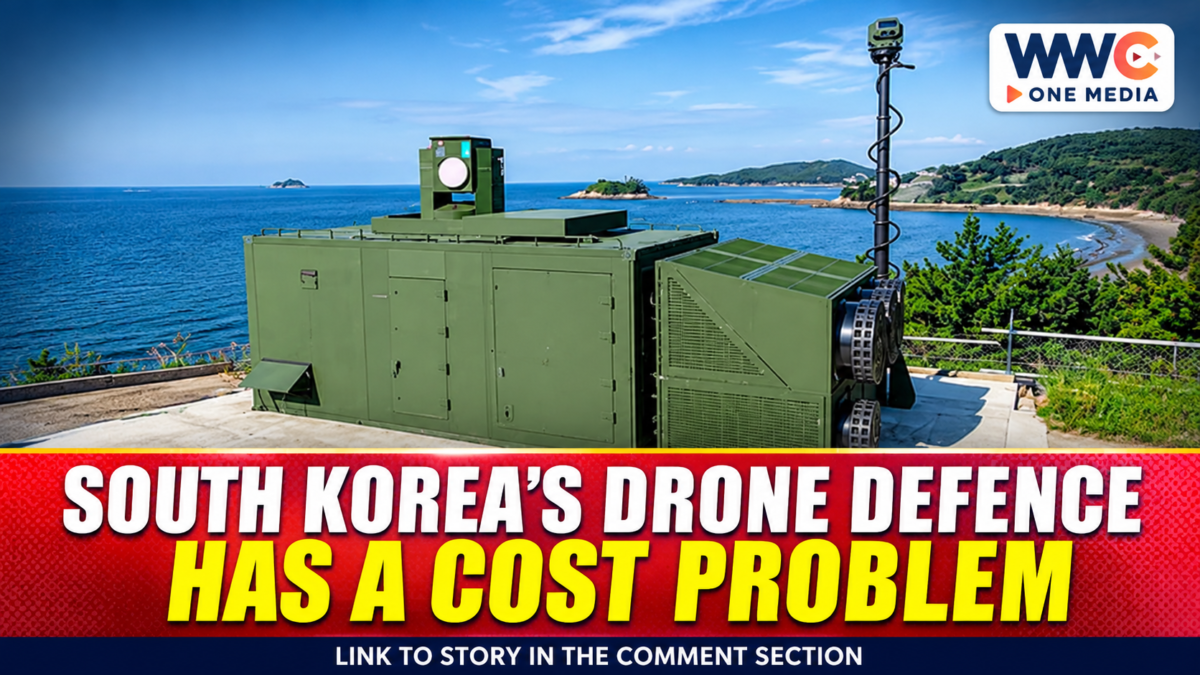
South Korea is increasing investment in systems designed to counter unmanned aircraft, including laser-based weapons, as part of a broader military modernisation programme. Its proposed 2027 defence budget allocates 806.1 billion won to strengthening drone and counter-drone capabilities, an 18.8% increase from the 678.8 billion won allocated for 2026.
The spending plan places particular attention on technologies intended to address small aerial threats without relying exclusively on conventional missiles. Among the systems being expanded is the country’s Cheongwang laser anti-aircraft weapon, alongside development work on a more mobile second-generation version.
The shift reflects a growing defence-planning challenge: protecting military facilities and personnel against relatively inexpensive unmanned aircraft while managing the cost of detection, interception and sustained operations.
For South Korea, the answer is not simply to replace every missile with a laser. Its official procurement plans instead point towards a layered defence network combining different technologies for different threats. 방위사업청+2
Why drone defence is becoming a budget priority
South Korea’s proposed 2027 defence budget totals 73.2777 trillion won, representing an 8.2% increase from the previous year’s budget.
The government submitted the proposal to the National Assembly on Sept. 3, 2026. It identifies advanced military technology, artificial intelligence, unmanned systems and counter-drone capabilities as investment priorities.
Within that proposal, spending for drone and counter-drone capabilities is scheduled to rise from 678.8 billion won in 2026 to 806.1 billion won in 2027.
That is an additional 127.3 billion won.
The proposed allocation covers more than weapons used to destroy incoming drones. It also includes research and development, training, equipment acquisition and systems intended to identify and respond to aerial threats.
The government has also outlined plans to develop swarm-drone technologies and expand the use of smaller unmanned aircraft for military missions.
This creates a two-sided modernisation effort: South Korea wants to expand its own drone capabilities while improving its ability to defend against similar technologies used by potential adversaries. 방위사업청+1
Cheongwang: South Korea’s laser-based answer
South Korea develops homegrown laser weapon technology to defend against drones
One of the most notable developments is the Cheongwang laser anti-aircraft weapon, officially designated Laser Anti-Aircraft Weapon Block-I.
South Korea’s Defense Acquisition Program Administration (DAPA) announced on July 11, 2024, that it had signed a mass-production contract with Hanwha Aerospace on June 25, 2024.
The programme began in August 2019, with 87.1 billion won invested in development. The Agency for Defense Development led the system-development work, while Hanwha Aerospace participated as the prototype manufacturer.
The system uses a high-powered fibre-based laser directed at a target to disable it. DAPA identifies small unmanned aircraft and multicopters as intended targets.
Unlike conventional interceptor missiles, the weapon does not require a separate projectile for each engagement. It uses electricity to generate the laser beam.
DAPA estimated the cost of one firing at approximately 2,000 won in its July 2024 announcement.
That figure is important, but it should be understood correctly. It refers to the estimated cost per firing, not the total cost of purchasing, operating and maintaining the complete weapons system.
The distinction matters when comparing laser weapons with conventional air-defence equipment. 방위사업청
Domestic technology is becoming part of the strategy
South Korea’s laser programme has continued beyond the initial production contract.
On June 1, 2026, DAPA announced that it had successfully developed a domestically produced laser oscillator, one of the central components of the Cheongwang system.
The agency said the new component increased the system’s domestic content rate, measured by value, from 76% to 90%.
It also reported that the domestically developed oscillator improved major performance characteristics by approximately 50% or more compared with the previously imported component.
Additional testing showed a reduction in the time required to disable targets.
For drones, the reported engagement time decreased from two to four seconds to one to two seconds. For unmanned aircraft, the time decreased from more than 10 seconds to within several seconds.
DAPA said the domestically produced component would be incorporated into future production quantities following completion of the relevant defence specifications.
This development has implications beyond the weapon’s immediate battlefield application.
Reducing reliance on imported components can improve supply-chain control, support domestic manufacturing and provide greater flexibility for future upgrades.
It does not mean every component is now domestically produced, but the increase from 76% to 90% represents a measurable change in the system’s local industrial content. 방위사업청
Why South Korea is not abandoning conventional missiles
Laser weapons offer an attractive alternative for certain engagements, but they are not universal replacements for conventional air-defence systems.
A laser-based system requires electrical power, functioning sensors, a suitable engagement environment and sufficient time to maintain its beam on a target.
Its practical performance can also be affected by atmospheric conditions and the characteristics of the target.
Conventional missiles, meanwhile, remain important for threats that require different engagement ranges, speeds or destructive effects.
South Korea’s own defence plans reflect this distinction.
The proposed 2027 budget includes additional investment in an integrated counter-drone system for areas near the border, continued funding for the existing Laser Anti-Aircraft Weapon Block-I and new research and development for a mobile Laser Anti-Aircraft Weapon Block-II.
The government is therefore pursuing several complementary capabilities rather than relying on one technology.
This is also consistent with the country’s broader investment in long-range air-defence systems, including the L-SAM programme, which addresses a different category of aerial threat.
For readers following regional military developments, WWC has also examined North Korea’s recent air-defence missile development and weapons demonstrations.
The strategic environment makes detection, tracking and interception capabilities important parts of South Korea’s defence planning.
What the investment could mean for the defence industry
The expansion of counter-drone spending could create opportunities for South Korean defence manufacturers, research institutions and technology suppliers.
Hanwha Aerospace participated in the initial Cheongwang production programme. The subsequent domestic laser-oscillator development also demonstrates the role of local industrial suppliers in advancing the system.
However, a larger budget allocation does not automatically translate into completed procurement contracts, guaranteed production volumes or additional export orders.
The proposed funding must pass through the budget process, while individual projects must progress through their own acquisition, development and evaluation requirements.
South Korea is also pursuing a broader approach to drone acquisition. Its proposed K-Blue UAS certification system is intended to support the rapid acquisition of drones that meet quality requirements.
That initiative suggests the government is looking beyond weapons alone. Reliability, standardisation, training and supply availability are also important components of a functioning drone ecosystem.
The country’s defence industry could benefit if these programmes lead to sustained demand for locally developed systems. Actual commercial results, however, will depend on procurement decisions, technical performance and production capacity.
This broader regional interest in unmanned technology also connects with Japan’s planned transfer of surveillance drones and coastal radar to the Philippines, where unmanned aircraft are being considered for a different purpose: maritime monitoring rather than interception.
What happens next
The next major milestones involve the implementation of South Korea’s proposed 2027 defence budget and the progress of its planned counter-drone programmes.
The government has identified increased investment in Laser Anti-Aircraft Weapon Block-I, development of the mobile Block-II version and an integrated counter-drone system.
The domestic laser oscillator is also expected to be incorporated into future production quantities.
The effectiveness of these investments will ultimately depend on operational performance, reliability, deployment conditions and the ability to integrate different systems into a coordinated defence network.
For South Korea, the central challenge is not simply finding a cheaper way to destroy a drone. It is building a defence structure that can detect, assess and respond to different aerial threats without making every interception unnecessarily expensive.
The laser programme offers one possible part of that solution. Whether it can deliver the expected operational and financial advantages at scale will become clearer as deployment and procurement progress.
Frequently asked questions
1. What is South Korea’s Cheongwang laser weapon?
Cheongwang is South Korea’s Laser Anti-Aircraft Weapon Block-I. It uses a high-powered laser to disable small unmanned aircraft and multicopters.
2. How much does one Cheongwang laser firing cost?
DAPA estimated the cost at approximately 2,000 South Korean won per firing in its July 2024 announcement. This does not represent the full cost of operating the system.
3. How much is South Korea allocating to drone defence in 2027?
The proposed 2027 budget allocates 806.1 billion won to drone and counter-drone capabilities, up 18.8% from 678.8 billion won in 2026.
4. Who manufactures South Korea’s Cheongwang laser weapon?
Hanwha Aerospace participated as the prototype manufacturer and signed the initial mass-production contract with DAPA on June 25, 2024.
5. Will laser weapons replace conventional air-defence missiles?
No. Laser weapons are intended for particular types of aerial threats. Conventional missiles remain necessary for other targets and engagement requirements.
Additional WWC internal coverage
The security dimension also connects with South Korea’s emergency security meeting following a North Korean missile launch. That separate development provides regional context for Seoul’s continued attention to air and missile defence.