
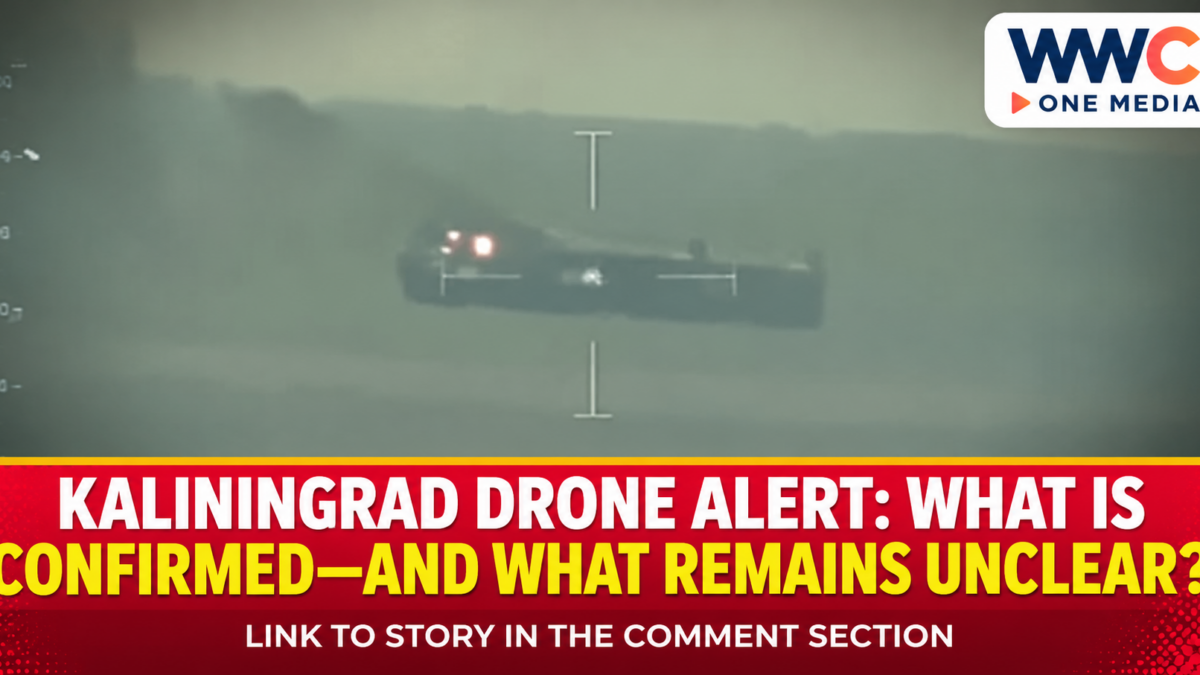
Reports of air-defence activity and explosions in Russia’s Kaliningrad region on Nov. 21 have raised questions about a possible security incident near Baltiysk, home to a major Russian naval facility. However, publicly available information does not establish that the Baltic Fleet base was struck or that any military installation sustained confirmed damage.
The incident illustrates the difficulty of verifying events around military facilities during an active war, particularly when early accounts rely on video clips, local reports and claims circulating online. The distinction between an air-defence response, a suspected drone incident and a confirmed strike remains central to understanding what happened.
Kaliningrad Drone Alert: What the Available Information Shows
Reports circulated on Nov. 21 describing alerts, possible aerial activity and air-defence fire in the Kaliningrad region, Russia’s Baltic exclave between Poland and Lithuania.
Baltiysk became a particular focus because it is a major port city associated with Russia’s Baltic Fleet. That strategic significance, however, does not independently establish that the naval facility was the target of any activity reported that evening.
An alert or defensive response can indicate that authorities detected or suspected a potential aerial threat. It does not, by itself, prove that a drone reached a military target, that a strike occurred or that infrastructure was damaged.
The distinction matters because the initial information surrounding military incidents can change as authorities investigate, review footage and assess possible threats.
At this stage, the key question is not simply whether activity was reported, but what can be confirmed independently from the available evidence.
Why Baltiysk Matters to Russia’s Baltic Security
Baltiysk is strategically important because of its location on the Baltic Sea and its association with Russia’s naval presence in the region.
Kaliningrad is geographically separated from mainland Russia and borders NATO members Poland and Lithuania. Its location makes military developments there particularly sensitive for Russia and neighbouring European countries.
The region’s military significance means reports of aerial activity can quickly attract international attention. But its strategic importance should not be used as a substitute for evidence when assessing the details of a particular incident.
The same caution applies when interpreting images or videos showing lights, flashes, smoke or tracer-like activity. Visual material may show something happening in the sky, but it may not reveal the precise location, cause, target or result.
For readers following Russia’s wider drone-defence activity, WWC previously examined Russia’s reported drone interceptions across multiple regions, highlighting why official interception claims and independently confirmed outcomes should be treated as separate categories of information.
Air-Defence Activity Does Not Automatically Confirm a Strike
Air-defence systems can be activated for several reasons, including a suspected drone, an unidentified object or a warning issued as a precaution.
Even when video appears to show defensive fire, the footage alone may not establish what the system was engaging. It may also be difficult to determine whether the recording shows the same location and time as the incident being discussed.
A confirmed strike requires stronger evidence, such as an official acknowledgement, verifiable imagery of an impact, reliable geolocation or an independently documented damage assessment.
Without that evidence, claims that a particular naval facility, oil terminal or military installation was hit should remain unconfirmed.
That is particularly important in the Baltic region, where military activity, electronic interference, drone operations and competing information claims can complicate the verification process.
Why the Baltic Region Is Watching Drone Incidents Closely
Kaliningrad’s position between NATO countries places it within a particularly sensitive security environment.
Drone activity near national borders can create risks beyond the location where an aircraft is detected. Authorities may need to assess airspace concerns, determine whether an object presents a threat and decide whether precautionary restrictions are necessary.
These incidents also raise questions about attribution. Detecting an object does not necessarily establish where it was launched, who controlled it or what its intended destination was.
WWC has previously reported on a drone incident inside Lithuania that prompted a NATO response, illustrating why investigators must distinguish an aircraft’s route from proof of its operator or intended target.
That distinction is especially important when an incident occurs close to NATO territory. A premature attribution could create unnecessary alarm or contribute to inaccurate claims about cross-border activity.
The Information Gap Is as Important as the Initial Reports
In fast-moving military incidents, early information often consists of separate pieces: videos, alert notifications, statements by local authorities and accounts from people in the area.
Those pieces may provide useful clues, but they do not necessarily form a complete or verified picture.
A video showing air-defence activity cannot independently establish that a naval installation was attacked. Reports of explosions do not establish the type of weapon involved, while smoke or a bright flash does not automatically confirm a successful strike.
The responsible approach is to assess each claim separately.
Was there an official alert? Was an aerial object identified? Was defensive fire confirmed? Was an impact documented? Was damage inspected? Were casualties reported?
Each question requires evidence of its own.
Kaliningrad’s strategic position has previously been central to regional security discussions, including Russia’s warnings concerning NATO and the military situation around the exclave. Those wider tensions provide context, but they do not verify the details of the latest reported incident.
What Happens Next
The most important developments would be a clear official account of the alert, confirmation of whether aerial objects were detected, and any documented assessment of damage or casualties.
If authorities release verified information about an incident involving a military or civilian facility, that would help establish whether the reports involved defensive activity, an attempted attack or an actual impact.
Until then, the available information does not justify declaring that the Baltic Fleet base was successfully attacked.
The reported activity is relevant to regional security, but the evidence must determine the conclusion—not the strategic importance of the location or the speed at which claims circulate online.
Frequently Asked Questions
Were explosions reported in Kaliningrad?
Reports circulated on Nov. 21 describing explosions and air-defence activity in the Kaliningrad region. The precise circumstances and results remain incompletely verified.
Was Russia’s Baltic Fleet base in Baltiysk attacked?
A confirmed strike on the Baltic Fleet base has not been established by the public evidence reviewed for this draft.
Were Ukrainian drones involved?
Drone activity was alleged in circulating reports, but the available evidence does not independently establish the origin, operator or target of any aircraft involved.
Was military infrastructure damaged?
No independently verified damage assessment establishing damage to the Baltic Fleet base or a specific military installation was available for this draft.
Why is Kaliningrad strategically important?
Kaliningrad is a Russian exclave on the Baltic Sea between Poland and Lithuania. Its location and military significance make security incidents in the region sensitive for Russia and neighbouring NATO countries.










