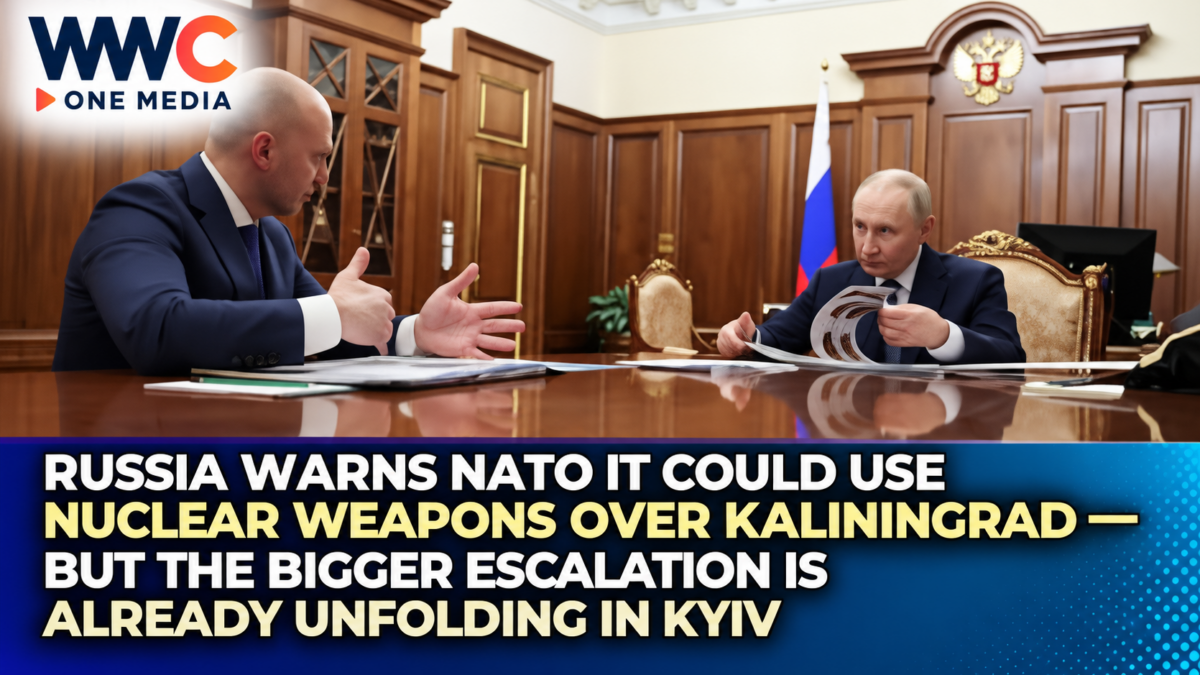
BRUSSELS/KYIV — Russia has delivered one of its strongest nuclear warnings to NATO in years, saying it is prepared to use its full military arsenal—including nuclear weapons—if the alliance attempts to isolate or blockade the heavily militarized Russian exclave of Kaliningrad.
The warning came in a diplomatic communication sent to NATO and reviewed by Reuters, with Moscow accusing the alliance of pursuing a “dangerous and reckless course” that could trigger a direct armed confrontation.
Russia also warned that any such conflict could involve strikes on “decision-making centers” inside NATO member states.
But NATO Secretary General Mark Rutte has sought to lower the temperature.
He said the alliance sees no imminent Russian threat to NATO territory, stressed that NATO is defensive, and urged Moscow to stop making nuclear threats and end its invasion of Ukraine.
That creates a dangerous contradiction.
NATO says no blockade of Kaliningrad is planned.
Russia says it is preparing for the possibility anyway.
And while both sides insist they are trying to deter the other, the rhetoric is becoming increasingly explicit.
Kaliningrad Is the Flashpoint
Kaliningrad is one of Russia’s most strategically sensitive territories.
The Russian exclave sits on the Baltic Sea between Poland and Lithuania, both NATO members.
It is geographically separated from mainland Russia and hosts important military infrastructure, including Russia’s Baltic Fleet and nuclear-capable Iskander missile systems.
Its location makes it both valuable and vulnerable.
If a direct NATO-Russia conflict ever erupted in the Baltic region, Kaliningrad would almost certainly become one of the most important strategic locations.
Russia therefore treats any suggestion that the territory could be cut off from the rest of the country as an existential military threat.
Moscow Says NATO Is Preparing a Blockade
Russia’s warning goes further than ordinary deterrence language.
Moscow says it has information suggesting NATO could be preparing an air and naval blockade of Kaliningrad.
NATO rejects that claim.
Rutte said the alliance poses no offensive threat to Russia and described Moscow’s nuclear rhetoric as unnecessary and unhelpful.
That distinction is critical.
There is currently no independently verified evidence that NATO has decided to blockade Kaliningrad.
Russia’s threat is therefore a response to a scenario Moscow says it fears, not to an announced NATO operation.
That does not make the warning insignificant.
It shows how quickly military exercises and defensive deployments can be interpreted by the other side as preparation for offensive action.
NATO Is Strengthening the Baltic Region
Russia’s concern is occurring against a backdrop of dramatically stronger NATO defenses along its eastern flank.
NATO says it has reinforced forces from the Arctic to the Black Sea in response to Russia’s full-scale invasion of Ukraine and growing concerns over sabotage, cyberattacks and airspace violations.
The alliance has deployed additional:
fighter aircraft,
air-defense systems,
ground forces,
naval patrols,
and surveillance capabilities
throughout the Baltic region.
On September 15, NATO aircraft shot down a drone that violated Lithuanian airspace, according to the alliance.
Those moves are intended to reassure NATO members.
Moscow sees them very differently.
Russia Says the Military Buildup Is Provocative
The Kremlin argues that NATO’s increasing military presence near Russia represents evidence of hostile intent.
Russia has also pointed to NATO exercises and the alliance’s Baltic Sentry mission as evidence of what Moscow describes as preparation for greater control over the Baltic Sea.
NATO says those deployments are defensive and were strengthened because of Russian actions.
That produces a classic security dilemma.
NATO strengthens defenses because it fears Russia.
Russia sees those defenses and feels more threatened.
Russia increases military readiness.
NATO then interprets that buildup as proof it needs even stronger defenses.
Neither side has to actively want war for that cycle to become dangerous.
Rutte Says Putin ‘Can Never Win’ Against NATO
Despite the language from Moscow, Rutte attempted to reassure European governments.
He said Russian President Vladimir Putin understands that Russia could not defeat NATO in a direct war.
That is why Rutte said he does not currently view Moscow’s warning as evidence of an imminent attack.
But NATO still formally responded to the Russian communication.
That matters.
The alliance clearly considers the nuclear warning serious enough that it could not simply ignore it.
Rutte’s approach appears to be:
do not panic,
do not escalate rhetorically,
but maintain overwhelming deterrence.
NATO Remains a Nuclear Alliance Too
Russia is not the only nuclear power in this confrontation.
NATO’s deterrence policy relies on a combination of U.S., British and French nuclear capabilities alongside conventional and missile-defense systems.
The alliance says nuclear forces remain a central element of deterrence as long as nuclear weapons exist.
That means any Russian nuclear attack on NATO territory would risk an overwhelming response.
This is precisely why nuclear deterrence is supposed to prevent direct war.
But deterrence works only if every side correctly interprets the intentions of the other.
The danger lies in miscalculation.
Analysts Warn Miscalculation Is the Real Risk
The current confrontation is dangerous not because NATO or Russia has announced plans for nuclear war.
Neither has.
The danger is that military movements, intelligence assessments and political statements could be misunderstood during a crisis.
Reuters cited nuclear-security experts warning that the growing intensity of rhetoric increases the possibility that one side could misread the other’s intentions.
That is especially concerning around Kaliningrad.
Because the territory is isolated geographically, Russia may perceive routine NATO operations nearby as preparations to cut it off.
At the same time, NATO governments may interpret Russian deployments inside Kaliningrad as preparation for attacks on Poland or Lithuania.
Putin Has Now Repeated the Warning Publicly
The threat did not end with the diplomatic message.
On October 1, Putin publicly reiterated that Russia would defend its territory using all available weapons if attacked, while denying that Moscow plans to attack European countries.
The wording matters.
Putin did not announce that Russia is preparing to use nuclear weapons now.
He repeated Russia’s doctrine of potentially using its full arsenal if Moscow believes Russian territory is under attack.
For NATO, the challenge is making sure defensive activity is not misinterpreted as the beginning of that scenario.
Meanwhile, Russia Is Intensifying Its War on Ukraine
The nuclear rhetoric in the Baltic comes as the war in Ukraine is becoming more intense again.
Russian forces launched a large-scale missile and drone attack on Ukraine around September 30, killing at least seven people, including a child, according to AP.
The strikes targeted energy and other infrastructure in and around Kyiv and other cities.
Ukraine says Russia has increased the use of:
ballistic missiles,
anti-ship missiles,
and faster jet-powered drones
that are harder for air-defense systems to intercept.
The assault has renewed fears that Moscow is beginning another coordinated campaign against Ukraine’s energy infrastructure ahead of winter.
Russia Is Also Targeting Kyiv’s Digital Infrastructure
The CNBC report highlighted another development receiving less attention than the nuclear threat:
Russia is increasingly targeting data centers and communications infrastructure in Kyiv.
Targets reportedly included major internet and data facilities.
That matters because modern warfare depends increasingly on digital infrastructure.
Data centers support:
banking,
communications,
government services,
business operations,
cloud computing,
and internet connectivity.
Damaging them can disrupt civilian life even without destroying traditional infrastructure such as bridges or power plants.
Digital Infrastructure Is Becoming a Battlefield
Russia’s focus on communications demonstrates how warfare has evolved.
Traditional military campaigns target:
air bases,
weapons depots,
railways,
and command centers.
Modern societies also depend on:
servers,
fiber-optic networks,
cloud platforms,
mobile towers,
and data centers.
Destroying those systems can create economic and psychological pressure without necessarily taking territory.
Ukraine has become one of the first large modern wars where digital infrastructure is consistently intertwined with conventional warfare.
Kyiv Is Also Facing Repeated Bridge Attacks
The strikes have continued since the CNBC report.
On October 3, Russian attacks damaged Kyiv’s Northern Bridge, forcing traffic to be suspended and disrupting one of the major routes across the Dnipro River.
Russia says bridges and transport infrastructure are legitimate military targets because they support Ukrainian logistics.
Ukraine argues Moscow is increasingly attacking infrastructure needed by millions of civilians.
Both sides deny intentionally targeting civilians.
But the cumulative effect is becoming severe.
Moscow Says the Strikes Will Continue
Russia has now said its large-scale attacks on Kyiv and other Ukrainian cities will continue.
On October 3, Moscow described the strikes as retaliation for Ukrainian attacks inside Russia and warned foreign nationals and diplomatic personnel about the risks of remaining in Ukrainian cities.
Putin has said Ukraine will continue to “pay a price” for attacks on Russian territory.
That language suggests the current escalation may not be temporary.
Ukraine Is Responding by Hitting Russian Oil Refineries
Kyiv is also escalating.
President Volodymyr Zelenskyy said Ukraine will intensify strikes on Russian oil refineries in response to what he describes as Moscow’s new doctrine of targeting Ukrainian infrastructure.
Ukraine argues refineries support Russia’s war economy by:
producing fuel for the military,
generating export revenue,
and supporting the state budget.
Those attacks have already disrupted parts of Russia’s refining system.
But they have also contributed to tighter global diesel markets, creating pressure on Kyiv from allies concerned about fuel prices.
Trump Has Asked Ukraine to Stop Refinery Strikes
U.S. President Donald Trump has publicly urged Zelenskyy to stop attacking Russian diesel-producing facilities because of the impact on global fuel markets.
Zelenskyy has so far shown little willingness to abandon the strategy.
That creates another layer of tension inside the Western coalition.
Ukraine sees Russian energy infrastructure as one of the few strategic targets where it can impose major economic costs on Moscow.
Washington is simultaneously concerned that successful Ukrainian attacks could worsen global inflation.
Russia Says Western Arms Factories Could Become Targets
The nuclear warning also comes amid broader Russian threats against Europe.
Russian officials have said weapons factories supporting Ukraine could be considered legitimate military targets under certain circumstances.
That does not mean Russia has announced plans to attack NATO factories.
But the rhetoric is another indication that Moscow increasingly portrays Western military assistance to Ukraine as direct participation in the conflict.
NATO rejects that characterization.
Alliance members say they support Ukraine’s right to defend itself while remaining outside the war themselves.
That distinction has been central to Western policy since 2022.
NATO Is Still Increasing Support for Ukraine
Despite Moscow’s threats, NATO has not indicated it will reduce military support.
Rutte said alliance members and partners allocated more than $10 billion over the past year through programs providing U.S. weapons and other military equipment to Ukraine.
NATO continues to emphasize air defense because Russian missiles and drones increasingly target Ukrainian cities and energy infrastructure.
Rutte has argued that delays in weapons deliveries cost lives.
That suggests Russia’s nuclear warnings are unlikely to produce the political outcome Moscow may want: significantly reducing Western support.
Lithuania Is Spending More Than 5% of GDP on Defense
The Baltic states are particularly alarmed by Russia.
Lithuania is expected to spend about 5.38% of GDP on core defense in 2026, according to NATO.
That is extraordinary by European standards.
The country is also investing in military infrastructure to accommodate allied troops.
Lithuania and neighboring Poland are central to the Kaliningrad issue because the Russian exclave sits between them.
Any confrontation there would immediately involve NATO territory.
The Suwałki Gap Is Another Strategic Vulnerability
Near Kaliningrad lies the Suwałki Gap, a narrow stretch of Polish-Lithuanian territory linking the Baltic states to the rest of NATO by land.
Military planners have long considered it one of the alliance’s most strategically sensitive areas.
Kaliningrad sits to one side.
Belarus—Russia’s close military ally—sits on the other.
If Russia ever attempted to sever that corridor, Estonia, Latvia and Lithuania could become much harder to reinforce over land.
Conversely, Russia fears NATO could isolate Kaliningrad during a conflict.
That geographical reality helps explain why rhetoric around the region becomes so intense.
Russia Has Nuclear-Capable Missiles in Kaliningrad
Kaliningrad hosts Iskander missile systems, which can carry either conventional or nuclear warheads.
That gives the region strategic importance far beyond its size.
Missiles launched from Kaliningrad can potentially reach targets across significant portions of Northern and Central Europe.
The territory also hosts Russian naval and air-defense assets.
That makes it simultaneously:
a defensive shield for Russia,
an offensive platform,
and a potential target during any NATO-Russia war.
Russia Is Increasing Reliance on Nuclear Signaling
NATO says Russia has become more reliant on nuclear rhetoric and dual-capable weapons during the Ukraine war.
The alliance has criticized Moscow for stationing nuclear weapons in Belarus and repeatedly using nuclear threats as a form of strategic intimidation.
Russia argues those moves are responses to Western military pressure and NATO’s nuclear capabilities.
Both sides portray their own nuclear forces as deterrence.
Each portrays the other side’s forces as threatening.
That asymmetry in perception is exactly what makes escalation dangerous.
The Nuclear Threat May Also Be Designed to Divide NATO
There is another possibility.
Rutte argues that Putin uses extreme rhetoric partly to distract NATO countries from supporting Ukraine and to create political division inside Europe.
Nuclear threats can create pressure on governments.
Some voters may ask whether supporting Ukraine is worth the risk of confrontation with Russia.
Others may demand even greater defense spending.
That makes nuclear signaling a political tool even if Moscow has no immediate intention of using nuclear weapons.
Europe Is Already Nervous About Hybrid Warfare
European governments are also increasingly accusing Russia of actions below the threshold of open war.
These include allegations involving:
cyberattacks,
sabotage,
disinformation,
GPS interference,
and suspicious activity around infrastructure.
Russia denies responsibility for many of those incidents.
NATO says such activities are increasing in frequency.
That creates another escalation problem.
A sabotage incident causing significant casualties could force NATO governments to decide whether it constitutes an armed attack.
The boundary between hybrid conflict and conventional war is increasingly difficult to define.
Ukraine’s War Is Now Costing $155 Billion a Year
All of this is happening while Ukraine faces enormous financial pressure.
Reuters reported that the total cost of Ukraine’s war effort is expected to reach approximately $155 billion in 2026.
Kyiv faces a roughly $27 billion funding gap that threatens its ability to sustain military operations into 2027.
Ukraine’s domestic budget revenues are already effectively absorbed by defense spending, leaving the country heavily dependent on Western financial support.
That means NATO’s support is not merely about weapons.
It is increasingly about whether Ukraine can financially sustain the war at all.
Russia Also Plans to Keep Spending Heavily
Russia is showing no sign of preparing to end its own military buildup.
Reuters reported that Moscow plans defense spending of around $202 billion in 2027.
That means both sides are planning for a prolonged war.
The economic picture therefore aligns with the military rhetoric.
Ukraine is looking for money to continue fighting.
Russia is budgeting for continued high military spending.
NATO is strengthening its eastern defenses.
And nuclear language is becoming increasingly explicit.
None of those trends point toward rapid de-escalation.
Peace Talks Remain Stalled
Rutte said Putin currently appears unwilling to engage seriously in negotiations to end the conflict.
“It takes two to tango,” he said, arguing that Moscow has shown little genuine willingness to move toward a peace settlement.
Russia argues that Western governments and Ukraine refuse to accept what Moscow describes as the territorial realities created by the war.
Ukraine rejects Russia’s demand to surrender territory Moscow has not fully captured.
That disagreement remains one of the central barriers to a settlement.
The Nuclear Rhetoric Does Not Mean Nuclear War Is Imminent
This point is critical.
The current evidence does not show that Russia is preparing an imminent nuclear strike against NATO.
Rutte explicitly says NATO’s threat assessment has not materially changed.
Russia’s statement was conditional.
NATO says the condition Moscow described—a blockade of Kaliningrad—is not being planned.
So headlines suggesting nuclear war is immediately approaching would overstate the evidence.
But dismissing the rhetoric entirely would also be a mistake.
Formal nuclear threats between Russia and NATO raise the consequences of any misunderstanding.
The Bigger Risk Is Escalation by Accident
The danger is increasingly concentrated in the Baltic region.
Russian aircraft and ships operate near NATO forces.
NATO fighters intercept drones and aircraft.
Military exercises take place near borders.
Ships patrol contested waters.
Cyberattacks and suspected sabotage create additional tension.
In that environment, one incident can change the political calculation extremely quickly.
A downed aircraft.
A missile landing on NATO territory.
A naval collision.
A strike misidentified as deliberate.
Any of those events could force leaders to make decisions within minutes.
That is why the increasingly explicit nuclear language matters.
Kyiv and Kaliningrad Are Now Part of the Same Escalation Story
At first glance, Moscow’s nuclear warning over Kaliningrad and its bombardment of Kyiv appear to be separate events.
They are increasingly connected.
Russia wants to weaken Ukraine and discourage NATO from increasing support.
NATO is strengthening its eastern flank because of the Ukraine war.
Russia sees that military buildup as a threat.
Ukraine responds to Russian attacks by striking targets deeper inside Russia.
Moscow then cites those attacks as justification for further escalation.
Each step reinforces the next.
NATO Is Trying to Project Calm — While Preparing for the Worst
Rutte’s message has been deliberately restrained.
There is no imminent threat.
NATO is stronger than Russia.
The alliance is defensive.
Support for Ukraine will continue.
But behind that calm language, NATO is increasing military readiness, strengthening air and missile defenses and stationing more forces on its eastern flank.
That tells a more complicated story.
NATO does not believe nuclear war is imminent.
But it clearly believes Europe’s security environment is dangerous enough to prepare for scenarios once considered extremely unlikely.
The Next Crisis May Not Begin in Ukraine
For more than four years, Ukraine has been the center of the conflict between Russia and the West.
The latest warning demonstrates how the confrontation could expand geographically.
Kaliningrad.
The Baltic Sea.
Poland.
Lithuania.
Belarus.
All are now increasingly important parts of the security equation.
A direct NATO-Russia clash remains something both sides say they want to avoid.
But the number of places where such a confrontation could begin is increasing.
That is what makes Moscow’s nuclear warning significant.
Not because Russia has announced an imminent nuclear attack.
But because the threshold for discussing nuclear weapons openly is becoming lower at exactly the moment conventional military activity around NATO’s eastern border is becoming more intense.
And while NATO insists there is no immediate threat, the real danger may be something harder to control:
a crisis neither side intends to start, but neither side can easily stop once it begins.