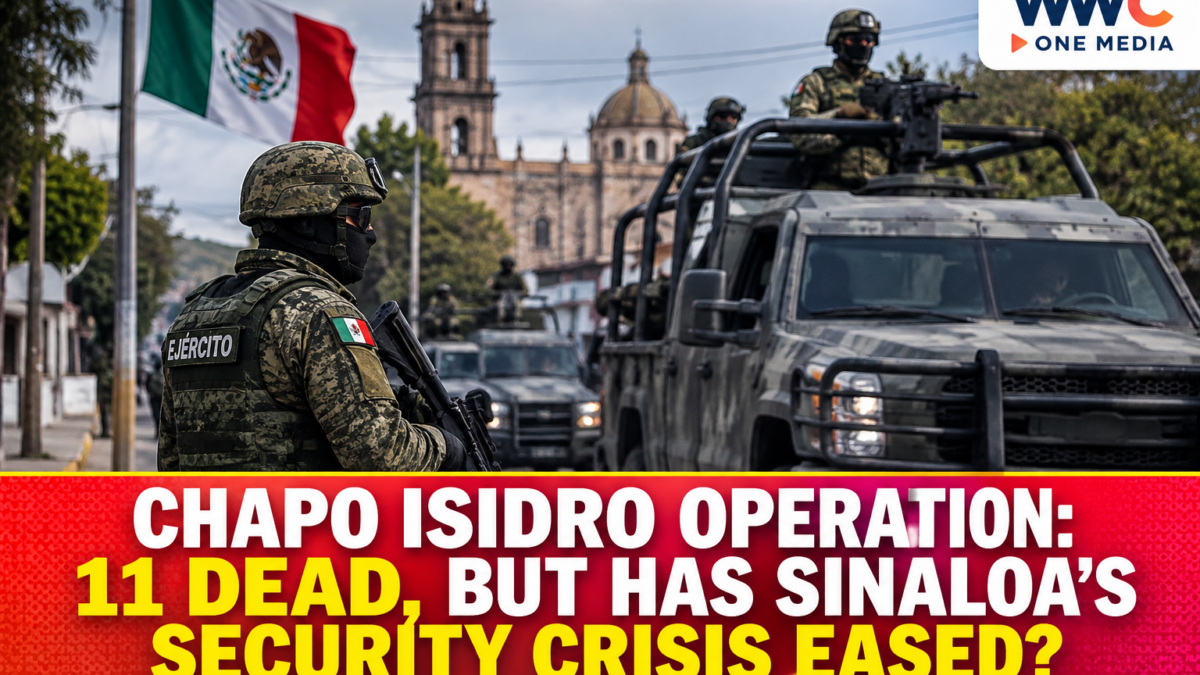
Mexico’s military says its Nov. 20 operation in Guasave, Sinaloa, resulted in the detention of Fausto Isidro Meza Flores, known as “Chapo Isidro,” and several other suspects. A follow-up statement recorded seven people described by the military as aggressors killed during the operation and four Army infantry personnel who died while travelling to reinforce security in the municipality.
The figures add up to 11 deaths, but the circumstances were not identical. The four soldiers were reported killed while moving to reinforce security, while the seven other deaths were attributed to the confrontation during the operation. That distinction matters when assessing the cost of the arrest and the response that followed.
The operation also triggered road blockades in several municipalities, prompting a wider security deployment. The central question now is not only who was detained, but whether authorities can maintain public safety and restore normal movement after a high-profile enforcement action.
Chapo Isidro operation: What Mexico says happened in Guasave
Mexico’s Defence Ministry said special forces from the National Guard and Army detained Fausto Isidro N, alias “Chapo Isidro,” in Guasave on Nov. 20. The ministry also named Germán N, known as “Serafín,” and José N among those arrested.
The ministry described the operation as the result of intelligence coordination between Mexican defence authorities and US counterparts. It said the military action involved reaching the target area, establishing security around the location and evacuating the detainees after their identities had been confirmed.
The three named detainees were transported to Mexico City aboard a Mexican Air Force aircraft and taken to the specialised federal prosecutor’s office for organised crime matters. The ministry said they were placed at the disposal of the federal public prosecutor, who would determine their legal situation.
The follow-up statement said eight suspected offenders had been detained in total. Three were transferred to Mexico City, while five were placed before the Attorney General’s Office in Culiacán. The ministry identified one of the five as Pánfilo N, whom it described as a cousin of “Chapo Isidro” and a logistical operator for the organisation.
The ministry also listed weapons, ammunition, tactical equipment, suspected drugs and money among the items seized. Its statement described the items as part of the operation’s results; it did not provide a judicial finding about the responsibility of each detainee.
Why the official death toll must be read carefully
The Defence Ministry’s Nov. 21 follow-up recorded seven people it described as aggressors killed during the operation. It separately reported that four regular Army infantry personnel died while travelling to reinforce security in Guasave.
Those two categories produce the combined figure of 11 deaths. They should not be compressed into a claim that 11 people died in one exchange of fire or that all 11 were members of the same group.
The ministry also stated that, at the time of its announcement, it had no report of harm to people uninvolved in the events. That is the military’s operational account as of the date of publication. It should not be converted into a final, independently verified civilian casualty assessment.
The US Department of Justice separately expressed condolences for the soldiers killed and confirmed the capture of Meza Flores. Its statement did not independently provide the Mexican military’s full breakdown of the 11 deaths.
For readers following how governments coordinate against criminal networks, WWC has examined the wider regional debate in its report on US security talks with Ecuador and the limits of anti-cartel cooperation. The Mexican operation is a separate case, but both raise the question of how enforcement cooperation is measured beyond the announcement of an arrest.
Road blockades spread the security response beyond the arrest site
Mexico’s Defence Ministry said blockades were recorded in Ahome, Guamúchil, Guasave and Navolato after the operation. It said an anti-blockade plan was activated with local authorities and security personnel were deployed to restore traffic and protect residents.
The state government’s Nov. 21 security update described a coordinated response involving federal, state and local institutions. It said authorities were working to remove vehicles used to obstruct roads and restore access for residents.
The state government also reported that residents in Guasave were able to return to their homes and that streets, roads and public spaces were reopening for daily activities. These statements describe the situation reported at that time; they do not establish that every disruption had ended permanently or that every route remained open afterwards.
Road access is a practical measure of public security. When major routes are blocked, residents can face difficulty reaching work, medical services, schools and family members. Businesses and transport operators may also experience interruptions, although the official statements reviewed do not provide a verified financial estimate of losses.
The wider issue of cross-border drug enforcement is also relevant to Philippine readers. WWC previously reported on the PDEA seizure of a major suspected drug shipment routed through Laos. The cases are not connected, but both demonstrate why investigations into organised trafficking require cooperation across agencies and jurisdictions.
The US case against Meza Flores remains a legal process
The US Department of Justice confirmed on Nov. 21 that Meza Flores had been captured by Mexican military forces in Guasave. It said a federal grand jury in the District of Columbia returned a second superseding indictment on Sept. 25, 2026.
The department described six counts involving alleged leadership of a continuing criminal enterprise, drug-trafficking conspiracies involving substances intended for importation into the United States, international money laundering, alleged material support to a terrorist organisation, narcoterrorism and firearms offences.
The department said the indictment included allegations involving cocaine, methamphetamine, heroin, marijuana and fentanyl. It also said the firearms counts included allegations involving a machine gun and a destructive device.
These are prosecution allegations, not findings of guilt. The department said that, if convicted, Meza Flores could face the death penalty or a mandatory term of life imprisonment. That describes potential penalties; it is not a sentence already imposed.
The department credited the Homeland Security Task Force investigation and identified the FBI, Homeland Security Investigations and other US agencies as participants, alongside Mexican partners. The announcement confirms cooperation, but does not publish a complete operational record of every agency’s actions during the arrest.
The legal distinction is important in any serious criminal case. WWC’s coverage of the Morelos student killing investigation has examined why arrests and allegations must remain separate from findings established through the courts. The same standard applies here, regardless of the seriousness of the charges.
Why capturing a senior figure does not prove a network has been dismantled
The arrest removes a prominent suspect from the group’s immediate operational picture, but it does not by itself establish that the organisation’s wider activities have stopped.
A criminal network can involve people responsible for logistics, financing, weapons, transport and distribution. The Mexican Defence Ministry’s own follow-up identified several alleged roles among the detainees, including a person it described as a financial operator and another as a logistical operator.
That information points to a broader enforcement challenge: authorities must establish whether investigations can reach the structures that support an organisation, rather than measuring success only by the detention of a senior figure.
This is analysis, not a claim that the organisation has reorganised or that further violence is inevitable. The official statements reviewed do not establish what happened to every part of the network after the arrests.
The same caution applies to public safety. A road reopening or a return of residents to their homes is an important immediate development, but sustained security requires continued monitoring and reliable information from local authorities.
What happens next
The next developments to watch are formal updates on the detainees’ legal status in Mexico, any official steps concerning proceedings in the United States, and further public-security information from Sinaloa.
The Mexican Defence Ministry said the detainees had been placed before the relevant prosecutorial authorities. The US Justice Department outlined the federal indictment, but its announcement did not set out a confirmed extradition timetable or a date for a future court hearing.
Authorities also need to keep the public informed about road access and security conditions in the affected municipalities. The Nov. 21 statements describe progress at that point, not a permanent guarantee that all routes and communities have returned to normal.
The operation is a significant arrest. Its longer-term result will depend on the legal process, the quality of follow-up investigations and whether public safety can be maintained after the immediate security deployment.
Frequently asked questions
How many people died in the Chapo Isidro operation?
Mexico’s Defence Ministry reported seven people it described as aggressors killed during the operation and four Army infantry personnel who died while travelling to reinforce security in Guasave. The combined figure is 11.
When was Chapo Isidro arrested?
The Mexican Defence Ministry said Fausto Isidro N, known as “Chapo Isidro,” was detained in Guasave, Sinaloa, on Nov. 20, 2026.
Who else was detained?
The ministry named Germán N, alias “Serafín,” and José N among the detainees. Its follow-up said eight suspected offenders were detained in total, with three transferred to Mexico City and five placed before federal prosecutors in Culiacán.
Which municipalities experienced road blockades?
The Defence Ministry reported blockades in Ahome, Guamúchil, Guasave and Navolato.
Has Meza Flores been convicted in the United States?
No. The US Department of Justice announced federal charges, but an indictment contains allegations that must be resolved through the judicial process.