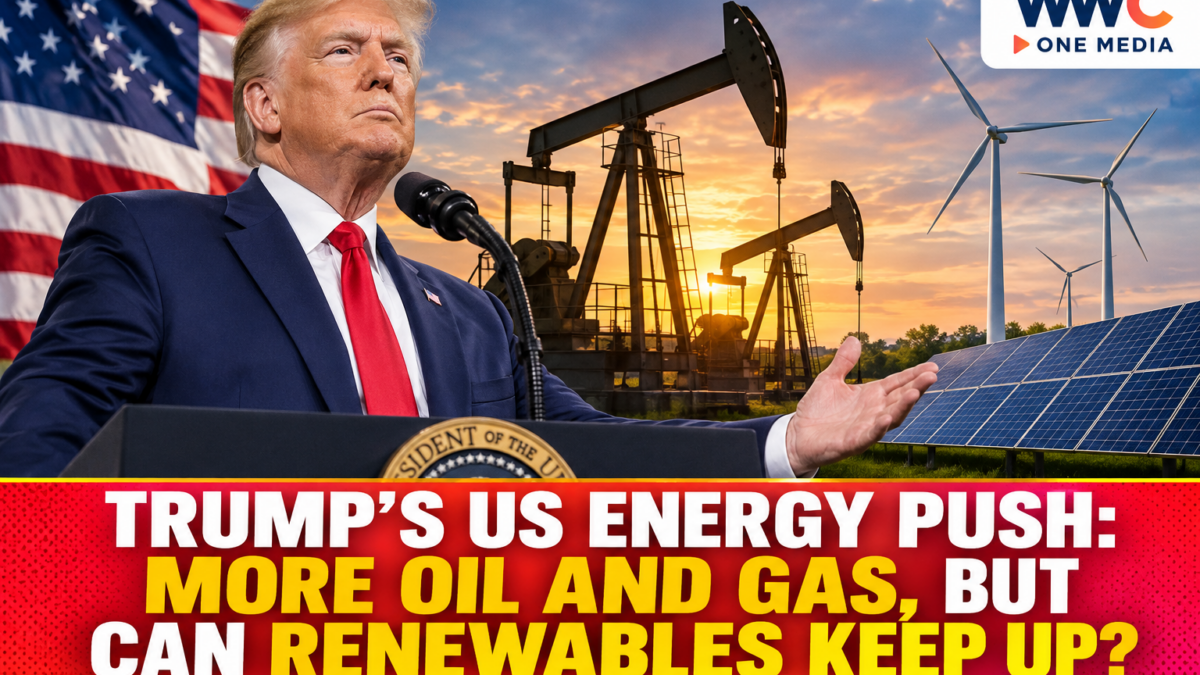
The Trump administration is backing additional domestic petroleum production, supporting offshore oil and gas investment and using emergency powers to keep selected power plants available during electricity supply pressures. The measures form part of a broader US energy policy that places domestic production and energy security at the centre of national planning.
But the country’s energy direction is not as simple as a return to fossil fuels alone. Federal forecasts still project increasing contributions from solar and wind, while electricity demand continues to rise and the government weighs how much existing generation capacity must remain available.
The result is a policy mix with competing demands: expand dependable domestic supply, support industrial and national-security requirements, manage electricity costs and accommodate a changing generation system. For international buyers and energy-importing economies, the distinction between political commitments and actual export capacity matters.
US energy policy puts domestic petroleum capacity in the national-security framework
A presidential determination dated Oct. 22, 2026, classified domestic petroleum production, refining and logistics capacity as resources essential to national defence. The document covers activities including exploration, production, pipelines, storage facilities and marine terminals.
The determination invokes Section 303 of the Defense Production Act. It authorises the administration to use purchases, purchase commitments, financial support and other instruments to expand the relevant capabilities.
The document argues that financing constraints, long project lead times, permitting obstacles and infrastructure limitations could prevent private industry from supplying the required capacity quickly enough. It therefore directs the relevant department to implement the determination.
This is more than a general statement supporting oil production. It creates a federal policy basis for intervention in parts of the petroleum supply chain, although the document itself does not guarantee that every proposed project will be financed or completed.
A $480 million loan backs offshore oil and gas expansion
The Department of Energy announced on Nov. 10 that its Office of Energy Dominance Financing had closed a $480 million loan for Arena Energy’s Project Elkhorn.
The project is intended to modernise 22 offshore platforms off Louisiana. At peak production, the department expects it to add up to 38,600 barrels of oil per day and as much as 77 million cubic feet of natural gas per day.
The department also said the project could add approximately 125 million barrels of oil and 250 billion cubic feet of natural gas over its operating life. It projected 2,400 construction-related jobs and 400 operations jobs.
These are project expectations, not production already delivered. The difference matters: a loan closing is a financing milestone, while additional output depends on construction, operating performance, market conditions and the project reaching its expected production levels.
The loan is also a concrete example of how the administration’s energy policy is being implemented through financing, rather than only through speeches or executive statements.
WWC previously examined Trump’s Venezuela oil arrangement and the question of who controls the supply. That arrangement is separate from Project Elkhorn, but both developments show why announced investment, ownership rights and actual barrels reaching the market must be treated as different measures.
Emergency orders keep selected power plants available
The Department of Energy’s emergency orders provide another view of the administration’s approach to electricity reliability.
On Nov. 13, the department issued an emergency order directing the Midcontinent Independent System Operator and Consumers Energy to ensure that the coal-fired J.H. Campbell Generating Facility in Michigan remained available to operate during an emergency period. The order took effect on Nov. 15 and runs through Feb. 12, 2027.
The department also directed the grid operator to use economic dispatch only during the hours necessary to meet the emergency and minimise costs.
A separate Nov. 20 order directed PJM Interconnection, in coordination with Constellation Energy, to ensure that Units 3 and 4 of the Eddystone Generating Station in Pennsylvania remained available from Nov. 21 through Feb. 18, 2027.
These are specific emergency measures, not proof that every coal or other conventional power station has received a permanent operating guarantee. Their limited duration and stated emergency purpose are important qualifications.
The policy question is how governments balance the immediate need for reliable electricity with the longer-term cost of maintaining older generation facilities. Keeping a plant available can provide a reserve option during a supply emergency, but it does not by itself establish how often the plant will operate or what its total costs will be.
Federal forecasts still show renewables gaining ground
The US Energy Information Administration’s November 10 Short-Term Energy Outlook provides a useful counterweight to the administration’s production announcements.
The agency projected that solar’s share of US electricity generation would rise from 8% in 2026 to 10% in 2027. Wind’s share was projected to increase from 11% to 12% over the same period.
Natural gas was projected to account for 40% of generation in 2026 and 39% in 2027. Coal was projected at 15% in both years.
The EIA also forecast US crude oil production at 13.9 million barrels per day in 2026 and 14.3 million barrels per day in 2027. US liquefied natural gas exports were projected at 17.6 billion cubic feet per day in 2026 and 19 billion cubic feet per day in 2027.
These are forecasts, not final results. Still, they show that a larger oil and gas sector can coexist with growth in renewable electricity generation. The generation mix is influenced by demand, fuel prices, plant availability, new construction and grid connections—not only by presidential policy.
WWC’s reporting on the US Senate’s energy permitting bill examines another part of this debate: how Washington is trying to accelerate infrastructure approvals while negotiating environmental review and electricity-system costs.
Why the policy matters beyond the United States
The United States is a major producer of oil and natural gas, and its export capacity can influence international markets. But additional domestic production does not automatically mean lower prices for overseas buyers.
The effect on importers depends on whether new output reaches export terminals, whether shipping capacity is available, how contracts are priced and what competing suppliers are doing. LNG volumes, in particular, depend on liquefaction capacity and international demand.
For Asian economies, more US LNG exports could widen the range of available suppliers. Yet buyers still need to consider contract duration, price exposure, shipping costs and the risks of relying too heavily on any single source.
The same lesson applies to the Philippines. Energy security is not achieved simply by identifying a potential supplier. It also depends on diversified procurement, infrastructure, affordability and the ability to manage changes in global prices.
WWC’s analysis of Southeast Asia’s electrification and power-grid challenge looks at the regional side of the equation: more electricity demand requires generation and networks that can deliver power reliably.
What happens next
The next test will be whether the administration’s policy announcements translate into completed infrastructure and measurable additional supply.
For Project Elkhorn, that means tracking construction and production against the Department of Energy’s stated expectations. For the emergency power orders, it means watching whether the specified plants remain available during the periods covered and whether further orders are issued.
The EIA’s next Short-Term Energy Outlook is scheduled for Dec. 8, 2026. Its updated projections will help show whether expectations for oil production, LNG exports, electricity demand and renewable generation have changed.
The wider question is not simply whether the United States produces more energy. It is whether its policy can deliver reliable and affordable power without making the country’s future supply system unnecessarily dependent on one group of fuels.
Frequently asked questions
Is Trump increasing US oil and gas production?
The administration is supporting domestic petroleum capacity through policy measures and financing. The Department of Energy’s $480 million Project Elkhorn loan is one example, although the additional output remains a project expectation.
What is Project Elkhorn?
It is an offshore infrastructure project by Arena Energy involving the modernisation of 22 platforms off Louisiana. The Department of Energy expects it to increase oil and natural gas production.
Is the US government keeping coal plants open?
The Department of Energy issued a time-limited emergency order for the coal-fired J.H. Campbell facility in Michigan, requiring it to remain available during the specified period. This is not a permanent guarantee for all coal plants.
Are renewable energy sources still growing in the United States?
The EIA’s November 2026 forecast projects solar and wind gaining shares of electricity generation in 2027. These are forecasts, not confirmed final generation figures.
Will more US oil and gas automatically lower energy prices in Asia?
No. International prices depend on production, export capacity, shipping, contracts, demand and competing suppliers. Additional US supply may widen options, but it does not guarantee lower prices for Asian consumers.