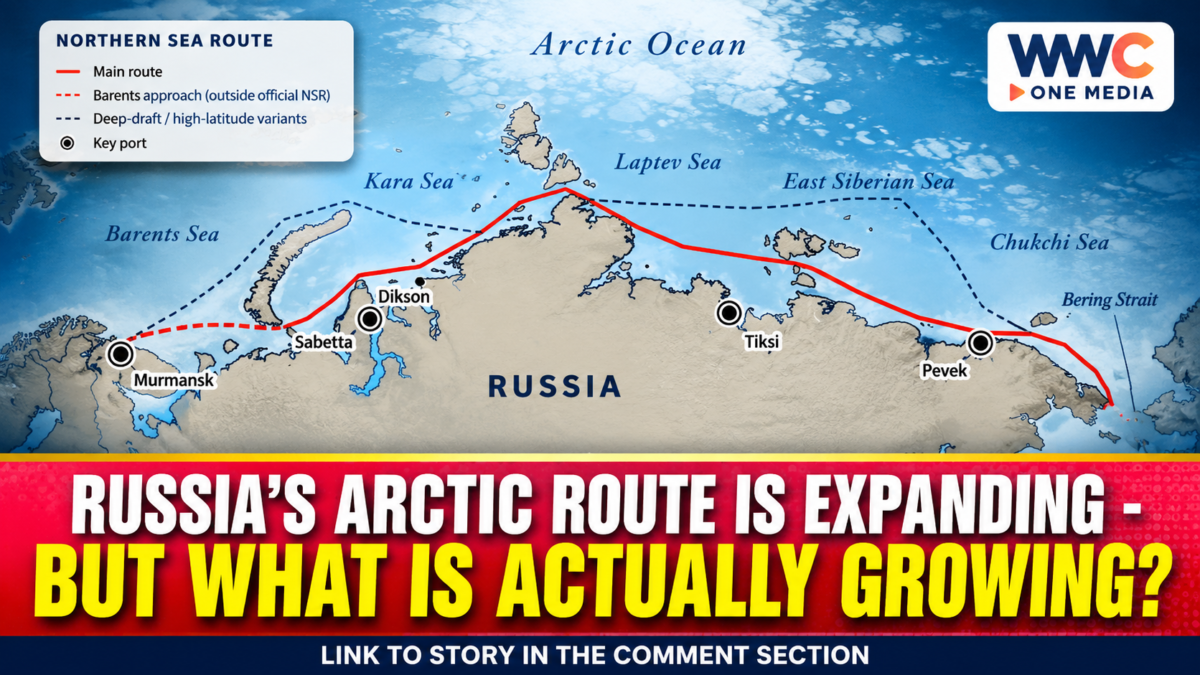
Russia’s Arctic shipping network is gaining a major new energy asset following the September launch of the first oil shipment from Rosneft’s Vostok Oil project. The development adds a new export source to the Northern Sea Route, but official figures show that the corridor’s existing cargo business remains dominated by Russian industrial and energy shipments rather than international container trade.
The distinction matters as Moscow works to turn its northern coastline into a more important commercial corridor. The infrastructure is expanding, but the scale of the investment should not be confused with proof that the route has already become a major alternative to established global shipping lanes.
Arctic route growth: The numbers behind Russia’s shipping network
Rosatom’s 2025 corporate performance report provides a useful baseline for assessing the Northern Sea Route, or NSR.
Cargo traffic reached 37.02 million tonnes in 2025, compared with 37.89 million tonnes in 2024. That represents a decline of approximately 2.3% year on year, despite the route remaining a major transport link for Russia’s Arctic industrial operations. report.rosatom.ru+1
The figures also show why total cargo volume needs careful interpretation.
Of the 37.02 million tonnes recorded in 2025, transit cargo accounted for 3.2 million tonnes. Transit refers to goods passing through the route rather than cargo serving Russian Arctic production sites or other destinations along the corridor.
Container activity was considerably smaller than the headline cargo total might suggest. Rosatom reported 24 container transit voyages in 2025, compared with 14 in 2024, while container cargo traffic reached 410,000 tonnes. report.rosatom.ru+1
This means that the NSR’s overall throughput should not automatically be interpreted as evidence of a large international container-shipping market. Much of the route’s established business is connected to Russia’s own resource and industrial economy.
Vostok Oil brings a new export source to the Arctic
A significant change came on Sept. 6, 2026, when Russia launched the first oil shipment from the Vostok Oil project.
The shipment was loaded onto the Arctic tanker Valentin Pikul at the Bukhta Sever port terminal. The commissioning event marked the beginning of a new stage for a project designed to connect oil production facilities in northern Krasnoyarsk Territory with an export terminal on the Kara Sea. rosneft.com+1
The project’s transport infrastructure is substantial.
Rosneft reported that the Vankor–Payakha–Bukhta Sever main pipeline stretches 790 kilometres and has a design capacity of 100 million tonnes per year. Its construction includes a 6-kilometre crossing beneath the Yenisei River. rosneft.com+1
That capacity, however, belongs to the pipeline system. It does not mean the Northern Sea Route can already carry an additional 100 million tonnes annually, nor does it establish that the pipeline is operating at full capacity.
Rosneft has outlined a gradual production and shipment ramp-up. The company said the project could ship 30 million tonnes of oil to consumers in the second half of 2027, increasing to as much as 50 million tonnes by 2030. These are company targets, not volumes already delivered. rosneft.com
Why the distinction between capacity and actual cargo matters
The Vostok Oil project illustrates a broader issue in evaluating Arctic infrastructure: a new facility can increase the potential supply of cargo without immediately producing a matching increase in recorded shipping traffic.
Oil must first be produced, transported through the pipeline, stored, loaded onto suitable vessels and delivered to buyers. Each stage has its own operational requirements.
The distinction is especially important when comparing the pipeline’s 100-million-tonne design capacity with the NSR’s 37.02-million-tonne total cargo figure for 2025. They measure different things. One describes the planned carrying capacity of a specific pipeline; the other records cargo transported through an entire maritime corridor during a completed year.
Rosatom’s own report projects NSR cargo traffic reaching 109.1 million tonnes by 2030. That figure is a corporate projection, not a confirmed outcome. report.rosatom.ru
The scale of the ambition is clear, but the actual result will depend on production growth, shipping availability, port operations and demand for the goods being transported.
China and international shipping remain important parts of the picture
Russia is also seeking to strengthen commercial cooperation with Asian partners.
In its 2025 report, Rosatom documented an international container transit voyage that began in Ningbo, China, in September 2025. The vessel called at Felixstowe, Rotterdam and Hamburg before completing the journey in Saint Petersburg in October. The trip took 20 days, according to the corporate report. report.rosatom.ru+1
This was a notable demonstration of the route’s potential, but one successful voyage does not establish a permanent, high-frequency international shipping service.
The commercial question is whether shipping companies can use the route consistently enough to justify the costs and operational requirements. That includes vessel suitability, ice navigation, seasonal scheduling, port infrastructure and the availability of return cargoes.
WWC previously examined the challenges facing South Korea’s Arctic shipping ambitions in its report on the country’s first commercial trial voyage through the Northern Sea Route. The voyage highlighted the interest among Asian economies, while also illustrating that access to the corridor involves more than simply choosing a shorter sailing distance.
The Arctic is becoming a bigger part of Russia’s energy strategy
The new oil shipment also fits into a wider effort to connect energy production with northern transport infrastructure.
Rosneft has described Vostok Oil as a major oil and gas development. The company’s September announcement reported that the project had a resource base of 7 billion tonnes of oil and that more than 2,000 wells had been commissioned. These are company-reported project figures, rather than independently established estimates of recoverable output. rosneft.com
The company has also described the infrastructure needed to support operations in a remote Arctic environment, including port facilities, storage tanks and specialised vessels.
This is not an isolated issue for Russia. Export terminals and transport links elsewhere in the country also play important roles in moving energy products to international buyers. WWC has separately examined the significance of Russia’s Ust-Luga oil-export hub, a different facility serving a different export corridor.
The Arctic strategy therefore needs to be understood as one component of a much wider energy and logistics network.
A shorter route does not automatically mean cheaper shipping
The Northern Sea Route is often discussed in terms of its potential to reduce sailing distances between Asia and Europe. But distance alone does not determine whether a voyage is commercially attractive.
In a Sept. 4, 2026 address at the Russia-China Energy Business Forum, Rosneft chief executive Igor Sechin said the route could reduce delivery time by 1.5 to two times and cut costs by one third. These are claims made by the company executive about the route’s potential advantages, not independently verified savings applicable to every shipment. rosneft.com+1
The actual economics depend on the cargo, vessel, season, insurance, icebreaker support and destination. A route that offers a time advantage for one shipment may not produce the same savings for another.
The expansion of Russian Arctic energy infrastructure also raises questions about the concentration of cargo around resource projects. More oil production can create demand for shipping, but that is different from developing a diversified international transport corridor serving multiple countries and industries.
For regional economies, the distinction is important. A route can become busier because one country exports more raw materials without necessarily becoming a widely used alternative for global container trade.
What happens next
The next major milestones will be the actual production and shipment volumes from Vostok Oil, the pace at which its port and pipeline facilities operate, and the Northern Sea Route’s recorded cargo and transit results for 2026.
Rosneft’s stated targets of 30 million tonnes in the second half of 2027 and up to 50 million tonnes by 2030 will provide benchmarks against which the project’s progress can be assessed.
For now, the official record establishes that the first Vostok Oil shipment has begun and that Russia has invested in a substantial Arctic transport system. It does not yet establish that the NSR has achieved a completed 2026 cargo total above 40 million tonnes.
The larger question is whether Russia can turn its growing Arctic energy infrastructure into a reliable, commercially competitive international shipping network. That will require more than new pipelines and ambitious cargo targets: it will require sustained deliveries, dependable operations and customers willing to use the route.
Frequently asked questions
What is Russia’s Northern Sea Route?
The Northern Sea Route is a maritime corridor along Russia’s Arctic coastline. It connects parts of the Atlantic and Pacific shipping networks and is used to transport cargo to and from Russian Arctic regions.
How much cargo moved through the Northern Sea Route in 2025?
Rosatom reported total cargo traffic of 37.02 million tonnes in 2025. Transit cargo accounted for 3.2 million tonnes.
What is the Vostok Oil project?
Vostok Oil is a major Rosneft oil and gas development in Russia’s northern Krasnoyarsk Territory. Its transport system includes a 790-kilometre pipeline leading to the Bukhta Sever port terminal.
Does the Vostok Oil pipeline have a capacity of 100 million tonnes annually?
Yes. Rosneft reported a design capacity of 100 million tonnes per year for the Vankor–Payakha–Bukhta Sever main pipeline. That is pipeline capacity, not the current annual cargo volume of the Northern Sea Route.
Has Russia confirmed that Arctic shipping exceeded 40 million tonnes in 2026?
The primary records reviewed for this article do not establish a completed 2026 total above 40 million tonnes. The latest completed-year figure verified here is Rosatom’s 37.02 million tonnes for 2025.