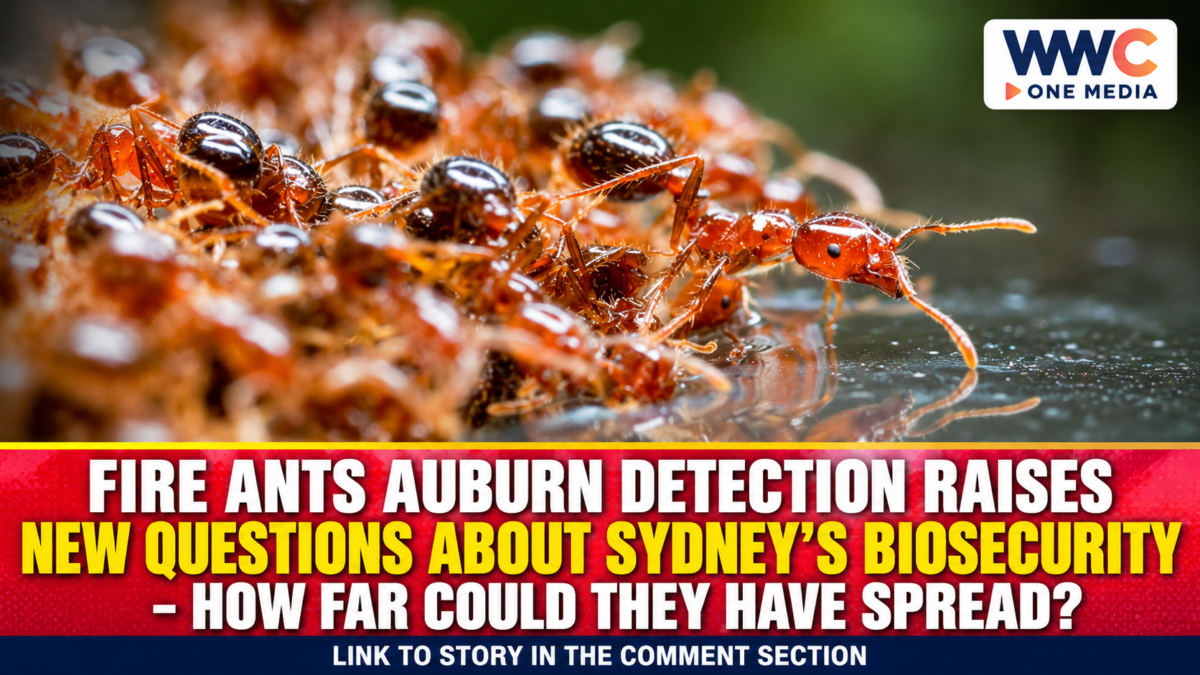
A confirmed nest of red imported fire ants in Auburn has triggered a new biosecurity response in western Sydney, with authorities investigating how the invasive insects reached the area. The detection was confirmed on Nov. 22, 2026, after a nest was inspected and treated over the weekend.
The discovery is significant because the Auburn site is outside the existing Enfield Intermodal biosecurity control zone and more than six kilometres from the earlier detection. Authorities say there is currently no evidence that the insects have spread beyond the treated Auburn site, but surveillance and tracing are continuing. DAFF+1
The immediate challenge is to establish whether the nest represents a separate introduction, determine whether other colonies are nearby and prevent the insects from becoming established in New South Wales.
Fire ants Auburn detection: What authorities have confirmed
The NSW Department of Primary Industries and Regional Development (DPIRD) was notified of a suspected detection in a semi-industrial area of Auburn on Nov. 21. Scientific testing confirmed the presence of red imported fire ants, scientifically identified as Solenopsis invicta, the following day.
The state biosecurity team had already inspected and treated the nest site during the weekend. The ants were destroyed after they were considered suspect fire ants, while samples were collected for further examination.
The NSW Government said experts examining the nest believed it could be around 12 months old. That is an assessment of the nest’s possible age, not a confirmed date showing when the infestation began. NSW Government+1
The location is outside the existing Enfield Intermodal Biosecurity Control Zone. Authorities are investigating how the insects arrived in Auburn, including whether the nest represents a separate infestation with a different origin.
Genetic analysis is being conducted through the National Fire Ant Eradication Program, led by the Queensland Government. The results could help investigators understand whether the Auburn detection is connected to the earlier Sydney finding or came through another pathway. NSW Government+1
Why the distance from Enfield matters
The Auburn detection adds another location to the biosecurity picture in metropolitan Sydney.
The earlier detection involved the Enfield Intermodal Logistics Centre. The Australian Department of Agriculture, Fisheries and Forestry recorded that specimens were found during routine surveillance on Sept. 23, with confirmation on Sept. 25. One nest containing two mounds was identified and treated at the site. DAFF
The Auburn nest is more than six kilometres from that earlier location and outside its current control zone. This geographical separation is one reason authorities are investigating whether the two detections share an origin.
The distinction matters. If the Auburn colony arrived independently, investigators may need to examine a different route by which the ants entered the area. If the detections are connected, tracing could help identify where the insects moved between locations.
Neither possibility has been established. The genetic analysis and further surveillance are intended to provide evidence rather than rely on assumptions about how the ants travelled.
Surveillance expands as authorities look for other nests
The NSW Government says surveillance activities have begun around the Auburn site, with detector dogs expected to assist as soon as possible. Officials are also engaging businesses in the surrounding area.
The response is being organised along the lines of the operation already used around Enfield. That programme included treatment and surveillance within 500 metres of the infestation, along with targeted surveillance extending to two kilometres.
The state government reported that the Enfield response had involved 729 reported cases inspected by biosecurity teams, 120 sites checked by detector dogs and face-to-face engagement with 1,600 people. These are figures for the Enfield operation, not the new Auburn search. NSW Government
A separate biosecurity control order for Auburn is being developed. The government said it would issue the order after further information from sample testing and consultation with nearby businesses and the community.
This is important for people who handle or transport materials that may carry ants or nests. The existing Enfield order addresses the movement of high-risk materials, including soil, turf, mulch and potted plants. It should not be assumed that the same legal restrictions already apply to Auburn before its own order is issued. Department of Primary Industries+1
Why red imported fire ants are a serious concern
Red imported fire ants are an invasive species that can create problems well beyond the immediate area where a nest is found. Their colonies can spread, and their stings can cause painful reactions. NSW guidance warns that disturbing a nest can cause ants to swarm and sting simultaneously.
The risk is not limited to people. Australia’s national eradication programme has identified potential impacts on agriculture, infrastructure, biodiversity and public spaces. The broader challenge is that an established infestation can require sustained monitoring and treatment rather than a one-time removal of a visible nest. Department of Agriculture+1
That is why the Auburn response includes surveillance and tracing after the nest site was treated. Destroying ants at one location does not, by itself, establish that no other nests exist nearby.
The issue also reflects a wider biosecurity challenge: invasive species can affect ecosystems in different ways. WWC has previously examined how invasive yellow crazy ants threaten Christmas Island’s red crabs, a separate species and a different ecological problem. The comparison shows why early detection and targeted control matter. WWC’s report on invasive ants and Christmas Island’s red crabs.
Other pest outbreaks demonstrate the importance of monitoring and coordinated response. WWC has also reported on the red-striped soft scale insect crisis affecting sugarcane communities and efforts to develop biological controls against agricultural pests. Those cases involve different pests, but they underline how quickly a biological threat can become a wider agricultural or environmental concern.
What residents should do if they suspect fire ants
NSW authorities have issued a simple instruction for anyone who encounters a suspicious nest or ant: leave it alone, take a photograph or video safely, and report it.
Residents should not attempt to destroy a nest, collect ants or apply pesticide themselves. The NSW Department of Primary Industries and Regional Development says treatment must be supervised by its biosecurity teams, warning that unapproved handling or treatment could contribute to further spread. Department of Primary Industries+1
Reports can be made through the NSW Biosecurity Helpline at 1800 680 244 or the official online reporting service.
Fire ant nests may appear as loose or crumbly soil mounds or flatter patches without an obvious entrance hole. They can occur in open grassed areas, gardens, parks, school grounds, roadsides and places where soil or turf is handled.
People should avoid disturbing suspicious mounds while waiting for official identification. The aim is to give biosecurity teams information they can assess safely.
What happens next
The next stage of the Auburn response will focus on surveillance, sample analysis and tracing. Genetic results may help determine whether the nest is linked to the earlier Enfield detection or represents a separate introduction.
Authorities are also expected to continue working with nearby businesses and residents while preparing an Auburn-specific control order. Until the investigation establishes the extent and origin of the detection, the absence of confirmed spread beyond the treated site should be treated as the current official assessment—not proof that further searches are unnecessary.
For now, the most important public contribution is early reporting. A suspected nest should be documented safely and referred to biosecurity officials rather than disturbed.
Frequently asked questions
Where were red imported fire ants found in western Sydney?
A nest was confirmed in a semi-industrial area of Auburn, in western Sydney. The site is outside the existing Enfield Intermodal Biosecurity Control Zone.
Have the fire ants spread beyond Auburn?
Authorities said there was no evidence of spread beyond the treated site at the time of their Nov. 23 statement. Further surveillance and tracing were continuing.
How old was the Auburn fire ant nest?
Experts examining the nest suggested it could be around 12 months old. This is an estimate, not a confirmed date of establishment.
Are the Auburn ants connected to the Enfield detection?
That has not yet been established. Genetic analysis is underway to help determine the origin of the Auburn ants.
What should residents do if they find a suspected fire ant nest?
Do not disturb or treat it. Safely take a photograph or video and report the sighting to the NSW Biosecurity Helpline at 1800 680 244.