Japan is considering a major expansion of its KOSEN technical-college system, with agriculture among the new fields being considered as the government reviews how to prepare young people for changing industrial and regional needs. A Nov. 16, 2026, interim policy document from the Ministry of Education, Culture, Sports, Science and Technology (MEXT) identifies agricultural education as one area that may require new standards and facilities.
The proposal could broaden a system traditionally associated with engineering and practical technical training. It is not yet an announcement that agricultural courses have opened or that specific colleges have been approved to offer them.
The change matters because Japan is looking beyond conventional engineering education to develop skills that can support regional industries, food production, research and emerging technologies. It also raises a practical question: how can a technical-college model built around laboratories and hands-on engineering be adapted to agriculture without losing the strengths that made it distinctive?
What makes Japan’s KOSEN system different?
KOSEN, formally known as colleges of technology, are higher-education institutions that accept students after junior high school. Their main programme runs for five years and combines general education with specialised technical subjects, laboratory work and practical training.
Unlike the conventional route in which students complete senior high school before entering university, KOSEN students begin specialised education at around age 15. MEXT describes the system as a way to develop practical engineers and people capable of research and development.
Japan had 58 KOSEN institutions as of May 2025: 51 national colleges, three public colleges and four private colleges. Their combined student population was 53,305. 文部科学省ホームページ+1
The system is not exclusively a route into immediate employment. MEXT’s data show that approximately six in 10 graduates enter employment, while four in 10 continue their studies. Graduates can also progress to advanced courses or transfer to universities.
This mix of early specialisation and practical learning is central to the proposed expansion. Agriculture would enter a system designed to connect education directly with the skills required by industries and local communities.
Why agriculture is being considered for KOSEN
MEXT’s Nov. 16 interim review identifies a need to expand KOSEN education beyond its established engineering focus. It says new fields should be considered in light of the kinds of professionals society needs, as well as industrial and regional demand.
Agriculture is specifically named alongside content-related fields as an area for which the government should examine appropriate educational environments and institutional standards. 文部科学省ホームページ+1
The proposal reflects a broader effort to make technical education more responsive to changes in the economy. The ministry’s review points to population decline, advances in digital technology and generative artificial intelligence, green transformation, and semiconductor-sector growth as factors increasing demand for specialised talent.
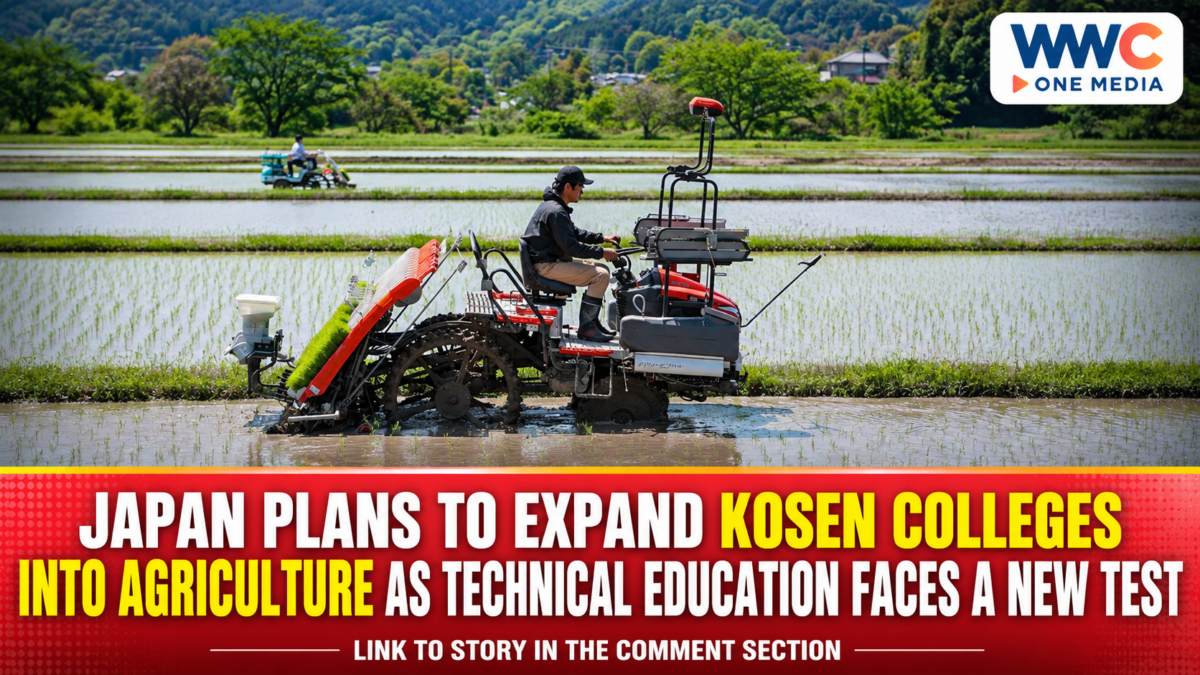
Agriculture could fit into this approach through technical and scientific training. Depending on how future programmes are designed, potential areas of study could include agricultural machinery, environmental monitoring, automation, data-driven production and food-related technologies. These are possible applications of technical education, not a confirmed list of courses announced by MEXT.
The distinction is important. The government is considering the standards and educational conditions needed to support new fields. It has not yet published a final curriculum or confirmed which colleges will establish agriculture departments.
The expansion is part of a wider KOSEN reform
Agriculture is only one element of the ministry’s proposed reform. The Nov. 16 interim review groups its recommendations around three broad priorities: increasing the scale of KOSEN education, improving educational quality and making graduates’ qualifications more internationally understandable.
The first priority includes encouraging the establishment of additional public and private technical colleges. It also calls for more opportunities for students to enter KOSEN and for institutions to respond to fields beyond their traditional scope.
The second concerns funding, facilities, research and recruitment of qualified teachers. The ministry says rising prices and personnel costs are putting pressure on the resources needed to maintain and improve technical education.
The third addresses the international recognition of KOSEN qualifications. Graduates currently receive the Japanese title of jun-gakushi, commonly translated as associate. The interim review calls for further examination of how their learning achievements can be more clearly recognised internationally, including possible legal changes involving the award of degrees. 文部科学省ホームページ+1
These proposals are connected. Expanding the number of colleges or adding new subjects will have limited value if institutions cannot recruit specialist teachers, maintain suitable facilities or demonstrate that their qualifications are recognised by employers and overseas education systems.
What agriculture could gain from a technical-college approach
A technical programme in agriculture could help connect scientific knowledge with the practical challenges faced by farms and food producers.
Modern agricultural production increasingly involves machinery, sensors, environmental data, water management and controlled growing conditions. A programme that combines engineering and agricultural knowledge could help students understand both the biological requirements of crops and the technologies used to manage production.
The potential benefit is particularly relevant to rural communities. MEXT’s interim review identifies regional industry and local problem-solving as important responsibilities for KOSEN institutions. It also notes that graduates are not always staying in the regions where they studied, making local workforce development an ongoing concern. 文部科学省ホームページ+1
The challenge will be ensuring that agricultural education is not treated as an engineering course with a different label. Farming has its own scientific foundations, seasonal demands, land and water requirements, and economic realities. A credible programme would need appropriate agricultural expertise, practical facilities and partnerships with producers.
Japan’s existing KOSEN network already has examples of specialised education connected to agriculture and fisheries. MEXT’s reference material lists an agriculture, forestry and fisheries education initiative involving Toba College of Maritime Technology and several other colleges. This shows that the system has some experience with related fields, although it does not mean a full agricultural department has already been established. 文部科学省ホームページ
Why the discussion is relevant to the Philippines
The proposed reform offers a useful comparison for the Philippines, where agricultural training must also respond to changing technology and the needs of producers.
In Quezon City, for example, a university-linked urban farming initiative has combined practical training with community participation. WWC previously examined the urban farming programme involving Quezon City University, which illustrates how educational institutions can connect agricultural skills with local needs.
Training is equally important for growers outside major cities. Vegetable farmers in Capiz completing agricultural training highlights the value of practical instruction in production methods and farm management.
Technology can also help farmers respond to environmental uncertainty. WWC’s report on AI-powered weather forecasting in the Philippines examined how improved forecasting information could support decisions in agriculture and other weather-sensitive sectors.
These Philippine initiatives are not part of Japan’s KOSEN proposal. They illustrate a shared policy challenge: technical knowledge becomes more useful when education, research and practical application are connected.
For the Philippines, Japan’s approach is worth watching not because the two education systems are identical, but because it raises questions about how technical institutions can support agricultural modernisation and regional development.
What happens next
MEXT’s Nov. 16 document is an interim policy review, not a final regulation establishing agricultural departments. The next stage involves translating the broad recommendations into specific standards, institutional requirements and implementation arrangements.
For agriculture, that means determining what qualifications teachers must hold, what facilities colleges need and how programmes should combine technical subjects with agricultural science and practical experience.
The government will also need to consider how new programmes can be supported financially without weakening existing KOSEN institutions. Its own review identifies teacher recruitment, infrastructure and operating costs as important challenges.
The outcome will determine whether agriculture becomes a fully developed part of Japan’s technical-college framework or remains a proposed area of expansion.
Frequently asked questions
1. What is KOSEN in Japan?
KOSEN refers to colleges of technology that provide five-year higher education programmes for students entering after junior high school. They focus on practical and specialised technical education.
2. Is Japan already opening agricultural KOSEN colleges?
The government has identified agriculture as a potential new field and is examining the standards needed for expansion. The Nov. 16, 2026, interim review does not confirm the opening of specific agricultural colleges.
3. How many KOSEN colleges does Japan have?
Japan had 58 KOSEN institutions as of May 2025: 51 national, three public and four private colleges.
4. Why does Japan want to expand KOSEN education?
The government wants technical education to respond more effectively to changing industrial needs, population decline, digital technology, regional challenges and demand for specialised professionals.
5. Could the KOSEN model be relevant to the Philippines?
Its emphasis on practical training, technical skills and links with regional industries offers lessons for Philippine institutions exploring agricultural technology and workforce development. However, any adaptation would need to reflect the country’s own education system and farming conditions.