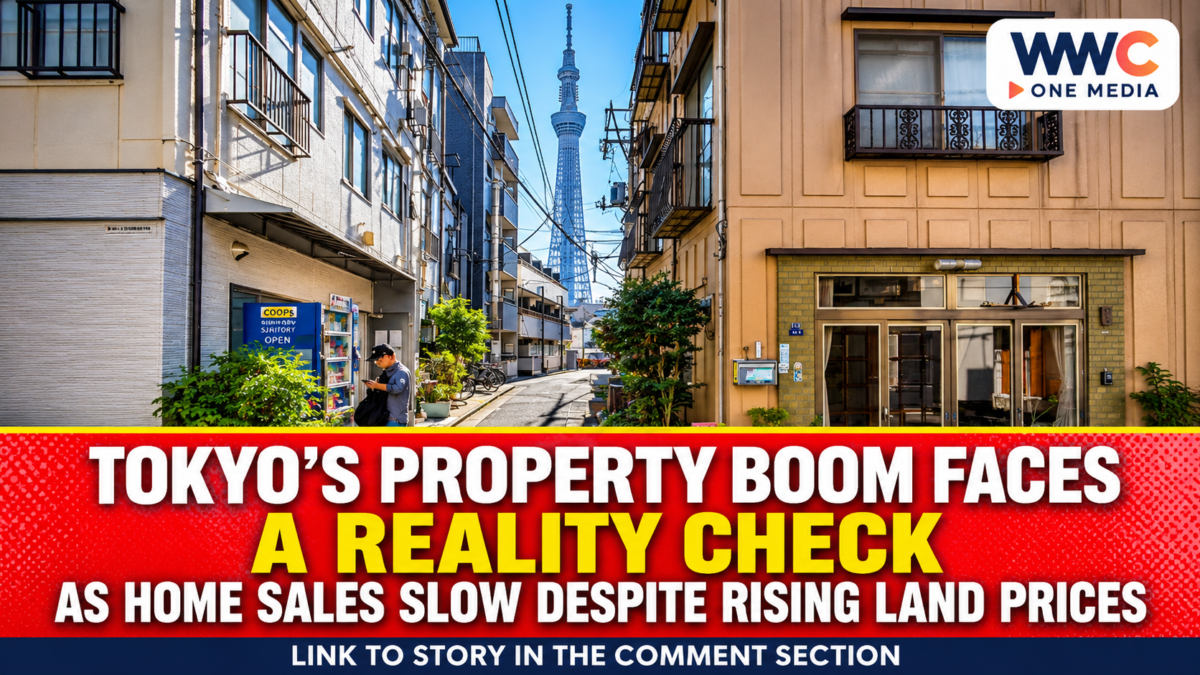
Tokyo’s property market is showing two contrasting trends: official land values continue to climb, but completed transactions for existing condominiums across the capital’s wider metropolitan area are weakening. The latest figures suggest that Japan’s real estate momentum is becoming increasingly uneven, raising questions about how long higher valuations can coexist with slower buyer activity.
Data published by Japan’s Ministry of Land, Infrastructure, Transport and Tourism (MLIT), the Bank of Japan (BOJ) and the Real Estate Information Network for East Japan (REINS) point to a market that is still attracting investment but showing signs of strain in parts of its residential sector.
The distinction matters. Rising land prices do not necessarily mean that buyers are purchasing more homes, and higher asking prices do not guarantee that sellers can close transactions at those levels. For homeowners, developers and investors, the difference between advertised values and completed sales may become one of the most important indicators to watch.
Tokyo’s property boom is being driven by rising land values
Japan’s latest official land survey provides evidence that the upward movement in property values has not disappeared.
In its September 2026 prefectural land-price survey, MLIT reported that land prices across the country increased for a fifth consecutive year. The survey covered 21,466 locations, with prices assessed as of July 1, 2026.
The Tokyo metropolitan region recorded an average year-on-year increase of 4.0% in residential land prices and 8.9% in commercial land prices. Both figures reflect a market in which land used for businesses and housing continues to command higher valuations.
The commercial property segment is particularly notable. Its rate of increase was substantially higher than that of residential land, suggesting that demand for commercially valuable locations remains an important part of the region’s property story.
The BOJ’s October 2026 economic outlook also identified rising land prices, particularly for commercial properties in the major metropolitan areas, as part of the broader economic recovery.
Its charts showed Tokyo recording approximately 5.8% annual growth in residential land prices and 11.4% in commercial land prices in the 2026 survey.
These figures help explain why Tokyo continues to attract attention from property investors. However, land-price assessments are not the same as completed home sales. They measure a different part of the market and should not be treated as proof that every residential property is becoming easier to sell.
Existing condominium sales reveal a different picture
The latest REINS report offers a more cautious view of the residential market.
Its October 2026 report showed that completed existing-condominium transactions across the Greater Tokyo region totalled 3,392 units, a 19.7% decline from the same month a year earlier. This marked the seventh consecutive month of annual decreases.
The average completed price per square metre fell 6.9% year on year to ¥794,400. The average transaction price dropped 6.5% to ¥49.79 million.
At the same time, the number of existing condominiums held in inventory increased 22.5% to 53,510 units.
The combination is significant: fewer properties are changing hands, while the number of available properties is growing.
The figures cover the Greater Tokyo region, which includes Tokyo and the three neighbouring prefectures of Kanagawa, Saitama and Chiba. They should not be interpreted as a measurement of Tokyo’s 23 wards alone.
Nevertheless, they show that the residential resale market is facing a different set of conditions from the land-price indicators.
A seller may still expect a higher price based on nearby listings or previous market valuations. But if buyers are completing fewer transactions and available inventory is expanding, sellers may face greater pressure to adjust expectations.
The gap between asking prices and completed sales matters
One of the clearest features of the October REINS report is the difference between the prices of properties being offered and those actually being sold.
The average newly registered asking price for existing condominiums in the Greater Tokyo region reached ¥69.85 million, up 16.6% from October 2025.
The average price of properties held in inventory stood at ¥70.07 million, up 24.3% year on year.
By comparison, the average completed transaction price was ¥49.79 million.
These figures do not represent identical groups of properties. Differences in location, size, building age and quality can influence average prices. They therefore cannot establish that individual sellers are consistently asking 40% more than buyers are willing to pay.
Still, the contrast highlights an important market question: are sellers’ expectations rising faster than the prices buyers are prepared to pay?
When listings increase while completed transactions decline, properties can remain on the market for longer. Sellers may then have to reconsider their asking prices, particularly if competing properties offer better value.
The situation is relevant to Japan’s ongoing discussion about condominium affordability and speculative resales. WWC previously examined the government’s proposed response in its coverage of Japan’s condominium resale tax debate.
However, weaker resale activity alone does not prove that speculation has ended or that property prices are about to fall across the country.
Higher borrowing costs are changing the investment calculation
Japan’s financing environment is another factor that property investors cannot ignore.
The BOJ’s October 2026 outlook said real interest rates had been rising, although they remained low, particularly in the short-term segment. It also reported that lending rates and corporate financing costs had increased as market interest rates moved higher.
For property investors, borrowing costs influence the amount of capital required to purchase buildings and the income needed to justify an acquisition.
A property that appeared attractive when financing was exceptionally cheap may produce a less appealing return when interest expenses increase.
This does not mean every investor will withdraw from Japan. Buyers with substantial capital, long investment horizons or properties generating dependable rental income may continue to pursue acquisitions.
But financing conditions can make investors more selective, particularly when purchase prices are already elevated.
The changing calculation was also explored in WWC’s earlier report on PGIM Real Estate’s more selective approach to Japanese property acquisitions.
For developers, higher financing costs may also influence decisions about new projects, land purchases and construction schedules. The ultimate effect will depend on demand, project economics and access to funding.
Japan’s property market is not moving in one direction
The latest figures do not support a simple conclusion that Japan is experiencing either an uninterrupted property boom or a nationwide housing downturn.
The land survey shows continued increases in residential and commercial land values. The BOJ also described the broader rise in metropolitan commercial land prices as part of Japan’s economic recovery.
Yet REINS recorded a substantial decline in existing-condominium transactions and completed prices across Greater Tokyo in October.
Other residential segments also show different patterns. In the same REINS report, existing detached-home transactions across the Greater Tokyo region fell 5.8% year on year to 1,700 units, while their average completed price increased 3.6% to ¥39.38 million.
That difference illustrates why the housing market should not be judged using a single price indicator.
Property type, location, supply, financing and buyer demand can produce very different outcomes even within the same metropolitan region.
Commercial land may continue to appreciate while some residential sellers struggle to find buyers. Detached houses may record rising average transaction prices even as completed sales decline.
Japan’s real estate market is therefore better understood as a collection of connected but distinct segments rather than one uniform investment opportunity.
The distinction also matters for companies that own substantial property portfolios. WWC has previously examined how Yamada Holdings’ proposed property transaction fits into the wider business environment, where selling property can be a financial decision separate from the performance of a company’s main operations.
What happens next
The next important test will be whether residential transaction activity stabilises or continues to weaken in subsequent monthly reports.
Investors and homeowners will need to distinguish between official land-price assessments, asking prices and completed transaction prices. Each measures a different part of the market, and relying on only one can produce an incomplete picture.
The direction of borrowing costs will also matter. If financing becomes more expensive, some buyers may delay purchases or reduce the prices they are prepared to offer. If demand remains strong in selected locations, however, desirable properties may continue to command premium valuations.
For now, the official data point to a market with continued land-price growth but weaker resale activity. That is not evidence of an imminent collapse. It is a warning that rising property values alone cannot tell the full story of Tokyo’s housing market.
Frequently asked questions
Are property prices still rising in Tokyo?
Yes. Japan’s 2026 prefectural land survey showed annual increases in both residential and commercial land prices in the Tokyo metropolitan region. However, existing-condominium transaction prices across Greater Tokyo declined in October.
Did condominium sales fall in Tokyo in October 2026?
REINS reported 3,392 completed existing-condominium transactions across Greater Tokyo in October 2026, down 19.7% from the same month a year earlier. The figure covers Tokyo and three neighbouring prefectures, not only the capital’s 23 wards.
Why are asking prices higher than completed transaction prices?
Asking prices reflect what sellers want to receive, while completed transaction prices reflect properties that buyers and sellers have actually agreed to trade. Differences in property characteristics also affect the averages.
Are higher Japanese interest rates a risk for property investors?
Higher borrowing costs can reduce the attractiveness of leveraged property investments and make acquisitions more expensive. The effect depends on financing arrangements, rental income, purchase prices and the investor’s financial position.
Does the latest data mean Tokyo’s property market is heading for a crash?
No. The available official figures show diverging trends, not proof of an impending crash. Land prices continue to rise in the Tokyo region, while existing-condominium sales and completed prices have weakened across Greater Tokyo.