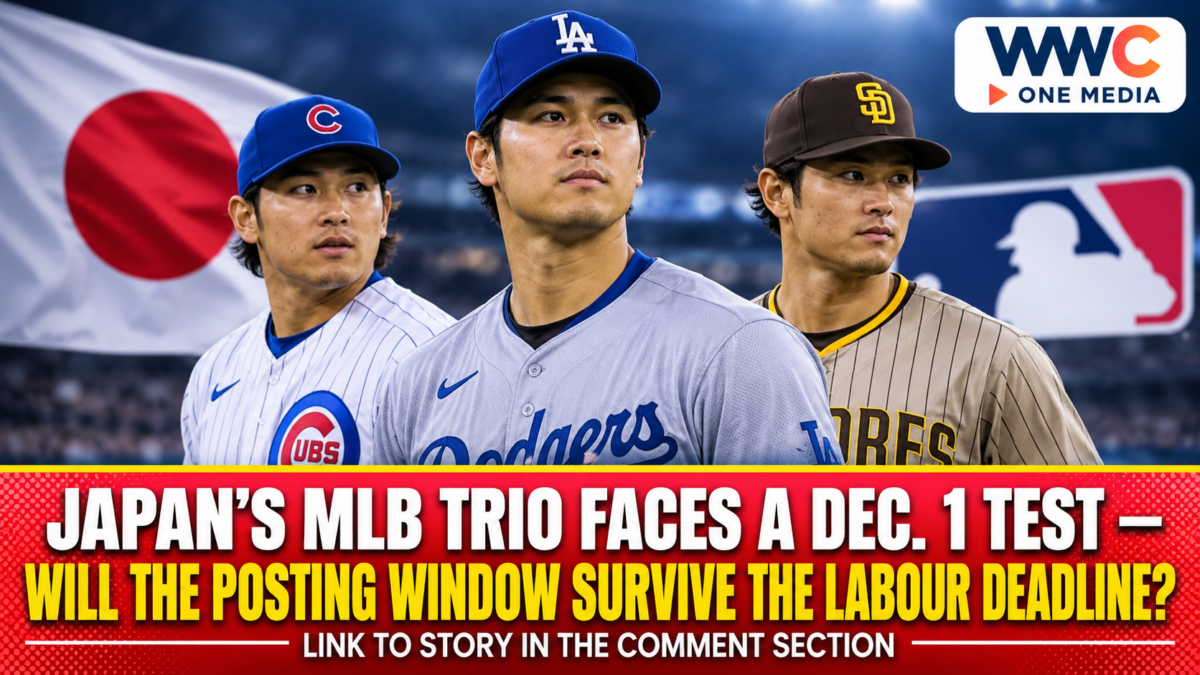
Three Japanese professional baseball players have entered Major League Baseball’s posting system, giving all 30 MLB clubs an opportunity to negotiate for their services ahead of the 2027 season. Their negotiations are unfolding as MLB’s current collective bargaining agreement approaches its Dec. 1, 2026, expiry date.
The timing creates a complicated offseason for Hanshin Tigers infielder Teruaki Sato and pitchers Kaima Taira of the Saitama Seibu Lions and Hiromi Itoh of the Hokkaido Nippon-Ham Fighters. Their clubs have confirmed the posting procedures, but the public records do not establish that any of the three has signed an MLB contract or that a lockout will automatically change the posting deadlines.
The central issue is the intersection of two processes: individual transfer negotiations between Japanese players and MLB clubs, and labour negotiations between MLB and the players’ union.
Japan MLB Posting: Three Players, Three Different Cases
The three players reached the posting stage through separate decisions by their Japanese clubs.
Hanshin Tigers confirmed that its application for Sato’s transfer negotiations through the posting system had been submitted to and accepted by MLB. The club announced the completed application on Nov. 2.
The 2026 NPB record shows why Sato is attracting attention. He finished the Central League season with a .306 batting average, 39 home runs and 106 runs batted in. Those figures placed him at the top of the league in all three categories.
His official NPB season record provides the statistical basis for assessing his latest season. His posting does not, however, establish which MLB club will sign him.
Taira’s opportunity comes after a standout season with Seibu. The Lions confirmed that the posting application had been submitted through NPB and that MLB had notified all Major League clubs. Negotiations were scheduled to begin at 8 a.m. US Eastern Time on Nov. 2.
The official Pacific League statistics list Taira with a 1.36 earned-run average across 23 appearances, 12 wins and 141 strikeouts in 146 innings. He also received the league’s Best ERA award.
Itoh’s club, Nippon-Ham, announced on Nov. 1 that it had approved his move through the posting system and begun the application process. The right-handed pitcher completed the 2026 season with a 3.18 ERA, 10 wins, 10 losses and 159 strikeouts across 172⅔ innings.
These records show three different profiles entering the same international transfer mechanism: a high-production infielder, a pitcher who led his league in ERA and an established starter with a substantial workload.
How the 45-Day Posting System Works
Posting is not identical to ordinary international free agency. It allows an NPB club to make an eligible player available to MLB teams before that player reaches the usual international free-agency threshold.
MLB’s published explanation says players who do not have the required nine years of professional experience can request to be posted. Once the process is official, all 30 MLB clubs receive a 45-day negotiation window.
If a player does not reach an agreement during the applicable period, he returns to his NPB club for the coming season and cannot simply restart the same posting process until the following offseason.
The Japanese club also has a financial interest in a completed transfer. Under MLB’s published rules, the release fee is calculated using the guaranteed value of the player’s MLB contract.
For a Major League contract worth up to US$25 million in guaranteed value, the release fee is 20% of that amount. Higher contract values use additional percentage tiers.
This means a completed transfer can involve more than the player’s salary. The agreement also determines the payment owed to the Japanese club under the posting arrangement.
The full framework is explained in MLB’s Japanese Posting System rules.
Why the Dec. 1 MLB Labour Deadline Matters
The MLB Players Association lists Dec. 1, 2026, as the expiry date of the current Major League collective bargaining agreement.
That date matters because the posting negotiations began in early November and the ordinary 45-day process can extend beyond the agreement’s expiry.
However, an agreement expiring is not the same as a lockout already being declared. The official union record establishes the expiry date; it does not confirm that a work stoppage is inevitable.
The two sides were still discussing labour matters on Nov. 20. One public development involved the international amateur entry system. MLB had proposed an international draft, while the MLBPA put forward a different proposal focused on player protections, signing-bonus pools and the rules governing young international prospects.
That debate is important to the future of international amateur recruitment, but it should not be confused with the posting of established Japanese professionals. Sato, Taira and Itoh are already professional NPB players seeking MLB contracts through a separate mechanism.
The distinction matters because a dispute over how young international amateurs enter professional baseball does not automatically establish a new rule for the current NPB posting cases.
What a Lockout Could Mean — and What Is Not Yet Confirmed
A work stoppage could create uncertainty for transactions and negotiations involving MLB clubs. The previous lockout, which began in December 2021, demonstrated how a labour dispute can disrupt the league’s normal offseason business.
But the official posting explanation and the current public labour records reviewed do not provide a specific rule stating that all three players’ negotiation periods automatically end on Dec. 1 if a lockout begins.
That means the often-repeated suggestion that the players must complete their contracts before the labour deadline should be treated cautiously unless MLB, NPB or the relevant clubs issue a formal clarification.
For now, the confirmed facts are narrower: the three players have entered the posting process, the standard system provides a 45-day negotiation period, and the MLB collective bargaining agreement is due to expire on Dec. 1.
The distinction is important for supporters and prospective MLB teams. A potential labour stoppage is a risk to monitor, not proof that a particular player’s negotiations have already been shortened.
Japan’s Growing Baseball Presence in the International Game
The interest in Japanese players reflects a wider international baseball connection. Japan’s professional league continues to produce players who attract MLB attention, while its national team remains a major force in Asian competition.
Japan’s recent APBC 2026 championship campaign highlighted the depth of its developing talent. The posting process provides another route for established professionals to test themselves in North America’s major league.
The international path is also visible through established Japanese MLB stars. WWC previously examined Shohei Ohtani’s role with the Los Angeles Dodgers, illustrating the attention Japanese players bring to the Major Leagues.
The history behind that connection stretches further back. The career of Japanese baseball great Yutaka Enatsu shows the depth of the professional game that continues to develop players for domestic and international competition.
For Sato, Taira and Itoh, the immediate question is whether they can convert their posting opportunities into MLB contracts within the applicable rules.
What Happens Next
The next major date is Dec. 1, when the current MLB collective bargaining agreement expires. Labour negotiations may continue up to that point, and any formal agreement or work-stoppage announcement could affect the offseason environment.
The three players’ individual posting processes remain separate. Their clubs have confirmed the relevant applications, but the records reviewed do not establish completed MLB contracts or confirmed destination teams.
The next reliable developments will be official announcements from MLB, the players’ Japanese clubs or the players themselves. Until those announcements appear, naming a destination or declaring that a lockout has shortened the posting windows would go beyond the available evidence.
For now, the 2027 MLB market has three prominent Japanese candidates, a standard posting framework and a labour deadline approaching at the same time. The final outcome remains open.
Frequently Asked Questions
Which Japanese players are seeking MLB contracts?
The three confirmed players are Teruaki Sato of the Hanshin Tigers, Kaima Taira of the Saitama Seibu Lions and Hiromi Itoh of the Hokkaido Nippon-Ham Fighters.
How long does the Japanese posting process give MLB teams?
MLB’s published posting rules provide a 45-day negotiation period after a player is officially posted.
When does MLB’s current labour agreement expire?
The MLB Players Association lists Dec. 1, 2026, as the expiry date of the current Major League collective bargaining agreement.
Has MLB officially confirmed a lockout?
The records reviewed confirm the agreement’s expiry date and ongoing negotiations, but do not establish that a lockout has already been formally declared.
Will a lockout automatically end the three players’ posting windows on Dec. 1?
The official records reviewed do not establish an automatic Dec. 1 deadline for these three cases. A formal clarification from MLB, NPB or the clubs would be needed before stating that as fact.
Have Sato, Taira or Itoh signed with an MLB team?
The club announcements confirm their posting procedures. They do not confirm completed MLB contracts or specific destination teams.