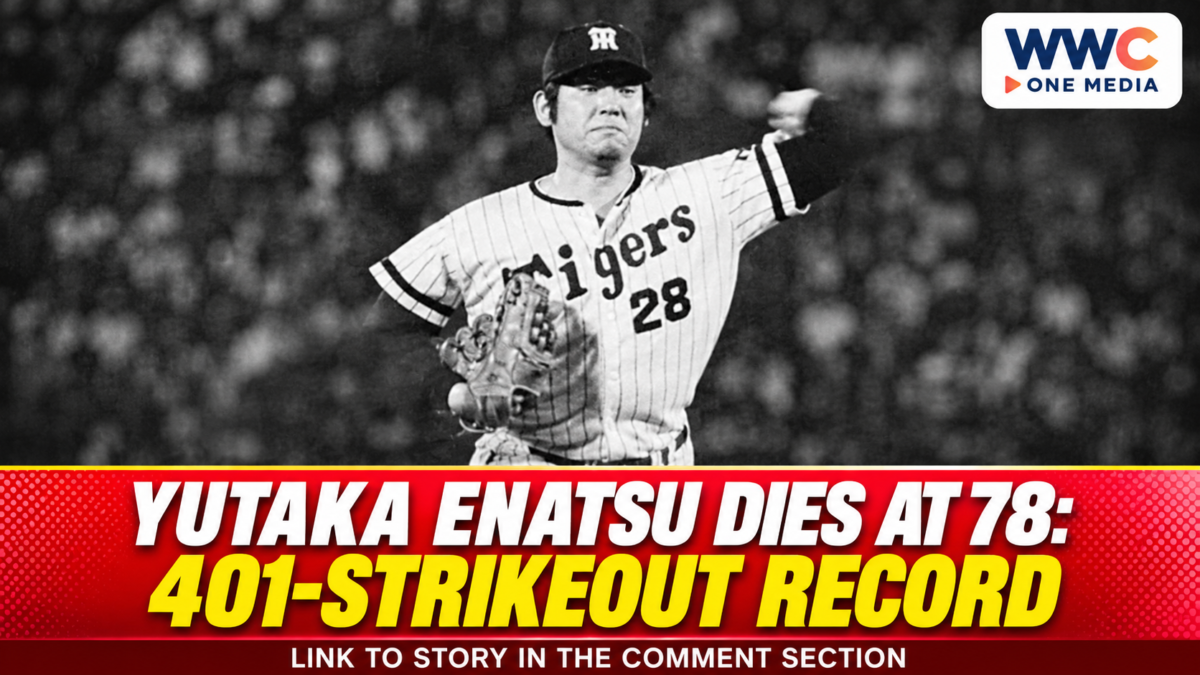
Yutaka Enatsu, one of the most influential left-handed pitchers in Japanese professional baseball, died on Nov. 17, 2026, at a hospital in Tokyo. He was 78.
The Seibu Lions confirmed his death in an official announcement, remembering Enatsu as a former player who represented the club in 1984. His career, however, stretched across five Japanese professional teams and left records that remain part of the country’s baseball history. 埼玉西武ライオンズ
Enatsu was born on May 15, 1948. His professional career began with the Hanshin Tigers in 1967 and continued with the Nankai Hawks, Hiroshima Toyo Carp, Nippon-Ham Fighters and Seibu Lions. 埼玉西武ライオンズ+1
His legacy is best understood through two achievements: a single-season strikeout record that still stands and a pressure-filled performance in the 1979 Japan Series that became known as “Enatsu’s 21 Pitches.”
The 401-strikeout season that still stands
Enatsu’s most extraordinary statistical achievement came in 1968, his second season with Hanshin.
The official Nippon Professional Baseball record book lists his total of 401 strikeouts that year as the highest single-season mark in its historical rankings. He reached that figure over 329 innings pitched, a workload that underlines the demands placed on starting pitchers during that era. NPB.jp 日本野球機構+1
The number has endured across generations of players. NPB’s historical table continues to place Enatsu first, ahead of Kazuhisa Inao’s 353 strikeouts in 1961 and Masaichi Kaneda’s 350 in 1955.
Enatsu also appears elsewhere near the top of the same list. He recorded 340 strikeouts in 1970, another season that ranks among the highest totals in Japanese professional baseball. NPB.jp 日本野球機構
The record helps explain why his reputation was built on more than speed or power. Sustaining that level of strikeout production required consistency, control and the ability to challenge hitters throughout a long season.
For readers following Japan’s current generation, the contrast is striking. Japan’s recent APBC 2026 championship highlighted a younger group of players preparing for the next international challenges. Enatsu’s career belongs to a different era, but his numbers remain a benchmark in the country’s professional game.
Nine consecutive strikeouts at the 1971 All-Star Game
Enatsu’s influence was not limited to regular-season statistics.
At the 1971 NPB All-Star Game, he struck out nine consecutive batters, a feat that remains unique in the league’s official record of consecutive strikeouts in an All-Star contest.
NPB’s own historical feature identifies the achievement as the only instance of nine successive strikeouts in the event. It came during the same game in which the Pacific League recorded an All-Star no-hitter. NPB.jp 日本野球機構
The accomplishment demonstrated his ability to perform on a major stage against leading hitters from the other league. It also gave fans a moment that could be measured not only in statistics but in the unusual pressure of an exhibition featuring the best players available.
The nine-strikeout sequence became one of the defining achievements of his career, alongside the 401-strikeout season.
Why “Enatsu’s 21 Pitches” remains part of baseball history
A different kind of achievement came in the 1979 Japan Series, when Enatsu was pitching for Hiroshima against the Kintetsu Buffaloes.
In the decisive seventh game on Nov. 4, Hiroshima protected a 4-3 lead in the bottom of the ninth. Kintetsu loaded the bases with no outs, creating a situation in which one hit could have changed the championship.
NPB’s historical account describes how Enatsu struck out Kyosuke Sasaki, recognised the attempted squeeze play by Shigeru Ishiwata and helped complete a play that caught the runner at third. He then struck out Ishiwata to end the threat. NPB.jp 日本野球機構
The sequence became known as “Enatsu’s 21 Pitches” and is remembered as one of the most dramatic closing moments in Japan Series history.
The official series record confirms Hiroshima won Game 7 by 4-3, with Enatsu credited with the save. The victory secured Hiroshima’s first Japan Series championship. NPB.jp 日本野球機構+1
The moment showed another side of Enatsu’s ability. The 401-strikeout season reflected endurance over months; the 1979 finale demanded precision and composure in a single, decisive inning.
A career across five teams
Enatsu’s career took him through five franchises over 18 seasons, from 1967 to 1984.
He spent his first nine seasons with Hanshin before moving to Nankai for 1976 and 1977. He then joined Hiroshima from 1978 to 1980, played for Nippon-Ham from 1981 to 1983 and finished his playing career with Seibu in 1984. 埼玉西武ライオンズ+1
That path placed him in different teams and competitive environments, while his reputation continued to follow him. His time with Hiroshima became particularly associated with the club’s first Japan Series title and the decisive ninth-inning performance that secured it.
His career also forms part of the wider story of Japanese baseball’s development. The sport has produced generations of players whose achievements are remembered through both statistics and defining championship moments. WWC previously examined that legacy in its tribute to Isao Harimoto and his enduring NPB hits record.
Enatsu’s own record book entry lists him among the leading strikeout pitchers in NPB history, with 2,987 career strikeouts and 3,196 innings pitched. NPB.jp 日本野球機構+1
What his legacy means for Japanese baseball
Enatsu’s career is a reminder that baseball greatness cannot be reduced to one statistic.
The 401 strikeouts capture his dominance over a full season. The nine consecutive All-Star strikeouts show what he could accomplish against elite opposition. The 1979 Japan Series performance illustrates how a pitcher could shape a championship through decisions and execution under pressure.
These achievements also help explain why his name remains central to discussions of Japanese baseball history. His career bridged the role of a powerful starting pitcher and the high-pressure demands of relief work, while his most famous moments remain part of the sport’s shared memory.
Japan’s baseball landscape continues to change, with new players and national-team ambitions shaping the next generation. Yet the historical standards set by players such as Enatsu remain important reference points for understanding how the game developed.
His death marks the loss of a major figure in Japanese baseball. His records and defining performances, however, remain part of the sport’s history.