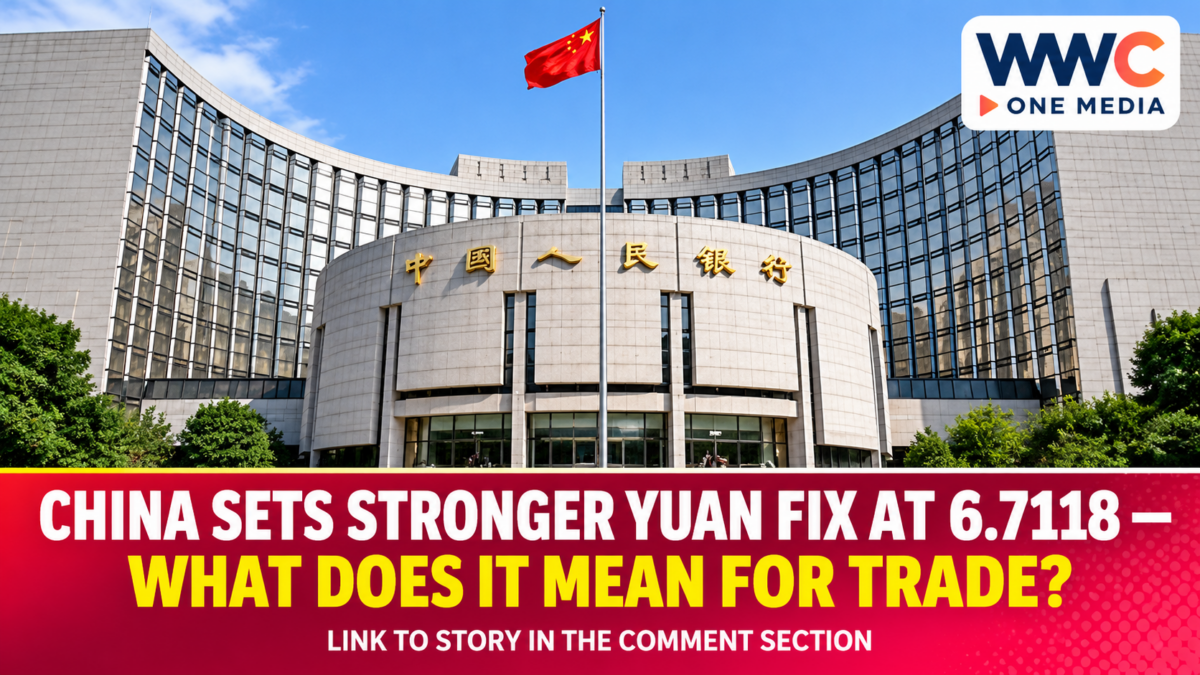
China’s official yuan reference rate strengthened to 6.7118 per US dollar on Nov. 18, 2026, from 6.7132 the preceding trading day, according to the daily benchmarks published by the China Foreign Exchange Trade System (CFETS). The move occurred days after the People’s Bank of China (PBOC) raised foreign-currency reserve requirements for financial institutions, highlighting the different tools used in managing exchange-market conditions.
For businesses, a stronger official fixing does not automatically mean that the yuan will appreciate throughout the day. It is a benchmark, not a guaranteed transaction price, and the direction of future exchange rates remains uncertain.
China yuan fix: what the 6.7118 number means
The Nov. 18 USD/CNY fixing was 6.7118, compared with 6.7132 on Nov. 17. The difference is 0.0014 yuan per dollar, or 14 units in the market’s four-decimal-place convention. Since USD/CNY measures how many yuan buy one dollar, the lower number represents a stronger yuan reference rate.
The official trading system publishes this central parity on each business day under PBOC authorisation. Its methodology draws on quotations from market makers before the onshore market opens, with reference to previous trading, foreign-exchange supply and demand, and movements in major international currencies.
Importantly, this is not the same as an intraday traded rate or the rate that a Philippine importer would receive from a commercial bank. A headline about a stronger fixing describes the reference established that morning; it does not independently establish where the currency finished trading.
The historical claim that the fixing is the strongest since 2022 would require checking a complete comparable historical series. The immediate day-to-day change can be verified directly without making that broader ranking.
Another policy move shows why the PBOC is watching liquidity
The PBOC announced on Nov. 3 that it would raise the foreign-exchange deposit reserve requirement ratio for financial institutions by two percentage points, from 4% to 6%, effective Nov. 15. The announcement identified management of foreign-currency liquidity as the purpose of the measure.
The reserve requirement applies to qualifying foreign-currency deposits held by financial institutions; it should not be confused with China’s main reserve requirement for renminbi deposits. The distinction matters because two measures called reserve requirements can work through different parts of a bank’s balance sheet.
A higher foreign-currency deposit reserve ratio changes the amount of those deposits that institutions must hold as reserves. That can affect the availability and pricing of foreign-currency liquidity without dictating the yuan’s daily exchange rate.
Analysis: Read together, the stronger fixing and the reserve adjustment show that authorities have more than one instrument available when exchange-market conditions change. They do not prove a precise target rate or establish that the central bank intends to permit an uninterrupted rally.
Exporters and importers face different currency effects
A stronger yuan can reduce the local-currency value of dollar receipts for a Chinese exporter whose production expenses are primarily in yuan. That outcome depends on the invoice currency, the timing of conversion, foreign-currency expenses and hedging arrangements.
Conversely, the yuan cost of a dollar-priced imported component can decline if the exchange rate appreciates and other prices remain unchanged. Neither effect is universal; companies often have both export sales and imported inputs.
WWC’s earlier examination of currency exposure among Chinese electric-vehicle exporters provides a company-focused illustration of why exchange-rate movements are not automatically good or bad for earnings.
Businesses cannot derive their actual profit or loss from the daily fixing alone. Financial statements and contractual exposure are needed to establish a measurable impact.
Why stronger guidance is not a forecast
The PBOC’s published 2026 policy stance includes a commitment to keeping the renminbi basically stable at a reasonable and balanced level, while guarding against excessive exchange-rate movements. That general policy objective is not a published year-end USD/CNY prediction.
The daily central parity mechanism accommodates information from the previous trading session and international markets. Changes in the dollar, trade receipts and expectations about interest rates may all affect subsequent conditions, but their combined future effect cannot be known from one official rate.
WWC has separately examined an investment bank’s favourable outlook for the yuan. That article considers a private institution’s forecasts; the present report concerns an official daily benchmark and the distinction between a policy tool and a market projection.
Analysis: The reference rate is best understood as one observable piece of China’s foreign-exchange framework. Investors should not confuse a higher official valuation of the yuan on a particular date with a commitment to deliver a specific future appreciation.
What it means for Philippine companies and regional borrowing
For Philippine importers paying Chinese suppliers, currency exposure depends first on whether the contract is billed in yuan, dollars or pesos. The yuan’s movement against the dollar does not by itself determine its movement against the Philippine peso.
An exporter receiving yuan also faces a different exposure from a borrower required to repay yuan-denominated debt. A stronger yuan may increase the peso value of yuan receipts, or increase peso repayment costs, depending on the relevant exchange rates and timing.
In regional finance, WWC has examined yuan-denominated borrowing in China’s bond market. Such financing can diversify funding sources but introduces currency obligations that cannot be measured solely from the dollar-yuan midpoint.
No specific change to Philippine retail prices, the peso exchange rate or local debt costs can be inferred from the Nov. 18 fixing without additional transaction-level or official market data.
What happens next
The next official CFETS daily fixings will show whether the reference rate continues moving lower, stabilises or reverses. The PBOC’s subsequent policy communications may also clarify how it assesses foreign-currency liquidity after the Nov. 15 reserve adjustment.
A meaningful assessment of commercial consequences will require observable exchange rates, company disclosures and actual invoices rather than a single benchmark. On Nov. 18, the verified fact is a stronger official yuan fixing—not a guaranteed appreciation path or an established financial gain for every importer.
FAQ
What was China’s yuan fixing on Nov. 18, 2026?
CFETS published a central parity of 6.7118 yuan per US dollar, compared with 6.7132 on Nov. 17.
Does a lower USD/CNY rate mean a stronger yuan?
Yes. It means fewer yuan are required to buy one dollar. The official fixing remains distinct from a bank’s customer exchange rate.
Did China change its foreign-currency reserve requirement?
Yes. The PBOC announced an increase from 4% to 6%, effective Nov. 15, to manage foreign-exchange liquidity.
Will a stronger yuan make Chinese imports more expensive in the Philippines?
Not necessarily. Philippine prices depend on invoicing currency, the peso’s exchange rate, supplier pricing and other costs. The USD/CNY fixing alone cannot establish the result.