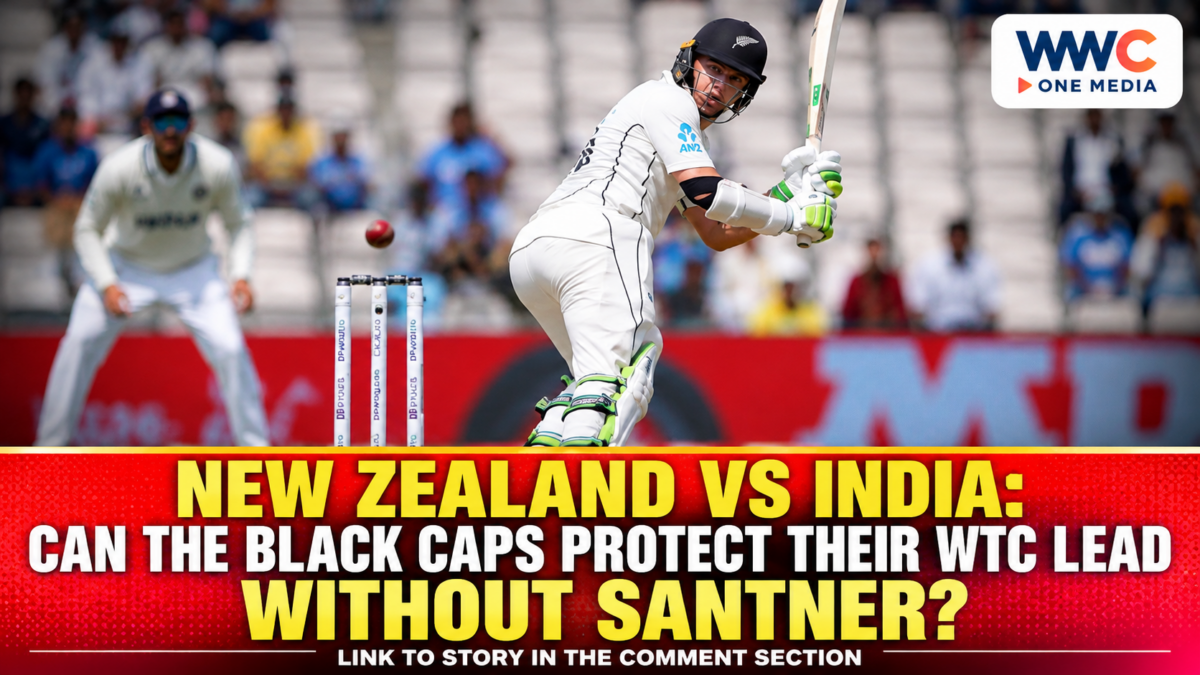
New Zealand and India are set to begin a two-Test series in Wellington on Nov. 19, with the opening match at Cello Basin Reserve forming part of the 2025–27 ICC World Test Championship. The contest comes with New Zealand leading the current championship table and India sitting fourth, giving both sides an important opportunity to strengthen their positions before the next phase of the cycle. NZC+2
The hosts enter the series with a significant selection adjustment: all-rounder Mitchell Santner has been ruled out of both Tests after fracturing his right hand during the final one-day international against India. Dean Foxcroft has been called into New Zealand’s squad as his replacement. ICC
The immediate challenge for New Zealand is to maintain the balance of its side without one of its experienced spin-bowling options. India, meanwhile, arrive with a pace attack that includes Jasprit Bumrah, Mohammed Siraj and the newly added Gurnoor Brar.
The two-match series is not a final, but its points could influence the teams’ routes towards the 2027 championship decider.
New Zealand vs India: Why the WTC table matters
The latest ICC standings available before the opening Test place New Zealand first with 72.22 percentage points, while India are fourth at 51.52. South Africa are second on 71.43, and Australia are third on 69.23. ICC+1
The standings are calculated using the percentage of points won, rather than simply counting total points. Under the championship system, a team earns 12 points for a win, six for a tie and four for a draw. The top two teams qualify for the final in 2027. ICC
That structure makes every Test important. A strong series can improve a team’s percentage, while a poor result can make the remaining schedule more difficult.
New Zealand have played six Tests in the current cycle, winning four, losing one and drawing one. India have played 11, with five wins, four defeats and two draws. ICC
For New Zealand, the home series is an opportunity to protect its position near the top. For India, it is a chance to reduce the gap and keep its qualification campaign moving in the right direction.
Santner’s absence changes New Zealand’s selection equation
Santner’s injury is one of the most important developments before the first ball.
The 34-year-old fractured his right hand after being struck while batting in the fifth and final ODI against India in Mount Maunganui. He will miss both Tests, with Dean Foxcroft brought into the 14-player squad. ICC
Santner’s absence removes an experienced left-arm spin option and an all-rounder from New Zealand’s choices. The team will have to decide how to distribute those responsibilities among the remaining players.
Foxcroft’s inclusion gives the selectors another option, but his presence in the squad does not guarantee a place in the final XI.
New Zealand’s announced squad is led by Tom Latham and includes Tom Blundell, Devon Conway, Jacob Duffy, Matt Henry, Kyle Jamieson, Daryl Mitchell, Henry Nicholls, Glenn Phillips, Rachin Ravindra, Nathan Smith, Blair Tickner and Will Young, alongside Foxcroft. ICC
The squad announcement also included players managing injury concerns. Blundell had a quadricep issue, Conway a concussion concern and Ravindra a shoulder issue when the group was named. Their availability and match fitness remain important selection considerations. ICC
India adds Gurnoor Brar to its Test bowling options
India have also made a late adjustment to their squad.
Gurnoor Brar was added for the two-Test series, while Kuldeep Yadav was released to play domestic cricket in India. The 26-year-old Brar received his maiden Test call-up after taking nine wickets during the ongoing ODI series in New Zealand, as recorded in the ICC’s squad update. ICC
The updated Indian squad is captained by Shubman Gill and includes Yashasvi Jaiswal, KL Rahul, Devdutt Padikkal, Rishabh Pant, Dhruv Jurel, Ravindra Jadeja, Anshul Kamboj, Jasprit Bumrah, Prasidh Krishna, Akash Deep, Sai Sudharsan, Nitish Kumar Reddy, Washington Sundar, Mohammed Siraj and Brar. ICC
Pant has been declared fit and joined the squad in Wellington, removing the fitness uncertainty attached to his original selection. ICC
India’s bowling choices will be closely watched. Bumrah and Siraj provide established international experience, while Brar’s inclusion adds another pace option. The final combination will depend on conditions, fitness and the team’s assessment of the Basin Reserve surface.
The 2024 result adds context, but not a guarantee
The teams last met in a Test series in 2024, when New Zealand recorded a 3–0 win in India. That result gives the visitors a recent series achievement to draw confidence from, but it does not determine what will happen in Wellington. ICC
The current contest comes under different conditions, with New Zealand playing at home and both teams carrying different squad questions.
For India, the challenge is to translate its available batting and bowling depth into a consistent performance across five days. For New Zealand, the task is to use home conditions while adjusting to Santner’s absence.
The wider development of cricket in Asia also remains relevant to the sport’s audience. WWC previously examined cricket’s growing profile in Japan during the Asian Games, a reminder that international fixtures can serve both established cricket audiences and markets where the sport is still expanding.
India’s selection decisions have also been part of the wider cricket conversation, including the questions surrounding Mohammed Shami’s place in India’s future plans. The current Test squad, however, should be assessed on the players officially selected for this series.
Wellington opens a demanding two-Test assignment
The first Test is scheduled for Cello Basin Reserve in Wellington, with the second match set for Hagley Oval in Christchurch from Nov. 27. NZC+1
The short series leaves little room for a slow start. A victory in the opener would give either side an early advantage, while a draw would leave the championship points to be decided across the two matches.
New Zealand’s position at the top of the table makes the series particularly valuable, but India have a clear incentive to take points away from home. Neither side can treat the opening Test as an isolated contest because the result feeds directly into the wider championship standings.
What happens next
The first Test begins on Nov. 19 at Cello Basin Reserve in Wellington. The teams then move to Christchurch for the second Test, scheduled to start on Nov. 27 at Hagley Oval. NZC+1
The main pre-match questions are whether New Zealand can compensate for Santner’s absence, whether Foxcroft earns a place in the playing XI and which pace combination India selects.
The championship implications will become clearer once the first result is recorded. Until then, New Zealand hold the stronger table position, but India have two opportunities to challenge that advantage.
Frequently asked questions
1. When is the New Zealand vs India first Test?
The first Test is scheduled to begin on Nov. 19, 2026, at Cello Basin Reserve in Wellington.
2. Why is Mitchell Santner missing the Test series?
Santner fractured his right hand after being struck while batting in the fifth ODI against India. He has been ruled out of both Tests.
3. Who replaced Mitchell Santner in New Zealand’s squad?
New Zealand called up all-rounder Dean Foxcroft to its 14-player squad.
4. Who is captaining India in the Test series?
Shubman Gill is listed as India’s captain in the updated Test squad.
5. Where will the second Test be played?
The second Test is scheduled for Hagley Oval in Christchurch, beginning on Nov. 27, 2026.