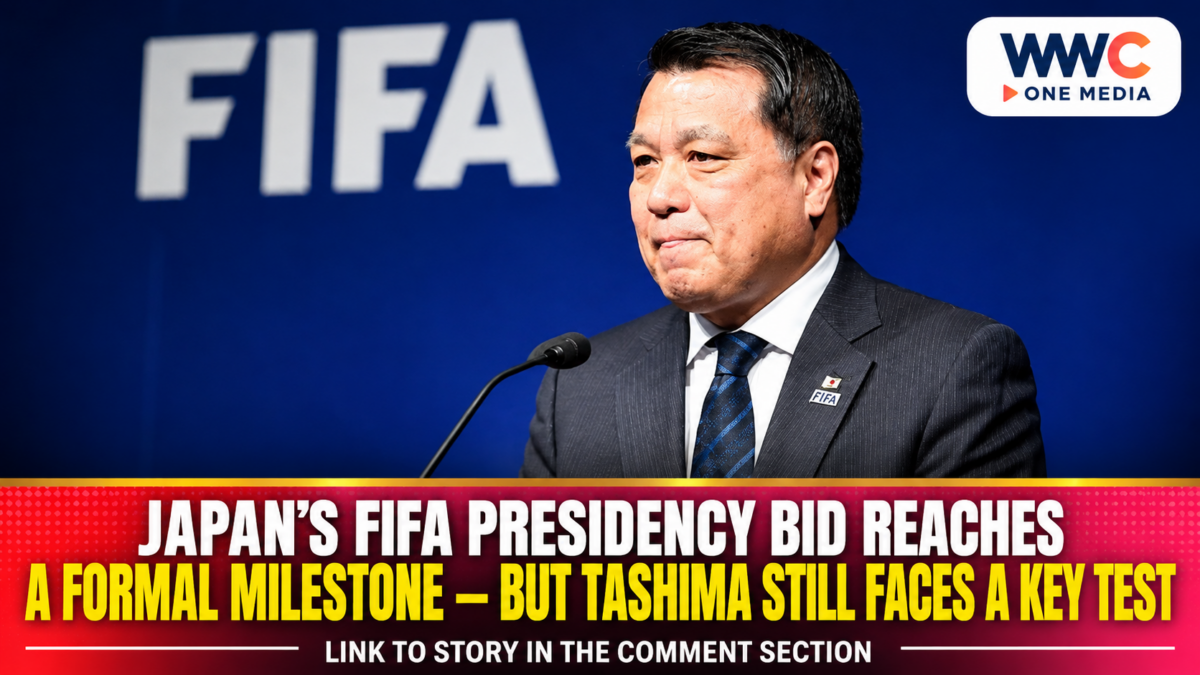
Japan’s Football Association has formally submitted Kozo Tashima’s nomination for the FIFA presidency, moving the former association chief’s campaign into the organisation’s official review process. The submission was made on Nov. 17, ahead of the election scheduled for March 18, 2027, in Rabat, Morocco.
The step gives Japan a formal place in the approaching leadership contest, but it does not yet mean Tashima has been officially confirmed as a candidate. FIFA must first complete its eligibility checks and confirm that the requirements have been met.
The distinction matters. A nomination is the beginning of the formal process, while approval determines whether a proposed candidate can proceed to the ballot. For world football, the coming months will show whether Tashima’s governance message can develop into a fully approved challenge to the incumbent leadership.
Japan’s FIFA presidency bid moves beyond an announcement
The Japan Football Association (JFA) confirmed that it sent FIFA a letter nominating Tashima on Nov. 17. The submission followed a unanimous decision by the JFA board at its 13th meeting on Nov. 5 to recommend him for the position.
The association’s published board record identifies the decision as a recommendation concerning the next FIFA presidential election. Its subsequent announcement confirms that the required documents had been prepared and the formal letter had been submitted.
This sequence is important because it separates two stages that can easily be confused: the national association’s decision to support a prospective candidate, and the international governing body’s review of that candidate.
The JFA announcement says FIFA will conduct eligibility checks on Tashima and the other proposed candidates. FIFA is expected to announce the candidates formally after confirming that they meet the applicable requirements.
For readers following the contest, the nomination is therefore a verified procedural milestone—not a declaration that the election field is already final.
Governance and transparency are central to Tashima’s stated platform
Tashima’s published comments place organisational standards at the centre of his proposed contribution to FIFA.
He said he wants to use his experience in Japanese football to promote stronger governance and more transparent organisational management at the international level. His statement also highlighted fair play, respect and integrity as principles he wants to communicate more widely.
Those are broad objectives, but they provide an indication of the themes he intends to bring into the campaign.
The practical test will be whether these principles are developed into specific proposals. Governance reform can involve several areas, including how major decisions are explained, how member associations are consulted and how accountability is maintained within an international sports organisation.
Tashima’s statement identifies the direction he wants to pursue. It does not yet provide a detailed manifesto or a list of proposed structural changes.
That leaves room for a more substantive campaign programme to emerge if FIFA confirms his eligibility.
The 2027 election will be decided by FIFA’s member associations
The JFA has confirmed that the election is scheduled for March 18, 2027, during the 77th FIFA Congress in Rabat, Morocco.
The association’s announcement states that representatives of FIFA’s 211 member associations will vote to choose the next president.
This gives the contest a wider institutional dimension. A candidate’s national association support is significant, but the final decision belongs to FIFA’s membership through the Congress vote.
Incumbent president Gianni Infantino has already announced his intention to seek re-election. In a statement delivered at the 76th FIFA Congress in Vancouver on May 1, he said he would be a candidate in the 2027 election.
The contest therefore involves a challenge to an incumbent who has publicly declared his intention to remain in office. The formal nomination process and subsequent eligibility review will determine which proposed challengers can advance to the election.
For a broader look at the governance debate surrounding FIFA, WWC previously examined Infantino’s pledge to promote greater dialogue after the abandoned commercial investment proposal. That discussion provides context for why transparency and consultation have become prominent themes in football administration.
Japan’s football leadership role extends beyond the national team
The nomination also places the JFA’s institutional role in international football under attention.
National associations do more than select teams and organise domestic competitions. They represent their members in international football structures and participate in decisions affecting the sport’s direction.
Japan’s wider sporting ambitions have also been visible in its regional commitments. WWC has covered Japan’s role as host of the Aichi-Nagoya Asian Games and the country’s effort to use sport to strengthen regional connections in its report on the Games’ “One Asia” vision.
That is a different subject from FIFA’s presidential election, but it illustrates the broader setting in which Japan’s football institutions operate: international competition, sporting development and cooperation across Asia.
The JFA’s own announcement links its support for Tashima to what it describes as the continued development and international standing of Japanese football. Tashima’s statement similarly connects that development with his proposed contribution to FIFA.
The significance of the nomination will ultimately depend on whether he can translate those arguments into a programme that resonates with associations across the global game.
The campaign still needs to move from principles to detail
Tashima’s public statement outlines priorities, but several important questions remain unanswered in the official material reviewed for this report.
The JFA has not published a detailed campaign manifesto alongside its nomination announcement. It has also not identified the other national associations that provided support for the nomination.
Those omissions should not be treated as evidence of a problem. They simply mean that the public record currently provides a clear account of Japan’s formal action and Tashima’s stated priorities, but not a complete picture of his campaign organisation or international support.
The next meaningful developments will be FIFA’s eligibility review, the formal publication of approved candidates and the release of more detailed campaign positions.
The governance discussion will also need to move beyond general commitments. Football associations and voters will have to assess what each candidate proposes to change, how those changes would be implemented and how progress could be measured.
What happens next
FIFA will conduct eligibility checks on Tashima and the other proposed candidates. The governing body will formally publish the candidates after confirming that they satisfy the applicable requirements.
The election is scheduled for March 18, 2027, at the 77th FIFA Congress in Rabat. FIFA’s 211 member associations are expected to take part in choosing the next president.
Until the review is completed, Tashima’s position should be described as a formally submitted nomination rather than a confirmed place on the ballot.
For Japan, the submission is a significant step into the international football leadership debate. For FIFA’s member associations, the more important question will be what each candidate offers beyond the campaign message.
Frequently asked questions
1. Who has Japan nominated for the 2027 FIFA presidency?
The Japan Football Association has nominated its honorary president, Kozo Tashima.
2. When did Japan submit Tashima’s nomination?
The JFA submitted its nomination letter to FIFA on Nov. 17, 2026. The association published its announcement on Nov. 18.
3. Has FIFA officially confirmed Tashima as a candidate?
Not yet. The JFA says FIFA will conduct eligibility checks before formally announcing candidates who meet the requirements.
4. When and where will the next FIFA presidential election take place?
The election is scheduled for March 18, 2027, during the 77th FIFA Congress in Rabat, Morocco.
5. Who will vote in the FIFA presidential election?
The JFA announcement states that FIFA’s 211 member associations will vote to elect the next president.
The JFA has also taken public positions on wider regional football matters. Its leadership’s concerns about the 2027 AFC Asian Cup were covered in WWC’s report on Japan’s warning over the tournament’s hosting arrangements, another example of the association’s role in international football discussions.