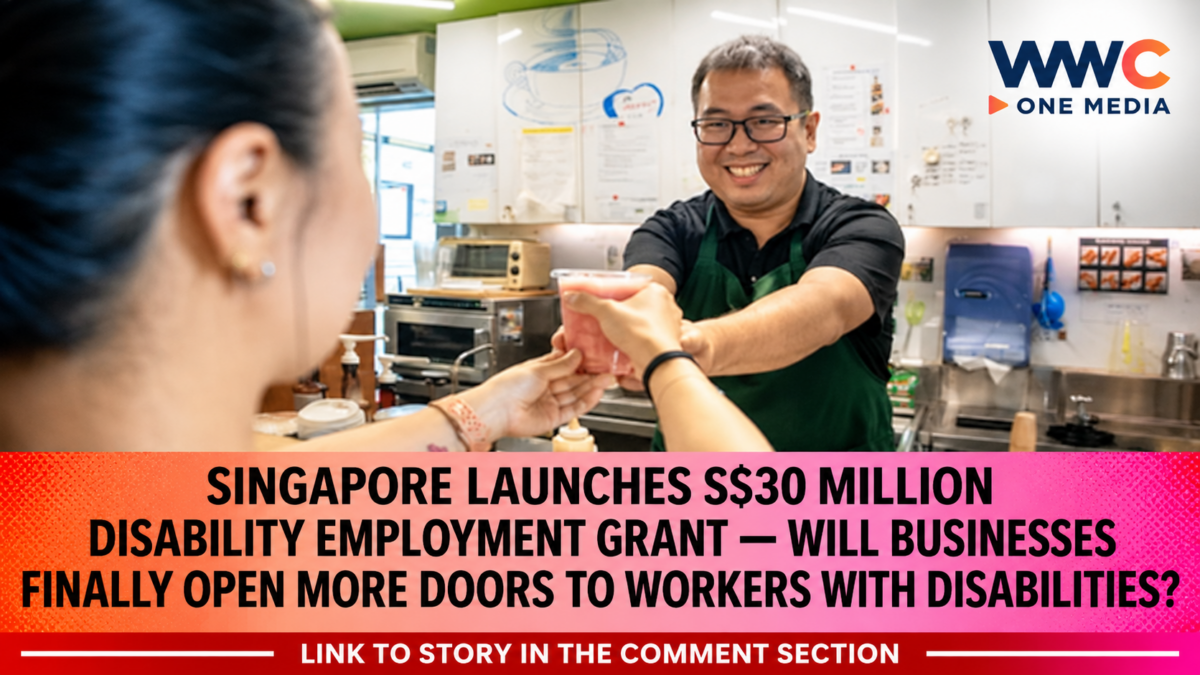
Singapore is stepping up efforts to make disability-inclusive employment more accessible, with a new S$30 million government grant aimed at helping businesses create jobs for persons with disabilities who require moderate levels of workplace support.
Announced by Coordinating Minister for Social Policies and Health Minister Ong Ye Kung on November 10, 2026, the Stronger Support – Enabling Employment Grant (S-EEG) will provide additional funding to enterprises that employ a meaningful number of workers with moderate support needs.
The first call for proposals will be launched by SG Enable by the end of 2026. The initiative is part of a wider package of measures designed to help people with disabilities enter the workforce, remain employed and build sustainable careers.
The announcement comes alongside planned improvements to the Enabling Employment Credit (EEC), which provides wage offsets to employers hiring eligible local workers with disabilities. The changes are expected to take effect in January 2027.
The government is also preparing to combine existing employer grants into a single Enabling Employment Grant in the first half of 2027, making financial assistance easier to access and broadening the types of workplace support businesses can fund.
New S$30 Million Grant Targets Businesses Hiring Workers With Moderate Support Needs
The new S-EEG is designed for enterprises employing a meaningful number of persons with disabilities who require moderate support needs. These employees may need regular, structured assistance to perform their duties, adapt to workplace routines or develop their skills.
The funding is intended to help businesses provide that support rather than simply cover the cost of hiring.
Employers may face additional expenses when recruiting workers with disabilities, including:
- Redesigning job responsibilities to match individual abilities.
- Providing specialised training and workplace coaching.
- Modifying offices, equipment and work processes.
- Hiring additional supervisors, training officers or professional support staff.
- Making arrangements that help employees travel to and from work.
The government hopes the additional funding will encourage more businesses to employ people who might otherwise face greater barriers to entering the workforce.
The S-EEG will initially receive approximately S$30 million. SG Enable, Singapore’s national disability agency, is expected to launch its first call for proposals by the end of 2026.
The funding will be introduced as an additional tier above the broader Enabling Employment Grant.
Three Existing Employer Grants to Be Combined in 2027
Another major change is the planned consolidation of three existing employer support schemes into a single Enabling Employment Grant.
The new grant is expected to launch in the first half of 2027, replacing:
- Open Door Programme Job Redesign Grant.
- Open Door Programme Training Grant.
- Employer Development Grant.
The current system can require employers to navigate separate funding arrangements, making it more complicated to identify the right assistance and submit applications.
The consolidated grant is expected to simplify access and cover a wider range of workplace inclusion expenses.
These may include customised in-house training, job coaching, workplace accommodations and other measures that help employees with disabilities remain productive and develop their careers.
The change is significant for smaller businesses that may want to adopt inclusive hiring but lack the resources or expertise to establish their own support systems.
Enabling Employment Credit to Provide Higher Wage Support From January 2027
The government is also enhancing the Enabling Employment Credit, which provides wage offsets to employers hiring eligible local workers with disabilities.
The changes announced by Senior Parliamentary Secretary for Social and Family Development Eric Chua will expand eligibility and increase temporary wage assistance.
Under the updated scheme:
| Support measure | Existing arrangement | Updated arrangement |
|---|---|---|
| Monthly income ceiling | S$4,000 | S$5,000 |
| Permanent wage offset | Up to 20%, capped at S$400 | Up to 20%, capped at S$400 |
| Temporary wage offset | Up to 20%, capped at S$400 | Up to 30%, capped at S$600 |
| Temporary support duration | 9 months | 12 months |
| Payout frequency | Half-yearly | Quarterly |
The permanent wage offset remains at up to 20% of an eligible employee’s monthly income, capped at S$400.
The temporary wage offset will increase from 20% to 30%, with its monthly cap rising from S$400 to S$600. It will also be extended from nine months to 12 months for employees who have not been working for at least six months before being hired.
The qualifying monthly income ceiling will rise from S$4,000 to S$5,000, allowing more employees to qualify.
These enhancements are scheduled to take effect in January 2027.
Payouts will also become quarterly instead of half-yearly. The first quarterly payout is scheduled for December 2027 and will cover wages paid from July to September 2027.
Taken together, eligible employers could receive up to S$1,000 in monthly wage offsets during the temporary support period, depending on the employee’s qualifying wages.
Only About One in Three Working-Age Persons With Disabilities Is Employed
The new measures address a continuing challenge in Singapore’s labour market.
According to Ministry of Manpower figures, 34.7% of persons with disabilities aged 15 to 64 were employed in 2025, compared with 33.6% in 2024.
The government has set a target of increasing the employment rate to 40% by 2030 under the Enabling Masterplan 2030.
The employment challenge is not limited to finding a first job.
Some workers need continuing assistance after being hired, particularly when workplace responsibilities change, new colleagues arrive or additional training becomes necessary.
Families have also raised concerns about the transition from special education into adulthood, sometimes described as the “post-18 cliff”. This refers to uncertainty about whether young people with disabilities will have access to suitable employment, career development and independent living opportunities after leaving school.
A broader taskforce package announced in October seeks to address these concerns through education, employment and community support.
WWC ONE MEDIA previously reported on Singapore’s planned Employment Support Office, which will provide longer-term career guidance and employment assistance to persons with disabilities and employers.
The office, which will be established by SG Enable, is expected to become fully operational in the second half of 2027. It will help job seekers access career advice, skills upgrading and employment support while guiding companies on hiring, job redesign and workplace integration.
More Than 190 Organisations Recognised for Inclusive Hiring
The announcements were made during the Enabling Mark Awards 2026, which recognised businesses and individuals supporting disability-inclusive employment.
More than 190 organisations received Enabling Mark accreditation at the November 10 ceremony, nearly double the number recognised at the previous awards ceremony in 2024.
The accreditation framework recognises organisations that make meaningful efforts to recruit, support and retain employees with disabilities.
The government also introduced a refreshed Enabling Mark 2.0 framework, placing greater emphasis on actual inclusion outcomes, including employee retention and career development.
Examples highlighted by officials include United Overseas Bank, which redesigned work processes for employees with autism, and Marina Bay Sands, which made physical adjustments such as lowering card-access readers and computer kiosks to support employees who use wheelchairs.
Smaller enterprises and social businesses were also recognised for creating employment opportunities.
Crunchy Teeth Shows How Inclusive Employment Can Work
One example is Crunchy Teeth, a social enterprise bakery that trains and employs young people with autism.
The business has trained more than 20 autistic young people in tasks such as baking, packing cookies and operating mall stalls.
Its founders described how establishing structured work systems, using visual instructions and supporting communication between employees helped create a more accessible working environment.
The bakery’s recognition demonstrates that inclusive employment is not simply about offering someone a job. It also requires an environment where employees can learn, contribute and develop confidence over time.
Another example is Cummins Asia Pacific, which employs 13 persons with disabilities in roles including service advisers and document controllers.
The company has highlighted the practical costs involved in supporting employees, including transportation arrangements for a wheelchair user travelling to and from its Tuas facility.
Its experience illustrates why employers are asking for broader financial assistance beyond wage subsidies.
Singapore Plans More Support Beyond Employment
The government’s wider disability-support programme also includes improvements to community services.
Another 2,300 places will be added at day activity centres and sheltered workshops by 2030, bringing total capacity to 5,800 places.
The Enabling Skills for Life Programme is also being tested at selected facilities. It aims to help persons with disabilities build independence, participate in community life and prepare for employment where possible.
By 2028, SG Enable is expected to establish 12 Enabling Services Hubs across Singapore to connect persons with disabilities and caregivers with community programmes, resources and future care-planning services.
These measures reflect a broader policy shift towards supporting people with disabilities throughout different stages of life, rather than focusing only on access to education or initial job placement.
Can the New Grants Make Inclusive Hiring Standard Practice?
The S$30 million S-EEG and the planned expansion of wage support represent a significant investment in Singapore’s disability-inclusive employment efforts.
However, financial incentives alone may not be enough to transform workplace culture.
Businesses will also need managers who understand different support needs, accessible working environments, practical job designs and opportunities for employees to progress.
The success of the measures will depend on whether employers use the funding to create sustainable jobs rather than short-term placements.
For job seekers and families, the most important outcome will be whether these initiatives lead to more meaningful employment opportunities, greater independence and long-term career stability.
Singapore has set a clear target of reaching a 40% employment rate for working-age persons with disabilities by 2030. The next challenge is turning that ambition into lasting opportunities across more industries and businesses.
The government is increasing financial support, simplifying grants and strengthening employment services. Whether these changes can make inclusive hiring a normal part of business practice will become clearer as the new programmes begin rolling out in 2027.