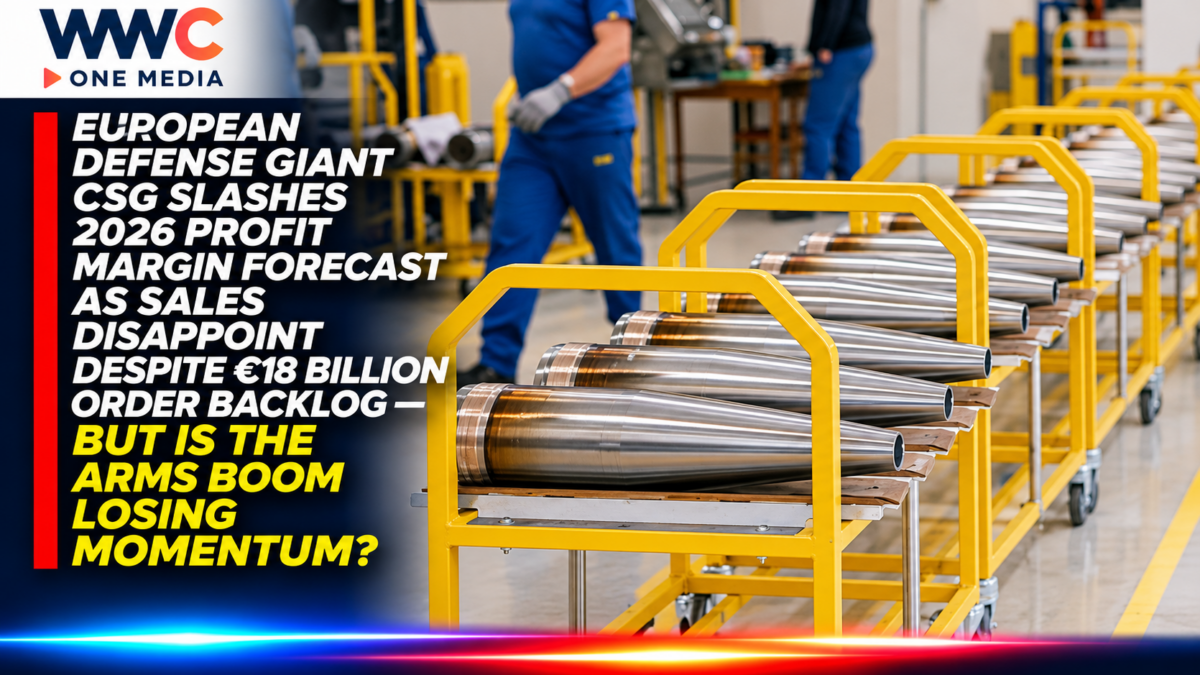
PRAGUE / AMSTERDAM — November 11, 2026 — Europe’s booming defense industry is facing a fresh profitability test after Czech weapons manufacturer Czechoslovak Group (CSG) sharply lowered its full-year operating profit margin forecast, even as military orders surged to a record €18 billion.
The defense conglomerate, controlled by billionaire Michal Strnad, now expects an operating earnings-before-interest-and-taxes (EBIT) margin of approximately 21% for 2026, down from its previous target of 24% to 25%.
The warning came alongside weaker third-quarter results, with revenue falling 11.7% year over year to €1.51 billion and operating EBIT declining 20.9% to €317 million.
The figures highlight an increasingly important problem facing the global arms industry: Strong demand for weapons does not necessarily guarantee higher profits.
CSG has been benefiting from European military modernization, ammunition demand and efforts by NATO governments to rebuild defense stockpiles. But changes in customer preferences, declining prices for certain ammunition products and longer production schedules have complicated its growth strategy.
The company’s order backlog now stands at €18 billion, while its wider portfolio of orders and prospective business totals €47 billion.
Yet investors are confronting a difficult question.
If European governments are spending heavily on defense and CSG has more orders than ever, why is one of the continent’s fastest-growing weapons manufacturers expecting substantially weaker profit margins?
CSG Cuts Operating Profit Margin Outlook From 24%–25% to 21%
CSG’s November 11 trading update delivered a significant downward revision to its profitability forecast.
Management now expects its 2026 operating EBIT margin to reach approximately 21%, compared with the previous guidance range of 24% to 25%.
The reduction represents a deterioration of three to four percentage points in the company’s expected operating profitability.
However, CSG reaffirmed its full-year revenue guidance of €7.4 billion to €7.6 billion.
That distinction is significant.
The company is still forecasting substantial annual sales, but it expects to retain a smaller proportion of those sales as operating profit.
Two major developments are driving the revised forecast.
First, demand has shifted toward extended-range ammunition, encouraging CSG to accelerate the sale of older, standard-range ammunition inventory at lower market prices.
Second, the company’s Land Systems business is growing rapidly, but some programs have not yet achieved the profitability levels management expects as production scales up.
Together, these factors are affecting the company’s overall profit margin despite continued demand for defense equipment.
The revised forecast raises questions about how quickly CSG can convert growing military orders into stronger earnings.
Third-Quarter Revenue Drops Nearly 12%
CSG’s third-quarter financial performance was considerably weaker than the same period in 2025.
The company reported the following results for the three months ended September 30:
| Financial measure | Q3 2026 | Q3 2025 | Change |
|---|---|---|---|
| Revenue | €1.51B | €1.71B | -11.7% |
| Operating EBITDA | €359M | €442M | -18.8% |
| Operating EBIT | €317M | €401M | -20.9% |
| Net profit from continuing operations | €150M | €203M | -26.0% |
| Operating EBIT margin | 21.0% | Approximately 23.5% | Lower |
The decline indicates that CSG generated less revenue and operating profit during the quarter despite continued expansion in its defense order pipeline.
Nevertheless, the company attributed part of the revenue weakness to the timing of military equipment deliveries.
Approximately €300 million in revenue previously expected during the third quarter has shifted into the final quarter of 2026.
The company said significant Land Systems order milestones are scheduled for the fourth quarter, when the associated revenue is expected to be recognized.
This means the quarterly sales decline does not necessarily indicate that customers canceled orders.
Instead, some revenue has been delayed by production and delivery schedules.
Still, investors will be looking closely at whether CSG can complete its planned deliveries before year-end.
Nine-Month Revenue Still Grows to €4.76 Billion
Despite its disappointing third quarter, CSG’s performance over the first nine months of 2026 remained positive.
Revenue increased 6.1% year over year to €4.761 billion, compared with €4.485 billion during the same period of 2025.
Operating EBIT reached €1.102 billion, a slight increase from €1.097 billion a year earlier.
The nine-month operating EBIT margin stood at 23.1%, compared with approximately 24.5% a year earlier.
Meanwhile, net profit from continuing operations rose 40.9% to €721 million.
These results illustrate the complexity of CSG’s financial position.
The group is still generating revenue growth and substantial earnings, but its underlying operating profitability has weakened.
Its Defense Systems division remains the principal growth driver, recording a 9.5% revenue increase during the nine-month period.
The figures also show why investors should distinguish between a disappointing quarter and the performance of the business over a longer period.
CSG has not reported an overall nine-month revenue collapse.
Its more immediate challenge is protecting profit margins while delivering a growing portfolio of defense contracts.
Why Ammunition Prices Are Hurting CSG’s Profits
One of the most important explanations for the margin downgrade involves changing demand within the ammunition market.
Since Russia’s full-scale invasion of Ukraine in 2022, European governments have accelerated purchases of artillery ammunition and other military supplies.
The conflict revealed shortages in Western ammunition inventories and increased the urgency of expanding production capacity.
However, military demand is evolving.
CSG said customers are increasingly prioritizing extended-range ammunition, which can provide greater operational flexibility than conventional standard-range products.
In response, the company has been shifting its manufacturing operations toward higher-value ammunition.
During the third quarter, it accelerated the disposal of standard-range ammunition inventory, accepting lower market prices than those achieved in earlier periods.
Those lower prices reduced profitability.
The development should not be confused with a collapse in demand for all ammunition.
CSG continues to report robust demand for medium- and large-caliber products.
Rather, the company is experiencing a transition in the product mix demanded by customers.
That transition can temporarily weaken earnings while manufacturers invest in equipment, components and production capacity required for newer products.
The challenge is ensuring that the resulting higher-value ammunition business eventually generates sufficient returns to offset the short-term pressure.
European Rearmament Continues Despite Profit Warning
CSG’s weaker profitability comes against a backdrop of sustained European defense spending.
Governments across NATO have been rebuilding military inventories, increasing procurement budgets and investing in domestic weapons manufacturing.
The war in Ukraine remains one of the major drivers.
European countries have also become more concerned about their ability to sustain military operations without excessive dependence on overseas suppliers.
CSG is positioned to benefit from those trends through its ammunition, military vehicle, aerospace and defense technology businesses.
Reuters reported in August that the company’s first-half revenue had exceeded analyst expectations, supported by strong ammunition demand and expansion in its defense operations.
At that time, first-half revenue increased more than 17% year over year to approximately €3.3 billion.
The contrast with the latest third-quarter results shows how quickly financial performance can shift as production schedules and product demand change.
The broader European defense market has not necessarily weakened simply because one manufacturer reduced its margin guidance.
But CSG’s results suggest that the industry’s expansion may be accompanied by uneven profitability.
This is especially important as NATO governments consider additional long-term military procurement commitments.
As previously reported by WWC ONE MEDIA in its coverage of a new NATO weapons-funding push for Ukraine, military assistance increasingly depends on manufacturers’ ability to convert funding commitments into actual equipment deliveries.
For defense contractors, securing an order is only the beginning.
The financial outcome also depends on production costs, delivery schedules, supply-chain performance and contract terms.
CSG’s €18 Billion Backlog Shows Demand Remains Strong
One of the strongest elements of CSG’s November trading update was its growing order backlog.
The company reported a record €18 billion in outstanding orders as of September 30, compared with €15 billion at the end of 2025.
Land Systems accounted for the largest share of the backlog at approximately 57%.
Medium- and large-caliber ammunition represented another 32%.
The remaining balance included small-caliber ammunition, aerospace, defense electronics and advanced systems.
CSG also identified €29 billion in prospective business under negotiation.
Combined with its backlog, this gives the company a total commercial opportunity of €47 billion.
However, the €47 billion should not be presented as guaranteed future revenue.
It includes prospective business that has not necessarily been converted into binding contracts.
Even the €18 billion backlog contains different categories of commitments, including framework and less-certain orders.
These distinctions are important because investors often look at defense order books as indicators of future growth.
A strong backlog provides visibility, but it does not automatically guarantee that revenue will be recognized on schedule or at the originally expected profit margin.
Land Systems Becomes a Bigger Part of CSG’s Business
CSG is increasingly developing beyond its traditional reputation as an ammunition supplier.
The company’s Land Systems business includes military vehicles and related defense equipment.
Growth in this division is helping diversify the group as European governments expand military modernization efforts.
However, Land Systems projects can involve long manufacturing cycles, specialized components and complex delivery schedules.
CSG’s third-quarter results show that these characteristics are now affecting the timing of revenue recognition.
Management said some deliveries have moved into the fourth quarter of 2026, while other activities are shifting into 2027.
The growing contribution from Land Systems is also placing pressure on group margins because profitability is still developing as programs scale.
This illustrates a central challenge for rapidly expanding industrial companies.
Diversification may strengthen long-term growth prospects, but new operations can initially carry lower margins and greater working-capital requirements.
For CSG, the success of its diversification strategy will depend on whether Land Systems can eventually deliver stronger financial returns as production volumes increase.
Working Capital Becomes Another Warning Sign
CSG’s earnings update also revealed a significant change in its working-capital outlook.
The group now expects net working capital to remain below 35% of annual revenue at the end of 2026.
Previously, it expected the ratio to remain below 20%.
The higher forecast reflects inventory accumulation and investments in components needed for the production of extended-range ammunition and military equipment.
The company said it has been building inventories to support future deliveries and meet growing customer demand.
However, inventory accumulation ties up cash that might otherwise be available for other business activities.
When deliveries are postponed, the release of that cash can also be delayed.
CSG recorded negative pre-tax operating cash flow of €200 million during the first nine months, although third-quarter operating cash flow was positive.
The company expects some working-capital normalization as delayed orders are delivered, including during 2027.
Investors will therefore be watching whether the expected cash release materializes.
A company can report strong revenue growth and a substantial backlog while still facing financial pressure if too much cash remains tied up in inventory and production.
Debt Rises as CSG Invests in Expansion
CSG’s expanding operations are also affecting its leverage.
Net debt reached approximately €4.32 billion at the end of September.
Its net debt-to-trailing operating EBITDA ratio increased to 2.4 times.
Management attributed part of the increase to investments in strategic partnerships, joint ventures and financial support for important suppliers.
The group reported €731 million in investments in joint ventures and strategic stakes, alongside approximately €700 million in financing provided to key suppliers.
Excluding those investments and supplier-financing arrangements, CSG estimated its adjusted leverage ratio at approximately 1.6 times.
The company also refinanced €3.1 billion in senior credit facilities, reducing financing costs by approximately 125 to 150 basis points and extending maturities.
These developments show how CSG is attempting to balance growth with financial flexibility.
But higher debt and working-capital demands could become more important if project delays continue or profitability does not recover as expected.
CSG Expands Into the United States and Space Technology
Despite the near-term earnings disappointment, CSG continues investing in new markets.
The company has been strengthening its presence in the United States through ammunition production, defense-related manufacturing and industrial partnerships.
In Iowa, it has begun developing the Future Artillery Complex.
The group has also established CSG Land Systems North America in Michigan and announced jet-engine manufacturing activity in Wisconsin.
CSG said it secured a place within a U.S. Army ammunition plant modernization framework valued at up to $4.2 billion.
However, that figure represents the overall framework ceiling, not guaranteed revenue for CSG.
Individual projects will need to be awarded separately.
The company is also expanding into space technology.
In October, CSG became the largest shareholder in MDA Space, a Canadian space technology company.
The investment reflects its ambition to broaden its capabilities beyond traditional defense equipment.
These investments could open additional commercial opportunities.
But expansion into new sectors also creates execution risks, particularly when a company is already managing substantial capital expenditure and working-capital requirements.
Why Ukraine’s War Still Matters to CSG
The Russia-Ukraine war remains central to Europe’s defense-industrial outlook.
Ukraine’s military continues to depend on a large and reliable supply of artillery ammunition, vehicles and other equipment.
European governments have also been replenishing stockpiles depleted by earlier military assistance.
This has created sustained demand for manufacturers such as CSG.
However, the potential direction of peace negotiations introduces another layer of uncertainty.
A ceasefire or political settlement could change the timing and composition of defense procurement, although it would not necessarily eliminate demand.
Governments may continue replenishing inventories and modernizing their forces even after fighting subsides.
In related coverage, WWC ONE MEDIA examined the European Union’s €90 billion Ukraine support framework, including funding intended to sustain defense procurement and industrial production.
Such commitments illustrate why defense manufacturers continue to see substantial long-term opportunities.
However, government funding announcements do not automatically translate into immediate revenue for individual contractors.
Procurement schedules, contracting procedures and manufacturing capacity all influence when companies receive orders and recognize sales.
Can CSG Recover Its Profit Margins by 2027?
CSG remains confident in its medium-term financial outlook despite the reduction in its 2026 margin forecast.
The company is pursuing greater vertical integration, particularly in the production of energetic materials used in ammunition manufacturing.
Its strategy includes expanding in-house production capabilities to reduce dependence on external suppliers.
The group aims to complete its shift toward fully integrated extended-range ammunition production by the end of 2027.
Management also expects its annual ammunition production capacity to reach approximately 1.1 million rounds by that time.
These developments could help improve profitability if manufacturing efficiency increases and the company captures more value from its supply chain.
CSG previously outlined a medium-term operating EBIT margin ambition of approximately 26% to 28%, supported by vertical integration and scale.
The company reaffirmed its medium-term guidance in the November update.
However, those projections remain dependent on future production, demand, costs and delivery performance.
They are not guaranteed outcomes.
The immediate priority is demonstrating that its reduced 2026 margin forecast represents a temporary transition rather than a sustained deterioration in profitability.
Defense Stocks Face a More Complicated Investment Outlook
CSG’s latest results highlight an important distinction for investors evaluating the European defense sector.
Government spending commitments can create strong demand for weapons and military equipment, but that demand does not guarantee uniform profit growth across manufacturers.
Companies still face raw-material costs, specialized labor requirements, financing expenses, contract delays and changing customer preferences.
Defense manufacturers may also need to invest heavily in production capacity before receiving the full financial benefits of new orders.
CSG’s experience is particularly relevant because the company has grown rapidly through acquisitions, ammunition expansion and diversification.
Reuters previously reported that investors had become more cautious about the company’s valuation following its January 2026 stock-market listing.
Its first-half performance helped demonstrate the strength of its underlying defense operations.
The November margin downgrade introduces another test of investor confidence.
The key issue is whether management can deliver the revenue it has promised while bringing costs, inventory and production schedules under control.
What Happens Next for Czechoslovak Group?
Investors will be watching several developments during the remainder of 2026 and into 2027.
First, CSG must deliver the approximately €300 million in revenue that shifted from the third quarter into the fourth quarter.
Second, the company needs to demonstrate that its operating margin can stabilize following the lower-priced sale of standard-range ammunition.
Third, management must address the buildup in working capital and convert more of its inventory into cash through completed deliveries.
Fourth, its Land Systems division must continue expanding while improving operational efficiency.
Finally, the company’s investments in vertically integrated ammunition production will need to deliver the profitability improvements management anticipates.
The company still expects annual revenue of €7.4 billion to €7.6 billion and continues to report substantial demand across its defense businesses.
But the downward revision to its margin forecast means that revenue growth alone may not be enough to reassure investors.
The Bottom Line: Europe’s Defense Boom Faces a Profitability Test
CSG’s November 11 earnings update reveals an unusual contrast.
The Czech defense group has a record €18 billion order backlog, €47 billion in total backlog and potential commercial opportunities, and a significant role in Europe’s expanding military-industrial sector.
Yet its third-quarter revenue fell nearly 12%, operating profit declined more than 20%, and management reduced its full-year operating profit margin target to approximately 21%.
The company attributes the pressure to ammunition product shifts, lower-priced inventory sales, growing Land Systems operations and postponed deliveries.
Those explanations are commercially plausible and consistent with its latest disclosure, but investors will need future results to determine how temporary the pressures really are.
For now, CSG’s order book remains strong, while its profitability outlook has weakened.
The bigger question is whether the company can turn record military orders into sustained earnings growth—or whether Europe’s defense boom is entering a more difficult phase in which manufacturers must fight harder to protect their profits.