MANILA, PHILIPPINES — November 11, 2026 | WWC ONE MEDIA | Philippine Politics, Sandiganbayan, BJMP and Government Accountability
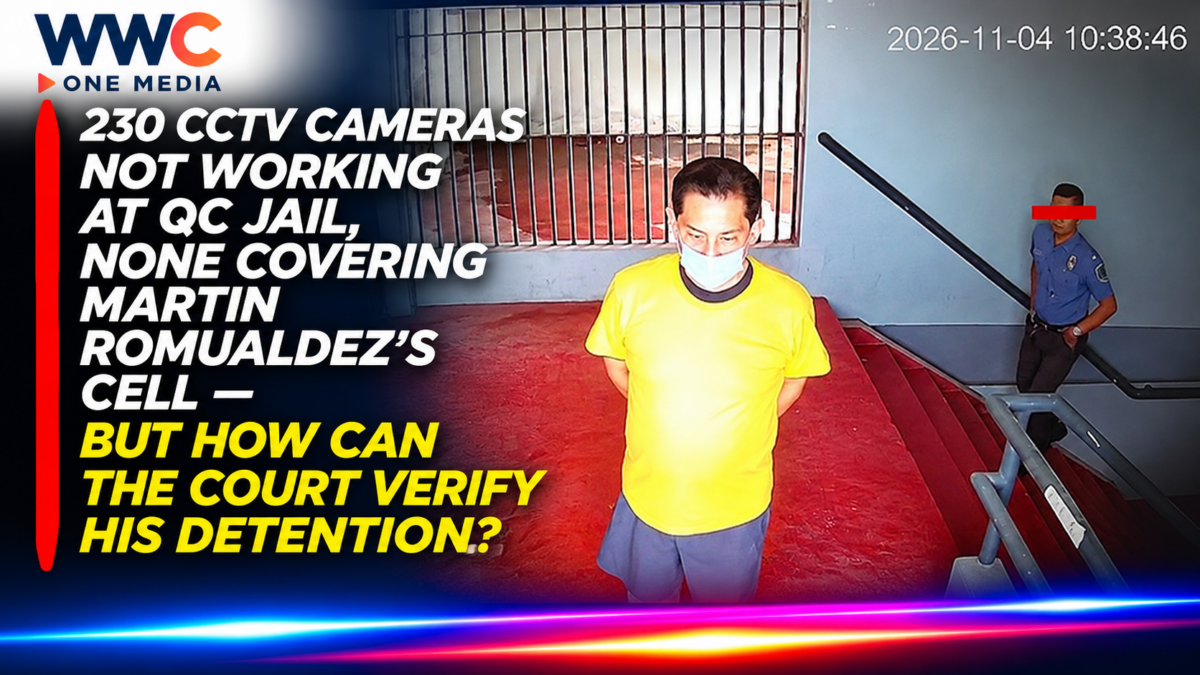
A court inspection of the New Quezon City Jail in Payatas has uncovered serious surveillance failures, with 230 security cameras not operational and no functioning CCTV cameras covering the area where former House Speaker Martin Romualdez is detained.
The findings have intensified scrutiny of the Bureau of Jail Management and Penology (BJMP), raising questions about how prison officials document the movements of high-profile detainees and demonstrate compliance with court orders.
According to the Sandiganbayan Third Division, only 220 of the jail’s 450 CCTV cameras were working during its inspection.
The situation was even more concerning in the section housing high-profile detainees.
Of 152 cameras installed in that area, only 28 were operational.
The court also discovered that the surveillance system had insufficient storage capacity, causing some recordings to be overwritten before investigators could review them.
The deficiencies mean the court cannot independently verify, through continuous CCTV coverage, the jail warden’s assertion that Romualdez remained inside the facility without unauthorized departures.
But the Sandiganbayan emphasized an important distinction.
The absence of functioning surveillance does not prove that Romualdez escaped, secretly left jail or was allowed unauthorized movements.
The investigation has also raised questions about a personal aide who was permitted to assist Romualdez during his detention.
With jail officials ordered to explain the system’s failures, the controversy is becoming a major test of custodial accountability.
How can authorities guarantee that court-ordered detention rules are being followed when the cameras meant to monitor a high-profile detainee are not working—and will investigators uncover negligence, improper privileges or simply a badly maintained security system?
Sandiganbayan Finds More Than Half of Jail Cameras Are Not Working
The Sandiganbayan Third Division’s inspection revealed extensive problems in the New Quezon City Jail’s surveillance infrastructure.
Court findings showed that the facility had 450 CCTV cameras.
Only 220 were operational.
That left approximately 51.1% of the cameras nonfunctional.
The deficiencies were especially severe in the area designated for high-profile detainees.
Of 152 cameras installed there, 124 were not working.
That means fewer than one in five cameras in the section were operational.
The court identified a further problem: there was no functioning CCTV coverage of the location of Romualdez’s detention cell.
These findings are significant because surveillance is one way authorities can independently establish whether detainees remain in authorized areas.
Security cameras also help document incidents, monitor access and review allegations of improper treatment or unauthorized movement.
However, CCTV is not the only method of verifying custody.
Visitor records, guard logs, vehicle records, personnel rosters and other documentation may also provide relevant evidence.
The court is examining those records as part of its inquiry.
Why the Court Cannot Independently Verify Romualdez’s Movements
The court’s concern involves the gap between what jail officials say happened and what independently reviewable evidence can establish.
Jail Superintendent Maria Lourdes Pacion has maintained that Romualdez was not permitted to leave the facility without proper authorization.
But the inspection revealed that no operational cameras were monitoring his cell area.
The court also discovered limitations in the surveillance system’s recording storage.
Some footage had already been overwritten.
That creates a problem for investigators attempting to reconstruct a detainee’s movements over several weeks.
Even when particular cameras are operational, recordings may no longer be available if storage systems automatically replace older footage.
Consequently, the court said it could not fully verify the warden’s statements using the surveillance system.
This does not establish that her statements are false.
It means the available CCTV evidence is insufficient to independently confirm them.
That distinction is essential for accurate reporting.
The Controversy Began With Retracted Jail-Exit Allegations
The investigation followed allegations circulated by columnist Ramon Tulfo.
Tulfo claimed that Romualdez had been secretly leaving the detention facility, allegedly using a backdoor route and an ambulance.
He also claimed that security cameras were disabled during the supposed movements.
The allegations attracted national attention because Romualdez is detained while facing a multibillion-peso plunder case.
But Tulfo later retracted his account.
He acknowledged receiving incorrect information from a source.
The BJMP also denied that Romualdez had been permitted to leave jail secretly.
Its initial review of available CCTV footage found no recorded unauthorized departure during the period it examined.
In earlier coverage, WWC ONE MEDIA reported on the BJMP’s denial of the unauthorized-departure allegations and the Sandiganbayan’s decision to require detailed detention records.
The latest court findings add a critical qualification to that earlier account.
While investigators did not establish an unauthorized departure, the inspection revealed that the jail’s surveillance system could not provide complete independent confirmation of continuous custody.
The failure of the CCTV system and the truth of the original allegation are separate questions.
Jail Warden Faces Questions Over Romualdez’s Personal Aide
Another major issue concerns a personal aide who was allowed access to Romualdez while he was detained.
During a November 5 hearing, Pacion made statements suggesting that the aide had remained inside the facility since Romualdez’s commitment.
She later clarified that the aide was on call but entered the jail during visiting hours, from approximately 8 a.m. to 5 p.m.
The aide has been identified in other reporting as Arvin de Guzman.
According to the court, surveillance snapshots showed Romualdez accompanied by a civilian on October 19, October 26 and November 2.
All three dates fell on Mondays.
That raised further questions because Pacion had previously stated that the facility did not permit visits on Mondays.
The apparent inconsistency does not, on its own, establish an unlawful visit.
Investigators must determine the civilian’s identity, the purpose of the visits and whether appropriate authorization was given.
Nevertheless, the contradictory explanations have prompted the court to request a formal assessment from the BJMP.
Ombudsman Remulla Previously Questioned Alleged VIP Treatment
The personal-aide controversy had already attracted the attention of Ombudsman Jesus Crispin “Boying” Remulla.
On November 7, Remulla criticized the arrangement and questioned whether jail officials had allowed a powerful political figure privileges unavailable to ordinary detainees.
The Ombudsman indicated that his office would examine the matter.
In related reporting, WWC ONE MEDIA examined Remulla’s demand for an investigation into Romualdez’s personal jail aide and the question of who authorized the arrangement.
The issue goes beyond whether a detainee receives help with personal or medical needs.
Detention facilities may have legitimate reasons to provide assistance to people with documented health or accessibility requirements.
The critical questions are whether the arrangement complied with BJMP regulations, received appropriate authorization and was properly recorded.
Authorities must also determine whether similar accommodations are available to other detainees with comparable needs.
No final administrative finding of misconduct has been established in the sources reviewed.
Court Orders BJMP to Explain the Broken CCTV System
The Sandiganbayan has directed BJMP national headquarters to submit a detailed report about the condition of the surveillance system.
BJMP Chief Jail Director Efren Nemeño was instructed to report within ten days on the state of the cameras, outstanding repair requests and measures needed to restore proper monitoring.
The court also directed the bureau to evaluate the personal-aide arrangement.
BJMP national headquarters must submit its findings and any corresponding actions within 30 days.
The review may result in referral to the Office of the Ombudsman if potential wrongdoing is identified.
Separately, the court directed Pacion, medical officer Henry Fabro and relevant IT personnel to appear at a hearing scheduled for November 12, 2026.
That hearing is expected to provide an opportunity to clarify the security problems and detention procedures.
The reporting deadlines should be understood as time periods specified in the court’s order.
They do not establish that the investigations have already been completed.
Why the Missing CCTV Records Matter
Modern detention security relies on several overlapping systems.
CCTV footage can help verify incidents, but footage must be retained long enough to support legitimate investigations.
A camera that is operational today may provide little historical evidence if recordings are automatically overwritten after a short interval.
Other critical records include entry and exit logbooks, visitor authorizations, guard assignments, medical movement records and vehicle logs.
In this case, the court has requested detailed information about Romualdez’s movements since his commitment to the facility.
The requested records include CCTV maintenance data, recordings where available, information on power interruptions and documents identifying personnel authorized to operate the system.
The investigation could also determine whether the jail had adequate procedures for preserving relevant evidence after the allegations emerged.
These are institutional questions involving the BJMP’s custodial responsibilities.
They should not be confused with proof that Romualdez personally caused the failures or benefited from them.
Romualdez Faces a Separate ₱7.44-Billion Plunder Case
Romualdez remains detained in connection with a plunder case involving alleged kickbacks from government-funded infrastructure projects.
The Office of the Ombudsman has accused him and several co-accused of involvement in transactions totaling approximately ₱7.44 billion.
The allegations involve flood-control and other infrastructure projects financed during the 2022–2025 period.
Romualdez has denied wrongdoing.
In related coverage, WWC ONE MEDIA examined testimony by a former DPWH official in the ongoing proceedings against Romualdez and the questions surrounding alleged infrastructure kickbacks.
The prosecution must establish the allegations through evidence presented and examined in court.
The CCTV inquiry is a separate issue.
The existence of surveillance deficiencies does not establish the truth of the plunder allegations.
Likewise, any procedural irregularities involving detention would not automatically determine the outcome of the underlying criminal case.
Sandiganbayan Orders Romualdez Suspended for 90 Days
In another development, the Sandiganbayan issued an order on November 10 directing the preventive suspension of Romualdez from his duties as Leyte’s First District representative.
The suspension is to last 90 days from his receipt of the order.
The court directed the appropriate House officials to receive the order and report on the action taken.
The suspension is connected to the pending plunder case.
It is not a punishment imposed after a conviction.
Romualdez’s lawyer, Ade Fajardo, emphasized that the court had not found his client guilty.
The defense maintains that Romualdez has not been proven to have received unlawful commissions or kickbacks.
The distinction matters because preventive suspension and criminal conviction serve different legal purposes.
A preventive suspension may be ordered during proceedings under applicable law.
It does not remove the prosecution’s burden of proving guilt.
Court Testimony Raises Other Questions About Infrastructure Projects
The legal controversy involving Romualdez has also drawn attention to the documentation of national infrastructure spending.
During a November 9 bail hearing, DPWH Programming Division chief Peter Paul Cortez testified about 444 projects worth approximately ₱27.43 billion that had been identified in department records as associated with Romualdez.
Cortez said those projects had not undergone his division’s regular technical review before appearing in the enacted 2025 budget.
However, he also acknowledged that he had no personal knowledge that Romualdez himself requested the projects.
In separate coverage, WWC ONE MEDIA examined the DPWH testimony and the unresolved question of who directed the projects’ inclusion in the budget.
That testimony concerns the underlying infrastructure controversy, not the CCTV system.
It does not establish that Romualdez committed plunder or personally ordered the alleged budget insertions.
The surveillance inquiry and the financial allegations must remain separate in the judicial process.
Questions Over Romualdez’s Associates Remain Unresolved
The plunder proceedings also involve other individuals accused in connection with the alleged financial scheme.
One is Joselyn Tragua Sereño, a former personal assistant to Romualdez.
The Bureau of Immigration previously confirmed that Sereño had departed the Philippines before a hold-departure order was issued.
In related reporting, WWC ONE MEDIA covered the immigration authorities’ statement concerning Sereño’s departure and the search for other individuals named in the case.
Sereño is not the same individual as Arvin de Guzman, the personal aide discussed in the jail-access controversy.
The distinction is important because both have been described as assistants in separate reporting.
Their involvement concerns different matters.
The court must assess the evidence against each accused independently, and the presumption of innocence continues to apply.
Why the Findings Matter Beyond One High-Profile Detainee
The court’s inspection raises a broader question about detention security throughout the country.
If a jail has hundreds of nonfunctional surveillance cameras, the consequences may extend beyond a single detainee.
Broken cameras can affect the documentation of security incidents, visitor access, alleged abuse and unauthorized movement.
Inadequate recording storage can make it harder to reconstruct events after complaints are filed.
For ordinary detainees, reliable monitoring can also provide protection against misconduct.
For jail officers, accurate records can help answer allegations about what happened during their shifts.
Security infrastructure therefore supports both accountability and fairness.
The findings should prompt an examination of maintenance, equipment budgets, repair requests and retention policies.
But no evidence reviewed establishes that the same camera failure rate applies across other Philippine detention facilities.
Five Questions the BJMP Must Answer
1. Why were 230 cameras not operational?
The bureau must explain whether the failures resulted from maintenance problems, equipment age, funding constraints or other causes.
2. Why was Romualdez’s cell area not covered by working cameras?
Investigators need to establish the reason and determine whether it breached applicable security requirements.
3. What happened to the missing recordings?
The court must determine the system’s retention limits and whether relevant footage was overwritten through normal operation or other circumstances.
4. Was the personal-aide arrangement properly authorized?
The BJMP must review access records, visiting rules and the explanations provided by jail officials.
5. Can authorities independently document Romualdez’s custody?
The court may examine guard logs, visitor records, movement registers and other evidence beyond CCTV footage.
The Bottom Line: Missing Cameras Create a Serious Accountability Gap
The Sandiganbayan’s inspection has confirmed extensive security deficiencies at the New Quezon City Jail.
More than half of the facility’s CCTV cameras were not working.
In the high-profile detainee section, fewer than one in five cameras were operational.
Most significantly, no functioning CCTV cameras covered Romualdez’s cell area.
Those failures prevented the court from independently verifying his continuous presence through the surveillance system.
But they did not establish that he escaped, secretly departed the jail or received unauthorized permission to leave.
The earlier allegations of secret departures were retracted by the journalist who made them.
The current investigation concerns whether jail officials maintained adequate security procedures and properly authorized the personal-aide arrangement.
With reports due from the BJMP and further court proceedings scheduled, the case will test the bureau’s ability to account for its own custodial practices.
A court inspection has revealed 230 broken or nonfunctional security cameras at the Quezon City Jail, including every camera covering Martin Romualdez’s cell area. But as the Sandiganbayan demands answers about missing footage, conflicting testimony and a personal aide’s access, can authorities establish a reliable record of the former Speaker’s detention—or will the investigation reveal deeper failures in the country’s jail-security system?