LONDON, UNITED KINGDOM / NEW YORK, UNITED STATES / MANILA, PHILIPPINES — November 11, 2026 | WWC ONE MEDIA | Global Business, Corporate Mergers, Consumer Goods and Competition Regulation
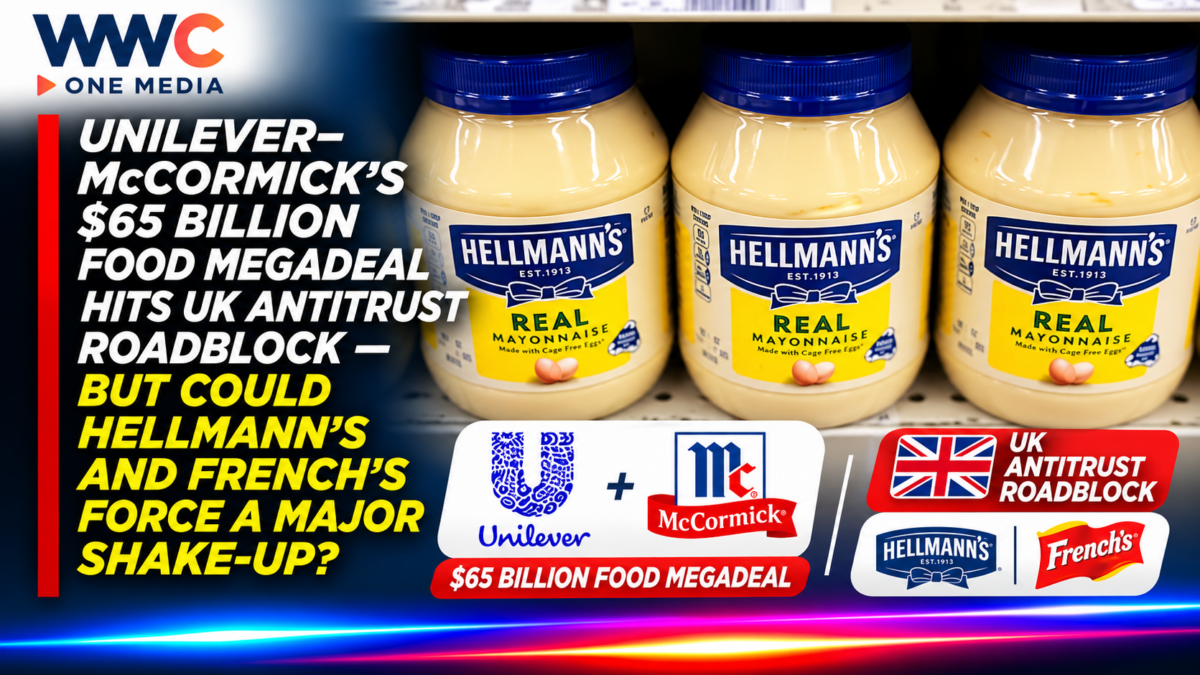
A proposed $65 billion combination involving some of the world’s best-known food brands has encountered a major regulatory obstacle after Britain’s competition watchdog warned that the deal between Unilever’s food business and American spice giant McCormick could weaken competition.
The United Kingdom’s Competition and Markets Authority (CMA) has given the companies until November 18, 2026, to propose remedies addressing its concerns.
Otherwise, the regulator intends to refer the transaction for a more extensive Phase 2 investigation.
The proposed merger would place brands such as Hellmann’s, Knorr, French’s mustard, Frank’s RedHot and Cholula within a single food business generating approximately $20 billion in annual revenue, based on 2025 figures.
But Britain’s competition authorities are concerned about the consequences of combining major players in overlapping product categories.
The companies have already identified one particularly sensitive area: mustard.
Unilever previously announced plans to seek a buyer for its historic British mustard brand Colman’s, a move intended to address potential competition concerns involving McCormick’s French’s brand.
That proposed divestment demonstrates how even a comparatively small product category can become a major issue in a multibillion-dollar international merger.
With just days remaining before the regulatory deadline, can Unilever and McCormick satisfy British competition authorities—or could the fight over familiar supermarket brands delay one of the biggest food-industry deals in history?
UK Watchdog Warns of Reduced Competition
The Competition and Markets Authority announced its concerns on November 11 following an initial investigation into the proposed transaction.
The regulator’s central responsibility is to assess whether mergers could substantially reduce competition in British markets.
When two companies combine businesses that compete directly, regulators examine whether customers could face fewer alternatives, higher prices, reduced innovation or weaker competitive pressure.
The CMA concluded that the Unilever–McCormick combination raises concerns requiring an appropriate response from the parties.
The companies have until November 18 to propose undertakings that could resolve those concerns.
If acceptable remedies are not offered, the transaction faces referral to an in-depth investigation.
The deal has not been prohibited.
The present decision concerns whether the transaction can proceed without a more extensive review or whether further regulatory examination is required.
That distinction is important for investors, employees, suppliers and consumers assessing the implications of the announcement.
How Big Is the Unilever–McCormick Deal?
Unilever and McCormick announced their agreement on March 31, 2026.
Under the proposed transaction, Unilever would separate its food division and combine most of that business with McCormick.
The companies assigned Unilever Foods an enterprise value of approximately $44.8 billion.
Reuters has described the overall combination as a transaction worth approximately $65 billion.
These values should not be treated as interchangeable.
The $44.8-billion figure is the enterprise valuation assigned to the Unilever Foods business under the transaction terms.
The larger figure refers to the broader combination.
The resulting company would generate approximately $20 billion in annual revenue based on historical 2025 figures.
The deal would bring together products used in millions of households, restaurants and commercial kitchens.
Its scale is one reason competition authorities are examining the transaction closely.
Hellmann’s, Knorr, French’s and Frank’s RedHot Under One Roof
The combined business would include several major consumer brands.
Unilever Foods brings products such as Hellmann’s mayonnaise, Knorr cooking products, Maille mustard and other food brands.
McCormick contributes its namesake herbs and spices, French’s mustard, Frank’s RedHot, Cholula and other seasonings.
The companies argue that the combination would create a more competitive global flavor business.
McCormick has significant expertise in spices, sauces and flavor development.
Unilever Foods has an extensive international distribution network and established brands in cooking aids and condiments.
Together, the businesses could expand their reach into retail stores, restaurants and food-service markets.
But their combined scale also raises competition questions.
Some brands serve different consumer needs.
Others compete within closely related product categories.
For regulators, the important question is not simply how many recognizable brands a company owns.
It is whether combining those brands would reduce meaningful competitive alternatives in particular markets.
Colman’s Mustard Becomes a Major Regulatory Issue
One of the clearest examples involves British mustard.
Unilever owns Colman’s, a historic brand with deep roots in the United Kingdom.
McCormick owns French’s, another major mustard business.
Combining the two could reduce competition within particular segments of Britain’s mustard market.
Recognizing that issue, Unilever announced in August that it was seeking potential buyers for Colman’s and related assets.
The proposed divestment was intended to address possible competition concerns before the wider merger was completed.
However, announcing an intention to sell a brand does not automatically resolve a regulator’s objections.
Authorities may need to assess whether the divested business would remain commercially viable under a new owner.
They may also examine whether a proposed purchaser has the resources and incentives to compete effectively.
As of the November 11 announcement, the CMA had not publicly confirmed that the proposed measures were sufficient to resolve its concerns.
The November 18 deadline is therefore an important test.
Why Regulators Can Demand Business Sales Before Approving a Merger
Competition authorities sometimes allow mergers to proceed when companies agree to sell overlapping businesses or make other enforceable commitments.
These measures are known as remedies.
A structural remedy may involve divesting a brand, production facility or business unit.
The objective is to preserve sufficient competition after the main transaction closes.
Other arrangements may involve commitments concerning business conduct, although the suitability of such measures depends on the market and regulatory framework.
For Unilever and McCormick, divestment of Colman’s could reduce one obvious area of overlap.
But the CMA must consider whether that arrangement adequately addresses the concerns identified during its investigation.
The regulator has not established that consumers have already suffered higher prices because of the proposed merger.
Its review is forward-looking.
It assesses the potential consequences of a combination that has not yet been completed.
Could a Phase 2 Investigation Delay the Deal?
The companies originally targeted completion by mid-2027.
That schedule remains subject to regulatory clearance, shareholder approval and other closing conditions.
If the transaction enters a Phase 2 investigation, the CMA would conduct a more extensive examination of the relevant markets and competition effects.
Such an investigation could require additional documents, economic analysis and engagement with customers, competitors and other interested parties.
A deeper review could delay the companies’ planned completion date.
It could also result in additional remedies or, in a more severe outcome, prohibition if competition concerns cannot be resolved.
However, a Phase 2 referral would not itself mean the merger has been rejected.
The companies may still be able to obtain approval after further examination.
For investors, the immediate uncertainty concerns whether the November 18 remedy process will avoid that longer route.
Unilever Wants to Become a Beauty and Personal-Care Powerhouse
The transaction is a central part of Unilever’s long-term restructuring.
By separating its Foods division, Unilever intends to concentrate on Beauty, Wellbeing, Personal Care and Home Care.
The remaining business would have approximately €39 billion in annual revenue, based on 2025 figures.
Its portfolio would include some of the world’s leading personal-care and household products.
Management believes that focusing on fewer business categories could improve decision-making, investment efficiency and growth.
The proposed transaction would also provide significant financial resources.
Unilever is expected to receive approximately $15.7 billion in cash, subject to closing adjustments.
Those proceeds would help the company manage separation costs, reduce debt and support capital returns.
Unilever has outlined approximately €6 billion in share buybacks across 2026–2029.
But these financial plans depend partly on the transaction’s successful completion.
A major delay could complicate the timeline.
McCormick Wants to Build a $20 Billion Global Flavor Business
For McCormick, the combination represents an ambitious expansion beyond its existing spice and condiment operations.
The company has a history of acquisitions.
Its previous purchases include French’s and Frank’s RedHot, acquired through Reckitt’s food division in 2017, and Cholula in 2020.
Those transactions expanded McCormick’s presence in hot sauces and condiments.
The Unilever Foods combination would be considerably larger.
The companies expect annual recurring cost synergies of approximately $600 million, net of planned growth reinvestment, by the end of the third year after closing.
They also anticipate approximately $100 million in additional cost and revenue synergies to be reinvested into growth.
These are management estimates, not savings already realized.
The benefits depend on successful integration of manufacturing, logistics, purchasing and corporate operations.
Regulatory remedies could also affect the final structure and economics.
Shareholders Face a Complicated Ownership Structure
The deal is structured as a proposed Reverse Morris Trust transaction.
Under the announced terms, Unilever and its shareholders would collectively receive 65% of the fully diluted equity of the combined company.
Unilever shareholders would hold approximately 55.1%.
Unilever itself would retain a 9.9% stake.
Existing McCormick shareholders would own approximately 35%.
McCormick would retain its corporate name and global headquarters in Hunt Valley, Maryland.
The combined company would also establish an international headquarters in the Netherlands and explore a secondary European listing.
The ownership arrangements reflect the relative values of the businesses being combined.
But the financial structure also creates integration and debt-management responsibilities.
Investors will need to evaluate not only the expected synergies but also financing costs and the company’s ability to maintain its targeted credit profile.
Investors Were Already Worried About the Merger
Regulatory uncertainty has been a concern since the agreement was announced.
Reuters reported that shares in both companies declined after the March announcement as investors assessed the deal’s complexity, financing requirements and regulatory risks.
Unilever experienced a particularly sharp negative market reaction.
Bloomberg subsequently reported that the transaction had contributed to substantial pressure on the company’s market valuation.
The concerns extended beyond antitrust review.
Investors also questioned whether a complex transaction involving numerous countries and brands could deliver the expected financial returns.
The combined company must integrate different systems, manufacturing arrangements and corporate cultures.
It must also preserve the commercial strength of its established brands.
The potential competition investigation adds another layer of uncertainty to an already complex transaction.
Workers Are Watching the Deal Closely
The proposed merger has also raised concerns among employees.
Reuters reported in March that Unilever’s European Works Council warned about possible job losses and workforce disruption.
Employee representatives expressed concern about the uncertainty surrounding the separation of the Foods business.
The companies have outlined arrangements intended to support the transition, including employment-related commitments under the transaction agreements.
Nevertheless, the expected cost savings could involve changes to administrative operations, procurement and other corporate functions.
The exact employment impact has not been established.
It would therefore be inaccurate to claim that a specific number of jobs will definitely be eliminated.
The companies must also meet applicable worker-consultation requirements before completing the transaction.
Britain’s Supermarket Industry Is Facing Wider Consolidation Pressure
The Unilever–McCormick investigation comes amid broader discussions about consolidation in Britain’s food industry.
In a separate development, supermarket operators Sainsbury’s and Morrisons held exploratory merger discussions that ultimately ended without an agreement.
The two situations involve different markets.
Sainsbury’s and Morrisons are retailers selling products directly to consumers.
Unilever Foods and McCormick manufacture and market branded food products.
But both demonstrate the importance of competition policy in Britain’s grocery economy.
Regulators must assess how consolidation could affect pricing, consumer choice and competitive conditions.
The consequences cannot be inferred from company size alone.
They depend on the specific markets in which the businesses compete.
Other Asian Regulators Are Also Blocking Problematic Deals
Competition scrutiny is not limited to Britain.
In October, Taiwan’s Fair Trade Commission blocked Grab’s proposed $600 million acquisition of Foodpanda’s Taiwanese operations.
Authorities raised concerns about the effects of the transaction on competition in the food-delivery market.
In related reporting, WWC ONE MEDIA examined Taiwan’s decision and the additional complication arising from Uber’s ownership stake in Grab.
That case is separate from the Unilever–McCormick merger.
The Taiwanese transaction involved food delivery platforms rather than condiment and packaged-food manufacturers.
Nevertheless, it illustrates how regulators can examine ownership arrangements and competitive incentives before allowing corporate combinations.
For multinational companies, a transaction that appears commercially attractive may still encounter obstacles if competition authorities identify unacceptable risks.
Philippine Companies Also Face Merger-Related Competition Rules
The Philippines has its own merger-control framework administered by the Philippine Competition Commission.
The regulator examines qualifying transactions and can impose conditions where competition concerns arise.
In a separate case, the PCC penalized Meralco PowerGen Corporation and another company for failing to meet reporting obligations associated with an earlier cleared transaction.
The Philippine case involved energy-sector reporting requirements.
It is not connected with Unilever or McCormick.
But it shows that merger reviews can produce obligations extending beyond the initial approval decision.
For businesses operating internationally, regulatory compliance is an important part of acquisition planning.
Big Food Faces Pressure Beyond Antitrust Regulation
Large packaged-food manufacturers are also confronting changing public-health and consumer-policy expectations.
Governments and international organizations are reviewing how certain food ingredients, marketing practices and nutritional characteristics should be regulated.
In related coverage, WWC ONE MEDIA examined a World Health Organization proposal concerning the regulatory treatment of industrially produced packaged foods and the response from major food companies.
That proposal is unrelated to the CMA’s merger investigation.
But it illustrates the wider regulatory environment facing multinational food manufacturers.
Companies must manage competition law, product labeling, food-safety obligations and consumer expectations.
A larger combined business may benefit from economies of scale.
Yet it may also face more complex compliance obligations across different markets.
Could the Merger Change Supermarket Prices?
One of the biggest questions for consumers concerns prices.
Mergers can generate savings through combined manufacturing operations, improved logistics and stronger purchasing arrangements.
Companies may use those savings to reduce prices, improve products or increase profit margins.
However, mergers can also reduce competitive pressure if previously independent brands become part of the same company.
The outcome depends on the number and strength of remaining competitors, retailers’ bargaining power and consumer substitution between products.
For example, some shoppers may readily switch between different mustard brands.
Others may strongly prefer one particular product.
Regulators examine those choices when assessing market competition.
The CMA’s investigation does not establish that Hellmann’s mayonnaise, Knorr products or French’s mustard will become more expensive.
It concerns the potential competitive consequences of the proposed combination.
Any specific forecast for supermarket price increases would require evidence not established in the reports reviewed.
What Happens Before November 18?
The immediate focus is the CMA’s remedy deadline.
Unilever and McCormick must determine whether they can offer measures that adequately address the regulator’s concerns.
Any proposed remedies would need to satisfy the CMA’s legal and economic requirements.
The regulator could accept appropriate undertakings or proceed toward a Phase 2 reference.
The outcome may affect the timing and structure of the overall transaction.
However, the November 18 deadline is not automatically the date on which the merger will be approved or rejected.
It is the deadline for addressing the concerns raised at the initial stage.
A later decision may be needed to determine whether the proposed measures are acceptable.
Five Questions Investors and Consumers Should Watch
1. Will Unilever and McCormick submit acceptable remedies?
The companies have until November 18 to address the CMA’s concerns.
2. Is selling Colman’s enough?
The planned divestment may address mustard-market overlap, but its sufficiency has not been confirmed.
3. Will a Phase 2 investigation delay closing?
A deeper review could complicate the targeted mid-2027 completion schedule.
4. Can the companies achieve $600 million in annual cost synergies?
Those savings depend on successful integration and the final transaction structure.
5. Will consumers benefit from the merger?
The answer will depend on competition, pricing, product innovation and the actual efficiencies achieved.
The Bottom Line: A $65 Billion Deal Faces a Critical Regulatory Test
Unilever and McCormick are attempting to create one of the world’s largest flavor and condiment companies.
The agreement would combine household brands spanning mayonnaise, mustard, spices, sauces and cooking products.
The companies believe the transaction will create a stronger international business with approximately $20 billion in historical annual revenue and substantial cost-saving opportunities.
But the UK competition watchdog has raised concerns about the potential consequences for British markets.
The companies now face a November 18 deadline to propose remedies or risk a more extensive investigation.
The dispute over Colman’s and French’s mustard demonstrates why even an enormous international merger can encounter obstacles in a relatively narrow product category.
For shareholders, the next step could influence the timing and economics of the combination.
For consumers, the central question is whether the transaction would preserve genuine competition among familiar supermarket brands.
Unilever and McCormick want to create a $65 billion global food giant, but Britain’s competition watchdog has given them just days to address its concerns. With Colman’s mustard already being considered for sale and a deeper investigation looming, can the companies protect their historic merger—or will the fight for supermarket competition force a dramatic change in the deal.