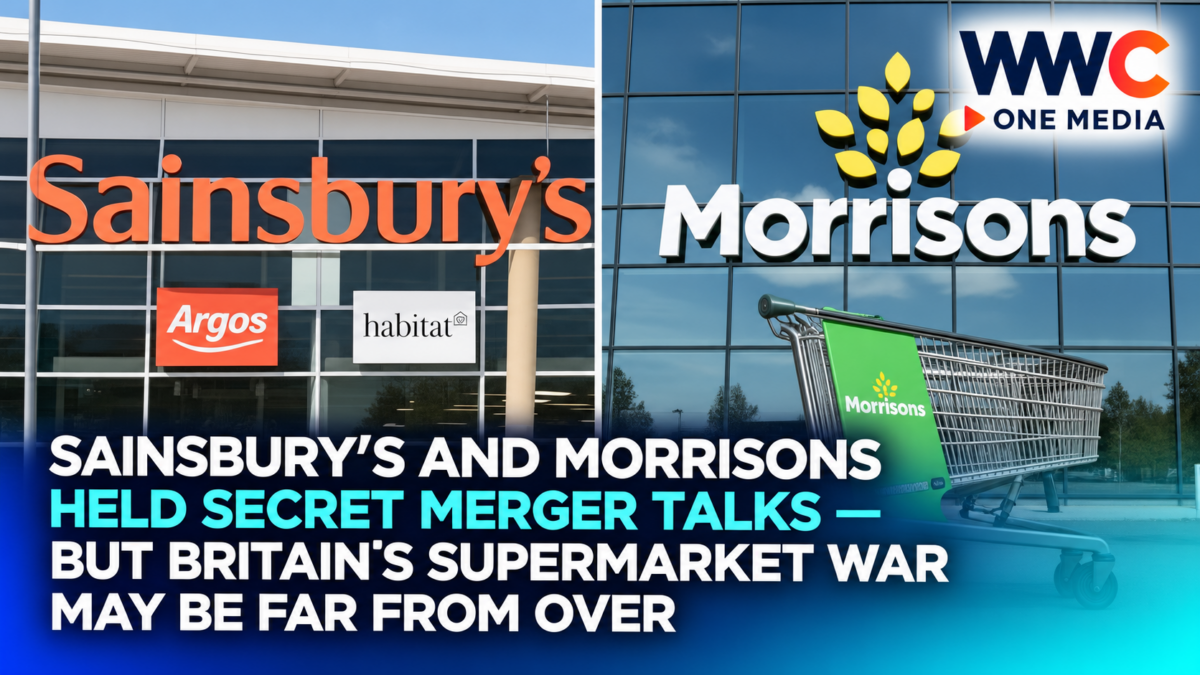
LONDON — Two of Britain’s best-known supermarket chains quietly explored a multibillion-pound merger that could have created a grocery giant controlling almost a quarter of the market—before Sainsbury’s walked away from the negotiations.
Sainsbury’s and Morrisons held exploratory merger talks between November 2025 and February 2026, according to the Financial Times and reporting confirmed by Reuters.
No formal offer was made.
The discussions are no longer active.
But people close to the situation have not ruled out the possibility of negotiations returning.
Had the companies reached an agreement, the combination would have produced one of the biggest restructurings of British food retail in decades.
Latest Worldpanel by Numerator data put Sainsbury’s at 15.2% of Britain’s grocery market and Morrisons at 8.4%, giving a theoretical combined share of 23.6%.
That would still leave the enlarged group behind Tesco, which controls about 27.8% of the market.
The failed talks therefore tell a bigger story than one abandoned deal.
Britain’s supermarket industry is entering another period of consolidation pressure as traditional chains fight simultaneously against Tesco’s scale, Aldi and Lidl’s discount model, rising operating costs and increasingly price-sensitive shoppers.
And Morrisons may still be available.
Sainsbury’s walked away before making a bid
Reuters says the discussions were exploratory and never advanced into a formal takeover proposal.
Sainsbury’s ultimately decided not to proceed.
Neither Sainsbury’s nor Morrisons has publicly explained why.
Both companies declined to comment on the reported talks.
That leaves several possible explanations.
A deal would have involved substantial regulatory risk.
Morrisons still carries significant financial obligations stemming from its private-equity ownership.
And combining two sprawling supermarket estates would have been operationally complex.
Any one of those problems could have been enough to stop negotiations.
Together, they made a deal extremely difficult.
The merger would have created Britain’s clear No. 2 supermarket force
Sainsbury’s is already Britain’s second-largest grocer.
Morrisons has fallen down the rankings as discounters expanded, but it remains a major national supermarket chain.
A 23.6% combined market share would have put the merged business roughly four percentage points behind Tesco while creating a much larger gap over Asda, Aldi, Lidl and other competitors.
That scale could have delivered significant advantages.
The companies could potentially have combined:
purchasing power;
distribution;
warehousing;
property;
technology;
loyalty schemes;
private-label sourcing;
fuel operations;
and supplier negotiations.
In grocery retail, where profit margins are thin, even relatively small efficiency improvements can translate into hundreds of millions of pounds.
That is why consolidation remains tempting.
But regulators would have looked very closely
Sainsbury’s has already learned how difficult a large supermarket merger can be.
In 2019, Britain’s Competition and Markets Authority blocked its proposed £7.3 billion combination with Asda.
The CMA concluded that the deal would likely lead to higher prices, poorer quality and reduced choice both nationally and in local markets.
It also found potential harm to customers buying fuel at overlapping petrol stations.
That precedent would inevitably have hung over any Sainsbury’s-Morrisons transaction.
A new merger would almost certainly have triggered a detailed CMA investigation.
And Sainsbury’s could have been required to sell stores in locations where the two chains overlap heavily.
The regulatory environment may be different from 2019
There is one argument that could make a future merger more plausible.
Britain’s grocery market has changed substantially since the CMA blocked Sainsbury’s-Asda.
Aldi and Lidl are now much larger competitors.
Lidl has already overtaken Morrisons in market share.
Online grocery shopping is more established.
Tesco and Sainsbury’s themselves have strengthened their positions.
Retail executives cited by Sky News believe those changes could make regulators more receptive to consolidation than they were seven years ago.
That does not mean approval would be easy.
It means the competitive argument would look different.
Lidl has become the disruption Morrisons cannot ignore
Perhaps the biggest structural change is Lidl.
The German discounter recently surpassed Morrisons to become Britain’s fifth-largest grocer by market share and currently holds roughly 8.7% of the market.
Its latest annual turnover jumped 10.8% to £13 billion, while operating profit rose almost 10%.
Lidl is also opening more than 50 additional stores in its current financial year as part of a £600 million investment program.
That expansion puts relentless pressure on traditional supermarkets.
Lidl does not need the same market share as Tesco to influence prices.
Its discount positioning forces larger rivals to compete harder on staples, promotions and private-label products.
Aldi is another permanent pressure point
Aldi controls around 10.6% of the British grocery market, according to Worldpanel’s September data.
Combined, Aldi and Lidl therefore hold close to one-fifth of grocery spending.
That is a profound shift from the market structure that existed before the financial crisis, when Britain’s “big four”—Tesco, Sainsbury’s, Asda and Morrisons—dominated food retail.
Today, consumers are much more willing to mix supermarkets.
They may buy staples at Aldi.
Premium items at Sainsbury’s.
Convenience products at Tesco Express.
Specialist products online.
That fragmentation makes scale increasingly valuable.
Morrisons has been rebuilding after a difficult private-equity era
Clayton, Dubilier & Rice bought Morrisons for approximately £7 billion in 2021, winning an auction against a consortium led by Fortress Investment Group.
The acquisition left the supermarket with a much more leveraged capital structure.
That became painful as interest rates rose and the competitive environment deteriorated.
But Morrisons has since made progress reducing its debt.
Its latest full-year results say debt has fallen 46% from its 2022 peak.
That is important because some coverage still refers broadly to the huge debt burden created by the takeover.
The debt remains strategically relevant, but Morrisons has been actively reducing it.
Morrisons is not a collapsing business
The retailer reported £15.8 billion in revenue for fiscal 2024/25, up 3.2%.
Like-for-like sales increased 2.8%.
Underlying EBITDA held at £835 million despite inflation, a cyber incident and higher employment-related costs.
Its loyalty program also reached a record 8 million active users.
And Morrisons said its market share was stable at 8.5% at the end of 2025.
More recent Worldpanel data show it around 8.4%-8.5%, with sales again growing.
So the rationale for a merger is not simply rescuing a failing chain.
It is about creating greater scale in a market where scale is becoming increasingly important.
Morrisons still has assets competitors could value
Morrisons differs from some supermarket rivals because it owns significant food-production infrastructure.
Historically, it has operated meat processing, bakeries, seafood facilities and other manufacturing operations.
It also owns substantial property and has a strong presence in northern England.
Those assets could be strategically attractive to a rival.
A buyer would not simply acquire stores.
It could acquire:
food manufacturing;
supplier relationships;
distribution infrastructure;
fuel sites;
property;
and millions of loyalty customers.
That helps explain why CD&R reportedly remains open to a transaction.
CD&R may eventually need an exit
Private-equity ownership is rarely permanent.
CD&R bought Morrisons in 2021.
Eventually it will want to monetize that investment through:
a sale;
a merger;
a partial disposal;
or potentially another public-market transaction.
Sky News reports retail insiders believe CD&R remains open to combining Morrisons with another major competitor.
That makes the Sainsbury’s talks important even though they failed.
They reveal that consolidation is not merely theoretical.
Serious discussions have already happened.
Asda could become part of the next deal wave
Morrisons is not the only private-equity-owned supermarket under pressure.
Asda is majority owned by private-equity firm TDR Capital and has also struggled with debt and market-share losses.
Sky News reports industry figures expect Asda to be involved if supermarket dealmaking accelerates.
That creates several hypothetical possibilities:
Morrisons and Asda;
Sainsbury’s and Morrisons;
or other asset combinations involving stores and logistics infrastructure.
None is currently confirmed.
But the ownership structures make consolidation plausible.
A Morrisons-Asda merger could face even more complications
Morrisons and Asda have geographic strengths that sometimes differ.
That could potentially reduce store overlap in some areas.
But both are heavily leveraged and private-equity-owned.
Combining two debt-heavy businesses would involve substantial financial restructuring.
It would also raise concerns about reducing competition among Britain’s largest grocers.
So a transaction that looks strategically logical could still prove financially or politically difficult.
That is the broader supermarket consolidation dilemma.
The businesses may need scale.
Regulators are specifically designed to stop scale from reducing consumer competition.
Sainsbury’s has been simplifying itself
Sainsbury’s has recently been sharpening its focus on grocery retail.
The company agreed this year to sell Argos for £120 million, a decade after paying more than £1 billion to acquire the wider Home Retail Group business.
That decision suggests management increasingly wants capital and attention concentrated on food.
Against that backdrop, exploratory talks with Morrisons make strategic sense.
One move reduces exposure to general merchandise.
The other could have dramatically expanded grocery scale.
Even though Sainsbury’s walked away, the logic behind discussing Morrisons becomes clearer.
Sainsbury’s is stronger than it was during the Asda bid
Sainsbury’s current market position is relatively healthy.
Worldpanel puts its share at 15.2%, with sales up 2.9% year on year in the latest reported period.
It has also benefited from focusing aggressively on food quality, price matching and loyalty through Nectar.
That gives Sainsbury’s less urgency than Morrisons.
It does not need a merger to survive.
That may partly explain why it was willing to walk away if the terms became unattractive.
Tesco remains the benchmark everyone is chasing
Tesco controls about 27.8% of Britain’s grocery market, almost twice Sainsbury’s share.
That scale produces major purchasing and distribution advantages.
A combined Sainsbury’s-Morrisons operation would still have remained behind Tesco.
But it would have moved much closer.
This is perhaps the strongest industrial logic for the deal.
Britain’s No. 2 grocer could have turned itself into a much more formidable challenger to No. 1.
Grocery scale matters because margins are tiny
Supermarkets generate huge revenue but relatively modest profit margins.
They must pay for:
stores;
electricity;
wages;
distribution;
refrigeration;
technology;
warehouses;
and enormous inventories.
At the same time, consumers can easily compare prices.
That means companies cannot simply raise margins without risking customer defections.
Scale helps by spreading fixed costs across greater sales volumes.
It also strengthens negotiating power with suppliers.
That makes consolidation especially tempting during periods of cost inflation.
Food inflation makes mergers politically difficult
The problem is that grocery mergers become most attractive to companies precisely when regulators are most likely to worry about them.
British households have spent years dealing with elevated food prices.
Worldpanel said grocery price inflation stood at 2.3% in September 2026.
That is far below the peaks seen earlier in the decade, but consumers remain highly sensitive to supermarket pricing.
A transaction that removes a major national competitor would therefore immediately raise political questions.
Would efficiencies reduce prices?
Or would reduced competition allow prices to rise?
The CMA would demand evidence.
The 2019 CMA decision still casts a long shadow
When the CMA blocked Sainsbury’s-Asda, it did not conclude that selling a few overlapping stores would solve the problem.
It found national as well as local competition concerns and concluded the merger could increase prices across stores, online grocery operations and petrol stations.
That was a much tougher ruling than many executives expected.
It showed regulators could block a supermarket mega-merger outright rather than simply demand divestitures.
Any future Sainsbury’s-Morrisons talks would have to begin with that history.
But Lidl and Aldi could change the regulator’s analysis
This is where the market-share numbers matter.
In 2019, the discounters were already substantial.
They are significantly stronger now.
Lidl alone has overtaken Morrisons.
Aldi is above 10%.
Online-only Ocado has expanded.
Consumers increasingly shop across multiple formats.
A future merging pair could argue that Britain’s grocery industry is far more competitive than it appears when looking only at the old “big four.”
Whether the CMA would accept that argument is uncertain.
A combined Sainsbury’s-Morrisons would still be smaller than Tesco—but that is not the whole test
It would be tempting to say a merger should be acceptable simply because 23.6% is below Tesco’s 27.8%.
Competition law does not work that way.
Regulators examine:
national competition;
local store overlaps;
online grocery competition;
fuel retail;
supplier effects;
and consumer choice.
A combination could be relatively modest nationally while eliminating meaningful local alternatives in dozens of towns.
That is why store sales would almost certainly become part of any negotiation with regulators.
Store divestments could weaken the merger logic
This creates another practical problem.
The more stores Sainsbury’s would have to sell to satisfy the CMA, the fewer cost and revenue benefits the merger could deliver.
Potential buyers would also need to exist for those sites.
If the best locations had to be sold to Aldi, Lidl or another rival, Sainsbury’s could end up strengthening the very competitors the merger was designed to combat.
That can make a theoretically attractive merger economically unattractive.
Suppliers would watch closely
A larger combined buyer could put more pressure on food manufacturers and farmers.
Supermarkets use their scale to negotiate:
prices;
payment terms;
promotions;
shelf placement;
and product development.
Greater buying power can help retailers hold down consumer prices.
But suppliers may argue that excessive concentration squeezes their margins and reduces investment.
That makes supplier competition another dimension regulators could examine.
Food security has also become a bigger political issue
Sky News notes that food security and rising supermarket costs have become more important policy concerns in recent years.
That could cut both ways.
Larger retailers may be more resilient because they can invest in supply chains and absorb disruptions.
But relying on fewer dominant chains can also create systemic concentration.
Governments increasingly care not only about prices but about whether food supply chains remain robust during:
wars;
energy shocks;
weather events;
and trade disruptions.
The discounters are investing while traditional grocers consider mergers
The contrast with Lidl is revealing.
On the same day reports of the failed Sainsbury’s-Morrisons talks emerged, Lidl announced another £600 million investment and more than 50 store openings.
Aldi has also announced aggressive investment.
The German chains are still expanding organically.
Traditional supermarket groups are increasingly discussing structural consolidation.
That says a great deal about where competitive momentum currently sits.
Lidl’s rise changes more than market rankings
Lidl’s success demonstrates that consumers are willing to abandon familiar supermarket loyalties for value.
Its annual turnover has surpassed £13 billion.
Customer visits rose by tens of millions.
Its market share reached about 8.7%.
That puts Morrisons under direct pressure.
But it also pressures Sainsbury’s.
If Lidl continues opening stores, its growth will come from somebody else’s customers.
Consolidation becomes one way incumbents can defend scale.
A merger could save costs—but integration itself costs money
Combining supermarket groups is not simply a spreadsheet exercise.
Companies would need to integrate:
IT systems;
loyalty databases;
distribution;
management teams;
store formats;
supplier contracts;
brands;
and possibly hundreds of properties.
That can take years.
During integration, competitors can attack.
Customers can become confused.
Employees can leave.
Aldi and Lidl could use the disruption to accelerate expansion.
That means merger synergies need to be large enough to justify substantial execution risk.
The brands themselves create another question
Would both Sainsbury’s and Morrisons names survive?
Possibly.
The two brands appeal to somewhat different consumers and have different regional strengths.
Keeping both could preserve customer loyalty.
But operating two brands limits some potential efficiencies.
A full rebranding would be extremely expensive and risky.
Any future transaction would therefore require a detailed brand strategy.
That is another reason these deals are more complicated than combining market-share numbers.
Morrisons’ manufacturing assets could be especially valuable
Morrisons has historically distinguished itself by owning more of its food-production chain than most rivals.
That can provide control over:
meat;
fish;
bakery products;
fresh foods;
and private-label manufacturing.
For Sainsbury’s, access to those operations could potentially create savings and strengthen fresh-food supply.
But extracting those benefits would require significant integration.
And regulators might examine whether stronger vertical control could disadvantage suppliers.
Private equity changes the negotiation dynamics
Sainsbury’s is publicly listed.
Morrisons is controlled by CD&R.
Their objectives are not identical.
Sainsbury’s management must convince public shareholders that a takeover generates attractive long-term returns.
CD&R ultimately wants an exit that maximizes the value of its Morrisons investment.
If CD&R’s required valuation is too high, Sainsbury’s can simply walk away.
That may already have happened once.
The failed talks still matter because they broke a psychological barrier
For years, another supermarket mega-merger looked politically impossible after the CMA’s 2019 decision.
Now we know executives were willing to explore one again.
That changes the conversation.
If Sainsbury’s and Morrisons seriously discussed combining, boards across the industry are almost certainly examining similar possibilities.
The talks may have failed.
The idea of consolidation has clearly returned.
The next supermarket deal may not involve Sainsbury’s
Sky News reports CD&R remains open to another transaction involving Morrisons.
Asda is also expected to play a role in any future industry shake-up.
That means the next headline could involve a completely different pairing.
Morrisons has strategic assets.
CD&R eventually needs an exit.
Asda wants to regain competitiveness.
Sainsbury’s wants scale but can afford patience.
The ingredients for future dealmaking remain.
Regulators may ultimately decide whether consolidation happens at all
The economic logic pushing supermarkets together is easy to understand.
The legal logic keeping them apart is equally strong.
Britain wants:
low food prices;
strong competition;
investment;
reliable supply chains;
and financially healthy retailers.
Those goals do not always point in the same direction.
A larger supermarket can be more efficient.
It can also be more powerful.
That tension will determine whether the next merger gets approved.
The real battle is bigger than Sainsbury’s versus Morrisons
The grocery market is being remade by structural forces.
Tesco has regained strength.
Sainsbury’s has consolidated second place.
Aldi and Lidl keep expanding.
Morrisons has fallen behind the fastest-growing discounters.
Asda has been trying to recover lost ground.
Online grocery remains important.
And shoppers remain intensely focused on price.
A merger would not eliminate those forces.
It would be a response to them.
Britain may be approaching a new supermarket shake-up
Sainsbury’s and Morrisons did not agree a deal.
That is the most important immediate fact.
There is no current merger to approve.
There is no offer price.
There is no shareholder vote.
There is no CMA filing.
But the negotiations reveal how seriously some of Britain’s biggest retailers are thinking about structural change.
A combined Sainsbury’s-Morrisons group would have controlled almost one pound in every four spent in British supermarkets.
It would still have been smaller than Tesco.
It would have faced fierce opposition from regulators.
And Sainsbury’s ultimately decided not to proceed.
Yet CD&R reportedly remains open to another combination.
That means the failed merger may not be the end of the story.
It may instead be the clearest signal yet that Britain’s supermarket industry is approaching another major round of consolidation—
and the next deal could reshape where millions of families buy their groceries.