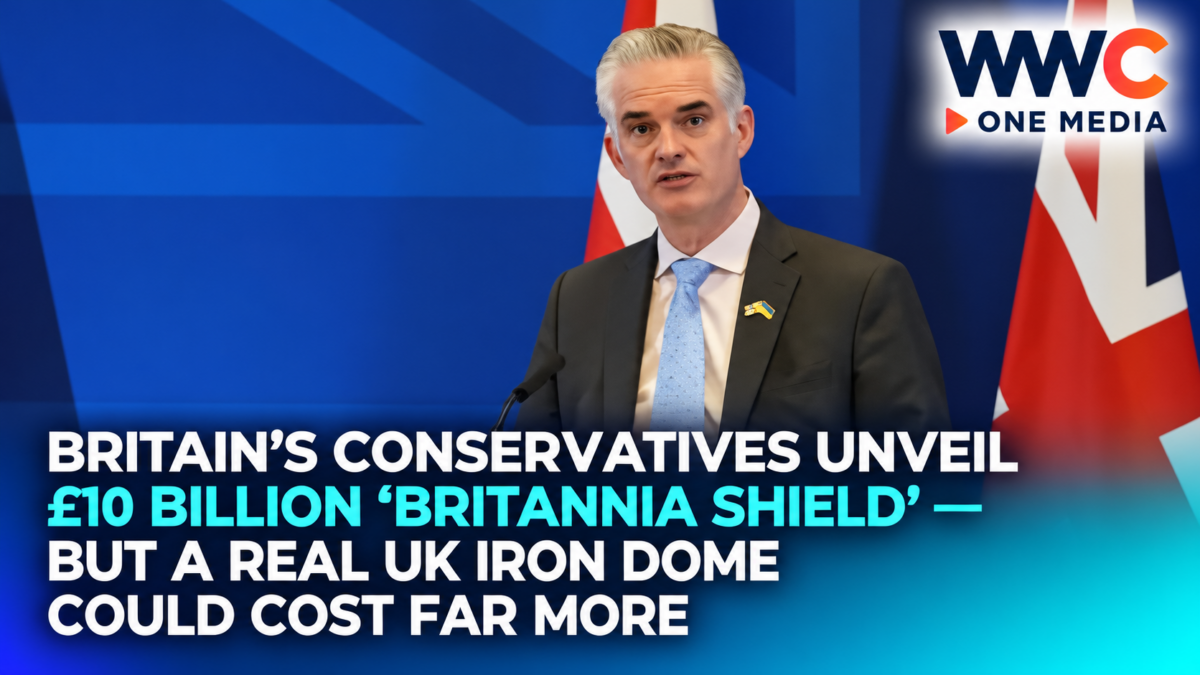
BIRMINGHAM — Britain’s Conservatives have unveiled a £10 billion plan to build a national missile-and-drone defence network dubbed “Britannia Shield,” arguing that cheap drones and long-range missiles have made the UK homeland far more vulnerable than it was even a decade ago.
The proposal, announced at the Conservative Party conference, would combine:
advanced radar;
integrated command-and-control systems;
interceptor missiles;
counter-drone technology;
electronic warfare;
and larger ammunition stockpiles.
Party leader Kemi Badenoch says the system would be designed to protect the United Kingdom, British overseas territories and military bases abroad from increasingly sophisticated aerial threats.
Shadow Defence Secretary James Cartlidge is describing Britannia Shield as one of Britain’s most significant air-defence programs since the Cold War.
But the central question is already obvious:
Is £10 billion anywhere near enough to create the kind of protection the Conservatives are promising?
The Tories want a British answer to Israel’s Iron Dome
The party is deliberately invoking Israel’s Iron Dome because it has become the world’s best-known example of layered missile interception.
But Britannia Shield would not literally be an enlarged Iron Dome.
Israel’s Iron Dome is primarily designed to intercept shorter-range rockets and artillery threats.
Britain would need to defend against a much wider set of potential weapons, including:
long-range cruise missiles;
ballistic missiles;
one-way attack drones;
low-flying unmanned aircraft;
and potentially more advanced hypersonic systems.
That means a UK network would require several layers of detection and interception rather than one single defensive system.
Britain is much bigger than Israel
Geography is one reason the comparison becomes difficult.
Israel is geographically compact.
Britain is roughly twelve times larger by land area and has critical infrastructure spread across:
London;
industrial regions;
military bases;
ports;
nuclear facilities;
energy infrastructure;
data centres;
and remote strategic locations.
The UK also has defence commitments to overseas territories and military facilities beyond the mainland.
A truly comprehensive defensive umbrella would therefore require far more sensors, weapons and deployment sites than a simple “Iron Dome for Britain” slogan suggests.
The first version would not cover everything
Conservative plans reportedly call for a minimum deployable capability within five years, with further expansion over the following five years.
That wording matters.
The party is not promising that every British city would instantly sit beneath a perfect defensive bubble.
Initial deployments would likely prioritise the most strategically important sites:
military airfields;
command centres;
nuclear facilities;
major ports;
government centres;
and critical infrastructure.
That makes the proposal more realistic.
But it also means the phrase “protect the whole United Kingdom” should not be interpreted as literal, complete interception coverage from day one.
Parliament has already warned Britain is badly exposed
The Conservatives are not inventing the vulnerability.
A 2025 Defence Committee report heard evidence that the UK had “next to nothing” in integrated air and missile defence compared with several European allies.
The committee highlighted investments already being made by countries including Germany, Norway, Sweden, Spain and Italy.
That assessment has become much more important after lessons from Ukraine and the Middle East.
Modern wars have shown that inexpensive drones can attack:
power plants;
airfields;
fuel depots;
radar installations;
and other strategic targets
without requiring conventional air superiority.
That changes the economics of defence.
An attacker can launch a relatively cheap drone.
The defender may have to fire a missile costing hundreds of thousands—or even millions—of pounds.
Ukraine changed the calculation
The war in Ukraine has fundamentally changed how Western governments think about homeland defence.
Russia has repeatedly used large combinations of:
cruise missiles;
ballistic missiles;
Shahed-style drones;
and decoy targets
to overwhelm air-defence networks.
Ukraine has responded using a layered mixture of:
Patriot;
NASAMS;
IRIS-T;
mobile guns;
electronic warfare;
and locally developed counter-drone systems.
The lesson is straightforward:
no single weapon can protect an entire country.
The UK government’s own 2025 Strategic Defence Review explicitly said the changing character of warfare—including the widespread use of drones—required Britain to rethink how it protects the homeland.
Britain already has some air defence—but not a nationwide shield
The UK is not completely undefended.
The Royal Navy operates Type 45 destroyers equipped with the Sea Viper air-defence system.
The British Army has Sky Sabre.
The RAF can also use fighter aircraft for air defence.
But Britain does not operate a nationwide land-based missile shield comparable with the integrated systems protecting Israel or some frontline NATO countries.
The UK also does not currently own U.S.-built Patriot batteries.
That means some high-end threats could require:
Royal Navy deployment;
fighter interception;
support from NATO allies;
or future systems not yet in service.
Labour is already investing—but at a much smaller scale
The current government is not ignoring the issue.
Britain’s 2025 Strategic Defence Review promised up to £1 billion in new homeland air and missile defence funding.
The detailed June 2026 Defence Investment Plan later allocated £790 million over four years specifically for protection against air, missile and drone threats.
That money will support:
new radars and sensors;
improved command systems;
counter-drone capabilities;
directed-energy weapons;
upgrades to the Sea Viper system;
and a new Integrated Air, Space and Missile Defence Operations Centre.
The Conservatives are therefore proposing a much bigger investment.
Britannia Shield would average roughly £1 billion per year for a decade.
But whether even that is sufficient remains disputed.
Some experts think £10 billion would barely begin the job
One of the most important caveats in the FT report is cost.
Military analysts cited in current British coverage have suggested a credible nationwide system could cost closer to £80 billion to £120 billion, depending on how broad the coverage is and what threats the system is expected to defeat.
That is an enormous difference.
A £10 billion program could build:
radar networks;
command infrastructure;
interceptor stockpiles;
counter-drone systems;
and defences around selected strategic sites.
But a genuinely comprehensive shield covering most of the country against everything from cheap drones to ballistic missiles would require much deeper spending.
That is why Liberal Democrat defence spokesman James MacCleary dismissed the Conservative price tag as insufficient for a true nationwide system.
The biggest expense may be the missiles themselves
Radar gets attention.
Interceptor stockpiles can become the real financial problem.
A country may spend billions building detection systems and launcher infrastructure.
But if a war requires hundreds or thousands of interceptions, ammunition can disappear quickly.
Ukraine has demonstrated that air defence is partly a stockpile problem.
A system is only useful as long as it has interceptors.
The Conservatives therefore say Britannia Shield would include larger missile stocks, not simply new launchers.
That is strategically important because Western militaries have repeatedly discovered that peacetime ammunition inventories were designed for much shorter conflicts than modern wars are producing.
Cheap drones create an even harder problem
Using a premium interceptor against a £20,000 drone is economically unsustainable.
That is why Britannia Shield would almost certainly need cheaper layers.
Potential options include:
electronic jamming;
gun systems;
small interceptor drones;
short-range missiles;
and directed-energy weapons.
Britain is already developing DragonFire, a laser weapon intended to destroy aerial targets at very low cost per shot.
The government committed nearly £1 billion to directed-energy weapons under the Strategic Defence Review.
If laser and electronic-warfare systems mature quickly enough, they could become essential to any future British shield.
Russia is the obvious long-term threat
Although Iran and Middle Eastern conflicts feature heavily in political rhetoric, Russia is likely the most significant state threat for British defence planning.
Moscow possesses:
long-range cruise missiles;
ballistic systems;
large drone inventories;
submarines;
and aircraft capable of threatening NATO territory.
The 2025 Strategic Defence Review explicitly described Russian aggression as one of the defining drivers behind the new UK defence posture.
In a major NATO conflict, Britain could become a target because it hosts:
airbases;
naval facilities;
nuclear infrastructure;
intelligence sites;
and logistical hubs supporting allied operations.
That makes homeland air defence part of NATO deterrence, not simply domestic protection.
RAF Fairford has made the threat feel less theoretical
The Britannia Shield announcement also comes shortly after the United States removed B-1 bombers from RAF Fairford following security concerns around the Gloucestershire base.
That episode involved a suspected terrorism investigation rather than a missile attack, but it reinforced public awareness that British bases supporting American military operations can themselves become targets.
The Conservatives are using that broader climate of insecurity to argue that Britain needs more layered protection.
Still, it would be wrong to claim the Fairford incident proves Britain specifically needs an Iron Dome-style system.
The threats involved are different.
Base security, sabotage, terrorism and missile defence overlap strategically but require different countermeasures.
Badenoch is also using defence as a political dividing line
Britannia Shield is as much a political announcement as a military one.
Badenoch wants to rebuild Conservative credibility on national security and distinguish the party from Labour.
She has promised to increase defence spending to 3% of GDP by 2030.
The Conservatives say that increase would provide more than £10 billion in additional annual defence spending and would finance Britannia Shield alongside other military priorities.
The party proposes funding that wider uplift partly through welfare reforms, including reinstating the two-child benefit cap and changing housing benefit.
That immediately turns missile defence into a domestic spending argument.
The question becomes not only:
How much security does Britain need?
But:
What is government willing to cut to pay for it?
Labour says the Conservatives lack credibility
Labour’s response has focused heavily on the Conservatives’ previous record in office.
A Labour spokesperson argued that successive Conservative governments allowed military manpower and capabilities to shrink.
The current government points to its own £298 billion Defence Investment Plan over four years, including £790 million for air and missile defence and billions more for drones, munitions and other military systems.
Labour has also committed to reaching 3.5% of GDP on defence by 2035, although the path and timing of intermediate spending increases remain politically contentious.
So the disagreement is not whether Britain should spend more.
Both major parties say it should.
The disagreement is over:
how fast;
how much;
what to prioritise;
and what spending should be sacrificed elsewhere.
A shield cannot guarantee Britain will be safe
This may be the most important technical reality.
No missile defence system is impenetrable.
Even Israel—despite possessing one of the world’s most sophisticated layered systems—still experiences successful strikes.
Air defence works by reducing damage, not eliminating it.
Experts giving evidence to Parliament stressed that integrated air and missile defence should be viewed as a way to attrit and mitigate incoming attacks, not as a magical bubble preventing every weapon from getting through.
That distinction should shape how Britannia Shield is discussed.
“Shield” sounds absolute.
Reality is probabilistic.
The system would need multiple layers
A realistic British architecture could eventually look something like this:
Long-range radar identifies incoming threats.
Command systems classify the targets.
Fighter aircraft or naval systems intercept certain aircraft and missiles.
Long-range ground-based missiles engage high-value threats.
Shorter-range weapons target cruise missiles and drones.
Electronic warfare disrupts navigation and communications.
Lasers or guns defeat inexpensive drones at close range.
No single layer would be enough.
Britannia Shield would therefore be closer to an integrated national defence network than a single weapons system.
That is why comparing the whole concept directly with Iron Dome can be misleading.
Britain also has to decide what gets protected first
Even with £10 billion, policymakers would need priorities.
Likely candidates would include:
London;
nuclear facilities;
RAF bases;
naval bases;
government command centres;
major ports;
energy infrastructure;
and defence-industry locations.
Protecting every town equally would be unrealistic.
That creates politically difficult questions.
Would Manchester receive the same level of protection as London?
Would remote energy facilities be defended ahead of population centres?
Would overseas bases compete for the same interceptor stockpiles?
Those questions rarely appear in slogans about national shields.
They become unavoidable during actual military planning.
Overseas territories make the mission even bigger
Parliamentary evidence has also highlighted vulnerabilities outside mainland Britain.
The UK has security responsibilities involving territories and facilities including:
Gibraltar;
Cyprus;
the Falkland Islands;
and other strategic sites.
A hostile power might attack those locations precisely because they are less protected than London.
One defence expert told MPs that striking power infrastructure in the Falklands or critical facilities in Cyprus could damage British credibility just as effectively as attacking the mainland.
If Britannia Shield genuinely includes overseas protection, the £10 billion budget becomes even more stretched.
The industrial opportunity could still be significant
A major air-defence program would also create opportunities for British defence companies.
Potential beneficiaries could include firms working on:
radar;
missiles;
electronic warfare;
lasers;
counter-drone systems;
AI-enabled targeting;
and command-and-control software.
The government already wants defence spending to support domestic manufacturing.
The current Defence Investment Plan includes billions for munitions, autonomous systems and AI.
A Conservative Britannia Shield would likely build on that industrial base rather than start from zero.
That could make the program an economic as well as strategic policy.
Europe is rebuilding air defence too
Britain is not alone.
Germany, Poland, Greece, Cyprus and other European countries are investing heavily in layered air defence.
Russia’s invasion of Ukraine shattered the assumption that large-scale missile warfare in Europe belonged to history.
For frontline NATO members, the threat is immediate.
Britain is geographically safer.
But geography is less protective when missiles, drones and sabotage operations can travel much farther than before.
That is why the air-defence debate is spreading westward.
The biggest argument is no longer whether Britain needs better protection
That question is increasingly settled.
The British government already accepts the need.
Parliament has warned of serious gaps.
Military leaders support better integrated defence.
The Conservatives want to spend far more.
The real debate is now about scale.
How much protection can £10 billion actually buy?
If Britannia Shield is meant to defend selected critical targets, the figure may be meaningful.
If it is sold as a nationwide equivalent of Israel’s integrated missile shield, experts warn the real bill could be many times higher.
And that makes the Conservative proposal strategically important—but politically risky.
Because once voters are told Britain needs a shield over the country, the next question becomes unavoidable:
how much are they willing to spend when £10 billion may only be the beginning?