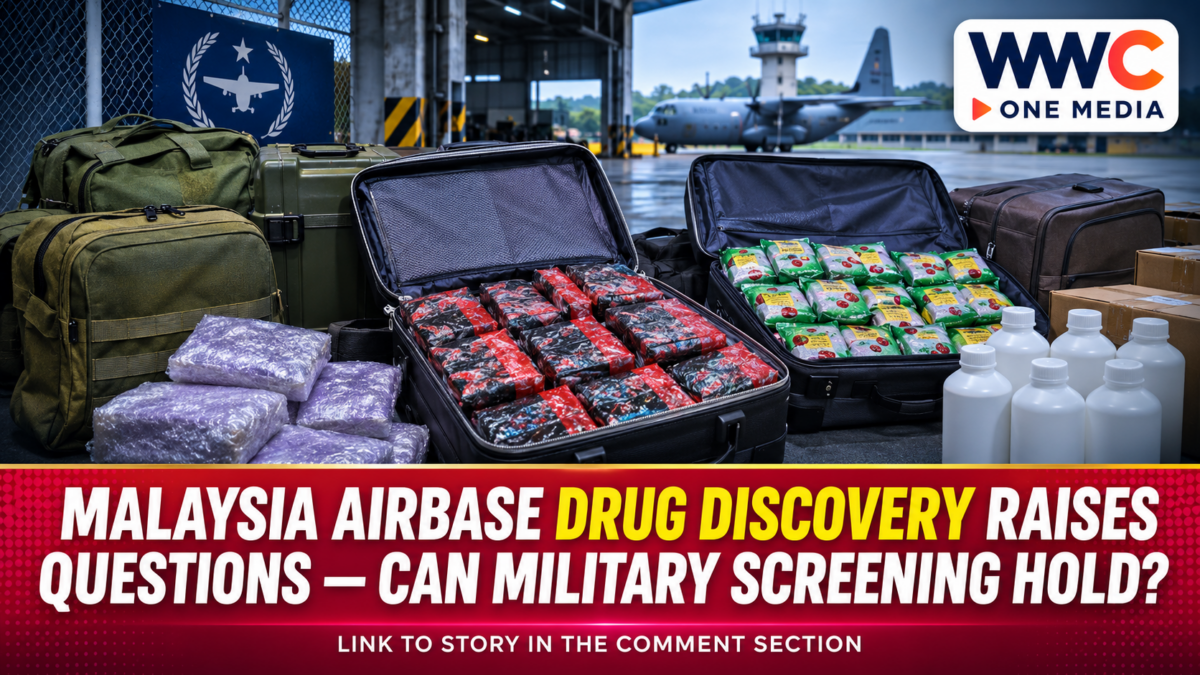
KUALA LUMPUR, Malaysia — A routine baggage inspection at Malaysia’s Subang Air Base on Nov. 17 uncovered approximately 96.6 kilograms of suspected drugs, prompting a police investigation involving Royal Malaysian Air Force (RMAF) personnel. By Nov. 20, the military had confirmed that five officers and two other personnel had been detained to assist investigators.
The discovery has placed Subang airbase screening procedures under scrutiny, particularly how baggage is checked before military aviation facilities are used.
The central issue is no longer simply whether suspicious material was discovered. It is whether the controls that helped expose this incident can consistently prevent unauthorised items from passing through a sensitive transport operation.
Missing Screening Stickers Triggered Further Checks
Air-force personnel at the Air Movement Section building identified baggage that did not carry the security-screening stickers used to indicate completion of the required checks.
That irregularity prompted further examination by the RMAF’s ground defence personnel, known as HANDAU.
The additional screening detected suspicious packages arranged inside the baggage. Military personnel subsequently detained individuals suspected of involvement and transferred the matter to the Royal Malaysia Police’s Narcotics Criminal Investigation Department.
The discovery illustrates why procedural checks remain important even in environments protected by military personnel.
A screening sticker may appear to be a minor administrative detail. In practice, a visible confirmation that an inspection has been completed provides another opportunity to identify baggage requiring further attention.
The important distinction is that the missing stickers triggered suspicion; the additional examination established that the baggage required police investigation.
Military Personnel Face an Ongoing Investigation
The RMAF’s Nov. 20 statement identified five officers and two other personnel who had been detained in connection with the investigation.
Detention for investigation does not establish criminal responsibility. Individual involvement, the origin of the suspected substances and any possible organised operation remain matters requiring evidence.
The military said it would cooperate with police investigators and would not protect personnel found responsible for misconduct involving military aircraft or assets.
This distinction matters because criminal investigations and institutional accountability address different questions.
Police must establish whether offences occurred and who may be legally responsible. Military authorities must also examine whether existing supervision, baggage controls and internal reporting arrangements operated effectively.
One process cannot automatically substitute for the other.
Subang Airbase Screening Reveals a Wider Security Challenge
The Nov. 17 discovery highlights the difference between detecting one suspicious consignment and maintaining a consistently effective security system.
In this incident, the RMAF’s own personnel identified the irregularity and initiated additional checks. That is evidence of an internal control functioning at a critical moment.
However, one successful interception does not establish that every stage of the broader system is effective.
A reasonable security review would examine whether screening requirements are applied consistently, whether baggage can enter controlled areas without proper verification and whether irregularities are recorded for later examination.
These are questions for institutional review, not findings that particular failures have already been established.
Malaysia has also been examining security controls at civilian aviation facilities. WWC ONE MEDIA previously covered tighter baggage checks at Kuala Lumpur International Airport, where stronger screening has been part of the government’s response to aviation-security concerns.
The civilian and military environments have different operating requirements. Nevertheless, both depend on clear procedures, staff accountability and the ability to identify items requiring further examination.
Earlier Air-Force Programmes Show an Existing Anti-Drug Framework
The RMAF had documented anti-drug education and prevention activities before the Subang discovery.
In April 2024, the air force’s Provost Marshal Branch conducted a training course at Sendayan for 22 officers assigned anti-drug responsibilities across headquarters, bases and units.
The programme covered enforcement responsibilities, relevant regulations and coordination with military and civilian agencies.
Its activities included a demonstration of preliminary drug-screening procedures and discussion of prevention and rehabilitation measures.
The existence of these earlier programmes is important context. It shows that anti-drug responsibilities were already recognised within the organisation rather than emerging only after the latest incident.
It does not, however, prove that every operational security procedure was effective in November 2026.
The challenge now is connecting institutional anti-drug policies with practical baggage checks, internal supervision and enforceable accountability.
Why Military Transport Security Matters Beyond One Base
Military aviation facilities perform functions that differ from ordinary passenger airports. Their operations can involve specialised transport, sensitive equipment and personnel working within controlled environments.
That makes dependable security procedures essential.
The Subang discovery provides a basis for examining how personnel verify baggage screening, communicate irregularities and transfer suspected criminal matters to civilian investigators.
It also demonstrates the importance of coordination between different agencies.
WWC has separately examined Malaysia’s planned body-scanning controls at the Johor–Singapore RTS Link checkpoint. Although that project involves a civilian border crossing, it raises a comparable policy question: how can security technology and human oversight operate together effectively?
Another regional example is the investigation of a suspected illegal-drug shipment seized at Manila’s port.
These are separate cases, with no established connection to the Subang investigation. Their relevance lies in the general importance of inspection, evidence handling and cooperation between responsible agencies.
A sound security system must both identify suspicious activity and preserve the information investigators need afterwards.
What Happens Next?
The immediate priority is the police investigation into the suspected drugs and the individuals detained.
The RMAF has committed to cooperating with police and taking appropriate action against personnel found responsible.
Beyond the criminal inquiry, the institution faces several practical questions: Are security-screening requirements applied consistently? Are exceptions independently reviewed? Can supervisors identify baggage that has not completed required checks?
A further question is whether any changes to inspection procedures will be formally documented and evaluated.
These measures would not, on their own, guarantee that future violations could never occur. They could, however, make compliance more measurable and potential irregularities easier to investigate.
For Malaysia, the Subang incident is both a successful detection and a reason to examine the strength of existing controls.
The outcome will depend not only on whether investigators establish individual responsibility, but also on whether the lessons from this discovery lead to demonstrably stronger oversight.