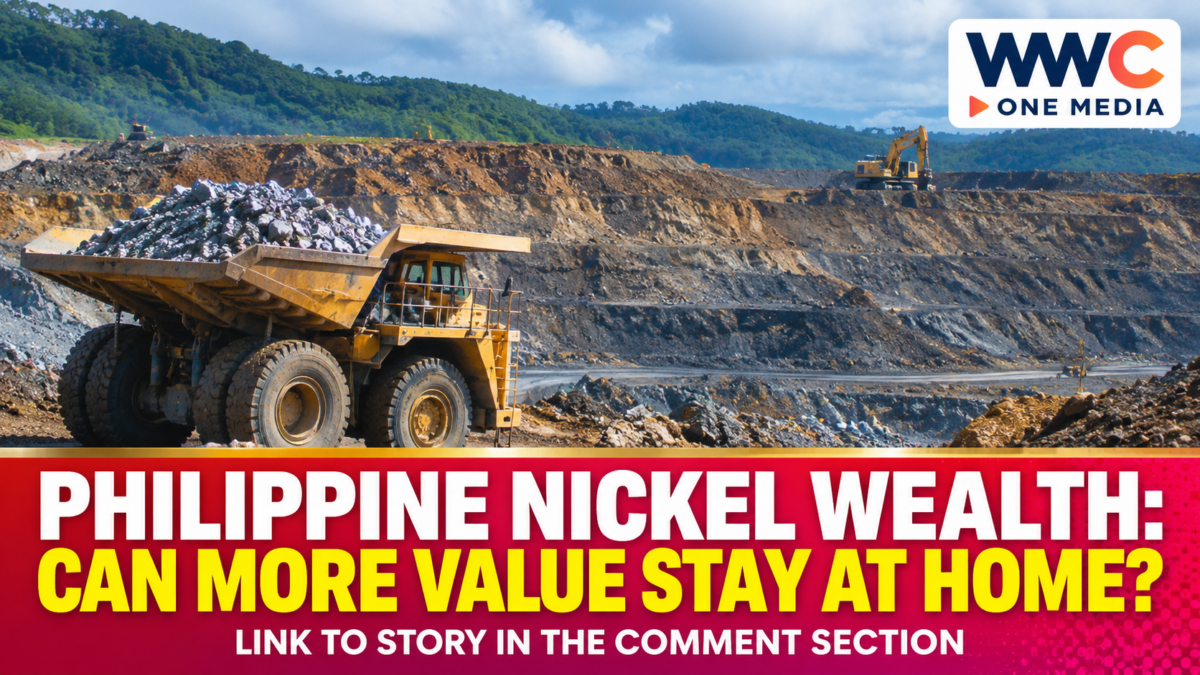
MANILA, Philippines — The Philippines entered November 2026 with two major policy changes reshaping its nickel industry: a new fiscal regime for large-scale metallic mining and a national framework for critical minerals. Together, these measures seek to turn mineral resources into stronger public revenues and more industrial activity inside the country.
The question is no longer simply how much nickel the Philippines can extract or export. It is how much lasting value Filipino workers, communities and businesses can retain after the ore leaves the mine.
Philippine nickel wealth faces a new policy test
Republic Act No. 12253, signed on Sept. 4, 2025, changed the fiscal rules for large-scale metallic mines. The Department of Finance issued implementing regulations in December 2025, addressing how royalties and windfall taxes are calculated, collected and monitored.
A separate step came on Aug. 21, 2026, when President Ferdinand R. Marcos Jr. signed Executive Order No. 122. The order established a framework for developing critical minerals and industries that use them, with government agencies directed to support processing, refining and downstream manufacturing.
These actions address different parts of the same challenge. Tax rules influence how revenue is shared during extraction; industrial policy influences which economic activities happen before products reach their final markets.
WWC has previously examined the sharp increase in Philippine nickel ore export earnings during the first half of 2026. Stronger exports can improve receipts, but they do not by themselves establish how much industrial value remains locally.
What the mining tax reform actually changes
The new framework retains a five-percent royalty for operations within mineral reservations. For mines outside those areas, it establishes an income-based royalty structure, with rates that vary by margin and a minimum levy for operations with low or negative margins.
It also introduces a windfall profits tax linked to unusually high margins. Under the framework described by the government’s extractive-industry transparency programme, the windfall mechanism applies above a 30-percent profit margin.
Another provision, known as ring-fencing, requires tax accounting on a project-by-project basis. In plain language, it is intended to prevent an operator from using losses associated with one project to reduce taxable profits attributable to another.
The Finance Department estimated that the revised regime could produce approximately ₱6.3 billion in additional revenue each year from existing mining projects. That figure is a government estimate, not revenue already collected.
The distinction matters. Lawmakers can change the formula for sharing mining proceeds, but the actual amount collected will still depend on production, prices, profitability, compliance and enforcement.
Can the Philippines move beyond exporting raw ore?
Executive Order No. 122 places domestic processing and higher-value industries at the centre of the government’s minerals strategy. It directs investment promotion toward refining, advanced materials, batteries, electronic components, renewable-energy technologies and other downstream activities.
That is a wider ambition than increasing mine production. A country can earn money exporting unprocessed material while other economies capture additional revenue from converting that material into products used by factories and consumers.
Processing is not automatically profitable, however. Facilities need dependable power, water, transport, skilled employees, financing and commercially viable demand. Developing them requires much more than announcing a policy preference.
The Finance Department’s explanation of EO 122 also identifies energy, logistics and water infrastructure as supporting industries. That acknowledgement is important: building value around nickel depends on the surrounding industrial system, not only the mineral deposit.
WWC’s earlier coverage of Mindanao’s proposed role in critical-mineral supply chains highlights why mine locations, electricity and manufacturing plans must be considered together.
Communities need measurable returns
Mining raises questions that go beyond company revenues and national export earnings. Communities need to know what public revenues are paid, how they are distributed, and whether development safeguards are enforced.
The 2025 fiscal law introduced greater disclosure and oversight provisions covering extractive-industry payments and related information. The implementing rules identify responsibilities for tax collection, reporting, monitoring and coordination across government agencies.
For the public, those requirements are most useful when disclosures are accessible, comparable and sufficiently detailed to test whether promised benefits materialise. An estimate of future tax collections should not be confused with an audited record of payments received.
Environmental compliance and community outcomes also need separate scrutiny. A higher tax take does not automatically demonstrate better restoration, improved local services or lower environmental risk. Those results require their own evidence and measurements.
Why industrial plans require careful evaluation
The national critical-minerals framework provides a direction for investment, but it should not be treated as proof that particular factories have already been built or that specific jobs have been created.
An announced processing project would need financing, permits, infrastructure and operating capacity before its benefits could be assessed. Policymakers should also distinguish investment proposals from binding commitments and commercial production.
Those questions extend to international technology partnerships. WWC has examined the investment, land-use and water questions surrounding a proposed Pax Silica development, where public benefit depends on the eventual terms and facilities rather than projections alone.
The same discipline belongs in nickel policy: count verified output, payments, local procurement, employment and downstream production instead of treating aspirations as completed gains.
What happens next
Implementation will determine whether the two reforms reinforce each other. Tax agencies must apply the revised revenue rules, while investment and environmental authorities evaluate projects that could expand processing and manufacturing capacity.
Useful public indicators would include actual mining taxes collected, project-level disclosures, operating processing capacity, direct employment and evidence of local supplier participation. These would reveal whether Philippine nickel wealth is generating broader domestic gains.
The opportunity is real, but so is the policy test. More extraction alone is not the same as more retained value. The stronger measure of success is what remains in the Philippine economy after the mineral has been sold.
Frequently asked questions
What is the Philippines’ new mining tax law?
Republic Act No. 12253 revised the fiscal system for large-scale metallic mining, including royalties, windfall taxation, project-level accounting and transparency requirements.
Is the Philippines banning nickel ore exports?
The official records reviewed for this article do not establish a currently operative blanket nickel ore export ban. The 2026 policy framework instead emphasises investment in domestic value-adding industries.
What is Executive Order No. 122?
It is the Aug. 21, 2026 directive establishing a national policy framework for critical minerals, including processing, refining and downstream industrial development.
Will mining reform guarantee higher government collections?
No. The Finance Department’s additional-revenue figure is an estimate. Actual receipts depend on market conditions, mining operations and implementation.