Shenzhen has begun a series of temporary transport and security controls ahead of the Asia-Pacific Economic Cooperation (APEC) Economic Leaders’ Meeting on Nov. 18 and 19, 2026. The measures include restrictions on non-local passenger cars, selected road closures and limits on drones and other low-altitude aircraft.
The controls affect different areas and operate on different schedules, making it important for residents, commuters and visitors to distinguish between citywide restrictions and measures that apply only to specific roads or dates.
The meeting places Shenzhen at the centre of a major regional diplomatic gathering, but the official notices also show the practical work involved in managing movement around a large international event. For people living or working in the city, the immediate concern is how to travel, make deliveries and reach essential services while the temporary rules remain in force.
Shenzhen APEC restrictions: What changes from Nov. 17?
A Shenzhen government decision imposes a temporary restriction on passenger cars with licence plates issued outside the city from Nov. 17 to Nov. 20. The restriction applies daily from 6 a.m. to 10 p.m. across the districts of Futian, Luohu, Nanshan, Bao’an, Longgang and Longhua.
The rule does not cover every road without exception. The decision identifies designated expressways and routes to Shenzhen Bao’an International Airport that remain available to qualifying vehicles. Drivers should check the specified routes rather than assume that all roads into or through the city are closed.
The notice also lists exemptions. These include vehicles performing duties such as military, police, firefighting, ambulance and emergency engineering work, as well as vehicles carrying special APEC credentials. Certain passenger transport vehicles and vehicles with Hong Kong, Macao or consular plates are also covered by stated exceptions.
The restrictions are enforceable by the city’s public security traffic-management authorities. The government decision says violations will be dealt with under applicable road-traffic rules.
For visitors arriving from neighbouring cities, the distinction between a general restriction and an exempt route is especially important. A journey to the airport may still be possible through the designated roads, but that does not give drivers permission to enter restricted local roads along the way.
Selected roads face additional controls during the leaders’ meeting
A separate Shenzhen police notice outlines temporary traffic controls in parts of the city from Nov. 17 to Nov. 19, generally between 7 a.m. and 10 p.m. Authorities may restrict traffic in sections of a broad area bounded by major roads, depending on road conditions and traffic flows.
The notice identifies nine roads and adjacent intersections that may face restrictions during two specific periods: from 4 p.m. to 10 p.m. on Nov. 18, and from 6 a.m. to 2 p.m. on Nov. 19.
The listed roads include sections of Shennan Avenue, Shahe West Road, Shahe East Road, Hongshulin Road, Xiangmihu Road, Hongli West Road, Qiaoxiang Road, Xiangmei Road and Yitian Road.
The notice says emergency vehicles and vehicles carrying special APEC credentials are exempt. It also identifies selected Shennan Avenue frontage roads where buses may continue to operate.
Authorities have published alternative routes for affected intersections and advised motorists to check navigation platforms for updated traffic information. People needing access for emergency medical treatment or urgent assistance are instructed to contact police or seek help from officers on the road.
These details matter because a restriction on a particular road or intersection is not necessarily a complete closure of an entire district. Travellers should check the exact time, location and permitted vehicle category before setting out.
Drone and low-altitude flight restrictions cover most of Shenzhen
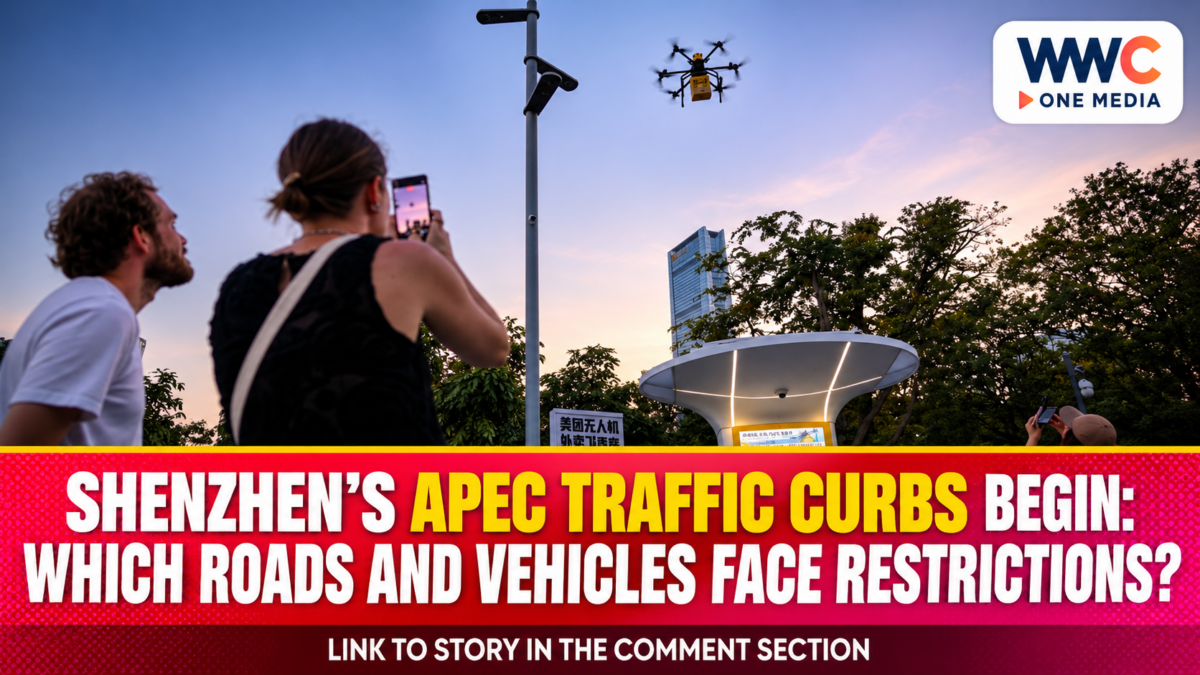
The controls extend beyond road traffic. A notice issued by the Shenzhen municipal government restricts low-altitude flights in Futian and Nanshan from Nov. 7. From Nov. 11 through Nov. 21, the restricted area expands to the rest of Shenzhen, excluding the Shenshan Special Cooperation Zone.
The restrictions cover drones, model aircraft, powered flying toys, helicopters, gliders, paragliders, hot-air balloons, kites, sky lanterns and other aircraft or airborne objects specified in the notice.
Individuals, businesses and organisations are prohibited from operating these aircraft or releasing covered objects in the designated areas during the relevant periods. The notice provides for authorised exceptions for activities such as emergency rescue, public security, weather monitoring, television broadcasting and approved logistics operations.
The distinction is relevant to businesses that use unmanned aircraft for photography, inspection, delivery or other commercial work. The fact that a drone is used for business does not, by itself, mean that it is exempt. Operators must fall within an authorised category and obtain the required approval.
The restrictions also demonstrate how a major international event can affect technology services beyond the immediate meeting venue. In a city known for its technology and manufacturing industries, low-altitude flight controls have implications for operators that depend on aerial equipment.
Why the different dates and exemptions matter
The restrictions do not begin and end together. The low-altitude flight measures started earlier in November and continue through Nov. 21. The non-local passenger-car restriction runs from Nov. 17 through Nov. 20. Additional road controls are scheduled around Nov. 18 and 19.
That staggered timetable means there is no single date on which all restrictions apply in the same way. A driver entering Shenzhen on Nov. 17 faces a different set of conditions from a drone operator working in the city on Nov. 21.
For businesses, the practical response is to review delivery schedules, staff travel arrangements and any activities that rely on drones or other aircraft. For residents, checking official traffic updates before travelling may help avoid restricted roads and unnecessary delays.
The broader context is also important. WWC has previously examined Shenzhen’s place in the technology and export economy. The city’s role as an international business centre makes the smooth operation of transport and logistics particularly relevant during a gathering of regional leaders.
The summit also comes amid wider diplomatic and economic developments involving China and its trading partners. Readers can explore WWC’s earlier coverage of China’s trade policy and rare-earth export controls for additional context.
What happens next
The APEC Economic Leaders’ Meeting is scheduled for Nov. 18 and 19 in Shenzhen. The temporary passenger-car restriction remains in effect through Nov. 20, while the low-altitude flight restriction continues through Nov. 21.
Residents and visitors should rely on the latest notices from Shenzhen’s traffic and public security authorities for road access, exemptions and changes. The published rules identify specific dates, hours, areas and vehicle categories; they should not be treated as a blanket closure of the entire city.
For more background on the diplomatic setting, see WWC’s previous report on the Shenzhen summit and its international significance.
Frequently asked questions
When is the APEC Economic Leaders’ Meeting in Shenzhen?
The meeting is scheduled for Nov. 18 and 19, 2026.
When are non-local passenger cars restricted in Shenzhen?
The temporary restriction runs from Nov. 17 to Nov. 20, daily from 6 a.m. to 10 p.m., across six named districts, subject to specified road and vehicle exemptions.
Are all roads in Shenzhen closed to outside vehicles?
No. The decision lists expressways and routes to Shenzhen Bao’an International Airport that are exempt from the temporary restriction. Certain vehicle categories are also exempt.
When do the drone restrictions end?
The citywide low-altitude flight restrictions, excluding the Shenshan Special Cooperation Zone, run through Nov. 21. Earlier restrictions applied in Futian and Nanshan from Nov. 7.
Can emergency vehicles pass through restricted roads?
The notices provide exemptions for specified emergency vehicles and vehicles carrying special APEC credentials. The road-control notice also provides a way to seek assistance for urgent medical or emergency access.