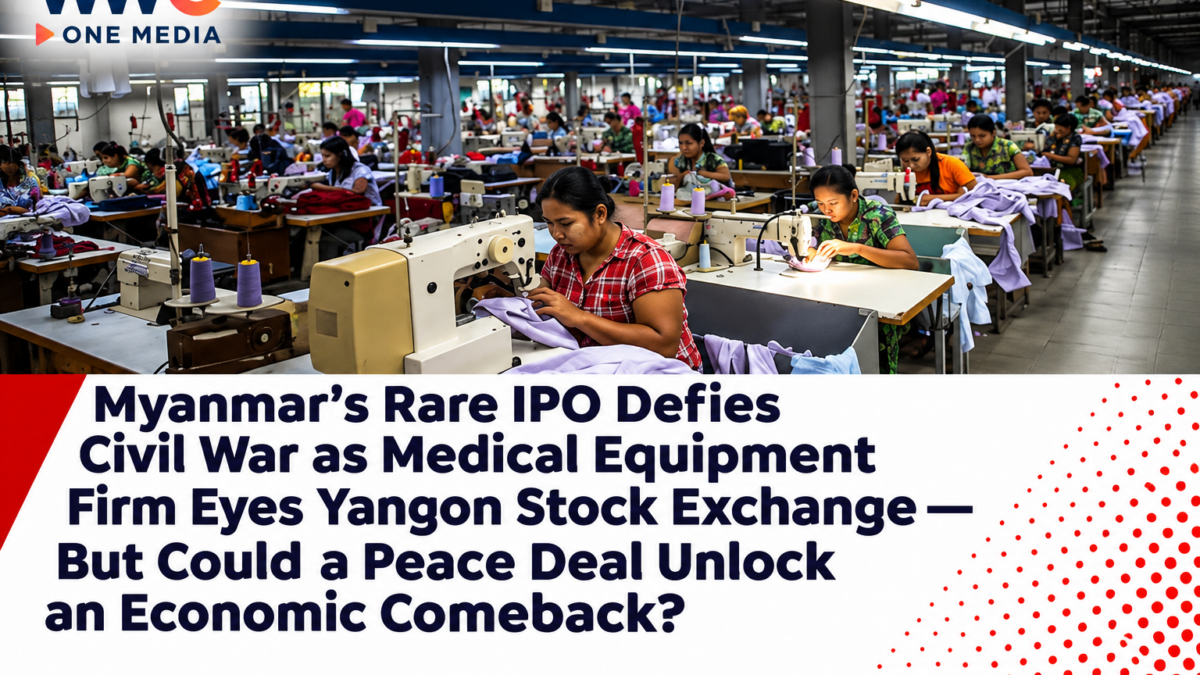
YANGON, MYANMAR / MANILA, PHILIPPINES — November 12, 2026 — In a country battered by more than five years of civil war, economic instability and international sanctions, a rare initial public offering is offering investors an unusual opportunity to bet on Myanmar’s long-term recovery.
Concordia Public Company Limited, a distributor of medical equipment, engineering products and office technology, is moving toward a listing on the Yangon Stock Exchange (YSX) after receiving conditional approval from the exchange on October 28.
The proposed listing comes at a difficult time for Myanmar.
The economy contracted an estimated 2% during the fiscal year ended March 2026, inflation reached 24.6% in April, and continuing armed conflict has disrupted businesses, transportation networks and investment.
Yet Concordia is pressing ahead with plans to raise capital through the country’s small stock market.
The company reported revenue of approximately 23.57 billion Myanmar kyat for the financial year ended March 2026, an 8.1% increase from the previous year.
However, its net profit declined 17.4% to K1.77 billion, revealing the pressure that rising costs, currency instability and difficult operating conditions are placing on businesses.
The proposed offering raises a significant question for investors.
Can a company build a successful publicly traded business in one of Southeast Asia’s most troubled economies—or is Myanmar’s latest IPO a risky bet on a peace and economic recovery that remain far from guaranteed?
Myanmar’s Yangon Stock Exchange Prepares for a Rare New Listing
The Yangon Stock Exchange conditionally approved Concordia Public Company Limited for admission to its Main Board on October 28, 2026.
The approval marks an important development for Myanmar’s limited public equity market.
Unlike larger Asian financial centers, Myanmar has relatively few listed companies, limited trading activity and restricted access to international investment.
Concordia’s proposed entry could expand the number of Main Board companies from eight to nine.
However, conditional approval is not the same as a completed IPO.
The company must finish the required offering and regulatory processes before its shares can begin trading.
Myanmar Securities Exchange Centre subsequently announced that it would collect expressions of interest from prospective investors between November 11 and December 7, 2026.
The final listing date and confirmed offer terms remain subject to completion of the process.
For Myanmar’s capital markets, the significance lies in the willingness of a private company to seek public financing despite exceptionally challenging economic conditions.
But the successful completion of one offering would not, by itself, establish that the country’s wider investment environment has recovered.
Concordia Targets an IPO Price of K2,500 to K2,700 Per Share
According to Myanmar Business Journal’s analysis of the company’s preliminary prospectus, Concordia has indicated an offering price range of K2,500 to K2,700 per share.
The preliminary transaction involves the potential issuance of approximately 296,296 to 320,000 new shares.
Those terms are subject to confirmation.
The company previously reported nine million shares outstanding and paid-up capital of K9 billion as of March 31, 2025.
The nominal value of existing shares should not be confused with the proposed IPO price.
The final valuation will depend on the confirmed offer price, number of shares issued and resulting total share count.
For investors, the key questions concern how much fresh capital Concordia will receive and how management intends to use the proceeds.
A primary share offering would raise money for the company to finance operations and expansion.
However, issuing new shares also dilutes the percentage ownership of existing shareholders.
The success of the IPO will therefore depend on the balance between its growth prospects, financial performance and the valuation investors are being asked to accept.
Medical Equipment Drives Revenue Growth
Concordia traces its origins to 1993, when it was established as an engineering business.
The company subsequently expanded into medical equipment, office automation, technical services and related commercial activities.
It converted into a public limited company in 2024 as part of preparations for its stock-market debut.
Today, medical equipment represents its largest source of revenue.
For the financial year ended March 31, 2026, Concordia reported:
| Financial indicator | FY2025/26 | Year-on-year change |
|---|---|---|
| Total revenue | K23.57 billion | +8.1% |
| Net profit | K1.77 billion | -17.4% |
| Medical equipment revenue | K17.99 billion | +21.7% |
| Engineering revenue | K1.99 billion | +15.0% |
| Office automation revenue | K3.49 billion | -27.1% |
Medical equipment accounted for approximately 76.3% of the company’s total annual revenue.
The strong performance in that division suggests continuing demand for healthcare products and technical services.
However, the concentration also creates risks.
Concordia depends on imported equipment, foreign suppliers and customers with sufficient budgets to purchase medical technology.
Changes in exchange rates, import availability or healthcare spending can therefore affect earnings.
Why Concordia’s Profit Fell Despite Higher Sales
The company’s latest financial results reveal an important warning for prospective shareholders.
Although revenue increased, net profit declined from approximately K2.14 billion to K1.77 billion.
The decrease reflected several factors, including higher operating expenses and foreign-exchange losses.
Concordia recorded an exchange loss of approximately K770.6 million during FY2025/26, compared with K483.5 million a year earlier.
The increase illustrates the difficulty of operating an import-dependent business when the local currency is under pressure.
Gross profit margins also narrowed.
Meanwhile, trade and other receivables increased to approximately K11.24 billion, highlighting the importance of collecting payments from customers.
The company reported improved operating cash flow, but investors must consider how quickly outstanding receivables can be converted into cash.
These results show that revenue growth alone does not guarantee higher profitability.
For a newly listed company, the ability to manage working capital, currency exposure and expenses will be central to its financial performance.
Myanmar’s Civil War Remains the Biggest Investment Risk
Concordia’s proposed IPO is taking place against the backdrop of Myanmar’s prolonged internal conflict.
The country has experienced widespread fighting since the military seized power in February 2021, removing the elected civilian government.
The takeover triggered nationwide protests and armed resistance.
Over the following years, the conflict expanded into a complicated struggle involving the military, ethnic armed organizations and resistance forces.
The fighting has damaged infrastructure, displaced communities, disrupted trade and increased the difficulty of operating businesses.
International sanctions have also complicated financial transactions and investment relationships.
These conditions make Myanmar substantially different from more stable emerging markets.
A company’s ability to generate revenue may depend on access to reliable electricity, transportation networks, imported products and functioning payment systems.
Even businesses located away from active fighting can face supply-chain disruptions and higher operating costs.
For investors considering Concordia, those risks cannot be separated from the company’s financial outlook.
The World Bank Warns Myanmar’s Economic Recovery Is Fragile
The latest World Bank assessment provides a sobering picture of Myanmar’s economy.
In June 2026, the institution estimated that real gross domestic product contracted by 2% during FY2025/26.
It also reduced its growth forecast for FY2026/27 to 2%, from an earlier projection of 3%.
The downgrade reflected a fuel-price shock and continuing structural problems.
According to the World Bank, higher energy costs have increased transportation and production expenses while adding pressure to foreign-exchange demand.
Inflation reached 24.6% year over year in April 2026.
The bank also warned that businesses continue facing unreliable electricity, weak domestic demand and regulatory uncertainty.
Although economic conditions showed tentative signs of stabilization, output and business activity remained below levels recorded before the 2021 military takeover.
A modest return to economic growth would therefore not mean that the economy had recovered its earlier losses.
For Concordia, improvements in healthcare spending and business confidence could support future demand.
But continued inflation and currency weakness could undermine the financial benefits of higher sales.
Peace Talks Offer Hope, But No Guaranteed Settlement
Recent diplomatic developments have raised the possibility of renewed political negotiations.
Reuters reported in August that regional diplomatic efforts were creating an opening for discussions between Myanmar’s competing political and armed groups.
Thailand and the Philippines were among the countries involved in diplomatic engagement.
However, a comprehensive peace settlement has not been achieved.
The military-led government and armed resistance organizations continue to face substantial disagreements.
Even if negotiations advance, rebuilding Myanmar’s economy would require more than ending active fighting.
Investors would need greater legal certainty, reliable financial institutions, functioning infrastructure and confidence that contracts can be enforced.
Restrictions associated with international sanctions would also remain an important consideration.
The prospects for peace may influence long-term investment sentiment, but no company should treat an end to the conflict as a guaranteed business assumption.
Healthcare Investment Could Become a Long-Term Opportunity
One of Concordia’s potential growth opportunities involves healthcare infrastructure.
The company has identified renal care, dialysis-related equipment and medical technology as areas for future expansion.
Its earlier annual report described a collaboration framework involving international medical technology company B. Braun.
However, some initiatives were still in the planning stages during the previously reported financial period.
Potential investment in dialysis equipment, specialized treatment services and hospital technology could create new revenue opportunities.
Myanmar’s healthcare system faces major challenges involving access, affordability, infrastructure and personnel.
Equipment distributors may play an important role in supplying hospitals and healthcare providers.
But future commercial opportunities depend on customers’ purchasing power, reliable product imports, service capacity and the availability of financing.
The prospect of increased healthcare demand should not be confused with guaranteed future earnings.
Yangon Stock Exchange Faces a Bigger Test of Investor Confidence
Myanmar’s stock exchange began trading in 2016 as part of efforts to develop a modern capital market.
The exchange was intended to provide domestic businesses with an alternative source of financing and create opportunities for public investment.
However, its growth has been limited by economic disruption, a small number of listed companies and restricted market liquidity.
Liquidity matters because investors need to be able to buy and sell shares without causing excessive price movements.
In a market with relatively few participants, trading activity can be uneven.
A new IPO may attract attention, but it does not automatically create a liquid secondary market.
Concordia’s proposed listing could broaden the exchange’s range of sectors by adding a company heavily exposed to medical-equipment distribution.
Whether the offering attracts sustainable demand will depend on valuation, disclosures, corporate governance and investor confidence.
Myanmar’s IPO Contrasts With Larger Asian Fundraising Markets
The contrast with larger Asian exchanges is striking.
Hong Kong, for example, has attracted substantial international fundraising activity, even as investor caution and falling technology valuations create challenges.
As WWC ONE MEDIA reported in its coverage of Hong Kong’s unusually high IPO withdrawal rate, approximately one in four IPO transactions covered by Bloomberg’s 2026 analysis failed to reach completion.
That development highlights how even established financial centers can struggle with investor confidence.
Myanmar faces additional problems, including political instability, currency controls and much thinner stock-market liquidity.
For a prospective issuer such as Concordia, a successful offering would be a significant corporate milestone.
However, its fundraising scale cannot be compared directly with the multibillion-dollar transactions common in larger markets.
The Philippines Offers a Different IPO Example
Elsewhere in Southeast Asia, companies are pursuing public offerings under very different economic conditions.
In the Philippines, financial technology company Mynt, the parent of GCash, completed a major stock-market debut in October 2026.
As WWC ONE MEDIA reported in its coverage of GCash’s post-IPO financial results, the company subsequently reported ₱16.5 billion in net income for the first nine months of 2026.
The Philippine example illustrates how IPOs can give growing businesses access to public investors and increase scrutiny of their financial performance.
Myanmar’s situation is fundamentally different because of its political and economic environment.
Nevertheless, both cases highlight the importance of transparency, credible financial information and realistic valuations.
A successful stock-market debut is not merely about attracting subscriptions.
Companies must also demonstrate that they can sustain their operations and deliver results after listing.
International IPO Markets Show Why Investors Must Remain Cautious
Concordia’s proposed transaction also arrives during a period of uncertainty for public offerings worldwide.
Companies in emerging and developed markets have faced volatile stock prices, changing interest-rate expectations and more selective institutional investors.
As WWC ONE MEDIA examined in its report on SoftBank-backed OPay’s disrupted New York listing, an IPO process can encounter unexpected complications even when substantial investor interest exists.
The risks facing Concordia are different, but the broader lesson applies.
Regulatory approval, a proposed valuation and a successful fundraising campaign are separate stages of becoming a publicly traded company.
None guarantees that shares will perform well after listing.
Similarly, WWC ONE MEDIA’s coverage of Citigroup’s expectations for China’s widening offshore IPO market illustrates how investors consider sector diversification when evaluating new listings.
Concordia could broaden Myanmar’s market beyond its existing concentration of listed businesses.
But the company’s exposure to healthcare equipment does not eliminate country-specific risk.
Foreign Investment Remains Complicated
Myanmar’s economic outlook is also influenced by its relationships with major international powers.
Reuters reported on November 10 that the military-led government was seeking greater US investment in its rare-earth minerals sector.
The United States has been considering ways to expand engagement while addressing concerns about China-linked supply chains.
However, Washington has also emphasized the importance of improving conditions for businesses and making progress toward a genuine peace process.
Meanwhile, Reuters reported on November 5 that Unilever had agreed to sell its stake in a Myanmar joint venture, with completion expected in 2027.
These developments demonstrate the conflicting signals facing foreign investors.
Some commercial opportunities remain attractive, but political instability, sanctions and operational risks continue complicating investment decisions.
Concordia’s IPO should therefore not be interpreted as proof that international businesses are returning to Myanmar on a large scale.
It is a company-specific fundraising effort taking place in an exceptionally difficult market.
What Happens Next for Concordia?
The next major steps involve completion of the offering process and publication of final listing details.
Prospective investors will need to examine the confirmed share price, number of shares, intended use of proceeds and any updated financial disclosures.
They will also need to evaluate the company’s exposure to foreign-exchange movements, its growing receivables and the profitability of its medical-equipment business.
Additional scrutiny may focus on ownership concentration and the rights of public shareholders.
Even after listing, trading activity may remain limited because Myanmar’s stock market is relatively small.
The company will need to demonstrate that the capital it raises can support commercially sustainable expansion.
The Bottom Line: A Rare IPO in a Country Still Searching for Stability
Concordia’s proposed Yangon Stock Exchange debut represents an unusual development in Myanmar’s troubled financial system.
The company has generated revenue growth and expanded its medical-equipment business despite a challenging operating environment.
But its latest profit decline demonstrates that higher sales have not insulated it from inflation, currency volatility and rising expenses.
Myanmar’s broader economy remains under pressure after years of conflict and political uncertainty.
The World Bank expects only modest growth in FY2026/27, while international investors continue confronting major regulatory, financial and security risks.
For the Yangon Stock Exchange, Concordia’s offering could become a milestone in developing a broader public equity market.
For investors, it represents a much more complicated proposition.
The company is seeking capital today, but its longer-term prospects will depend partly on whether Myanmar can create a more stable environment for businesses, employees and investors.
As Concordia prepares for a rare stock-market debut amid civil war and economic hardship, could this IPO become an early sign of Myanmar’s eventual financial recovery—or will the country’s unresolved crisis prove too great a risk for investors seeking the next frontier-market opportunity?