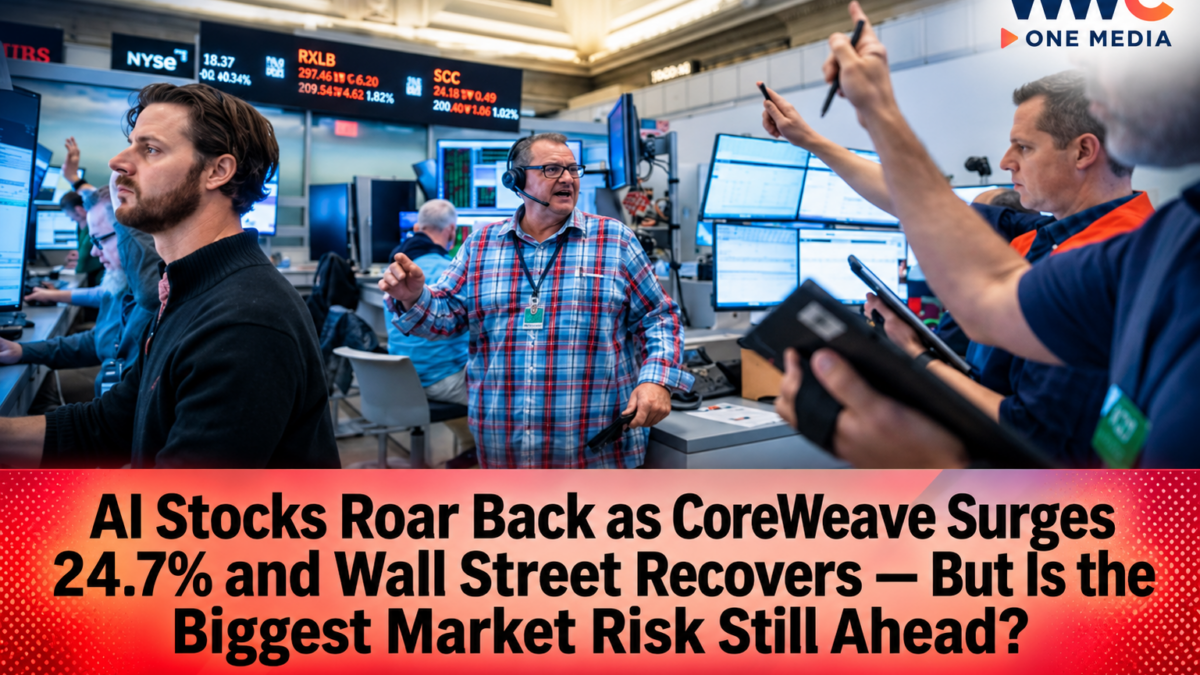
NEW YORK, United States — November 11, 2026 — Wall Street staged a powerful comeback Wednesday as artificial intelligence stocks recovered from last week’s brutal sell-off, with cloud-computing company CoreWeave leading the rally after delivering better-than-expected financial results.
The rebound pushed the S&P 500 up 1.3%, lifted the technology-heavy Nasdaq Composite by 1.6% and sent the Dow Jones Industrial Average higher by 0.5%.
At the center of the recovery was CoreWeave, whose shares surged 24.7% after the company reported a smaller-than-expected quarterly loss, raised its annual revenue forecast and offered investors a more reassuring picture of how it plans to finance its expensive artificial intelligence infrastructure.
The results helped ease concerns that the enormous investments powering the AI boom might become financially unsustainable.
But the recovery came with important warnings.
Oil prices climbed, inflation concerns continued to pressure expectations for Federal Reserve interest-rate decisions, and investors remained uncertain about whether the AI industry can generate enough long-term profits to justify its massive spending.
Wednesday’s rally brought Wall Street closer to recovering last week’s losses. However, the question confronting investors is whether this marks a lasting recovery or simply another temporary bounce in an increasingly volatile market.
CoreWeave Surges 24.7% as Earnings Revive Confidence in AI Spending
CoreWeave became the biggest story of Wednesday’s trading session.
The company, which provides cloud-computing infrastructure and access to advanced AI processors, saw its stock jump 24.7% after reporting results that helped address two major concerns: whether demand for AI computing remains strong and whether the company can finance its rapid expansion.
CoreWeave reported a smaller-than-expected loss for the summer quarter and raised its full-year revenue forecast above analysts’ expectations.
Chief Executive Michael Intrator also said the company expected approximately US$9 billion in customer prepayments and deposits over the following three months, alongside other sources of cash.
Those expected payments helped reassure investors concerned about the company’s borrowing requirements and the rising cost of financing data-center expansion.
The company’s performance was particularly important because CoreWeave has become a symbol of the financial risks surrounding the AI infrastructure boom.
Building and operating large data centers requires enormous investments in specialized chips, electricity, cooling systems and physical facilities.
Investors have increasingly questioned whether companies expanding at this pace can eventually generate enough cash to support those costs.
CoreWeave’s latest results offered a more encouraging answer, at least for the moment.
Reuters also reported that the company raised its annual revenue outlook and said it would avoid unsecured debt markets, pointing instead to cash flows from existing contracts to support its financing needs.
However, the company’s debt burden and the long-term profitability of AI infrastructure remain important risks.
Nasdaq Leads Wall Street Recovery as Technology Shares Climb
The gains extended beyond CoreWeave, with major US stock indexes closing higher.
<text color=”secondary” size=”xs” weight=”medium”>WEDNESDAY, NOVEMBER 11, 2026 — US MARKET CLOSE</text>
| Major index | Closing level | Daily change |
|---|---|---|
| S&P 500 | 7,619.38 | +1.3% |
| Nasdaq Composite | 25,466.19 | +1.6% |
| Dow Jones Industrial Average | 52,486.49 | +0.5% |
The S&P 500 gained 98.45 points, while the Dow added 254.60 points. The Nasdaq advanced 400.31 points, making technology shares the strongest contributor among the major indexes.
The S&P 500 also moved within approximately 2.6% of its record high set the previous month.
The rebound was significant because investors had spent the previous week selling shares in companies associated with artificial intelligence and data-center construction.
Last week’s losses were driven partly by concerns that political changes following the US midterm elections could lead to restrictions on new data centers and slower infrastructure expansion.
Wednesday’s performance suggested that some investors were once again willing to buy AI-related stocks after the steep declines.
However, recovering some lost ground does not necessarily mean the market’s earlier concerns have disappeared.
Micron, Broadcom and Nvidia Join the AI Stock Rally
The improvement in sentiment spread to several major technology and infrastructure companies.
Micron Technology climbed 11.9%, benefiting from renewed demand expectations for memory products used in advanced computing systems.
Broadcom gained 4%, while Nvidia advanced 2.9%.
GE Vernova, which supplies equipment and technology supporting electricity generation and infrastructure, rose 1.4%.
These gains demonstrated how closely the fortunes of semiconductor manufacturers, computing providers and energy infrastructure companies are connected to expectations for AI investment.
Artificial intelligence requires more than advanced software.
It depends on processors, high-bandwidth memory, cloud platforms, data centers and substantial electricity capacity.
That creates opportunities for companies across the technology and energy supply chain.
But it also means that concerns about slower AI spending can affect a wide range of businesses, not just the companies developing AI models.
Nvidia’s rebound was particularly notable because its shares had suffered significant losses earlier in the week amid separate controversy surrounding its chief executive, Jensen Huang.
The company’s board is investigating allegations involving Huang’s relationship with a businesswoman accused of having links to Chinese intelligence. Huang acknowledged the relationship, while Nvidia has said it has no reason to believe company secrets or national security were compromised.
Those allegations remain under investigation and have not been established as findings of wrongdoing.
Oil Prices Rise as Energy Concerns Complicate the Market Recovery
While technology shares rallied, oil prices moved in the opposite direction.
Brent crude, the international benchmark, gained 1.4% to settle at US$92.76 per barrel.
The increase came as oil recovered some of its earlier losses and remained sensitive to geopolitical developments involving the Middle East.
According to AP, Brent crude has traded within an approximate US$72-to-US$120 range since the conflict with Iran pushed energy prices sharply higher earlier in the year.
Rising oil prices can create problems for businesses and consumers.
Higher energy costs can increase transportation expenses, manufacturing costs and household spending. If those increases persist, they can also complicate efforts to bring inflation under control.
Airlines are particularly exposed because fuel represents a significant operating expense.
United Airlines shares fell 1.8% Wednesday as the broader market felt pressure from higher oil prices.
The contrast between rising technology stocks and weaker energy-sensitive businesses showed that the market recovery was not equally beneficial across all industries.
Federal Reserve Rate Fears Remain a Major Threat to Wall Street
Another major issue facing investors is the possibility of additional Federal Reserve interest-rate increases.
US inflation data released Tuesday came in hotter than expected, increasing concern that price pressures could remain persistent.
Reuters reported that October’s core consumer inflation rose 0.3% month over month, above economists’ forecast of 0.2%.
Before the report, Federal Reserve Governor Christopher Waller had said policymakers should consider a 50-basis-point rate increase if core monthly inflation reached at least 0.3%.
The latest reading therefore intensified market speculation about a more aggressive approach to monetary policy.
Higher interest rates can affect technology companies in particular because many depend on substantial borrowing to finance infrastructure, research and expansion.
When borrowing becomes more expensive, companies may need to spend more carefully. Investors may also become less willing to pay high valuations for businesses whose expected profits are far into the future.
The US Treasury market was closed Wednesday for Veterans Day, meaning investors did not receive a fresh session of Treasury trading to assess alongside the stock-market rally.
That does not mean interest-rate concerns have disappeared.
The inflation report and Federal Reserve commentary remain important factors that could influence the direction of financial markets in the coming weeks.
Not Every Company Joined the Rally
Although technology stocks helped lift the broader market, several companies moved for reasons unrelated to artificial intelligence.
Fossil Group surged 26.7% after reporting stronger quarterly profits than analysts expected and improving its revenue outlook.
The company’s results demonstrated that earnings strength outside the technology sector can also attract investor attention.
Meanwhile, real-estate-related shares remained under pressure following the recent increase in bond yields.
Homebuilder D.R. Horton declined 1.5%, while PulteGroup slipped 0.8%.
Higher borrowing costs can affect mortgage rates and reduce affordability for potential homebuyers, creating challenges for housing companies.
The different performances across industries highlight why investors should look beyond the headline gains of major stock indexes.
A rising S&P 500 does not mean every company or sector is recovering at the same pace.
Global Markets Also Advance, but Asia Delivers a Mixed Picture
The improvement in US technology shares was reflected across several international markets.
In Asia, South Korea’s Kospi jumped 2.6%, recording one of the strongest moves among major global indexes.
Shanghai shares rose 0.5% as China’s Singles Day shopping festival began, with investors watching sales figures for clues about consumer spending in the world’s second-largest economy.
Hong Kong’s Hang Seng Index moved in the opposite direction, falling 1%.
European stocks also advanced during Wednesday’s trading, reflecting improved sentiment toward technology companies and expectations for continued AI-related investment.
Reuters reported that the pan-European STOXX 600 was higher as investors reassessed the outlook for technology and other sectors following CoreWeave’s results.
The international performance showed that the AI trade remains a major influence on global investment sentiment.
However, regional differences in economic growth, monetary policy and geopolitical exposure continue to shape individual markets.
What the AI Recovery Means for Investors in the Philippines
For Philippine investors, the rebound in US technology stocks offers a reminder of how closely local financial markets are connected to international developments.
Major US companies such as Nvidia, Broadcom and Micron are included in many international investment funds and global equity portfolios.
Their share-price movements can influence the value of investments held by Filipinos through foreign stock platforms, mutual funds and other investment products.
The AI infrastructure industry can also affect the Philippines through electronics manufacturing, semiconductor supply chains and demand for technology-related services.
However, the US stock-market rebound does not automatically guarantee gains for the Philippine Stock Exchange.
Local share prices are also influenced by Philippine corporate earnings, interest rates, inflation, currency movements and domestic economic conditions.
For investors, the latest rally highlights the importance of looking beyond short-term price movements.
A company’s rising stock price does not necessarily mean its business model has become risk-free. Likewise, a sharp decline does not automatically make a stock undervalued.
The financial health of a company, its debt, future revenue and ability to generate sustainable profits remain essential considerations.
The Bigger Question: Can the AI Boom Deliver Enough Profits?
Wednesday’s rally provided temporary relief for investors who had been worried about the future of artificial intelligence spending.
CoreWeave’s earnings suggested that demand for computing infrastructure remains strong, while its financing announcements helped calm concerns about the cost of expansion.
But the wider industry still faces difficult questions.
Will AI companies generate enough revenue to justify the billions being spent on infrastructure?
Can cloud providers finance new data centers without accumulating unsustainable debt?
Will electricity availability, regulation and construction costs slow the industry’s expansion?
And can major technology companies maintain their earnings growth if borrowing costs continue rising?
These questions have become increasingly important as investors reassess the difference between the long-term promise of AI and the financial performance of the businesses building it.
WWC One Media has also examined the financial pressures behind this trend in its coverage of the Federal Reserve’s warning about AI-related debt and the possibility of a major technology-stock correction.
For now, CoreWeave’s results have given Wall Street a reason to breathe again.
But one strong trading session cannot erase the market’s concerns about inflation, financing costs, energy prices and the profitability of artificial intelligence.