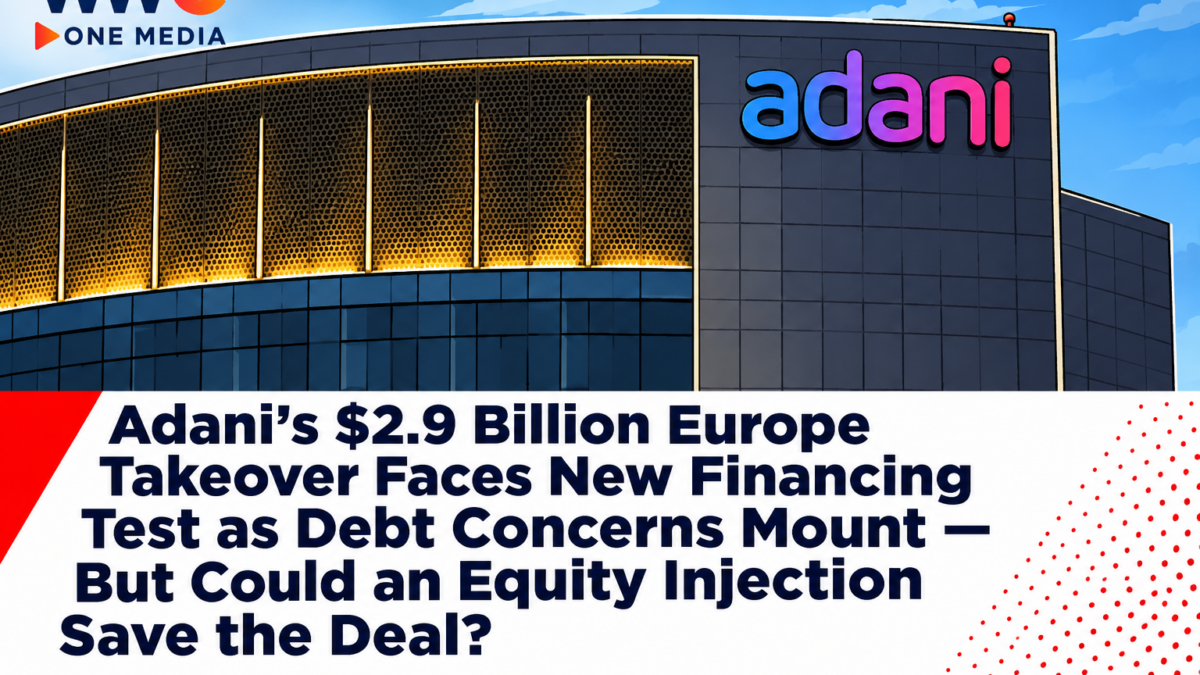
MUMBAI, INDIA / AMSTERDAM, NETHERLANDS / MANILA, PHILIPPINES — November 12, 2026 — Indian billionaire Gautam Adani’s global infrastructure empire is preparing for one of its most significant overseas acquisitions, as Adani Ports and Special Economic Zone Ltd. explores a potential combination of debt and equity financing for its approximately US$2.9-billion takeover of European liquid-storage company Evos.
The financing considerations, highlighted by Bloomberg on November 12, come one week after Adani Ports signed an agreement to acquire 100% of Netherlands-based Evos from Igneo Infrastructure Partners.
The transaction would give India’s largest private port operator control of eight liquid-storage terminals across five European countries.
It would also establish a major European operating platform for the Adani Group, extending its reach into energy storage, international commodity logistics and infrastructure supporting the transition to lower-carbon fuels.
But the acquisition raises an important financial question.
Can Adani finance its ambitious international expansion without placing too much pressure on its balance sheet?
The original agreement, announced November 5, values Evos at €2.56 billion in enterprise value, equivalent to approximately US$2.9 billion.
Adani initially said the all-cash transaction would be debt-funded, with Mitsubishi UFJ Financial Group, or MUFG, providing financing commitments of up to €2.8 billion.
Bloomberg’s latest report indicates that the company is now evaluating a combination of equity and debt.
The precise amount of any proposed equity contribution has not been independently established.
The deal remains subject to regulatory approvals and employee-representative consultation. It has not yet closed.
Adani’s $2.9 Billion Acquisition Could Transform Its European Business
Adani Ports announced on November 5 that it had agreed to acquire Evos, Europe’s second-largest independent liquid-storage operator.
Evos operates eight terminals in the Netherlands, Germany, Spain, Belgium and Malta.
The facilities are positioned near major European energy, shipping and industrial centers.
They include locations connected to the Amsterdam-Rotterdam-Antwerp region, Hamburg and the Mediterranean.
These are important hubs for the movement and storage of fuels, chemicals and other liquid commodities.
Unlike a conventional container port, a liquid-storage terminal provides specialized tanks, pipelines and related infrastructure for products such as gasoline, jet fuel, marine fuel and industrial chemicals.
These facilities can earn revenue by storing and handling products for energy companies, commodity traders and industrial customers.
The acquisition would give Adani a substantial European presence in a sector supported by long-term infrastructure demand.
It would also help diversify the company’s revenue beyond its existing South Asian and other international port operations.
However, the benefits will depend on completing the transaction and integrating Evos successfully.
Why the $2.9 Billion Price Tag Needs Explanation
One of the most important distinctions in the transaction is the difference between enterprise value and equity value.
Adani’s acquisition agreement places Evos’ enterprise value at €2.56 billion.
But the equity value is approximately €1.18 billion.
Enterprise value generally reflects the value of the operating business, including debt-related adjustments.
Equity value represents the value attributable to shareholders.
The difference is approximately €1.38 billion, although the final allocation is subject to the transaction’s debt and other closing adjustments.
This means it would be misleading to state that Adani is simply paying €2.56 billion directly to Evos’ shareholders.
The larger figure reflects the enterprise valuation of the business being acquired.
That distinction is central to understanding how the financing works.
A buyer must consider not only the purchase price for the shares but also the target company’s existing financial obligations.
For Adani, that makes the debt structure and eventual financing costs especially important.
Bloomberg Reports a Possible Debt-and-Equity Funding Mix
The latest financing development could influence the acquisition’s effect on Adani Ports’ financial position.
The company’s original November 5 announcement described an all-cash transaction financed through debt.
MUFG was identified as the sole underwriter, with commitments of up to €2.8 billion.
Bloomberg’s November 12 headline indicates that Adani is now considering a mix of equity and debt financing.
Such a structure could reduce the amount of new borrowing needed, depending on how much equity capital is contributed and where that capital originates.
But equity financing also has costs.
If a company raises money by issuing new shares, existing shareholders may experience dilution.
If capital comes from existing investors or internal resources, the consequences could be different.
Likewise, borrowing preserves ownership percentages but creates interest expenses and repayment obligations.
There is currently insufficient verified public information to identify the exact financing structure under consideration.
The company has not publicly established, in the sources reviewed, the precise equity contribution or a final revised funding agreement.
The correct conclusion is that Adani is reportedly evaluating alternatives while the previously announced debt commitment remains an important financing reference.
Evos Brings 6.3 Million Cubic Meters of Storage Capacity
Evos is a substantial infrastructure business.
Its portfolio comprises approximately 6.3 million cubic meters of storage capacity spread across 452 tanks.
The facilities also include 63 vessel and barge berths.
Several terminals have pipeline connections serving major industrial and transportation networks.
In 2025, Evos handled approximately 37 million metric tons of throughput.
Throughput measures the volume of material handled through the facilities over a period.
It should not be confused with storage capacity, which measures the physical space available at a particular time.
The company’s infrastructure allows customers to receive, store, blend and distribute various liquid products.
That role makes Evos part of Europe’s broader energy and industrial supply chains.
For Adani, the acquisition is not simply about buying more port facilities.
It is about gaining a foothold in specialized energy infrastructure that can support recurring commercial demand.
Why Evos’ 99% Occupancy Is Attractive to Investors
Evos reported average commercial occupancy of approximately 99%.
That figure suggests that nearly all its commercially available storage capacity was contracted or utilized under the company’s reporting measure.
High occupancy can support revenue stability.
The company also has contracts that include take-or-pay arrangements.
Under such agreements, customers may be required to pay for contracted capacity even if they do not use all of it.
This can help protect infrastructure operators against short-term fluctuations in customer activity.
Some contracts also contain adjustments linked to consumer-price inflation.
These arrangements may allow certain revenues to increase when inflation rises, depending on the applicable contractual terms.
For Adani, the combination of high occupancy, long-standing customers and contracted revenues is strategically attractive.
However, 99% occupancy should not be interpreted as guaranteed future utilization.
Contracts can expire, customers can face financial difficulty and demand can change.
The value of the acquisition will depend partly on maintaining these commercial relationships.
Evos Generated €219 Million in EBITDA
Evos’ latest reported financial results help explain its appeal.
For calendar year 2025, the company recorded revenue of approximately €392 million.
Earnings before interest, taxes, depreciation and amortization, or EBITDA, reached €219 million.
That represents an EBITDA margin of approximately 56%.
The margin reflects the relatively high operating profitability of the business before certain financing, tax and noncash accounting expenses.
Adani’s international ports portfolio reported an EBITDA margin of approximately 44.8% during the first half of its fiscal year ending March 2027.
The comparison suggests Evos could increase the combined group’s exposure to higher-margin operations.
But EBITDA is not the same as net income or free cash flow.
Infrastructure businesses also require maintenance, financing and other expenditures.
A company with a strong EBITDA margin can still face significant interest expenses or capital investment requirements.
Investors must therefore examine how much cash Evos generates after meeting those obligations.
The Acquisition Could Push Adani’s Leverage Higher
The main financial concern is debt.
Adani estimates that the combined company’s pro forma net debt-to-EBITDA ratio would reach approximately 2.76 times following the transaction.
The calculation uses Adani Ports’ fiscal 2026 financial figures and Evos’ calendar 2025 results.
Before the acquisition, Adani’s comparable leverage was substantially lower.
A higher net debt-to-EBITDA ratio indicates that a company has more net borrowing relative to its operating earnings.
That can reduce financial flexibility if business conditions deteriorate.
It can also make financing costs more important to future profitability.
Adani expects leverage to return toward approximately 2.5 times by fiscal 2027.
However, that remains a management forecast.
It depends on operating performance, cash generation, debt repayment and other financial developments.
A possible equity contribution could influence the eventual leverage outcome.
But without a finalized funding breakdown, its effect cannot be reliably quantified.
S&P Says Adani Can Absorb the Transaction
Credit-rating agency S&P Global Ratings has offered a more reassuring assessment.
In commentary reported November 11, S&P said Adani Ports should be able to absorb the financial impact of the proposed Evos acquisition while maintaining its overall credit quality.
The agency noted that Evos would expand the geographic diversity of Adani’s infrastructure portfolio.
It also highlighted the predictability of the target company’s contracted revenues.
S&P estimated that international investments could account for approximately 20% of Adani Ports’ revenue, compared with around 10%–15% previously.
The rating agency forecast that adjusted debt-to-EBITDA would remain below its downside trigger of 3.5 times over the following years.
However, S&P also acknowledged that Evos offers limited direct operating synergies with Adani’s Indian ports.
That means the strategic benefits are expected to come primarily from diversification, additional earnings and international expansion rather than immediate cost savings from combining identical operations.
The agency’s assessment reduces some concerns about the company’s ability to finance the transaction.
But it is not a guarantee that the acquisition will succeed.
Europe Becomes Adani’s Next Major Infrastructure Frontier
The Evos acquisition represents a major shift in Adani’s international strategy.
The group already operates or invests in port and logistics infrastructure in several countries.
Its international operations include projects in Sri Lanka, Tanzania and Australia.
Acquiring Evos would create a major platform in developed European markets.
That brings different opportunities and risks.
Europe has established industrial infrastructure, sophisticated energy markets and substantial commercial demand.
But it also has complex regulatory requirements, labor protections and environmental rules.
Adani must obtain the necessary approvals and complete consultation with relevant employee representatives.
The acquisition is expected to take up to 15 months from the November 5 agreement.
Completion could therefore extend into early 2028, depending on the regulatory process.
Until closing, Evos remains a proposed acquisition rather than an operating subsidiary already integrated into Adani’s financial results.
Adani Is Also Expanding Its Indian Airport Empire
The Evos deal is part of a wider expansion strategy across transport infrastructure.
Adani Group has become a major operator of airports and logistics facilities in India.
But expansion at this scale can create complex financing and regulatory challenges.
As WWC ONE MEDIA reported in its November 12 coverage of the Mumbai airport dispute, twelve foreign airlines have challenged planned flight reductions associated with airport redevelopment and the transition toward Navi Mumbai International Airport.
The airport dispute is separate from the Evos acquisition.
It does not establish any problem with the European transaction.
Nevertheless, it demonstrates how Adani’s infrastructure expansion requires the group to navigate multiple industries, jurisdictions and stakeholder relationships.
For investors, the question is whether its different businesses can continue growing while maintaining disciplined financial management.
Can Adani Benefit From Europe’s Energy Transition?
One important attraction of Evos is its exposure to both conventional fuels and newer energy products.
The company’s storage facilities handle gasoline, gasoil, marine fuels and jet fuel.
They also support products associated with the energy transition, including sustainable aviation fuel, biofuels, methanol and bioethanol.
As aviation, shipping and industrial companies seek alternatives to conventional fuels, demand for compatible storage and distribution infrastructure may change.
Some existing tanks and facilities can potentially be adapted for different products.
However, conversion may require engineering work, safety modifications and regulatory approvals.
Adani has not established that all Evos terminals can immediately switch to every emerging fuel type.
Nor does the acquisition guarantee that demand for transition fuels will grow at a particular rate.
The strategic opportunity lies in owning infrastructure positioned to serve several possible energy-market pathways.
How the Deal Compares With Global Port Expansion
Adani’s proposed acquisition also reflects a wider trend among infrastructure companies.
Major port operators increasingly seek to develop diversified international networks.
Some specialize in containers and cargo-handling terminals.
Others expand into warehouses, transport systems and energy logistics.
In the Philippines, Enrique Razon Jr.’s International Container Terminal Services Inc. offers a useful regional comparison.
As WWC ONE MEDIA reported in its coverage of ICTSI’s nine-month profit and cash position, the Philippine company is expanding its port operations internationally while managing profitability and capital spending.
ICTSI and Adani Ports have different business portfolios.
ICTSI’s core activities primarily involve container-terminal operations, while Evos specializes in liquid storage.
But both illustrate how port-related companies can build international networks that generate revenue across multiple economies.
The challenge is ensuring that expansion produces sufficient cash returns.
Financing Strategy Matters as Much as the Acquisition Price
Large infrastructure deals depend on capital markets.
Companies can fund acquisitions through bank loans, bonds, equity or combinations of these sources.
The choice affects future financial risk.
In September, ICTSI secured a US$1-billion term loan from BDO Unibank to support its global expansion.
As WWC ONE MEDIA reported in its coverage of the financing agreement, the loan illustrates how established infrastructure operators use long-term borrowing to finance growth.
Adani’s transaction is different in scale and structure.
But the central financial question is similar.
Can the assets being acquired generate enough cash to justify the financing required?
If borrowing costs rise, the acquisition may become less attractive.
If operating performance exceeds expectations, earnings may help support debt repayment and future investment.
An equity contribution could reduce immediate borrowing requirements, depending on how it is structured.
The final financing arrangement will therefore be one of the most closely watched aspects of Adani’s Evos takeover.
Europe’s Fuel Storage Market Has Strategic Importance for Asia
Although Evos is based in Europe, the transaction has implications for Asian energy logistics.
Global energy markets depend on storage and transportation networks linking producers, traders, refiners and consumers.
Disruptions in one region can affect prices and availability elsewhere.
As WWC ONE MEDIA reported in its coverage of Singapore’s Saudi oil-storage arrangement, governments and energy companies are using storage infrastructure to strengthen supply security.
Singapore’s arrangement concerns a different project and commercial structure.
But it illustrates why petroleum storage is strategically important.
Storage capacity can help companies manage delivery schedules, supply disruptions and inventory requirements.
For Adani, Evos provides access to European facilities serving international energy and industrial customers.
However, acquiring European storage terminals does not automatically give Adani control over fuel prices or global energy supply.
Those markets remain influenced by numerous producers, traders, shipping companies and policymakers.
Could the Philippines Benefit From More Global Energy Storage?
The transaction also offers lessons for the Philippines, which remains heavily exposed to imported petroleum.
The country has been exploring ways to strengthen fuel security through strategic inventories and overseas storage arrangements.
As WWC ONE MEDIA reported in its coverage of Philippine plans to secure petroleum reserves abroad, policymakers are evaluating options to improve the country’s resilience to international supply disruptions.
Evos’ European storage facilities are not part of an announced Philippine strategic-reserve arrangement.
No evidence reviewed establishes that Adani’s acquisition will directly lower Philippine gasoline or diesel prices.
However, the deal highlights the commercial value of infrastructure that connects energy suppliers with customers across international markets.
For fuel-importing economies, reliable storage and transport systems remain important even as the energy transition advances.
What Investors Should Watch Next
Several developments will determine whether Adani’s acquisition creates long-term value.
The first is the final financing structure.
Investors will want to know whether the company uses only debt or introduces an equity contribution.
The second is the cost of that financing.
Interest rates, repayment schedules and currency exposure can materially affect returns.
The third is regulatory approval.
The transaction cannot close until the necessary processes are completed.
The fourth is Evos’ operating performance.
Its 99% commercial occupancy and 56% EBITDA margin provide a strong starting point, but those figures must remain sustainable.
The fifth is leverage.
Adani has forecast a reduction in its combined net debt-to-EBITDA ratio after the acquisition.
Investors will assess whether actual results support that projection.
Finally, management must demonstrate that European expansion contributes to long-term shareholder value rather than simply increasing the size of its asset portfolio.
The Bottom Line: Adani’s $2.9 Billion Gamble Is About More Than Buying Terminals
Adani Ports is preparing to acquire one of Europe’s largest independent liquid-storage operators in a transaction valued at approximately US$2.9 billion.
The deal would add eight terminals across five countries and provide access to facilities handling conventional fuels, industrial liquids and emerging energy products.
Evos’ high occupancy and strong operating margins make it an attractive infrastructure business.
But the transaction will also increase Adani’s financial exposure.
The company originally announced debt-funded financing, while Bloomberg’s latest reporting indicates that an equity-and-debt combination is being considered.
The ultimate funding structure remains an important unanswered question.
S&P Global Ratings believes Adani can absorb the acquisition without materially weakening its credit quality.
Nevertheless, management must prove that Evos can generate enough cash to support the financial commitments involved.
The acquisition could strengthen Adani’s position as a global infrastructure operator. But the true measure of success will not be the number of terminals it owns—it will be the returns those assets generate after financing and operating costs.
As Adani moves toward a US$2.9-billion European takeover and considers combining debt with equity, can Evos’ profitable energy terminals fuel the group’s next international expansion—or will the cost of financing turn its biggest European opportunity into a test of financial discipline?