MANILA, PHILIPPINES — November 11, 2026 | WWC ONE MEDIA | Philippine Business, Corporate Earnings, Logistics and Global Trade
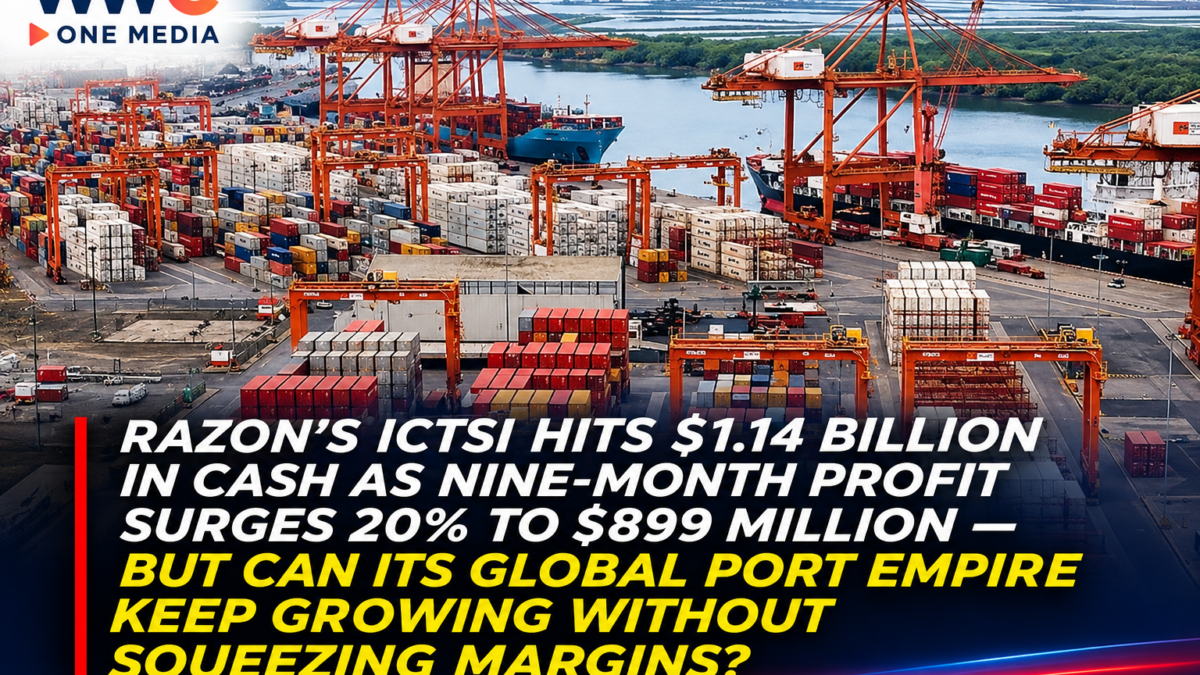
Philippine billionaire Enrique Razon Jr.’s global port company has delivered another powerful earnings performance, building a cash reserve of more than $1 billion while expanding its international terminal network.
International Container Terminal Services Inc. (ICTSI) reported $898.89 million in net income attributable to shareholders for the first nine months of 2026, up approximately 20% from $751.56 million a year earlier.
Revenue from port operations jumped 24% to $2.90 billion, while earnings before interest, taxes, depreciation and amortization (EBITDA) increased 21% to $1.87 billion.
The company ended September with $1.14 billion in cash and cash equivalents, providing liquidity as it pursues expansion projects across Asia, Africa, the Americas and Australia.
Its container-handling volume also increased approximately 13% to 12.11 million twenty-foot equivalent units (TEUs).
But a closer examination of the results reveals a more complicated picture.
Much of the reported cargo growth came from newly consolidated terminals in South Africa and Indonesia.
When those additions and a discontinued operation in China are excluded, comparable container volume increased by just 0.1%.
Meanwhile, operating costs rose faster than revenue, pushing ICTSI’s EBITDA margin lower.
With almost $900 million in nine-month profit and a billion-dollar cash reserve, can Razon’s global port empire continue expanding profitably—or will rising costs, higher debt and sluggish underlying cargo volumes eventually slow its momentum?
ICTSI Reports 20% Profit Growth Despite Global Trade Uncertainty
ICTSI’s latest earnings demonstrate the scale of its international operations.
For January through September 2026, the company reported:
- Revenue from port operations: $2.90 billion, up 24%.
- EBITDA: $1.87 billion, up 21%.
- Net income attributable to parent shareholders: $898.89 million, up approximately 20%.
- Recurring net income: $913.59 million, up 22%.
- Container throughput: 12.11 million TEUs, up approximately 13%.
- Operating cash flow: $1.56 billion, up 21%.
The results reflect contributions from newly added terminals, stronger ancillary-service income, favorable cargo mix and adjustments to service tariffs.
ICTSI’s diversified operations also helped offset weaker performance in certain markets.
However, the company reported additional operating expenses associated with its expanding terminal network.
The results underscore the opportunities and financial challenges facing one of the Philippines’ largest listed corporations.
ICTSI Builds a $1.14-Billion Cash Reserve
One of the most important figures in the company’s financial report is its cash balance.
ICTSI ended September 30 with approximately $1.14 billion in cash and cash equivalents, compared with around $1.10 billion at the end of December 2025.
The increase was approximately 3.8% during the first nine months of 2026.
Compared with September 2025, the company reported a stronger increase of approximately 31%.
The different percentages reflect different comparison periods.
The cash reserve gives ICTSI financial flexibility as it continues investing in its global terminal network.
However, cash and cash equivalents should not be confused with net income.
Profit measures earnings under accounting rules, while cash reflects liquid financial resources held at a particular date.
A company can report higher profit while facing cash pressures, or generate substantial cash even when certain accounting expenses reduce its reported earnings.
ICTSI’s latest figures show growth in both earnings and operating cash generation.
That combination is encouraging, although it does not eliminate the company’s debt obligations.
Operating Cash Flow Climbs to $1.56 Billion
ICTSI generated approximately $1.56 billion in net cash from operating activities during the first nine months.
That represents growth of around 21% from $1.28 billion during the comparable 2025 period.
Operating cash flow is particularly important for a capital-intensive port operator.
ICTSI must fund equipment purchases, terminal construction, maintenance and other infrastructure investments.
The company also has obligations involving borrowing costs, lease payments, concession arrangements and shareholder distributions.
During the first nine months, capital expenditures excluding capitalized borrowing costs reached approximately $507.43 million.
The company also distributed substantial dividends.
Despite these cash requirements, ICTSI maintained more than $1 billion in cash at the end of September.
Still, a strong cash position should be evaluated alongside financing obligations rather than viewed in isolation.
ICTSI’s Third-Quarter Profit Rises 15%
The company’s July-to-September performance provides another indication of earnings momentum.
Third-quarter revenue from port operations increased approximately 19% to $984.05 million.
EBITDA rose about 15% to $635.74 million.
Net income attributable to shareholders increased approximately 15% to $308.90 million.
These figures show continued growth.
However, the third-quarter revenue and profit growth rates were slower than those recorded for the full nine-month period.
That does not necessarily indicate an imminent downturn.
Quarterly growth rates can change because of acquisition timing, pricing, operating expenses and regional market conditions.
But investors will be monitoring whether ICTSI can maintain strong earnings growth as comparisons with newly integrated terminals become more demanding.
The Biggest Warning Sign: Existing Cargo Volumes Barely Grew
ICTSI’s consolidated container throughput increased approximately 13% to 12.11 million TEUs.
At first glance, that suggests a substantial expansion in cargo activity.
But the company disclosed that much of the increase came from changes in its terminal portfolio.
New operations at Durban Gateway Terminal in South Africa and Batu Ampar Container Terminal in Indonesia contributed to the reported growth.
The figures also reflect the removal of Yantai International Container Terminal in China following its disposal.
Excluding these portfolio changes, ICTSI’s comparable cargo throughput increased by only 0.1%.
This distinction is essential.
The company’s reported container volume has increased significantly, but the underlying increase in comparable cargo traffic was much smaller.
That does not make the reported growth invalid.
Acquisitions and new operating concessions are legitimate sources of expansion.
However, investors need to distinguish growth achieved by adding assets from growth generated by existing operations.
The long-term challenge is whether ICTSI can increase cargo traffic organically while maintaining the profitability of its expanded network.
ICTSI Generates More Revenue From Existing Ports
Despite the limited increase in comparable cargo volumes, ICTSI reported stronger revenue from its existing operations.
Excluding new and discontinued terminals, revenue increased approximately 15%.
The company attributed this improvement to tariff adjustments, favorable cargo mix and additional services.
Port operators can generate revenue from more than basic container handling.
They may also collect fees for storage, equipment use, cargo inspection and other terminal services.
Higher revenue per container can support earnings even when total traffic remains relatively stable.
But investors must consider whether these improvements are sustainable.
Tariff adjustments depend on contractual arrangements, market conditions and applicable regulatory requirements.
Customers may also respond to changing prices by adjusting shipping routes or service requirements.
For ICTSI, maintaining a competitive service offering will remain important.
Rising Operating Costs Put Pressure on Profit Margins
The company reported a substantial increase in cash operating expenses.
Costs rose approximately 37% to $801.40 million from $585.96 million a year earlier.
That was faster than the 24% increase in revenue.
The higher expenses reflected new-terminal operations, fuel costs, personnel expenses, volume-related charges and foreign-exchange effects.
As a result, ICTSI’s reported EBITDA margin declined from approximately 66% to 64%.
The margin measures EBITDA as a percentage of revenue.
A lower margin means the company retained slightly less EBITDA from each dollar of revenue than during the previous period.
ICTSI remains highly profitable on this measure.
But the decline reveals the financial cost of expansion.
New terminals may initially require substantial staffing, equipment and maintenance expenditure before reaching mature operating efficiency.
Management will need to demonstrate that those investments eventually generate sufficient returns.
Durban Gateway Terminal Strengthens ICTSI’s African Expansion
One of the biggest contributors to ICTSI’s reported growth was Durban Gateway Terminal in South Africa.
The terminal was consolidated into ICTSI’s financial results beginning January 1, 2026.
According to the company’s quarterly financial reporting, Durban contributed approximately $212 million in revenue during the first nine months.
Its net income attributable to ICTSI shareholders was approximately $7.1 million.
The figures show that the operation added significant revenue but made a comparatively modest contribution to earnings.
That is consistent with the challenges of integrating a large new terminal.
ICTSI must invest in equipment, operational improvements and customer service while managing costs.
Management expects these efforts to support future growth.
However, the eventual profitability of the Durban operation will depend on operating efficiency, customer volumes and commercial conditions.
Indonesia Expansion Adds Another Growth Platform
ICTSI’s Batu Ampar Container Terminal in Indonesia also contributed to the consolidated increase in cargo volumes.
The terminal began operations under ICTSI in September 2025.
Its inclusion in the 2026 nine-month results affected year-over-year comparisons.
The company has been building its presence in Indonesia as part of a broader strategy of serving emerging logistics markets.
Indonesia’s geographic scale and extensive inter-island trade create opportunities for modern port infrastructure.
But investments in new terminals involve financial and operating risks.
The success of the expansion will depend on cargo demand, shipping-line activity, terminal productivity and local economic conditions.
The growth contribution from Batu Ampar is therefore an important part of ICTSI’s reported results, but future returns still need to be demonstrated.
ICTSI’s $1-Billion BDO Loan Provides Additional Financing
ICTSI’s cash position has strengthened alongside its access to external financing.
In September, the company secured a $1-billion, 10-year term loan facility from BDO Unibank.
The agreement was signed on September 22, 2026.
The facility provides additional financing capacity for ICTSI’s investment activities.
In related coverage, WWC ONE MEDIA examined ICTSI’s $1-billion BDO loan and how it supports the port operator’s global expansion strategy.
However, a loan facility is not the same as cash generated through business operations.
Borrowing creates a repayment obligation.
It is also important not to assume that the entire $1-billion facility has been drawn and included in the reported September cash balance without reviewing the corresponding loan disclosures.
The agreement provides ICTSI with financial flexibility, but the company must manage its financing costs and obligations.
ICTSI’s Interest-Bearing Debt Reaches $3.5 Billion
ICTSI’s balance sheet also reflects the scale of its expansion.
As of September 30, interest-bearing debt, including the current portion of long-term obligations, reached approximately $3.50 billion.
That compares with $3.15 billion at the end of 2025.
The increase was approximately 11%.
The company’s total liabilities rose to around $8.47 billion.
These obligations include more than conventional borrowings.
Lease liabilities and amounts associated with concession rights are also significant.
ICTSI reported compliance with its loan covenants as of September 30.
Its financial statements also indicated that approximately 91% of long-term debt matures in 2028 or later.
That provides some protection against immediate refinancing pressure.
But future debt servicing will remain an important factor.
Investors should consider ICTSI’s cash generation, liabilities and capital expenditure requirements together.
BDO’s Expanding Corporate Lending Role Supports Infrastructure Development
The ICTSI financing also highlights the importance of Philippine banks in funding major infrastructure businesses.
BDO has continued expanding its corporate loan portfolio while maintaining a substantial presence in domestic banking.
In related reporting, WWC ONE MEDIA examined BDO’s ₱63.6-billion nine-month profit and its expanding ₱4.1-trillion loan portfolio.
The ICTSI transaction is one example of large-scale corporate financing.
For major infrastructure operators, long-term bank facilities can complement operating cash flow and equity capital.
However, access to credit does not guarantee that every expansion project will achieve its projected returns.
Banks must assess borrowers’ financial strength, and companies must manage their obligations carefully.
ICTSI Plans $740 Million in Capital Spending for 2026
ICTSI has maintained a substantial capital investment program.
The company estimates approximately $740 million in capital expenditures for the full year.
The spending covers terminal expansions, equipment and maintenance across its global network.
Projects include investments in the Philippines, Mexico, Brazil, the Democratic Republic of Congo and other markets.
For the first nine months, ICTSI had spent approximately $507.43 million, excluding capitalized borrowing costs.
The difference between year-to-date spending and the full-year estimate reflects planned expenditure that had not yet been completed as of September 30.
The $740-million amount is a spending estimate, not a guarantee that every project will finish during 2026.
Construction schedules, procurement and operating requirements can change.
Manila International Container Terminal Remains a Strategic Asset
ICTSI’s flagship Manila International Container Terminal is one of its most important Philippine operations.
The facility handles containerized international trade passing through Manila.
The company has been investing in additional capacity and modern terminal equipment.
Its Manila concession has also been extended, providing a longer operating horizon.
The company’s expansion plans include improvements intended to raise handling capacity and support larger shipping operations.
The benefits could include more efficient cargo processing and increased capacity for Philippine imports and exports.
However, additional terminal capacity does not automatically eliminate all shipping delays.
Port performance also depends on road access, customs procedures, shipping schedules, trucking availability and cargo demand.
For Philippine businesses, improvements in port efficiency can be valuable, but the wider logistics network must also function effectively.
Philippine Logistics Investments Are Expanding Beyond Seaports
ICTSI’s investment strategy is part of a broader modernization of Philippine logistics infrastructure.
Air cargo operators are also expanding capacity to support manufacturing, e-commerce and international trade.
UPS and Delbros Group recently inaugurated an air cargo facility at Clark International Airport worth more than $80 million.
The facility is designed to handle approximately 46,000 packages daily.
The UPS project and ICTSI’s terminal investments serve different transportation markets.
Air cargo is suited to many time-sensitive and high-value shipments.
Seaports are essential for larger containerized freight volumes.
Both can contribute to a more efficient logistics system if supported by reliable inland transportation and customs processes.
Digital Customs Services Are Becoming More Important
Improving physical port capacity is only one element of logistics modernization.
Businesses also need efficient customs procedures, documentation and payment systems.
FedEx recently introduced a digital service allowing Philippine customers to pay import duties and taxes online without logging into a separate account.
In related coverage, WWC ONE MEDIA examined FedEx’s Philippine Import Tool and how digital payment services could simplify customs clearance.
FedEx’s service is separate from ICTSI’s port operations.
But the comparison demonstrates the importance of improving the entire supply chain.
Even a highly efficient container terminal can face congestion if documentation or inland transport becomes a bottleneck.
Technology, physical infrastructure and operational coordination all influence logistics performance.
Global Shipping Costs Could Affect Future Cargo Demand
ICTSI’s prospects also depend on international trade activity.
Changes in tariffs, fuel prices, supply chains and consumer demand can affect shipping volumes.
Higher transportation costs may discourage certain shipments or prompt companies to adjust their sourcing strategies.
In related reporting, WWC ONE MEDIA examined rising holiday shipping costs in the United States and the additional pressure on smaller businesses reliant on logistics services.
Those US delivery charges are not ICTSI’s container terminal fees.
However, the broader issue is relevant: transportation costs influence commercial activity.
ICTSI’s diversified international portfolio can help offset weakness in individual markets.
But it cannot entirely eliminate exposure to global economic conditions.
Middle East Conflict Adds Another Risk
ICTSI’s operations have also faced disruptions connected to geopolitical developments.
The company reported lower volume at Basra Gateway Terminal in Iraq because of conflict-related conditions in the Middle East.
That illustrates the risks of operating across multiple international markets.
Geographic diversification can create growth opportunities and reduce reliance on one country.
But it also exposes a company to political instability, trade restrictions and security risks.
Higher fuel costs can further affect terminal operating expenses.
The company’s financial reporting identifies these factors as part of its more challenging operating environment.
Investors will be monitoring whether disruption at affected terminals persists and whether it materially affects future earnings.
Five Questions Investors Should Watch
1. Can comparable cargo volumes recover?
Reported throughput increased 13%, but volume growth excluding new and discontinued terminals was only 0.1%.
2. Will operating margins improve?
ICTSI’s EBITDA margin declined from around 66% to 64% as costs rose faster than revenue.
3. Can new terminals become more profitable?
The performance of Durban and Batu Ampar will become increasingly important as the operations mature.
4. Will the company maintain its cash strength?
The $1.14-billion cash reserve is substantial, but future capital spending and financing obligations remain significant.
5. Can ICTSI manage its growing debt?
Interest-bearing debt increased to $3.50 billion, making cash generation and financial discipline important.
The Bottom Line: ICTSI Is Growing, but the Quality of Growth Matters
ICTSI’s latest results reinforce its position as one of the Philippines’ leading international infrastructure businesses.
Nine-month net income attributable to shareholders rose approximately 20% to $898.89 million.
Revenue increased 24% to $2.90 billion.
The company generated $1.56 billion in operating cash flow and ended September with $1.14 billion in cash.
These are substantial financial achievements.
However, the reported figures also reveal important challenges.
Most of the container volume growth came from changes in the terminal portfolio.
Comparable cargo growth was nearly flat.
Operating costs rose faster than revenue, while the company’s debt obligations increased.
The central question is whether ICTSI can turn its enlarged global network into stronger organic growth and sustained profitability.
For Razon, the billion-dollar cash reserve provides a financial buffer.
But the long-term performance of the business will depend on disciplined investment, efficient terminal operations and the stability of international trade.
ICTSI has nearly $900 million in nine-month profit, more than $1 billion in cash and a rapidly expanding global port network. But with comparable cargo traffic barely growing and operating margins slipping, can Razon’s international terminal empire continue delivering record-breaking results—or is the biggest test of its expansion strategy still ahead?