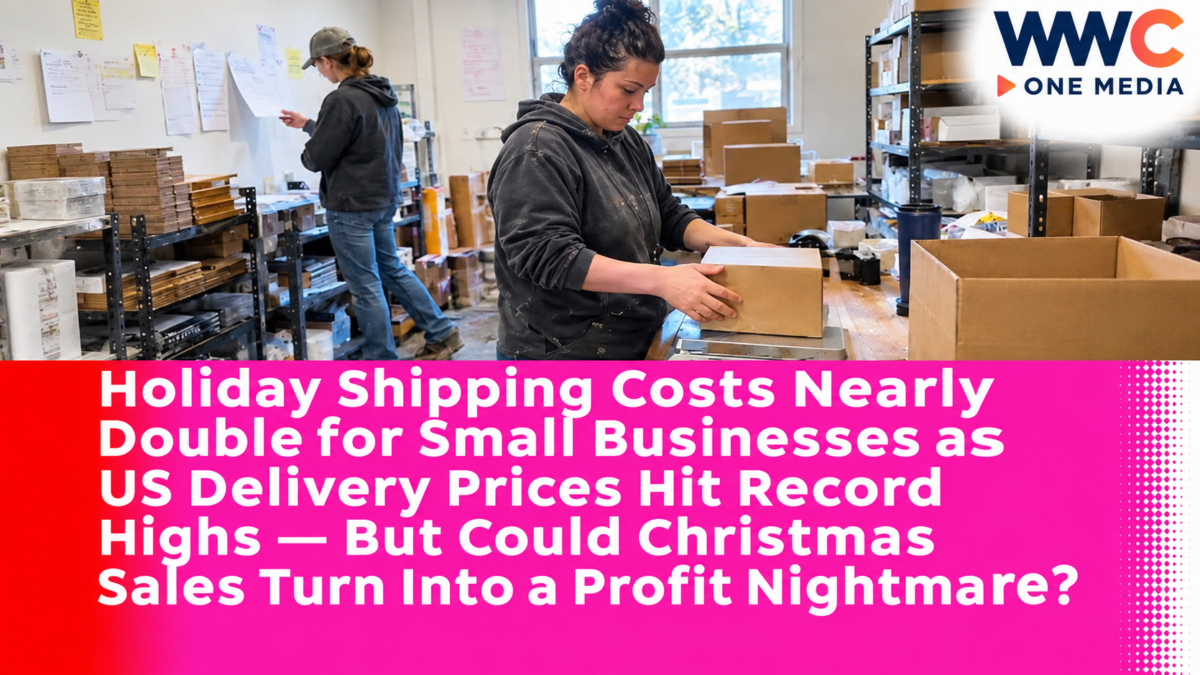
NEW YORK / WASHINGTON / MANILA — November 8, 2026 | WWC ONE MEDIA | Global Business, Retail, E-Commerce and Logistics
America’s small businesses are heading into one of the most important shopping seasons of the year with a costly problem: customers are still buying, but shipping those purchases is becoming significantly more expensive.
As UPS, FedEx and the US Postal Service impose holiday delivery surcharges, independent retailers are facing growing pressure to choose between increasing their prices and accepting smaller profits.
Some business owners warn that the additional costs could turn what should be their most profitable season into a financial struggle.
According to CNBC’s November 6 report, the pressure is particularly severe for smaller retailers that cannot negotiate the same shipping discounts as large corporations.
One entrepreneur, Jenni Shields, who operates the handmade accessories business Evie Pearl Handmade in Kansas, has watched her shipping expenses climb dramatically.
Eight years ago, she paid approximately $2.93 to ship an order.
Last year, the average shipping label cost approximately $4.50.
In October 2026, that expense approached $6 per package.
For a business selling handmade bows and accessories, the difference can significantly reduce earnings from each sale.
And the situation is worsening just as Americans prepare to spend an estimated $1.013 trillion during the November–December holiday shopping season.
Could record holiday spending help small businesses overcome the rising cost of delivery—or will shipping charges absorb the profits retailers desperately need?
Small Retailer Faces a Nearly $6 Shipping Bill
For Shields, the impact is immediate.
Her business sells handmade hair accessories, including bows and quilted headbands.
She charges customers approximately $6 for shipping.
That amount is intended to cover both the shipping label and roughly $1.50 in packaging supplies.
When labels cost around $4.50, the arrangement roughly covered her costs.
But when shipping increased to nearly $6, the combined cost of postage and packaging rose to approximately $7.50.
That creates a shortfall of roughly $1.50 per shipment before accounting for other business expenses.
It may sound modest.
But for a business selling hundreds of relatively inexpensive products, small losses can accumulate quickly.
Shields told CNBC that the increase was taking a significant financial toll.
She is now considering raising her delivery fees for the first time in six years.
The problem is that customers have become accustomed to free or inexpensive shipping.
Increasing fees could discourage purchases.
Absorbing the charges could weaken the business’s profitability.
That dilemma is at the center of the 2026 holiday retail challenge.
Delivery Prices Are Expected to Reach Record Highs
Independent industry research confirms that shipping expenses are rising.
Reuters reported on October 26 that US retailers were facing record holiday delivery costs as higher diesel prices and changes to carrier surcharges increased expenses.
According to the TD Cowen/AFS Freight Index, fourth-quarter ground parcel prices are forecast to rise approximately 5.8% from a year earlier.
Express delivery prices are projected to increase approximately 13.8%.
The forecasts describe average market trends, not identical price increases for every package.
Actual costs depend on shipment volume, weight, dimensions, destination and carrier agreements.
Still, the figures explain why small businesses are becoming increasingly concerned.
Shipping is not an optional expense for online retailers.
A company may generate strong sales through its website, social media or online marketplaces.
But those orders must still reach customers.
If fulfillment costs rise faster than revenue, higher sales can result in lower profits.
Diesel Prices Are Driving the Delivery Cost Shock
Fuel is one of the biggest reasons shipping has become more expensive.
Reuters reported that the average US diesel price reached approximately $6.28 per gallon on October 19, representing a substantial increase since the conflict involving Iran began earlier in 2026.
Diesel is used extensively in trucking and freight distribution.
Higher prices increase the cost of moving goods between warehouses, sorting centers, stores and residential addresses.
Air freight has also become more expensive.
CNBC cited Freightos data showing global air cargo rates of approximately $3.37 per kilogram, up 43% compared with a similar period the previous year.
Higher transportation costs can affect retailers before products even reach their warehouses.
A business importing inventory may face increased freight charges.
It can then incur additional expenses when sending those goods to customers.
The result is a squeeze at multiple points in the supply chain.
However, fuel prices are not the entire explanation.
Reuters reported that changes in the way major carriers calculate surcharges also contributed significantly to higher delivery bills.
That means businesses may continue facing substantial expenses even if fuel prices eventually decline.
UPS and FedEx Introduce Additional Holiday Fees
The 2026 holiday shipping season brings a new round of peak-period charges.
UPS introduced additional handling and oversized-package fees beginning September 27.
Its residential demand surcharges began October 25.
For qualifying residential ground deliveries, the standard seasonal surcharge increases to 75 cents per package from November 22 through December 26.
FedEx introduced certain handling-related charges on September 28, followed by residential demand surcharges on October 26.
Its standard qualifying residential ground surcharge rises to 80 cents per package from November 23 through December 27.
Those amounts are separate from ordinary shipping charges.
Some packages may also face fuel adjustments, remote-area fees or other applicable charges.
Oversized items can be especially expensive.
During the busiest holiday period, UPS’s published large-package seasonal surcharge can reach $117.50, while FedEx’s corresponding oversize demand surcharge can reach $117.25.
These higher charges apply to shipments meeting specified size or handling criteria.
They do not apply to every ordinary package.
Still, the costs create major pricing challenges for businesses selling furniture, equipment or other bulky goods.
USPS Also Raises Rates for the Holiday Season
The US Postal Service introduced temporary price increases beginning October 4, 2026.
The changes remain scheduled through January 17, 2027.
They affect services including Priority Mail, Priority Mail Express, USPS Ground Advantage and Parcel Select.
The size of the increase depends on the service, shipment weight and destination zone.
For example, the published commercial USPS Ground Advantage holiday increase for eligible packages weighing up to three pounds is 40 cents for shorter-distance Zones 1–4.
For comparable packages traveling to Zones 5–9, the increase is 55 cents.
Heavier or longer-distance shipments can face larger additions.
For small businesses, USPS may still be more economical than some private-carrier alternatives.
But comparing only a published surcharge does not establish the cheapest total price.
Businesses need to examine the complete shipping quote, including existing rates and applicable fees.
The Postal Service’s temporary adjustments also differ from earlier permanent price changes.
Retailers must account for both when calculating total fulfillment costs.
Amazon’s Free-Shipping Advantage Puts Independent Retailers Under Pressure
The rise in carrier charges is making competition with Amazon even more difficult.
Large retailers can negotiate shipping agreements based on substantial package volumes.
They may also use extensive warehouse networks and dedicated fulfillment operations.
Independent businesses generally have less negotiating power.
A small retailer shipping several dozen orders a week cannot necessarily secure the same per-package rate as a company handling millions of deliveries.
Amazon has also invested heavily in its logistics network.
That scale allows the company to offer shipping benefits that can be difficult for smaller competitors to match.
For independent businesses, the problem goes beyond delivery expenses.
Customers may compare the final checkout price with an Amazon listing offering free or discounted shipping.
Even when the smaller retailer’s product is competitive, delivery charges can influence the purchasing decision.
The challenge becomes particularly difficult when the product itself has a relatively low selling price.
A $6 shipping fee may seem reasonable on an expensive item.
But the same fee can discourage customers purchasing a $10 accessory.
Small Businesses Are Rethinking Free Shipping
Some retailers are responding by changing their delivery policies.
Todd Shelton, founder of a New Jersey clothing business bearing his name, told CNBC that the company recently began charging customers for return shipping.
Previously, the business had absorbed those expenses.
Shelton’s company sells clothing manufactured in the United States and uses imported materials, including Japanese denim and fabric from Portugal.
That means the business faces both product-related cost pressures and more expensive fulfillment.
The company remains profitable, according to the founder, but shipping and material costs are reducing margins.
For retailers, there are several potential responses.
They can increase shipping fees, raise product prices, introduce minimum-order thresholds or adjust return policies.
They can also attempt to reduce costs by choosing smaller packaging, consolidating shipments or comparing carriers.
But none of those options is risk-free.
Higher prices may discourage purchases.
Restrictive return policies can weaken customer satisfaction.
And offering free shipping while absorbing rising delivery expenses can reduce profitability.
The appropriate strategy depends on the products sold and how much profit each order generates.
Holiday Sales Could Reach $1.013 Trillion Despite the Cost Pressure
The shipping crisis is unfolding during what could be another record holiday shopping season.
The National Retail Federation forecasts that US retail sales during November and December will increase 4.2% to approximately $1.013 trillion.
That compares with approximately $972 billion in 2025.
The forecast suggests consumers remain willing to spend despite higher prices and economic uncertainty.
But the increase does not necessarily mean shoppers are purchasing substantially more merchandise.
Inflation contributes to the dollar value of retail sales.
When prices rise, total spending can increase even if the quantity of goods purchased grows more slowly.
The Associated Press has highlighted this distinction, noting that higher-income households are expected to account for a substantial portion of holiday spending growth.
Lower-income consumers remain under greater pressure from fuel costs and other household expenses.
For small businesses, that creates an uncertain combination.
Sales may be strong in dollar terms.
But customers may become more selective, while operating expenses continue rising.
Higher holiday revenue does not automatically mean higher holiday profit.
Why Strong Demand May Not Save Every Retailer
Retailers often depend heavily on the final months of the year.
Holiday shopping can generate substantial sales for businesses selling gifts, clothing, accessories, decorations and consumer products.
But the profitability of those transactions depends on several expenses.
A retailer must consider the cost of acquiring or producing merchandise, packaging, transaction fees, marketing and shipping.
If those costs rise, the company may earn less from each order.
For example, consider a hypothetical small business selling a product for $25.
If its merchandise and other costs total $14, and the business spends another $6 on shipping and packaging, it has $5 left before additional overhead and taxes.
If fulfillment costs increase by $2 without any change in selling price, that remaining amount falls to $3.
That represents a 40% reduction in the simplified contribution margin.
The example is illustrative, not a verified financial result from a particular retailer.
But it demonstrates why seemingly small shipping increases can have disproportionate consequences.
Global Air Freight Costs Are Rising Too
Shipping expenses are not limited to local parcel delivery.
CNBC reported that global air cargo rates have risen substantially.
Freightos data cited in the report placed average air freight prices near $3.37 per kilogram.
That is approximately 43% higher than the comparable period a year earlier.
The increase reflects higher transportation costs and demand for air cargo capacity.
Freightos research head Judah Levine also pointed to strong demand for shipping equipment used in data-center construction.
Advanced computing infrastructure requires specialized electronics and components.
Some of that equipment moves through air freight networks.
The resulting demand can contribute to freight-market pressure even before the busiest holiday shipping period.
For small retailers importing goods or materials, higher international shipping rates can increase inventory costs.
They may face those expenses before making a single holiday sale.
E-Commerce Expansion Is Also Creating Logistics Challenges in the Philippines
Although CNBC’s report focuses on the United States, the underlying problem is relevant to businesses in the Philippines.
Filipino online sellers also need reliable and affordable delivery services.
Shipping costs can influence whether customers complete purchases and whether businesses can expand beyond their local markets.
As WWC ONE MEDIA reported on Cebu businesses seeking nationwide expansion through improved logistics networks, high transportation expenses and unpredictable deliveries remain important obstacles for smaller enterprises.
The Cebu report examined efforts to strengthen distribution capabilities and improve access to national markets.
Those developments are separate from the US holiday carrier surcharges.
But both situations demonstrate the importance of logistics costs to business competitiveness.
A company may produce an attractive product and generate strong online demand.
Yet its growth can be constrained if delivering that product is too expensive.
UPS Expands Philippine Logistics Infrastructure
Large logistics companies are investing in facilities intended to improve delivery capacity.
As WWC ONE MEDIA reported on the expanded UPS–Delbros cargo hub in Clark, the companies have strengthened international cargo-handling operations through a facility with a reported capacity of 46,000 parcels daily.
The investment could improve access to global logistics networks for Philippine businesses.
However, the Clark hub does not eliminate all domestic shipping expenses.
Small businesses still depend on roads, local delivery networks, customs processes and competitive freight rates.
Likewise, US carrier surcharge schedules should not automatically be applied to Philippine domestic shipments.
Shipping prices differ by country, service and contract.
Warehouse Investment Is Increasing as Online Shopping Expands
E-commerce growth is also creating demand for modern fulfillment facilities.
As WWC ONE MEDIA reported on a record 22,000-square-meter warehouse lease in Laguna, logistics operators are investing in properties that support storage, sorting and distribution.
Warehouses closer to customers may help reduce certain transportation distances.
Efficient inventory management can also improve delivery reliability.
But warehouse expansion does not guarantee lower shipping prices.
Operating costs, equipment investments and demand conditions still influence the economics of fulfillment.
For small businesses, access to affordable third-party logistics services could become increasingly important as online sales volumes grow.
Shopee’s Creator Economy Creates Opportunities—but Delivery Remains Essential
Philippine businesses are also using new marketing channels to reach online shoppers.
As WWC ONE MEDIA reported on Shopee’s affiliate-driven sales growth, creator-led marketing is helping micro, small and medium enterprises expand their reach.
However, attracting a customer is only the beginning of an online transaction.
The product still needs to be packaged, dispatched and delivered.
Shipping costs, delivery delays and return expenses can influence customer satisfaction and profitability.
For growing online sellers, marketing success must therefore be supported by reliable fulfillment operations.
The challenge is to expand sales without allowing delivery expenses to consume too much of the revenue generated.
Five Ways Small Retailers Can Protect Holiday Profit Margins
There are practical steps businesses can evaluate before the busiest shipping weeks.
First, compare total carrier prices. Businesses should examine the full delivered cost rather than only the published holiday surcharge.
Second, review package dimensions. Smaller, appropriately sized packaging may reduce dimensional-weight or handling charges.
Third, reassess free-shipping thresholds. A minimum purchase amount can sometimes make subsidized delivery more sustainable.
Fourth, communicate delivery expectations clearly. Accurate shipping deadlines and tracking updates may help reduce avoidable complaints and disputes.
Fifth, calculate profit by order. Retailers should include packaging, transaction fees, return expenses and seasonal delivery charges when reviewing margins.
These strategies do not guarantee higher profits.
Their effectiveness depends on each business’s products, customer base and carrier agreements.
But they can help owners identify costs before those expenses become unexpected losses.
Three Possible Outcomes for the 2026 Holiday Shopping Season
Scenario 1: Strong sales outweigh higher shipping costs.
Retailers with healthy margins and effective fulfillment strategies could still enjoy a profitable Christmas season.
Scenario 2: Sales grow, but small-business profits shrink.
Higher delivery and operating expenses could absorb much of the benefit from increased holiday demand.
Scenario 3: Shipping costs reshape customer behavior.
Consumers may respond by consolidating purchases, meeting free-shipping thresholds, shopping earlier or choosing retailers with lower delivery charges.
These are possible outcomes, not established forecasts for every business.
The Bigger Question: Can Small Businesses Survive a Record Holiday Shopping Season?
The 2026 holiday season is shaping up to be a paradox.
Americans are expected to spend more than $1 trillion during November and December.
Yet many independent businesses are struggling with the growing cost of getting purchases to customers.
Higher diesel prices, carrier surcharges, expensive air cargo and additional fulfillment expenses are squeezing margins.
For large corporations, extensive logistics networks and negotiated shipping contracts can provide advantages.
For smaller retailers, the same cost pressures can threaten the profitability of individual orders.
The experience of Jenni Shields illustrates the problem.
Her shipping cost increased from $2.93 eight years ago to nearly $6 per package today.
But her customers still expect affordable delivery.
The confirmed crisis is not that holiday shopping has collapsed. It is that delivery costs are rising fast enough to erode profits even when consumer demand remains strong.
Small businesses must now decide how much of that burden they can absorb and how much they can reasonably pass on to customers.
And as the busiest shopping weeks approach, one question could define the holiday season for thousands of independent retailers:
Will America’s projected $1-trillion Christmas shopping boom deliver the profits small businesses have been hoping for—or could record shipping expenses turn their biggest sales season into their most expensive financial nightmare?