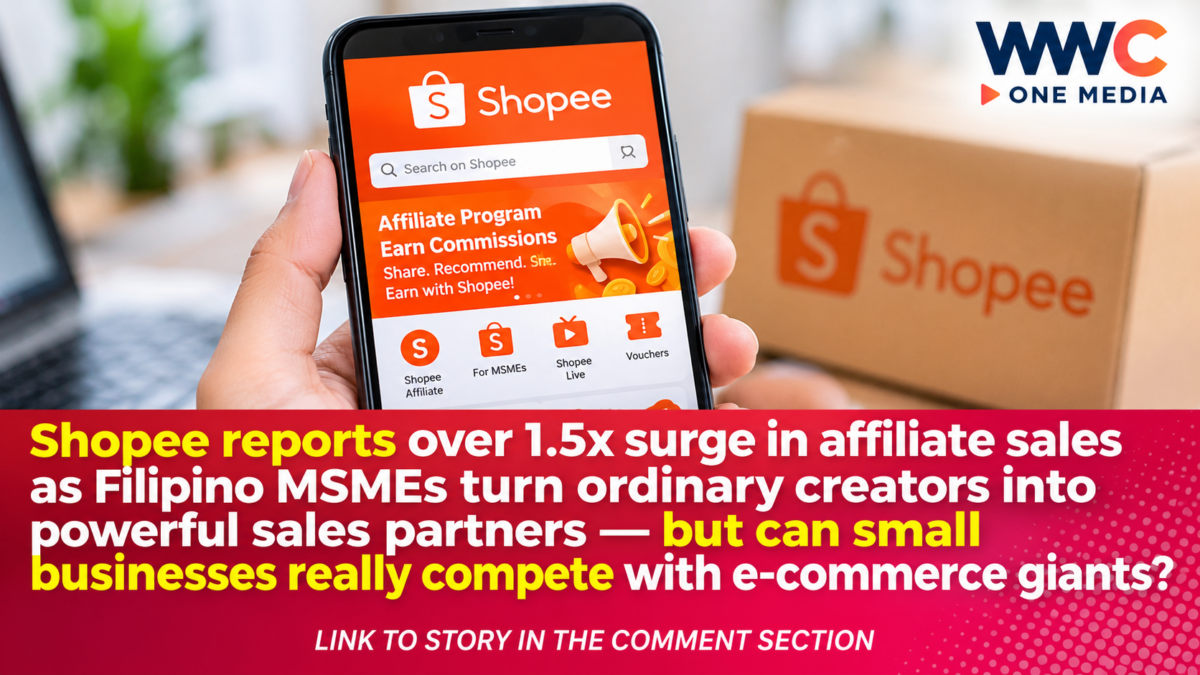
Shopee Reports Over 1.5x Surge in Affiliate Sales as Filipino MSMEs Turn Ordinary Creators Into Powerful Sales Partners — But Can Small Businesses Really Compete With E-Commerce Giants?
MANILA, Philippines — November 4, 2026 | WWC ONE MEDIA | Business, E-Commerce & Technology
The battle for online shoppers in the Philippines is changing, and small businesses are discovering that the next powerful sales representative may not be a celebrity influencer or an expensive advertising agency.
It could be an ordinary Filipino content creator armed with a smartphone, a compelling product demonstration and an affiliate link.
E-commerce giant Shopee has reported that traffic and sales generated through its Affiliate Program increased by more than 1.5 times, highlighting the growing role of creator-led marketing in helping Filipino micro, small and medium enterprises (MSMEs) reach customers.
The company is promoting the experiences of three homegrown businesses—Herah, B Coffee Co. and Hyperbrands—as examples of how affiliate partnerships can turn product demonstrations into online purchases.
Meanwhile, Shopee’s KOLLAB initiative has organized more than 30 events in 2026, connecting over 100 brands with more than 500 content creators and affiliates.
But behind these encouraging figures lies a bigger economic question.
Can affiliate marketing genuinely help Filipino small businesses compete against larger online retailers—or will rising commissions, competition and customer acquisition costs eventually threaten their profits?
Shopee’s Affiliate-Driven Traffic and Sales Rise More Than 1.5 Times
According to reports published by InsiderPH, Daily Tribune, Context.ph and PhilSTAR Life, Shopee is seeing stronger results from its affiliate marketing ecosystem.
The program connects sellers with creators who introduce products to their audiences through videos, reviews, tutorials and other promotional content.
When consumers discover products through these creators, they can proceed to purchase them through Shopee.
For smaller businesses, this creates another marketing channel beyond conventional advertisements and product listings.
Shopee reported growth of more than 1.5 times in affiliate-driven traffic and sales.
However, the company did not publicly specify the comparison period in the reports reviewed.
The figure therefore should not automatically be interpreted as a 50% year-on-year increase.
It is also an aggregate platform-level result rather than proof that every participating MSME experienced the same growth.
Still, the announcement underscores the increasing commercial importance of creators in the Philippine online retail industry.
For businesses with limited marketing resources, product demonstrations can make unfamiliar brands more accessible to potential customers.
Herah: How a Simple Product Demonstration Increased Sales
One of the examples highlighted by Shopee involves Herah, a Filipino innerwear brand focused on comfort and fit.
Like many online sellers, Herah faced the challenge of explaining its products through ordinary marketplace photographs and descriptions.
That changed when an affiliate creator uploaded a practical demonstration showing how the company’s nipple covers could be cleaned using dishwashing liquid.
The content addressed a potential customer question in a simple, relatable way.
According to the company, the demonstration unexpectedly helped increase sales.
Rather than focusing exclusively on celebrity endorsements or creators with enormous audiences, Herah began identifying niche creators whose content connected with relevant shoppers.
The company also started using Shopee’s performance data to determine which promotional formats were generating results.
Eventually, Herah established a dedicated internal team to manage its creator relationships.
The example illustrates a growing marketing principle: a convincing demonstration may be more useful to shoppers than a generic promotional message.
However, Herah did not disclose the exact number of additional units sold or the revenue attributable to that particular video.
Its reported success should therefore be viewed as a company-provided case study rather than independently measured proof of a universal marketing formula.
Hyperbrands Uses Real Pet Owners to Promote Products
Another company using Shopee’s Affiliate Program is Hyperbrands, which operates pet-care brands Dentalight and Moochie.
Instead of relying exclusively on traditional advertising, Hyperbrands works with creators who can demonstrate products in familiar household settings.
Pet owners can share their experiences with treats, pet food and related products.
For consumers evaluating unfamiliar brands, seeing products used in everyday situations may help answer questions that conventional advertisements leave unresolved.
Hyperbrands also uses Shopee’s performance information to identify effective creator content and improve its marketing approach.
The company has found that experimentation remains important because videos do not always perform as expected.
Hyperbrands CEO Luis Gan said creators can contribute fresh ideas that encourage the business to continue exploring new promotional approaches.
The strategy highlights a potential advantage for small businesses.
They can test different product messages and evaluate which ones attract engagement or lead to purchases.
But creator authenticity remains important.
A positive product review should not be treated as independent evidence of product quality when the creator has a financial relationship with the seller.
For pet products, buyers should continue checking ingredients, suitability, safety information and product claims.
B Coffee Co. Turns Everyday Routines Into Product Marketing
Filipino-owned B Coffee Co. is taking another approach to creator-led commerce.
The brand uses affiliate content to demonstrate how its coffee machines fit into common routines.
Instead of simply listing technical specifications, creators can show how the machines are used at home, beside a workstation or during a morning coffee break.
Such demonstrations can help customers visualize whether a product meets their needs.
B Coffee CEO Miguel Guerrero has emphasized the importance of showing shoppers how products fit into their everyday lives.
The company has also participated in Shopee’s KOLLAB events to develop additional creator relationships.
For businesses selling appliances or products requiring explanations, content demonstrations may be especially valuable.
But effective marketing is only one part of the purchasing decision.
Consumers must still consider price, warranties, reliability, maintenance requirements and customer support.
Shopee KOLLAB Expands Beyond Metro Manila
Shopee is also seeking to make creator partnerships more accessible to businesses outside the National Capital Region.
Through KOLLAB, the company organizes gatherings that connect merchants with content creators and affiliates.
In 2026, Shopee reported holding more than 30 KOLLAB events involving over 100 brands and more than 500 creators and affiliates.
The initiative has expanded to Cebu and Davao, where Shopee worked with local creator networks.
The regional expansion matters because entrepreneurs outside Metro Manila can face challenges in identifying marketing partners with relevant audiences.
A creator familiar with local shopping habits, language and community preferences may offer a different approach from a nationwide influencer campaign.
Shopee Philippines Head of Commercial Jack Ng said the company intends to continue making affiliate opportunities accessible to more businesses and creators across the country.
However, the reported participation numbers do not establish how many businesses became profitable, how much their sales increased or whether creators generated sustainable earnings after expenses.
Those outcomes would require additional performance disclosures.
The Philippine E-Commerce Market Is Becoming More Competitive
Shopee’s affiliate initiative arrives as digital commerce becomes increasingly important to Filipino entrepreneurs.
Launching an online storefront is now relatively accessible.
But attracting customers and operating profitably can be significantly more difficult.
Competition involves product quality, pricing, logistics, paid advertising, customer trust and the ability to generate repeat purchases.
WWC ONE MEDIA previously examined these challenges in 150+ Filipino Founders Joined This E-Commerce Program — But Launching Their Stores May Be the Easy Part.
That report explored LaunchStrong, a Philippine e-commerce mentorship initiative that says it has helped more than 150 aspiring entrepreneurs and supported the creation of over 100 consumer brands.
The initiative reflects a broader reality for Philippine online businesses.
Creating an online store does not automatically produce a successful company.
Entrepreneurs must also understand customer acquisition, pricing, inventory and operating margins.
Affiliate marketing offers another route to customer discovery, but sellers still need a viable business model.
Shopee’s 9.9 Campaign Shows the Scale of Social Commerce
The increasing importance of creator-led selling is not limited to Shopee’s latest announcement.
During its September 2025 shopping campaign, Shopee reported that Filipino MSMEs sold approximately 11 million items nationwide in a single day.
The company also reported that customers spent 1.1 million hours watching Shopee Live and Shopee Video during the 9.9 campaign.
Affiliate participation reportedly increased by 112% compared with the previous year’s event.
These figures were published by INQUIRER.net in a Shopee-sponsored report.
Although they provide useful context, they are company-supplied campaign statistics rather than independently audited figures.
They nevertheless illustrate the scale of activity occurring across digital shopping platforms.
Content creation, livestreaming and affiliate links are becoming increasingly connected to consumers’ purchasing journeys.
But growth in participation does not automatically mean that individual sellers or affiliates earn more profit.
Affiliate Marketing Is Not Automatically Free Advertising
One of the attractive features of affiliate marketing is that businesses may compensate creators based on attributable sales.
This can make certain arrangements more performance-oriented than advertising campaigns that charge primarily for exposure.
However, affiliate marketing should not be confused with cost-free customer acquisition.
Businesses may still incur commissions, discounts, platform charges, product-sampling costs, returns and fulfillment expenses.
A seller offering a generous affiliate commission may generate substantial revenue while retaining only a small portion as profit.
The issue is particularly important for entrepreneurs with limited working capital.
WWC ONE MEDIA previously explored these financial challenges in LaunchStrong Has Helped 150+ Filipinos Build E-Commerce Brands — But Launching Is No Longer the Hard Part.
The article examined how marketplace fees, advertising costs, inventory expenses and delivery obligations can erode the profitability of growing online stores.
For Shopee sellers, the most useful measurement is not simply how many views a creator generates.
It is whether the resulting purchases produce sustainable margins after all relevant expenses.
Digital Payments Are Helping Transform Online Selling
The growth of Philippine e-commerce also depends on consumers having convenient ways to complete transactions.
According to Bangko Sentral ng Pilipinas figures cited in recent reporting, digital payments accounted for 64.69% of measured retail payment transactions by volume in 2025.
That represents an increase from 57.45% in 2024.
WWC ONE MEDIA covered this development in DTI and Mastercard Join Forces to Help Filipino Small Businesses Go Digital — But Can They Turn a 64.69% Digital Payment Boom Into Real MSME Growth?.
The report examined a partnership between the Department of Trade and Industry and Mastercard aimed at improving digital payment adoption and business capabilities among Filipino MSMEs.
For creator-led commerce, convenient payment systems can help reduce friction between product discovery and checkout.
A shopper who sees an appealing product demonstration can evaluate the listing and complete a purchase through the marketplace.
However, faster checkout does not guarantee higher sales.
Consumers must still trust the product, seller and payment process.
TikTok Shop Is Also Competing for Filipino Sellers and Creators
Shopee is not the only digital platform seeking to expand creator-driven commerce.
TikTok Shop has developed its own ecosystem of short-form product videos, livestream selling and affiliate partnerships.
The competition is creating additional marketing channels for Filipino entrepreneurs.
Businesses can explore different platforms to determine where their target customers are most active.
However, operating across multiple marketplaces may also increase administrative complexity.
Sellers must manage product listings, inventory, customer messages, promotions and potentially different commission arrangements.
As social commerce expands, transparency and product authenticity become increasingly important.
WWC ONE MEDIA previously covered these issues in TikTok Shop and DTI Push Safer Online Shopping After 208 Million Listings Blocked — But Are Filipinos Truly Protected From Digital Scams?.
The report examined TikTok Shop’s global product-screening disclosures and its Philippine consumer education partnership with the DTI.
For Shopee and competing marketplaces, the same broader concern applies.
Creator recommendations may influence purchasing decisions, but consumers still need accurate information and effective protections against misleading products.
The Hidden Risks Behind the Affiliate Boom
While creator-led marketing offers opportunities, it also presents challenges for small businesses.
Commission and Operating Costs
High promotional expenses can reduce profit margins, particularly when sellers compete aggressively for creator attention.
Dependence on Platform Algorithms
A business relying heavily on social media exposure may experience sudden changes in visibility when platform recommendations or user behavior shift.
Creator Credibility
An affiliate’s reputation can influence consumer trust. Misleading demonstrations or exaggerated claims can damage both the creator and the business.
Inconsistent Campaign Performance
A product video that performs exceptionally well once may not produce the same results in subsequent campaigns.
Customer Retention
Affiliate marketing can introduce new buyers, but it does not guarantee that they will return.
For sustainable growth, MSMEs need to combine creator partnerships with reliable products, customer service and sound financial management.
How Filipino Creators Can Participate
Shopee’s Affiliate Program allows eligible creators to promote products through approved promotional channels.
According to Shopee’s Philippine Help Center, applicants generally must be based in the Philippines and have at least one social media post within the preceding 14 calendar days.
Applicants must complete registration and comply with the program’s terms and review process.
Approval is not automatic.
Actual commissions and payment eligibility depend on the applicable campaign rules and qualifying transactions.
Creators should also clearly disclose commercial relationships when publishing sponsored or commission-generating recommendations.
For ordinary Filipinos exploring affiliate marketing as an income opportunity, the program offers a potential revenue channel.
But it should not be presented as guaranteed income or a substitute for evaluating the time, effort and expenses involved.
What Other News Outlets Confirm
InsiderPH reported on November 4 that Shopee’s Affiliate Program generated more than 1.5-times growth in traffic and sales associated with creators.
Daily Tribune and Context.ph published November 3 reports covering the same development, including the experiences of Herah, Hyperbrands and B Coffee Co.
PhilSTAR Life published an earlier branded-content feature on October 30 discussing the affiliate initiative and KOLLAB events.
BusinessDiary and AI Times PH also covered the program.
These publications consistently identify the same businesses and report the same participation figures.
However, the overlap reflects substantial reliance on Shopee’s corporate announcement.
The reports do not provide independent audits of participating businesses’ financial results.
The company also did not disclose the precise comparison period behind the headline growth figure.
Accordingly, claims about affiliate-driven growth should remain attributed to Shopee.
Can Shopee’s Affiliate Program Produce Sustainable MSME Growth?
Shopee’s latest figures suggest that creator partnerships are becoming more important to online retail in the Philippines.
The experiences of Herah, Hyperbrands and B Coffee Co. demonstrate several ways businesses can use promotional content to explain products, build awareness and reach potential customers.
The expansion of KOLLAB beyond Metro Manila could also create opportunities for entrepreneurs and creators in regional markets.
But the long-term impact will depend on results that go beyond traffic and gross sales.
Small businesses need to know whether affiliate partnerships attract profitable customers, generate repeat purchases and provide returns that justify their marketing costs.
Creators must also evaluate whether commissions compensate them fairly for producing content and promoting products.
The greatest beneficiaries may ultimately be businesses that combine effective creator partnerships with strong products, transparent marketing and disciplined financial management.
Shopee’s affiliate ecosystem may be expanding, but its biggest test is still ahead.
Can the platform help Filipino entrepreneurs build lasting and profitable brands—or will intensifying competition, rising promotional costs and dependence on algorithms make the next phase of the e-commerce boom even harder for small businesses to survive?