QUEZON CITY, Philippines — November 4, 2026 | WWC ONE MEDIA | Business, Real Estate & Philippine Economy
The Gokongwei family’s property empire is making another major bet on Metro Manila’s office market, even as developers contend with elevated vacancies, cautious corporate tenants and the continuing impact of hybrid work.
Robinsons Land Corporation (RLC) has officially broken ground on Bridgetowne One, a 29-story premium office tower that will add approximately 51,400 square meters of leasable space to its growing Bridgetowne Destination Estate in Quezon City.
The development, targeted for completion in 2028, will increase Robinsons Offices’ presence in Bridgetowne to approximately 347,000 square meters across eight office developments.
It also supports the company’s ambition of reaching nearly one million square meters of office gross leasable area within the Quezon City–Mandaluyong–Pasig business corridor by 2030.
But the announcement comes at an important moment for Philippine commercial real estate.
Although multinational corporations, information technology-business process management (IT-BPM) companies and flexible-workspace operators continue seeking premium buildings, property consultants have reported persistent office vacancies and more selective leasing decisions.
The question is whether Robinsons Land’s newest skyscraper can capitalize on demand for modern workplaces—or whether adding more office space will become a costly gamble in a market that is still recovering.
Robinsons Land Begins Construction of Bridgetowne One
Bridgetowne One is the latest addition to Robinsons Land’s flagship mixed-use development along the C-5 corridor.
The project will rise at the corner of John Gokongwei Jr. Boulevard and West Drive, within the Bridgetowne Destination Estate in Quezon City.
Its location provides access to surrounding commercial and residential communities in Pasig, Mandaluyong, Marikina and nearby parts of Rizal.
According to the company’s announcement, the 29-story building will include 20 office floors, eight podium parking levels, basement parking, a ground floor, a garden deck and a service deck.
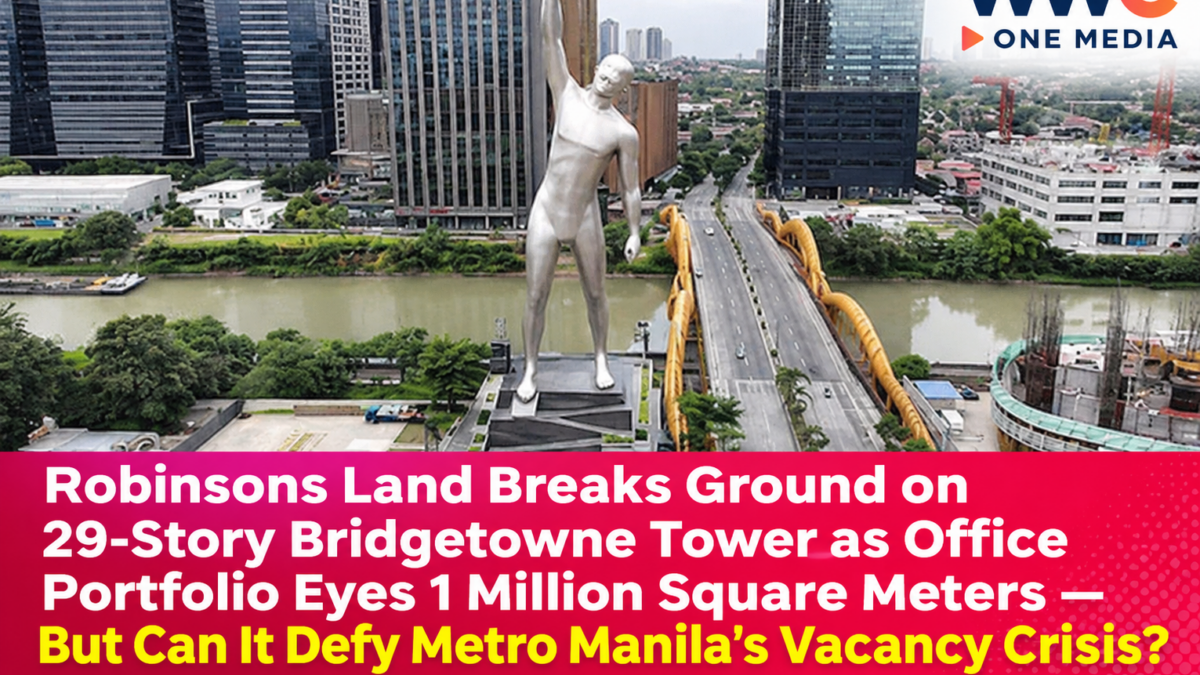
The tower will also feature an expansive lobby, landscaped spaces and views of Bridgetowne’s landmark sculpture, The Victor.
Robinsons Land President and CEO Mybelle V. Aragon-GoBio described the development as a long-term investment in the estate and the businesses expected to occupy it.
The groundbreaking represents the beginning of a new construction phase, not the completion of the project.
The company has set 2028 as its target delivery year.
Actual completion and tenant occupancy will depend on construction progress, regulatory requirements and leasing demand.
A 51,400-Square-Meter Expansion Could Transform Bridgetowne’s Business District
The new office tower is expected to significantly expand Robinsons Land’s existing office inventory in Bridgetowne.
Before Bridgetowne One, Robinsons Offices reported more than 295,000 square meters of gross leasable area across seven developments within the estate.
The new tower will increase the total to approximately 347,000 square meters across eight developments.
Gross leasable area, commonly called GLA, measures space available for commercial leasing.
It should not be confused with a building’s total construction floor area, which also includes parking, mechanical facilities and other spaces.
For Robinsons Land, expanding GLA creates the potential for additional rental revenue.
However, the financial benefit depends on securing tenants at commercially sustainable rental rates.
A larger portfolio does not automatically produce higher profits.
Building construction, financing, maintenance and property operating expenses must also be considered.
That distinction makes the project’s leasing performance particularly important.
Robinsons Offices Targets 1 Million Square Meters by 2030
Bridgetowne One forms part of a wider expansion strategy.
Robinsons Offices currently operates 35 office buildings across 13 highly urbanized Philippine cities.
Its nationwide portfolio exceeds 900,000 square meters of gross leasable area.
The company’s separate goal is to develop nearly one million square meters of office GLA specifically within the Quezon City–Mandaluyong–Pasig business corridor by 2030.
That target coincides with Robinsons Land’s 50th anniversary.
The two figures should not be confused.
The existing 900,000-square-meter portfolio refers to properties across the Philippines.
The one-million-square-meter target concerns a particular Metro Manila business corridor.
Bridgetowne One contributes to the regional expansion, but it does not by itself complete the company’s 2030 objective.
The wider development strategy depends on additional properties and projects being delivered over the coming years.
Why Robinsons Land Is Still Betting on Offices Despite Vacancies
Metro Manila’s office market has undergone substantial changes since the COVID-19 pandemic.
Remote work, hybrid arrangements and corporate cost-cutting have altered the amount and type of office space companies require.
Businesses increasingly evaluate whether physical workplaces offer sufficient benefits to justify rental costs and employee commutes.
This has encouraged what property consultants describe as a flight to quality.
Companies may relocate from older buildings into newer properties offering better transport access, modern facilities and improved environmental performance.
Yet stronger demand for premium buildings does not mean the overall market is booming.
According to Colliers Philippines’ second-quarter 2026 research, Metro Manila office vacancy remained around 19%.
Leechiu Property Consultants also reported weaker office transaction activity during the first half of 2026 compared with the same period in 2025.
WWC ONE MEDIA previously examined these conditions in Robinsons Offices Secured Q2’s Biggest Office Deal — But It Happened in the Weakest Market in Five Years.
That report highlighted the contrast between large leasing transactions in premium buildings and softer demand across the wider commercial property market.
For Bridgetowne One, the critical question is whether location, amenities and building quality will be sufficient to attract tenants despite the availability of competing office space.
A 9,800-Square-Meter KMC Solutions Lease Signals Demand
Robinsons Land’s confidence is supported by recent leasing activity.
In September 2026, flexible-workspace provider KMC Solutions committed to four additional floors covering approximately 9,800 square meters at GBF Center 1 in Bridgetowne.
The transaction provides an example of continued demand for modern office facilities within the estate.
Flexible-workspace operators can serve businesses seeking alternatives to conventional long-term leases.
They may provide offices, meeting rooms and managed workplace services for corporations expanding into new locations or adjusting their space requirements.
However, a major lease at one property does not guarantee that another building will achieve comparable occupancy.
Bridgetowne One will still need to compete for its own tenants.
The KMC transaction is best understood as evidence of leasing interest within Robinsons Land’s existing portfolio, not a confirmed pre-lease for the new tower.
Robinsons Land’s 33,400-Square-Meter Office Deal Shows Its Leasing Strength
Another major transaction occurred at The Jewel, Robinsons Land’s office and retail development in Mandaluyong City.
The company secured a 33,400-square-meter pre-leasing commitment at Asscher, the first planned office tower in the development.
According to CBRE Philippines’ second-quarter 2026 research, the transaction was the largest individual office leasing deal during the period.
Robinsons Offices recorded approximately 38,000 square meters of total office transactions in the quarter.
That placed the company ahead of other developers by transaction volume within CBRE’s coverage.
The deal demonstrates that substantial corporate leasing commitments remain possible even during periods of weaker overall demand.
But the property market is increasingly selective.
Companies are placing greater emphasis on accessibility, building quality, operational efficiency and employee experience.
For Robinsons Land, the challenge is reproducing successful leasing performance across additional developments rather than relying on a small number of major transactions.
Bridgetowne One Targets LEED Gold Certification
Sustainability is another major feature of the project.
Robinsons Land intends to pursue Leadership in Energy and Environmental Design, or LEED, Gold certification for Bridgetowne One.
LEED is a widely recognized green building rating system evaluating environmental performance and building design.
Certification can consider factors such as energy efficiency, water management, materials, indoor environmental quality and sustainable site development.
For corporate tenants, environmentally responsible buildings may support internal sustainability requirements and operational efficiency goals.
However, Bridgetowne One has not yet received LEED Gold certification.
It is a target that requires compliance with the relevant assessment process.
The building’s actual environmental performance will need to be measured after construction and during operation.
The distinction matters because a planned green building feature should not be presented as a completed achievement.
PEZA Location Could Attract IT-BPM Companies
Bridgetowne One is being developed within the Bridgetowne IT Park economic zone, where eligible enterprises may qualify for incentives administered under the Philippine Economic Zone Authority framework.
This positioning could make the tower attractive to IT-BPM firms, shared-services providers and multinational businesses.
Qualified companies may benefit from applicable fiscal incentives, subject to registration, investment approvals and legal requirements.
However, a building’s location inside an economic zone does not automatically entitle every occupant to tax benefits.
Companies must satisfy the requirements of the relevant incentive regime.
For Robinsons Land, the economic-zone status is one factor that may strengthen the project’s competitiveness.
Other considerations include telecommunications infrastructure, transportation access, rental prices, floor layouts and building services.
Bridgetowne Is Becoming More Than an Office District
The office expansion is part of Robinsons Land’s wider plan to develop Bridgetowne into a mixed-use business and lifestyle destination.
The estate includes residential developments, commercial buildings, shopping facilities and public spaces.
Opus Mall serves as one of its major retail and dining destinations.
Robinsons Land is also preparing to introduce Fili Hotel Bridgetowne, which is targeted for opening in the fourth quarter of 2027.
WWC ONE MEDIA previously explored the hospitality project in Fili Hotel’s Metro Manila Debut Set: Robinsons’ Luxury Brand Targets Q4 2027.
The hotel is intended to serve business travelers, event organizers and visitors to the expanding estate.
Its proximity to Opus Mall and the office district may create opportunities for corporate meetings, dining and hospitality spending.
However, the planned hotel opening and tower completion remain separate milestones.
Fili Bridgetowne’s reported 2027 opening target does not mean Bridgetowne One will be completed ahead of its 2028 schedule.
The broader strategy is to develop an environment where employees, residents and visitors can work, shop, dine and attend events within one district.
Why Integrated Townships Matter for Corporate Tenants
The competition among Philippine business districts increasingly involves more than the office tower itself.
Corporate tenants may consider employee convenience, transport options, dining facilities and nearby services when choosing workplace locations.
Developments that integrate commercial offices with residential and lifestyle amenities may offer advantages in attracting some businesses.
For example, employees who have access to restaurants, banks, convenience stores and public spaces within walking distance may find the office environment more convenient.
Companies may also benefit from having hotels and event facilities nearby.
However, these potential advantages are not guaranteed to produce stronger leasing demand.
Rental costs, traffic conditions, building management and access to public transportation remain important.
Bridgetowne’s long-term success will depend on how well Robinsons Land manages these factors as more properties are developed.
Robinsons Land Is Also Expanding Its Retail Business
The group’s strategy extends beyond the office sector.
Robinsons Land is among the major developers planning additional shopping centers, mall expansions and retail property upgrades.
WWC ONE MEDIA reported on the wider industry outlook in Philippine Mall Giants Bet ₱184 Billion on 46 Projects as Pickleball Replaces Cinemas — But Will Shoppers Keep Coming?.
The article examined planned investments by Robinsons Land, SM Prime, Ayala Land and Megaworld through 2030.
The reported ₱184-billion amount refers to the combined retail development pipeline of the four companies, not to Robinsons Land alone.
The broader trend reflects a shift toward integrating commercial properties with dining, entertainment and other experiences.
For Robinsons Land, this diversification creates opportunities to generate revenue from different property types.
But it also requires careful capital allocation and project management.
Energy Efficiency Could Become a Competitive Advantage
Building operating costs are another important consideration.
Large commercial properties consume substantial electricity for air-conditioning, lighting, elevators and other facilities.
Energy efficiency can therefore influence operating expenses and tenant decisions.
WWC ONE MEDIA previously reported on Robinsons Malls Saving 5.8 Million Kilowatt-Hours in Grid Electricity Purchases and Receiving a DOE Energy Award.
The savings concerned the company’s shopping mall operations, not Bridgetowne One.
Nevertheless, the initiative illustrates Robinsons Land’s broader focus on energy management.
For office properties, efficient building systems may help reduce operating expenses and support tenant sustainability goals.
But any projected savings at Bridgetowne One must be validated using actual operating data once the building is completed.
Flexible Workspaces Are Changing Corporate Leasing Decisions
The growth of flexible-workspace operators is another factor reshaping demand.
Across Asia-Pacific, companies increasingly use managed offices and flexible arrangements to support expansion without committing immediately to large conventional leases.
WWC ONE MEDIA examined this development in Apollo Is Providing $585 Million to Asia’s The Executive Centre — But Most of the Money Isn’t Going Into New Office.
The report explored financing for a premium flexible-workspace operator serving multinational businesses across Asia and the Middle East.
Although The Executive Centre transaction is separate from Robinsons Land, it demonstrates a wider market shift toward adaptable corporate office arrangements.
This trend helps explain why companies such as KMC Solutions remain important tenants within large commercial property portfolios.
For Bridgetowne One, demand could potentially come from conventional corporate tenants, IT-BPM companies and managed-office providers.
But the exact tenant mix remains to be determined.
Could Bridgetowne One Create More Jobs?
Robinsons Land expects the development to support business expansion and potentially contribute to employment growth.
During construction, contractors and suppliers may require workers across engineering, building trades and related services.
Once operational, office tenants could employ people in technology, customer support, finance, administrative services and other business functions.
The project could also support nearby restaurants, retail stores and service providers.
However, the company has not disclosed a verified number of permanent jobs that Bridgetowne One will create.
Job creation will depend on actual tenant commitments and the nature of the businesses occupying the building.
A company relocating employees from an existing office does not necessarily generate the same employment impact as a new business operation.
Therefore, projected economic benefits should be distinguished from confirmed hiring.
The Real Risk: More Space Does Not Guarantee More Tenants
Despite the positive leasing developments, Robinsons Land still faces a significant market challenge.
Metro Manila has substantial existing office space, while businesses continue adapting to hybrid work and changing operational requirements.
Property consultants have identified a divergence between premium buildings and older properties.
Modern, well-located developments may attract tenants seeking higher-quality workplaces.
Meanwhile, less competitive buildings can face greater pressure on occupancy and rental rates.
This means new office construction can still succeed—but project economics depend on attracting enough tenants at viable prices.
For Bridgetowne One, the key indicators will include pre-leasing commitments, rental rates, construction costs, occupancy after opening and the building’s operating performance.
The planned 51,400 square meters of space will represent additional capacity.
How much of that space generates recurring rental income will determine the project’s commercial contribution.
What Other News Outlets Confirm
InsiderPH reported on November 4 that Robinsons Land had broken ground on the 29-story Bridgetowne One tower and was targeting completion in 2028.
Bilyonaryo published a separate November 3 report confirming the project’s proposed 51,400-square-meter GLA, 20 office floors, LEED Gold target and contribution to the company’s long-term expansion strategy.
Manila Republic also reported the new development and its expected 2028 completion.
Earlier InsiderPH reporting documented Robinsons Offices’ leasing momentum at GBF Center 1 and The Jewel.
Meanwhile, Robinsons Land’s previous corporate filings identify its existing Bridgetowne office properties, while Colliers Philippines has examined the growth of the estate’s hospitality and commercial facilities.
These sources support the existence of the project and the company’s announced plans.
However, much of the initial groundbreaking coverage relies on Robinsons Land’s corporate announcement.
There is not yet independently established evidence that Bridgetowne One has secured enough pre-leasing commitments to reach a particular occupancy target.
The Bottom Line: Can Robinsons Land Win the Next Office Market Battle?
Robinsons Land’s decision to proceed with Bridgetowne One reflects confidence in the long-term demand for premium office space in eastern Metro Manila.
The project will add 51,400 square meters of leasable area, strengthening an estate already home to multiple commercial towers, residential developments, retail facilities and planned hospitality operations.
Its location, proposed sustainability features and access to an economic zone may improve its appeal to multinational companies and IT-BPM businesses.
Recent transactions involving KMC Solutions and The Jewel also demonstrate that Robinsons Offices continues to attract significant tenants.
But the wider office market remains competitive.
Elevated vacancies, changing workplace arrangements and careful corporate spending mean that new developments must prove their value.
The company’s latest groundbreaking is a statement of confidence—but the bigger test will come in 2028, when Bridgetowne One is expected to enter the market.
Will Robinsons Land’s newest 29-story skyscraper attract enough multinational firms and BPO tenants to justify its expansion—or could Metro Manila’s persistent office vacancy challenge turn its ambitious one-million-square-meter strategy into a much tougher financial gamble?