
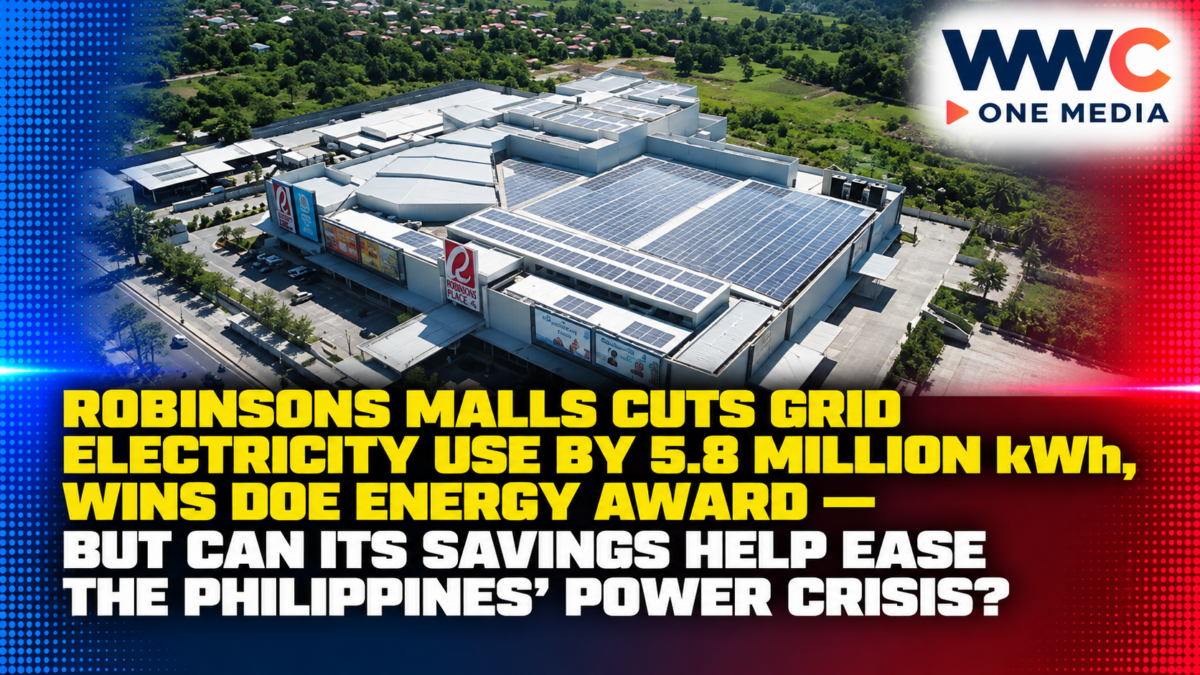
MANILA, PHILIPPINES — Gokongwei-led Robinsons Land Corporation (RLC) is intensifying its energy-conservation efforts after its Robinsons Malls business reported avoiding approximately 5.8 million kilowatt-hours in grid electricity purchases during the second quarter of 2026.
The achievement earned Robinsons Malls recognition as an Energy Efficiency and Conservation Champion at the inaugural Philippine Energy Awards organized by the Department of Energy (DOE) on October 7.
The company says the avoided grid electricity purchases from April to June are equivalent to the average monthly electricity consumption of approximately 29,000 Filipino households.
The recognition comes as shopping mall operators face mounting pressure to manage electricity costs amid an energy crisis, rising operating expenses and concerns over the country’s dependence on imported fuels.
Robinsons Malls is responding through more efficient building operations, solar energy, optimized lighting systems and participation in the government’s nationwide electricity-conservation campaign.
But while the reported savings demonstrate progress, they also raise an important question.
Can large commercial establishments significantly reduce electricity demand without compromising customer comfort and safety—or will worsening energy pressures demand more aggressive changes across the Philippine retail industry?
ROBINSONS MALLS REPORTS 5.8 MILLION KWH IN AVOIDED GRID ELECTRICITY
According to InsiderPH’s October 27 report, Robinsons Malls avoided purchasing approximately 5.8 million kWh of electricity from the grid between April and June 2026.
That equals 5.8 gigawatt-hours of electricity.
The result reflects the company’s efforts to manage energy demand through conservation measures and building technologies.
The figure is substantial for a commercial property business operating a nationwide network of shopping centers.
However, an important distinction must be made.
Reduced grid electricity purchases are not automatically the same as an identical reduction in total energy consumed.
A commercial property may reduce grid purchases by using less electricity, generating some electricity on-site, or obtaining energy through alternative arrangements.
The published announcement does not provide a complete breakdown separating those factors.
Therefore, the 5.8-million-kWh result should be described accurately as avoided grid electricity purchases rather than a fully verified reduction in all forms of electricity use.
WHAT DOES 5.8 MILLION KWH MEAN FOR FILIPINO HOUSEHOLDS?
Robinsons Malls says the reported volume is equivalent to the average monthly electricity consumption of approximately 29,000 Filipino households.
This comparison helps illustrate the scale of the electricity involved.
But it does not mean that the company generated enough power to supply those households directly.
Nor does it establish that 29,000 homes received lower electricity bills.
The household figure is an energy-equivalent comparison, not an actual residential electricity distribution program.
The reported 5.8 million kWh covers three months of reduced grid requirements across the mall network.
Meanwhile, the 29,000-household comparison refers to approximately one month of average household consumption.
Confusing those periods could create a misleading impression of the achievement.
DOE RECOGNIZES ROBINSONS MALLS AT FIRST PHILIPPINE ENERGY AWARDS
The Department of Energy presented Robinsons Malls with an Energy Efficiency and Conservation Champion recognition during the inaugural Philippine Energy Awards held October 7.
Energy Secretary Sharon Garin and Energy Undersecretary Felix William Fuentebella presented the honor to Robinsons Land corporate energy head Lucky Jay Damaso.
The recognition acknowledged the company’s voluntary conservation practices and operational improvements.
According to the original report, the DOE recognized the company’s efforts beyond the basic requirements of Republic Act No. 11285, or the Energy Efficiency and Conservation Act.
The law establishes a national framework for promoting efficient energy use.
However, receiving an award does not establish that every Robinsons property has achieved the same level of efficiency.
The company’s actual performance must still be evaluated through consistent energy measurements, appropriate reporting and long-term results.
ROBINSONS JOINS DOE’S ‘ORAS NATIN SA EFFICIENCY’ CAMPAIGN
One of the company’s most visible initiatives is its participation in the Department of Energy’s O.N.E. campaign.
O.N.E. stands for Oras Natin sa Efficiency.
The campaign was introduced at Robinsons Galleria Ortigas in May 2026 through a partnership involving the DOE and Robinsons Land.
It encourages businesses, households and institutions to adopt practical electricity-saving habits.
As part of the campaign, Robinsons Malls switches off or dims nonessential lighting every Monday between 8 p.m. and 9 p.m.
The measures include decorative lights, selected display lighting and illumination in areas that are not actively being used.
The company’s implementation is intended to preserve essential building operations, customer safety and comfort.
WHY MALLS ARE TARGETING NONESSENTIAL LIGHTING
Shopping malls consume electricity for numerous activities.
These include lighting, air-conditioning, ventilation, escalators, elevators, security equipment and commercial operations.
Not all electricity use can be eliminated without affecting essential services.
However, certain lighting systems may be reduced when they are not necessary.
Decorative installations and selected display lights are examples of equipment that can sometimes be dimmed or switched off temporarily.
The O.N.E. campaign aims to encourage these practical adjustments.
The intention is to make conservation a regular operating practice rather than a one-time publicity event.
But a weekly one-hour switch-off alone should not be assumed to explain all 5.8 million kWh in reported avoided grid purchases.
The company’s broader energy-management activities also contribute to its reported performance.
57 ROBINSONS MALLS JOIN THE WEEKLY CAMPAIGN
Manila Bulletin reported in May that Robinsons Land planned to implement the voluntary weekly conservation period across its 57 malls nationwide.
The company said the adjustments would be undertaken while maintaining essential services and safe operating conditions.
Deputy General Manager Maria Kristina Real-Lim also discussed potential electricity reductions of 10% to 25% through the targeted dimming or shutdown of nonessential lighting and equipment.
However, those percentages were presented as expected results of particular conservation measures.
They are not verified proof that every mall subsequently reduced its entire electricity consumption by 10% to 25%.
The actual results would depend on individual building operations, lighting systems and operating schedules.
ROBINSONS EXPANDS ITS USE OF SOLAR POWER
Electricity conservation is only one part of Robinsons Land’s strategy.
The company has also invested in rooftop solar generation across selected shopping malls.
Solar panels allow participating properties to produce some electricity on-site during favorable sunlight conditions.
This can reduce reliance on purchased grid electricity.
In May, Robinsons Land president and CEO Mybelle Aragon-GoBio said the company was interested in expanding solar generation where feasible.
The Philippine Daily Inquirer also reported on the company’s interest in broader rooftop solar deployment.
However, solar power does not eliminate the need for grid electricity.
Solar output depends on daylight, weather conditions, equipment performance and available roof space.
Shopping malls typically continue requiring electricity when solar generation is low or unavailable.
EARLIER COMPANY REPORTS SHOW A LONGER SOLAR INVESTMENT HISTORY
Robinsons Land’s 2023 annual report provides useful historical context.
At that time, the company reported operating 24 solar-powered malls and investing approximately ₱1.7 billion in installations involving more than 101,000 solar panels.
It also reported cumulative electricity-cost savings and avoided carbon emissions associated with those installations.
The report identified 47.3 million kWh of renewable electricity purchased during 2023.
These historical figures demonstrate that Robinsons Land’s renewable energy initiatives began years before the 2026 conservation campaign.
However, they should not be presented as the company’s current 2026 solar capacity or as new installations completed this year.
They describe the status and results reported for an earlier period.
EFFICIENT AIR-CONDITIONING IS ANOTHER MAJOR PRIORITY
Air-conditioning can represent a substantial part of shopping mall electricity consumption.
Large malls require systems capable of cooling extensive indoor spaces, especially in the Philippines’ warm climate.
Robinsons Land has described a chiller upgrade program intended to replace older equipment with more efficient systems.
Modern building controls may also help operators regulate cooling based on occupancy and operating requirements.
Improved building design and the use of natural daylight can reduce reliance on certain mechanical and lighting systems.
However, efficiency measures must preserve acceptable indoor conditions.
Reducing electricity demand should not compromise ventilation, accessibility, worker safety or the needs of shoppers.
ROBINSONS ALSO ADJUSTED MALL OPERATING HOURS
In March 2026, Robinsons Malls announced nationwide adjustments to standard operating hours beginning March 30.
The company said the changes supported energy conservation during the national energy emergency.
Shorter or adjusted operating hours can reduce the period during which selected building systems need to operate at normal capacity.
However, the effect depends on how tenants, employees and customers adjust their activities.
A reduction in operating hours may also affect businesses that depend on evening customer traffic.
For this reason, energy conservation must be balanced against commercial needs.
Customers should continue checking official mall information for the latest operating schedules instead of assuming all Robinsons locations have identical hours.
PHILIPPINE MALL OPERATORS REPORT HUNDREDS OF MILLIONS IN SAVINGS
Robinsons Malls’ efforts are part of a much wider conservation movement.
In April, BusinessWorld reported that 158 shopping malls across the Philippines had generated approximately ₱202.18 million in collective electricity savings following operational adjustments during an energy emergency.
The Department of Energy attributed the reported results to participating shopping mall operators.
These included Robinsons Malls, SM Supermalls, Ayala Malls, Araneta Malls, Megaworld Lifestyle Malls and Power Plant Mall.
The broader initiative demonstrated how multiple businesses could reduce their electricity requirements through coordinated measures.
However, the ₱202.18-million figure represents collective savings across participating malls.
It should not be attributed exclusively to Robinsons Malls.
The reporting also does not establish that those savings are directly comparable with Robinsons’ separate 5.8-million-kWh figure for April through June.
WHY ENERGY SAVINGS MATTER DURING AN OIL CRISIS
The Philippines faces vulnerabilities associated with imported energy.
International fuel-price increases can affect businesses, transportation and electricity generation.
Even when a shopping mall does not generate electricity directly from oil, changes in the broader energy market may influence operating costs and power prices.
Reducing unnecessary electricity use can help businesses manage expenses.
It can also lessen demand on the electricity system, particularly when conservation measures are coordinated during periods of high demand.
However, lower mall electricity consumption does not automatically translate into a lower price per kWh for residential customers.
Electricity tariffs depend on generation costs, network charges, taxes, regulatory mechanisms and other factors.
Conservation contributes to demand management but cannot independently solve the country’s energy-security challenges.
WHAT REPUBLIC ACT NO. 11285 REQUIRES
The Energy Efficiency and Conservation Act establishes policies intended to promote more efficient energy use throughout the Philippines.
The law supports energy conservation planning, efficiency standards and improved management of energy consumption.
Covered organizations may have responsibilities involving energy data, planning and reporting, depending on the relevant classifications and regulations.
Robinsons Malls’ DOE recognition highlights voluntary conservation efforts described as going beyond basic compliance.
But an award should not be interpreted as a substitute for regulatory monitoring.
Sustained compliance and performance require appropriate documentation and implementation.
HOW ENERGY EFFICIENCY COULD AFFECT MALL TENANTS
Tenants operating inside shopping malls also depend on electricity for lighting, refrigeration, air-conditioning and equipment.
Efficient common-area operations may help a property operator manage overhead expenses.
But whether those savings reduce tenants’ charges depends on lease agreements, billing arrangements and how operating costs are allocated.
The October announcement did not establish that Robinsons Malls has reduced rental rates or common-area charges because of the 5.8-million-kWh figure.
It would therefore be inaccurate to promise lower tenant bills without additional evidence.
For shoppers, the more immediate benefit may be continued access to commercial spaces designed to use energy more efficiently.
ENVIRONMENTAL BENEFITS STILL REQUIRE MEASUREMENT
Improved electricity efficiency can reduce the amount of energy required to operate a building.
On-site solar generation and renewable electricity purchases may also reduce reliance on certain fossil-fuel-based electricity sources.
However, calculating avoided greenhouse gas emissions requires information about the electricity source displaced and the relevant emissions factor.
The October 2026 report does not provide a verified carbon-dioxide reduction figure specifically tied to the 5.8 million kWh.
It also does not provide independently audited peso savings from that figure.
Therefore, reporting a precise emissions total or financial savings amount would require additional data.
The most defensible conclusion is that Robinsons Malls has reported a measurable reduction in grid electricity purchases, while the full environmental and financial effects require more detailed disclosure.
WHAT INDEPENDENT NEWS OUTLETS CONFIRM
InsiderPH reported the 5.8-million-kWh result and DOE recognition on October 27.
The Philippine Daily Inquirer also reported that Robinsons Malls reduced its grid electricity purchases by approximately 5.8 million kWh in the second quarter.
The Philippine Star independently covered the May launch of the O.N.E. conservation campaign and its implementation across Robinsons Malls properties.
Manila Bulletin documented the company’s plans to expand solar energy use and the targeted weekly conservation measures across 57 malls.
BusinessWorld separately reported the DOE’s broader mall-industry energy savings.
Robinsons Land’s official announcement verifies the O.N.E. campaign, while its earlier annual report documents historical solar investments.
These sources corroborate the program and reported results.
However, much of the October 27 reporting relies on the company’s own figures, and the reviewed sources do not establish an independent audit of the entire 5.8-million-kWh calculation.
WHAT THE RESULTS MEAN FOR ROBINSONS LAND INVESTORS
For shareholders of Robinsons Land Corporation, energy efficiency can be relevant to operating costs and long-term property management.
Electricity is a major expense in operating large shopping centers.
Reducing unnecessary consumption can potentially support operating margins, depending on implementation costs and contractual arrangements.
Solar installations may also reduce exposure to selected electricity-price movements.
But investing in new equipment requires capital.
Projects must be evaluated based on maintenance costs, equipment lifespan, reliability and expected financial returns.
The DOE award recognizes conservation initiatives, not a guaranteed improvement in Robinsons Land’s profits or share price.
Investors should continue examining the company’s financial disclosures and actual operating performance.
THE BIGGER QUESTION: CAN ENERGY-SAVING MALLS HELP BUILD A MORE RESILIENT PHILIPPINES?
Robinsons Malls’ recognition at the inaugural Philippine Energy Awards provides a public example of how major commercial establishments can participate in energy conservation.
Its reported 5.8 million kWh in avoided grid electricity purchases demonstrates the scale of the company’s energy-management efforts during the second quarter of 2026.
The weekly O.N.E. campaign also encourages shoppers, tenants and employees to think about unnecessary electricity use.
Meanwhile, solar power, efficient lighting, improved building systems and operational changes form part of a broader strategy.
But the country’s energy challenges require cooperation across multiple sectors.
Commercial buildings, industrial facilities, public institutions and households all influence electricity demand.
Power generation, transmission infrastructure, storage and energy policy remain equally important.
The real test for Robinsons Malls will be whether it can sustain measurable energy improvements year after year while maintaining safe and comfortable spaces for customers and tenants.
And as Philippine businesses confront uncertain energy costs, one question remains:
Will Robinsons Malls’ 5.8-million-kWh achievement inspire a nationwide transformation in commercial energy use—or will the country’s persistent power challenges demand far more than voluntary conservation campaigns?










