MANILA, Philippines — October 31, 2026
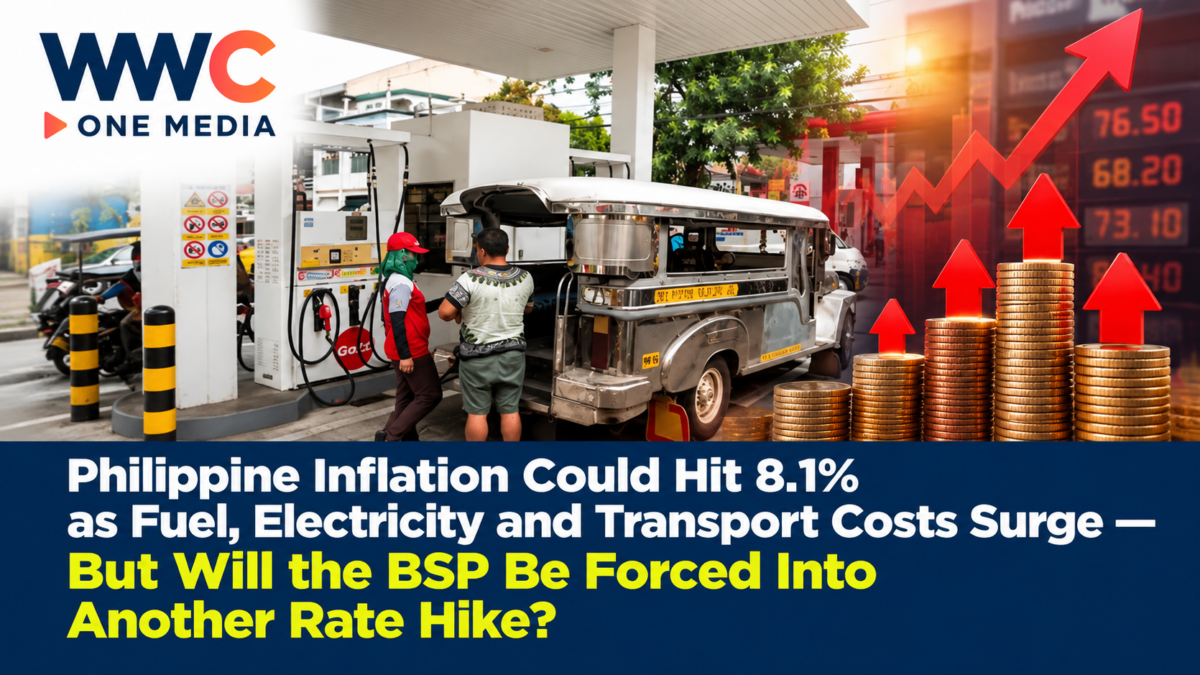
Filipino households could face another painful inflation shock as the Bangko Sentral ng Pilipinas (BSP) warned that consumer price increases may accelerate to as high as 8.1% in October 2026, driven by elevated fuel prices, more expensive electricity and higher public transportation fares.
The central bank’s October 30 forecast placed headline inflation between 7.1% and 8.1%, compared with the 7.2% recorded in September.
The upper end would mark the fastest annual inflation rate in more than three years, intensifying pressure on consumers already struggling with food, transportation and household expenses.
But the outlook is not entirely negative.
The BSP said lower prices for key agricultural commodities, including rice, vegetables, meat and fish, could partially offset increases in energy and transportation costs.
That means October inflation could still come in below September’s reading if the downward pressures prove strong enough.
According to Bilyonaryo, GMA News, The Philippine Star and Daily Tribune, the warning arrives just over a week after the central bank delivered an unusually aggressive 50-basis-point interest rate increase.
The move lifted the BSP’s benchmark policy rate to 5.50% as monetary authorities sought to prevent inflation from becoming more persistent.
The latest projection raises the stakes for the government’s inflation response.
With energy prices remaining elevated and households facing higher costs for everyday necessities, could the BSP be forced to raise borrowing rates again — or will improving food supplies provide enough relief to prevent another major inflation spike?
BSP Warns October Inflation Could Reach 8.1%
The Bangko Sentral ng Pilipinas released its latest monthly inflation forecast on Friday, October 30.
It estimated that annual headline inflation for October would settle between 7.1% and 8.1%.
The upper end would exceed September’s 7.2% reading by 0.9 percentage point.
The lower end, however, would represent a slight easing of 0.1 percentage point.
This distinction matters because the BSP released a forecast range, not a final inflation result.
Official inflation data are compiled and released by the Philippine Statistics Authority.
The PSA is scheduled to publish the October 2026 figure on November 5.
Until that announcement, any statement that inflation has already breached 8% remains premature.
Nevertheless, the forecast indicates that consumer price pressures remain substantial.
Even the lowest possible figure within the BSP’s range would be considerably above the central bank’s medium-term inflation target of 2% to 4%.
Fuel Prices Remain a Major Inflation Threat
The BSP identified higher domestic fuel prices as one of the principal sources of inflation pressure.
The Philippines is heavily dependent on imported petroleum products.
As a result, movements in global oil prices can affect domestic gasoline, diesel and other fuel costs.
Higher fuel prices have consequences beyond motorists.
They can increase the cost of transporting food from farms to markets.
They can raise delivery expenses for retailers and manufacturers.
They can also affect the operating costs of public transportation, logistics companies and businesses that rely on generators or fuel-powered equipment.
Developments in the Middle East have added to the uncertainty.
Conflict-related disruptions and concerns about energy shipments have contributed to volatility in international markets.
The BSP said it would continue assessing these developments when reviewing inflation and economic growth prospects.
For the Philippines, prolonged high fuel prices could make it more difficult for consumer inflation to return quickly to the official target.
Electricity Rates Add Another Burden to Household Budgets
Electricity is another major source of price pressure.
In October, Manila Electric Company increased its residential electricity rate by approximately ₱0.3191 per kilowatt-hour, bringing the rate to ₱15.0615 from ₱14.7424 in September.
For a household using 200 kilowatt-hours per month, that adjustment translates to roughly ₱64 in additional electricity charges, assuming the same consumption and applicable rate structure.
The actual change in individual bills can vary.
Nevertheless, the adjustment illustrates how utility costs can increase household spending even without a corresponding rise in consumption.
The situation has been particularly challenging in parts of the Visayas and Mindanao, where electricity shortages and wholesale market price differences have attracted scrutiny.
WWC ONE MEDIA previously examined these concerns in Visayas–Mindanao Power Shortage Faces Senate Probe as Electricity Rates Surge.
The report highlighted large differences in wholesale electricity prices across the country’s major grids and questions about adequate power supply.
When electricity becomes more expensive, the effects can extend beyond household bills.
Factories, shopping centers, food processors and service businesses may also face higher operating costs.
Some companies may absorb those expenses, while others may eventually pass part of the increase to customers.
Higher Transport Fares Are Feeding Into Consumer Prices
Public transportation fares are also affecting the inflation outlook.
Fare increases that took effect in late September are now influencing household transportation expenses.
Traditional jeepney minimum fares increased from ₱13 to ₱14, while modern jeepney minimum fares increased from ₱15 to ₱17.
Adjustments also affected other forms of public transportation.
For workers who rely on public transport every day, even a relatively small increase per trip can accumulate over a month.
Higher fares may also influence the cost of transporting goods and services.
WWC ONE MEDIA previously explored the overlapping pressures in Peso Slips as US-Iran Tensions, Wage Hike and Higher Fares Fuel Inflation Concerns.
The report detailed how changes in fuel prices, the exchange rate, wages and fares were beginning to influence the wider economic environment.
The latest BSP forecast suggests those pressures remain relevant.
But it would be inaccurate to conclude that transport fares alone are responsible for the entire inflation increase.
The consumer price index reflects movements across numerous categories of goods and services.
Rice and Other Food Prices Could Provide Some Relief
Although energy and transportation costs are pushing inflation higher, the BSP identified several possible offsets.
The central bank said favorable domestic supply conditions could help lower prices for rice, vegetables, meat and fish.
This is important because food represents a major portion of household spending, particularly for lower-income families.
Improved agricultural supply can reduce pressure on retail food prices.
When food prices increase more slowly — or fall in certain categories — they can partially offset inflation elsewhere in the economy.
However, the outlook remains uncertain.
Agricultural production can be affected by weather, transport disruptions, input costs and import arrangements.
Food-price improvements may also differ across regions.
A decline in the price of one commodity does not automatically mean the overall household grocery bill will fall.
For consumers, the combined direction of multiple food prices will determine whether meaningful relief emerges.
September Inflation Had Already Reached 7.2%
The latest forecast follows a substantial inflation increase during the preceding month.
According to the Philippine Statistics Authority, annual headline inflation rose to 7.2% in September, from 6.1% in August.
The acceleration was driven partly by higher prices for food and non-alcoholic beverages.
Inflation in that category increased to 6.7%, compared with 4.6% in August.
Transportation inflation reached 14.6%, while inflation for housing, water, electricity, gas and other fuels increased to 8.4%.
Core inflation, which excludes selected volatile food and energy items, rose to 4.7%.
These figures suggest that price pressures were affecting multiple parts of the economy.
WWC ONE MEDIA had previously warned of this possibility in Philippines Faces Broader, Stickier Inflation Wave as Food, Fuel and Labor Costs Rise.
The report examined concerns that inflation could become more difficult to reverse if several cost pressures occurred simultaneously.
The October projection provides further evidence that the inflation problem has not yet been contained.
BSP’s Surprise 50-Basis-Point Rate Hike Raises the Stakes
The central bank’s October warning comes shortly after a major monetary policy decision.
On October 22, the BSP raised its benchmark interest rate by 50 basis points to 5.50%.
The increase exceeded market expectations for a smaller adjustment.
The decision was intended to help contain inflation expectations and reduce the risk of persistent price increases.
WWC ONE MEDIA covered the move in BSP Stuns Markets With a 50-Basis-Point Rate Hike — What Happens Next to Loans, Prices and the Peso?.
The article examined how higher policy rates can affect lending, consumer demand and the Philippine peso.
For borrowers, higher interest rates can increase financing costs, although the effect on individual loans depends on whether rates are fixed or variable and on contractual repricing terms.
For businesses, tighter credit conditions may discourage some investment or expansion decisions.
For households, higher borrowing costs can reduce the affordability of loans and installment purchases.
The BSP must therefore balance inflation control against the danger of slowing economic activity.
Could Another Interest Rate Increase Be Coming?
The next monetary policy decision will depend on the inflation and economic data available to the Monetary Board.
BSP Governor Eli Remolona Jr. has indicated that the central bank remains prepared to take additional action if price pressures intensify.
The October inflation forecast will be one important input.
But a result near the upper end of the 7.1%–8.1% range would not automatically guarantee another rate increase.
The BSP must also consider underlying inflation trends, economic growth, inflation expectations, the exchange rate and international financial conditions.
A number of economists have suggested that another tightening move could become more likely if inflation remains elevated.
Philippine National Bank economist Alvin Arogo projected October inflation at approximately 7.4%.
Economist Jonathan Ravelas estimated 7.8%, while RCBC chief economist Michael Ricafort projected about 7.6%.
These estimates are below the BSP’s 8.1% upper limit but remain above the central bank’s inflation target.
They are independent forecasts, not official results.
The BSP’s next scheduled policy-setting meeting is December 17, 2026.
Why Higher Interest Rates Cannot Solve Every Inflation Problem
Monetary policy is important, but it has limitations.
Higher interest rates can reduce credit growth and moderate demand.
They can also help manage inflation expectations and potentially support the peso under some market conditions.
However, interest rates cannot directly produce more rice, repair electricity infrastructure or increase global oil supply.
That creates a difficult policy challenge.
When inflation is driven substantially by supply disruptions and imported energy costs, government measures outside monetary policy may be required.
These could include improvements in agricultural productivity, transportation efficiency, electricity supply and targeted assistance for vulnerable households.
The challenge is to address the sources of price pressure without creating additional financial instability.
El Niño Could Bring Another Food-Price Shock
A potentially severe El Niño event adds to uncertainty about the inflation outlook.
Dry conditions can reduce water availability and threaten agricultural production.
Rice and other crops may be particularly vulnerable when irrigation systems and water supplies are insufficient.
Reduced rainfall can also affect hydropower generation and raise electricity demand during periods of extreme heat.
WWC ONE MEDIA previously explored these risks in El Niño Emerges as Biggest Threat to Philippine Inflation as Prices Surge.
That report highlighted potential effects on rice production, power supply and household expenses.
The El Niño threat is particularly important because the BSP’s latest forecast assumes some relief from favorable agricultural supply conditions.
If weather disruptions intensify, those benefits could weaken in subsequent months.
However, the extent of any future agricultural damage cannot yet be known.
Business Leaders Urge Government to Support BSP’s Inflation Fight
Financial executives have also emphasized the need for coordinated economic measures.
On October 28, the Financial Executives Institute of the Philippines called for stronger government preparation against the effects of severe El Niño and persistent inflation.
The organization urged action involving food and water security, infrastructure, public spending and economic resilience.
WWC ONE MEDIA covered the statement in Government Urged to Match BSP’s Resolve as Very Strong El Niño Threatens Philippine Economy.
The group’s position reflects a broader concern among economists and businesses.
A central bank can tighten monetary conditions, but structural supply problems require other policy responses.
For households and businesses, the effectiveness of these measures will depend on actual implementation rather than announcements alone.
How an 8.1% Inflation Rate Could Affect Filipino Families
If inflation reaches 8.1%, it would mean the general consumer price index was approximately 8.1% higher than in October 2025.
It would not mean every product increased in price by exactly 8.1%.
Some goods may have risen more sharply, while others may have recorded smaller changes or price declines.
For illustration, a representative basket of goods and services costing ₱10,000 a year earlier would cost approximately ₱10,810 after an 8.1% increase, assuming its prices followed the overall index exactly.
Actual household experiences differ according to spending patterns.
A family using significant amounts of electricity or transportation may face different price changes from a household spending a larger share of its income on food.
Higher inflation also does not necessarily mean prices are increasing faster every week.
The published annual rate compares the price index with the same month one year earlier.
For consumers, however, the practical problem remains the erosion of purchasing power when wages and other income fail to keep pace with living costs.
What the November 5 Inflation Report Will Reveal
The Philippine Statistics Authority’s November 5 release will determine whether the BSP’s upper-range warning materialized.
A result above 8% would likely intensify discussion about additional monetary tightening and targeted government relief.
A figure closer to 7.1% could indicate that lower food prices and other offsets prevented a stronger acceleration.
But even the bottom end of the forecast range would leave inflation elevated relative to the BSP’s target.
Investors, policymakers, businesses and households will also examine the details behind the headline number.
Particular attention will be paid to food inflation, transportation costs, electricity, core inflation and changes across regions.
Those components will provide clues about whether inflation is becoming more persistent or beginning to stabilize.
The Bottom Line
The Bangko Sentral ng Pilipinas expects Philippine inflation to settle between 7.1% and 8.1% in October 2026, potentially exceeding September’s 7.2% rate.
The central bank identified domestic fuel costs, electricity prices and transport fares as major upward pressures.
Lower prices for rice, vegetables, meat and fish could help offset some of those increases.
The warning follows a surprise 50-basis-point policy rate increase that lifted the BSP’s benchmark rate to 5.50%.
Official October inflation figures are scheduled for release on November 5.
Until then, the 8.1% figure remains an upper-end forecast, not a confirmed inflation result.
As higher fuel, electricity and transport costs continue squeezing Filipino households, one question could determine the next stage of the country’s economic struggle: Will improving food supplies and government intervention prevent another inflation spike — or could the BSP be forced to raise interest rates again to contain a problem that refuses to disappear?