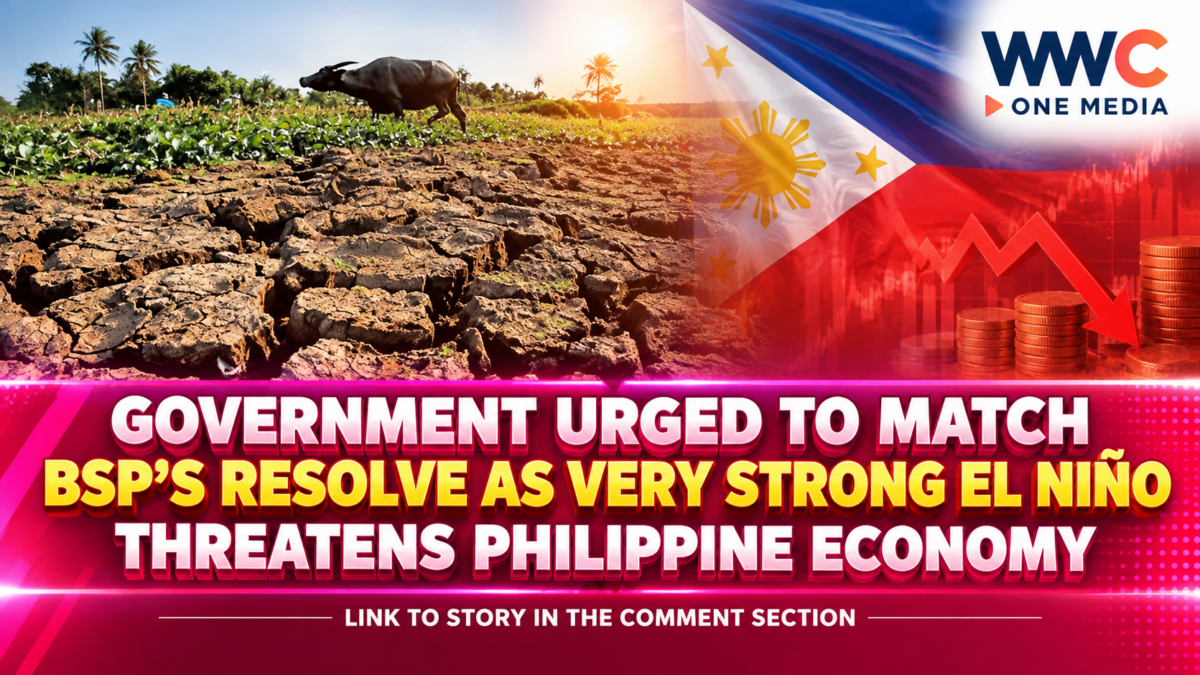
The Philippine government is being urged to step up its preparations for a potentially severe El Niño, with business leaders warning that decisive action is needed to prevent worsening food shortages, higher prices and additional pressure on household budgets.
The Financial Executives Institute of the Philippines (Finex) said the government must match the Bangko Sentral ng Pilipinas’ (BSP) determination to contain inflation by strengthening food and water security, improving public spending and preparing vulnerable communities for the effects of prolonged dry conditions.
In a statement released on Wednesday, October 28, Finex called for immediate action in five key areas, stressing that the country cannot rely on monetary policy alone to protect the economy from the potential impact of the climate phenomenon.
The group pointed out that while the central bank has already tightened monetary policy to address inflationary pressures, the government must also tackle supply problems that could push prices higher in the months ahead.
The warning comes as the Philippine Atmospheric, Geophysical and Astronomical Services Administration (PAGASA) has reported a strong to very strong El Niño in the tropical Pacific. Current projections indicate that the phenomenon could persist through the first quarter of 2027, with its effects potentially extending into the first half of next year.
Five Areas Requiring Immediate Government Action
Finex identified five priorities that authorities should address to reduce the economic damage associated with El Niño.
The first is protecting agricultural production and farmers’ livelihoods. The group recommended prioritizing repairs to existing irrigation facilities, improving water storage and deploying efficient irrigation equipment that can be put into operation quickly.
It also urged authorities to help farmers adjust planting schedules based on localized weather forecasts and provide access to drought-tolerant seeds. Crop insurance, emergency credit and timely assistance were likewise identified as important measures to help agricultural producers remain productive despite difficult weather conditions.
The second priority is securing food supplies early and transparently.
Finex said the government should regularly publish reliable assessments of agricultural production, available inventories and expected supply shortages. When gaps become apparent, authorities should arrange timely and carefully calibrated imports from diversified sources.
However, the group stressed that imports must be managed properly to avoid unnecessarily depressing farmgate prices when local farmers are harvesting their crops.
Waiting until shortages become obvious could leave consumers facing higher prices while limiting the government’s available options, Finex warned.
The third area involves reducing logistics and distribution costs. The business group called for faster customs clearance, the removal of unnecessary trading and transportation barriers, and improvements to bottlenecks affecting ports, storage facilities and distribution networks.
It also urged authorities to enforce competition rules and investigate unlawful hoarding or collusion, provided there is sufficient evidence and due process.
The fourth priority is preparing the country’s water and electricity systems together.
Finex recommended better coordination of reservoir management, repairs to leaking water infrastructure and clear protocols for allocating available water resources. It also warned that reduced hydropower generation could coincide with higher electricity demand, making advance planning essential.
Preventive maintenance and sufficient power reserves could help limit disruptions that might otherwise increase operating costs for businesses and households.
The fifth recommendation is to protect vulnerable families without compromising fiscal discipline.
Finex called for temporary, targeted assistance for those most affected by El Niño. It said funding should come from reprioritizing government spending toward urgent needs and effective programs rather than relying on broad subsidies that could strain public finances without addressing the underlying supply problems.
2027 Budget Should Prioritize Food, Water and Infrastructure
Finex said these recommendations should also guide the preparation and implementation of the 2027 National Budget.
The group emphasized that the debate should not simply focus on whether the government needs to spend more or less. Instead, authorities should examine whether public funds are being directed toward projects that can be implemented effectively and deliver meaningful economic benefits.
It urged the government to prioritize investments that strengthen food and water security, improve essential infrastructure, reduce logistics and energy costs, and expand the country’s productive capacity.
Projects that are poorly prepared, difficult to implement or expected to provide limited economic benefits should be reconsidered, the group added.
The recommendations come as the BSP continues to respond to mounting inflation risks, including higher global oil prices, transportation fare increases and potential disruptions to agricultural production.
BSP Raises Interest Rates as Inflation Risks Increase
On October 21, the BSP’s Monetary Board raised its Target Reverse Repurchase rate by 50 basis points to 5.50 percent, marking its fourth consecutive rate increase this year.
The central bank said inflation could accelerate further in the coming months, while average inflation is expected to remain elevated in 2027 before moving closer to its 3-percent target in 2028.
The BSP also identified El Niño as a major risk to agricultural production and food prices, alongside higher energy costs linked to renewed tensions in the Middle East.
Finex acknowledged the importance of the central bank’s efforts to control inflation but warned that monetary policy cannot solve the problem by itself.
The group stressed that fiscal policy and government action must address supply constraints, particularly those affecting food, water, electricity and transportation.
The challenge is becoming more urgent as the country prepares for the possible peak of El Niño. Without early intervention, reduced agricultural output and disruptions to essential services could translate into higher prices and additional financial pressure on Filipino households.
For the government, the coming months will test whether its spending priorities and preparedness measures can keep pace with the economic risks already confronting the country.